Did shacks temporarily shelter workers at Tillotson’s Vinton Street site?

Vinton Street Shacks

By Ronald Ahrens

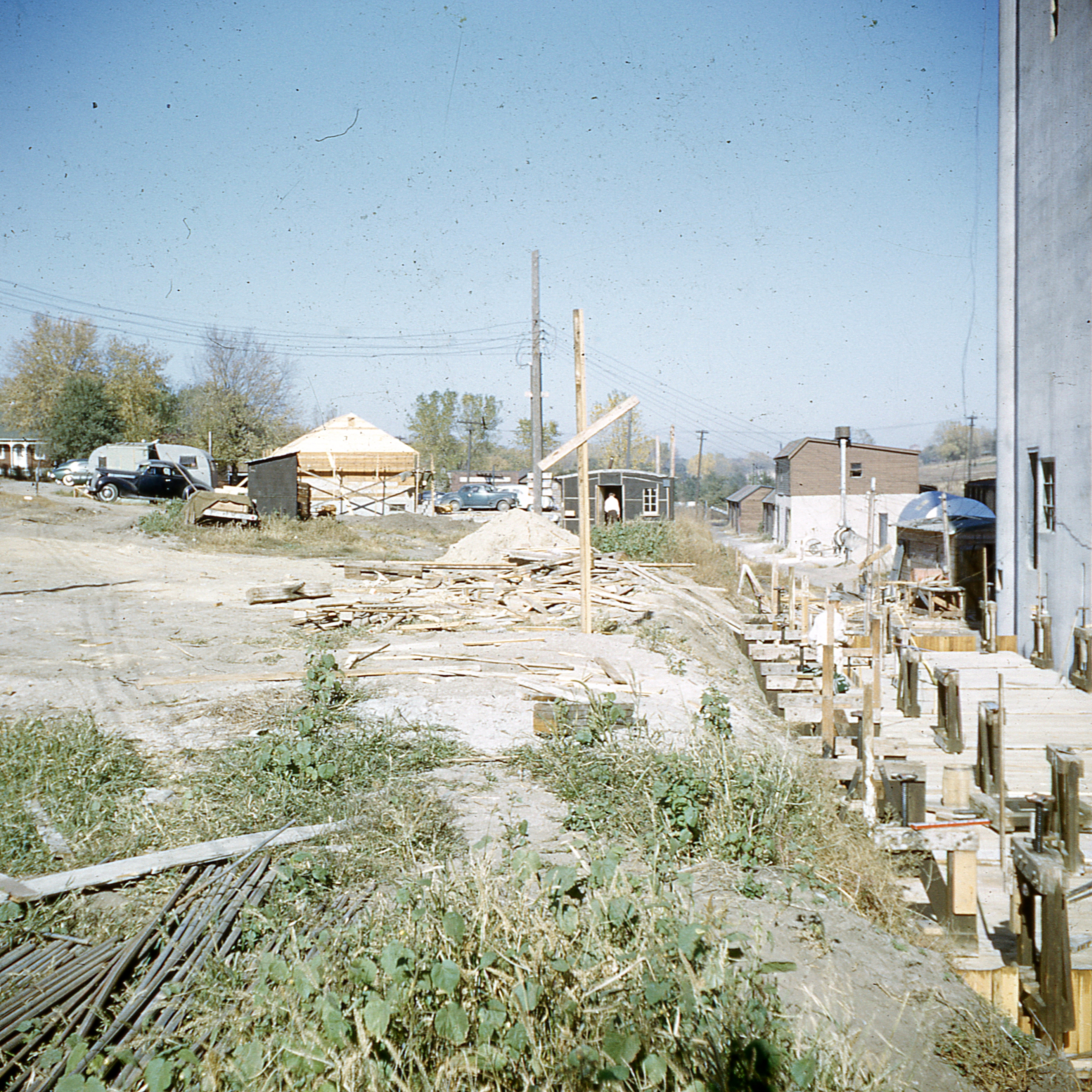
This photo from Tillotson Construction Company’s archives looks south from the site of the Vinton Street elevator, completed in 1950. On the far right you see the main house, which is finished but for windows. The driveway is formed up. Leftover rebar is in the lower left and scrap is heaped in the center.

It’s unknown whether the silver trailer was being used in connection with the job, perhaps as an office. The black car, which could be a 1938 Buick, and the ugly-duckling blue-gray car, which could be a Plymouth (or maybe a Hudson?)–did they belong to employees?

What especially intrigues us are the shacks along the street. Were they part of the job–again, as office space, or to accommodate  workers? Two of my Tillotson uncles have strained their memories but aren’t able to put together this part of the story, explaining why the photo was taken.

The Big Springs, Nebraska, elevator proved to be a Mayer-Osborn Construction job

The Cheppell, Nebraska elevator built by Chalmers & Borton

The Chappell, Nebraska elevator built by Chalmers & Borton. 

Story and photos by Kristen Cart

My grandfather William Osborn built an elevator in the western Nebraska town of Chappell, according to my dad Jerry Osborn. Dad’s recollections have guided our search thus far, for Mayer-Osborn elevators. Surely over the kitchen table he heard the names of towns where his absent father had construction jobs. Or perhaps he saw the postmarks of letters sent home.

Chappell was probably stamped on one of those postmarked letters, or it was the nearest town with a motel, because when I went to visit in 2011, there was nary a Mayer-Osborn elevator in evidence. Impressive elevators there were, but I found out later that they all had the ubiquitous Chalmers & Borton nameplate, the trademark of Grandpa’s biggest competitor.

The Mayer-Osborn elevator lacked the annex when it was first built. It is the same plan as used in McCook, Neb. and Blencoe, Iowa.

The Mayer-Osborn elevator at Big Springs, Neb. lacked the annex when it was first built. It is the same style as used in McCook, Neb., and Blencoe, Iowa.

One stop east on the rail line, however, was a large, handsome elevator that looked like one of Mayer-Osborn’s jobs. It was the spitting image of the first elevator Grandpa built on his own at McCook, Neb. The first time I saw it, I was curious enough to snap a photo, but identification was going to wait for another year. My dad knew nothing about Big Springs.

When Gary Rich, a contributor to this blog, looked into the builders of the elevators he photographed, he solved the mystery. He identified the Big Springs elevator by its manhole covers inside the driveway, each embossed with “Mayer-Osborn Construction, Denver, Colo.” above the Hutchinson Foundry stamp.

The Big Springs, Neb. elevator in October, 2012

The Big Springs, Neb., elevator in October, 2012. 

I paid another visit to Big Springs last fall after our Wyoming elk hunt. We didn’t get any elk, but I did get some nice photographs of the elevator. It was a sleepy Sunday with no one around. Next time, perhaps I can see inside.

It is an honor to pay respects to my grandfather’s enduring work. It is living history of a kind that is rarely noticed or mentioned. Once gone, it is scarcely remembered except in dusty repositories of pictures, and in mostly forgotten stories.

At Big Springs, Neb., that day of fading away is still far off in the future.

A Mayer-Osborn superintendent’s budget, from the back of a notepad

Ed Christoffersen papers008Story by Kristen Cart

On a slip-formed concrete elevator job, the superintendent was not expected to be deskbound. So it wasn’t a complete surprise to find a pay account jotted down on the back of Edwin Christoffersen’s handy notepad. His letters home probably came out of this paper supply, assuming he had time to write them.

The Cordell, Okla., elevator was built in 1950, when Edwin  Christoffersen took charge of the job for Mayer-Osborn Construction.

Dick Osborn0001

Richard “Dick” Osborn

It is easy to forget that times were so dramatically different then.

We were entering a frightening time, with the Korean War looming. Edwin’s nephew, my dad’s brother Dick Osborn, was putting on a uniform to go fight, taking a break from building elevators for the company.

Our country was pulling out of a period of deep recession and unemployment. Air travel was a luxury, but in no sense was it the comfortable experience we have now. Airplanes were loud and flew through the ugly weather, instead of over it. In the book “Fate is the Hunter,” Ernest K. Gann recounted the very real perils of flight in those days. He made it seem all too real in his excellent book.

Ed’s notepad recalls a bit of aviation history. Deco style was modern then. In small print, it even says “Made in U.S.A.”

Ed Christoffersen papers009a

Ed’s accounting.

On the reverse of this nearly empty pad of stationery, which miraculously survived for over sixty years among Edwin’s papers, is what appears to be an account of a monthly budget. It seems pretty clear that Ed would have been paid decently. The “coolies,” as they were called, did the physical labor and made $1 an hour. My dad, Jerry Osborn, got that job for one summer, and he didn’t get any special favors, either. The term was not a racial one in those days–it described the work, mostly done by local farm boys.

Edwin added up a sum exceeding $40 per month–perhaps it was what he had left over, after paying the bills. He came up with $170. Was this tally a payroll for his workers? Or was it a budget for his personal use? Did it record expenses for the Cordell project? It is hard to say.

In 1950, you could drive a good used car off the lot for a few hundred dollars, though a new Cadillac would have been out of reach for most people at over $3000. Maybe Ed had money left over to go get rowdy after work. Or maybe he could buy a good shotgun for his favorite pastime, which was hunting.

dick with man0001

Dick Osborn and Edwin Christoffersen nab a coyote.

I wish to thank Diane Osborn Bell for the pictures of her father, Richard “Dick” Osborn. Ed Christoffersen also kindly shared some of his dad’s personal papers, for which I am grateful.

It’s a truly illuminating way to look at man’s life and his work.

Blue skies at Lodgepole, Nebraska, and a perfect photo opportunity

dsc_0226

The J. H. Tillotson concrete elevator, built in 1948, and operated by Frenchman Valley Coop

Story and photos by Kristen Cart

On the way home from our Wyoming hunt last fall, we drove through Lodgepole, Neb. one more time. Gorgeous weather quelled the protests from the truck’s back seat, and with windows open, everyone settled down with books and gadgets while Mom (that would be me) got out with her camera.

I hope you enjoy some of the results as much as I did. This elevator, built by J. H. Tillotson, Contractor, in 1948, still stands proudly along old Lincoln Hwy. 30, in a town that is still a tourist destination. No one seemed curious about a lady with a camera–seems like it’s not so unusual around here.

dsc_0256

A track-side view of both elevators in Lodgepole, Neb.

The wooden elevator in the town is still in use, less than half a mile down the rail line. It appears to be in spiffy condition and ready for business. The town obviously takes pride in its agriculture and its heritage.

Happily, the history of the town intersects with the history of my grandfather, builder William Osborn, and our family. It has become a destination for us and a beautiful stop alongside the road.

Even the kids grudgingly admit it isn’t too bad, for an elevator.

dsc_0252

The wooden elevator with metal siding, flanked by metal bins

Newspaper clippings of the Lincoln, Nebraska, elevator show standard construction methods

Story by Kristen Cart

christofferson042

Omaha World-Herald

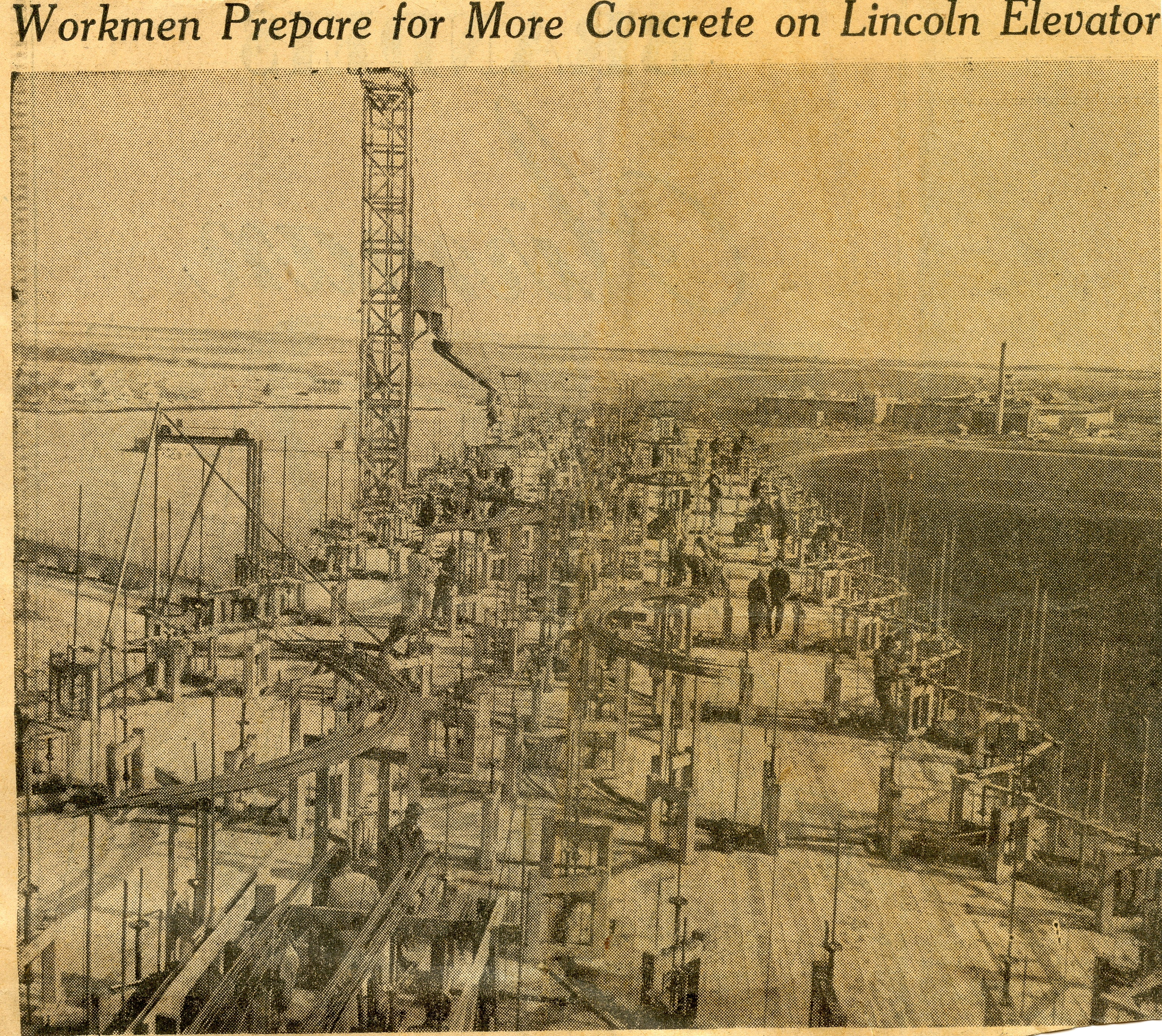
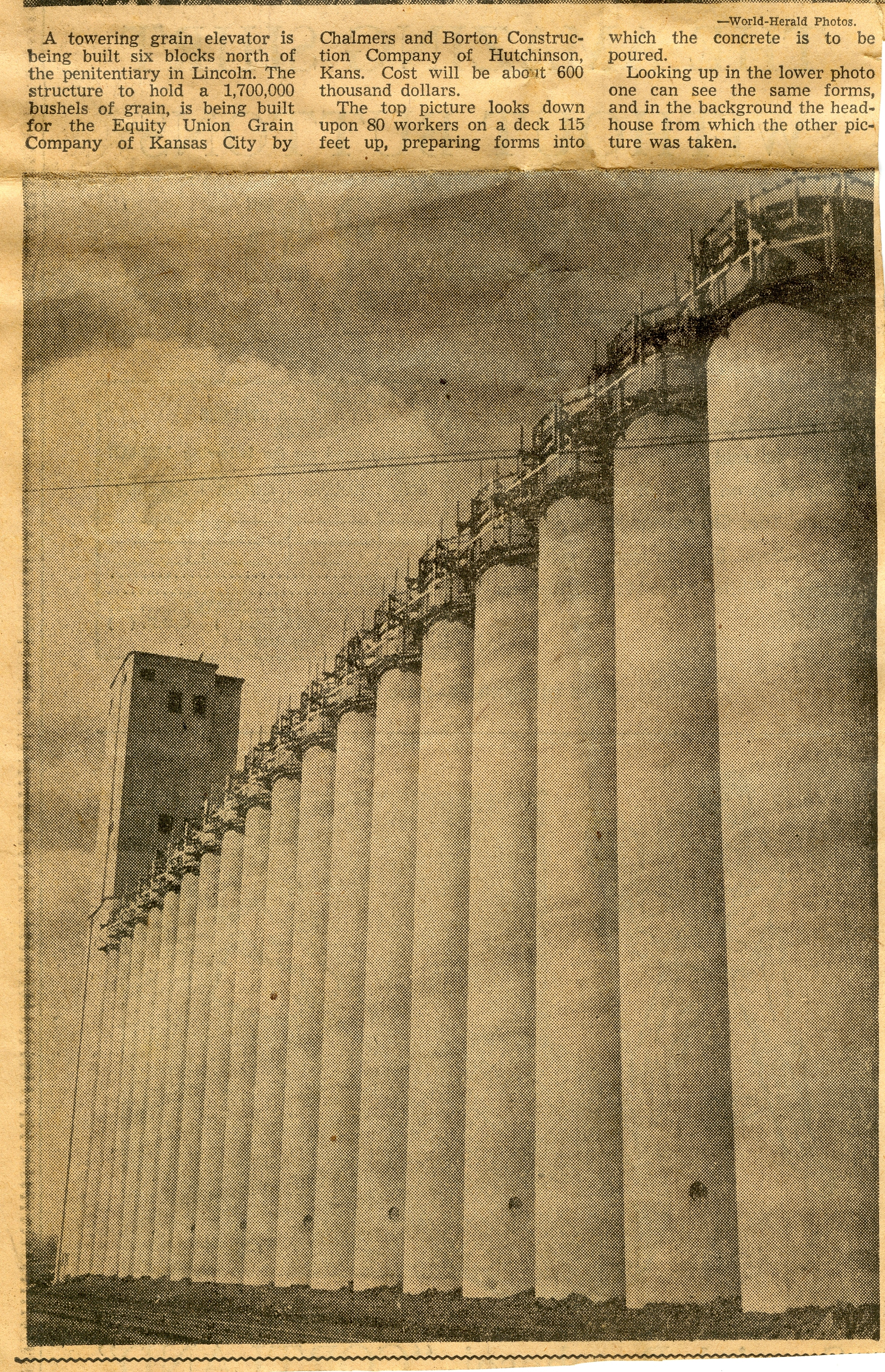
Among Edwin Christoffersen’s papers were clippings from the Lincoln, Neb., elevator construction site. While this was a Chalmers & Borton project, the clippings showed an impressively large elevator in the last stages of construction.

The story of a competitor’s biggest local project would have been of great interest to Ed, a superintendent for the Mayer-Osborn Construction Company. There is little doubt that Mayer-Osborn would have tried to get this contract. However, Chalmers & Borton frequently built the largest elevators.

It appears that the continuous pour was nearly complete for the huge structure, and that the planks were installed either for decking for the crews, or for the final pour which would cover each bin with a concrete cap. Once the concrete cured, final “wrecking out” would remove the forms.

christofferson043

Omaha World-Herald

The headhouse was already in place, so the elevator was very close to completion. What cannot be seen is whether equipment that would come from subcontractors for installation in the headhouse and pit had yet arrived, and of course the run that would top the elevator and provide for grain distribution was yet to be finished.

The images provide a rare glimpse of the process, one that Edwin Christoffersen saw fit to preserve, much to our delight. This is a breathtaking view of a moment in time when America built with intrepidity and confidence, and left us with a towering legacy in the Plains.

Tillotson Construction’s signature, the curved headhouse, was a practical matter

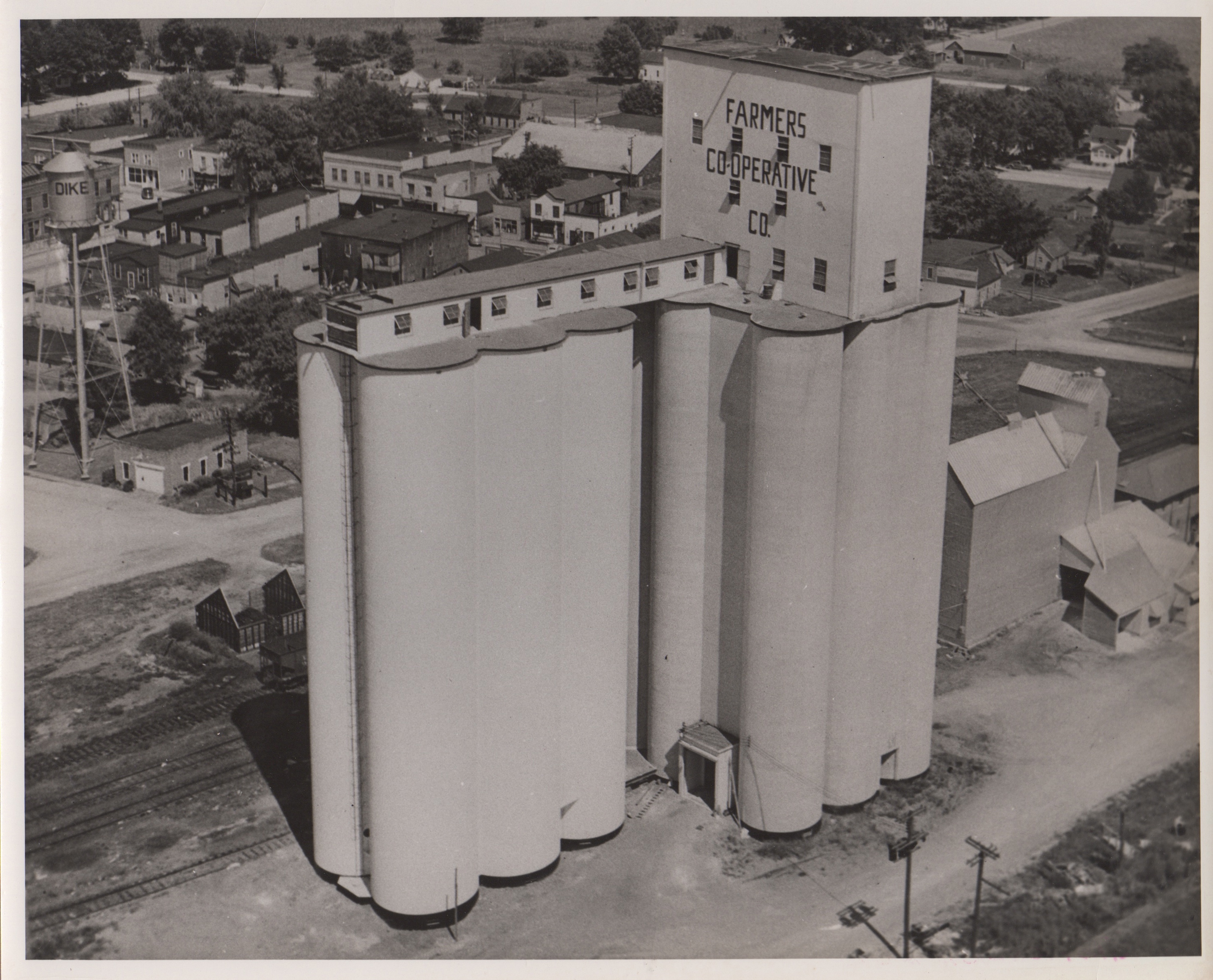
The main house of Tillotson Construction's elevator at Dike, Iowa, built in 1946 (annex, left, 1949), is crowned by a rectilinear headhouse.

The main house of Tillotson Construction’s elevator at Dike, Iowa, built in 1946 (annex, left, 1949), is crowned by a rectilinear headhouse. 

In this post, Charles J. Tillotson explains how his father, Reginald Tillotson, president of Tillotson Construction Company, developed the curved headhouse design.

It would be nice to say that the curved walls were created by Dad for aesthetic reasons and leave it at that.

However, a number of factors actually influenced the design, those being:

  1. Re-use of the curved yokes (the horizontal framework supporting the vertical forms used during slip-form construction of the storage bins).
  2. Building square corners into concrete slip-form construction proved to be more difficult than curved corners.
  3. Placing horizontal reinforcing steel for square corners entailed bending it at a ninety-degree angle and then manhandling it into position, whereas with the curved forms, the horizontal reinforcing steel could be inserted much easier by sliding it into position.
Tillotson's Aurora, Neb., elevator, built in 1950, has a curved headhouse.

Tillotson’s Aurora, Neb., elevator, built in 1950, has a curved headhouse.

For numbers two and three above, keep in mind that all horizontal reinforcing steel, or rebar, was placed by hand (anywhere from twelve to sixteen inches) during the slip-form process, all while the forms were being slipped vertically by screw jacks.

The horizontal steel had to be placed rather quickly throughout the entire structure, so that the steel bars were approximately in alignment from the beginning of placement throughout the structure and back to the beginning point.

On large projects, steel placement was divided into segments with a team captain in charge of each, and all captains would then synchronize their start times for installing the rebar.

Slip-form construction involves a great deal of detailed labor to carry out specific functions while the forms are being jacked vertically in constant motion. It used to be about five to six inches per hour.

Here is a fascinating look at the life and death of the Tidewater Grain Elevator in Philadelphia. It is a well researched article, which our readers should enjoy. Particularly illuminating are the comments. This blog delves into industrial and architectural history from a refreshing perspective, and is well worth exploring.

crd's avatarThe Necessity for Ruins

“Philadelphia used to have a lot of industry. Not so much anymore.” –Harry Hagin, site superintendent, Camden Iron and Metal, 12/19/07

104_6633.jpg

At 7AM on Sunday, demolition charges will echo throughout the refineries and tank farms of South Philadelphia as scrap dealers Camden Iron and Metal implode the headhouse of the last of Philadelphia’s great grain elevators, the Tidewater Grain Elevator at Girard Point. This will leave only the former Reading Company/Tidewater Company elevator at 20th and Shamokin St. to witness to the city’s history as a grain entrepot.

View original post 882 more words

An old wooden elevator comes down at Halsey, Oregon, and shares its secrets

dsc_0317

Halsey, Ore., in early 2012.

Story and photos by Kristen Cart

Elevators such as this one in Halsey, Ore., have elicited interest from photographers and curious travellers for as long as they have existed, especially since they are on the verge of extinction. Technology passed them by back in the early 1940s when most of the new construction in the United States went to slip-formed concrete.

dsc_0924

The remnants of the Halsey elevator, Feb. 2013, in a downpour.

Canada held out, building wooden elevators well into the 1970s, with a minority of them still in service today, and many more long since demolished, abandoned, or burned.

The end has come for the Halsey elevator. After hearing of its demise in an online forum, I recently passed near the town on I-5 and stopped to see the hulking remnant. It was a sorrowful sight, topless and dreary.

But beside it was a more interesting find.

In an empty lot next to the elevator, piled randomly, was the elevator’s leg. It brought to mind a story–a cautionary tale, really–which illustrated why concrete was so attractive to engineers looking for a better alternative.

dsc_0933

The leg from the Halsey, Ore. elevator, piled on the ground.

While exploring elevators in Alberta, Canada, I took a trip to a small town called Milo.

It was a snowy day, and as I gazed up at the lone wooden elevator, a gentleman pulled up in his truck and asked if I needed directions. He introduced himself as Ian Thomson. He was a long-time resident and farmer, and once we got on the topic of elevators, he told me that Milo once had nine wooden elevators lined up along the rail line. The sole survivor, silver-sided and huge, was built in the 1970s. It was still active, and its nearest neighbor had come down a year or two before.

DSC_0598

The lone wooden elevator in Milo, Alberta, Canada.

Ian told a tale of the demise of one of the old wooden houses.

One of Milo’s elevators was decommissioned in winter, years ago. When the leg was torn out, a salvage company tried to remove the conveyor belt to reuse the rubber. Water remained in the pit, and the lower portion of the leg could not be retrieved because it was frozen solid. So they cut the belt off at the top of the ice and hauled off what they could. The owners told Ian that as soon as the pit thawed out, he could have the rest.

It was an early spring day, and a thunderstorm rolled by. A farmer could always use rubber–Ian was thinking of mud flaps for his truck, so when he went to check the elevator that day, he was disappointed to find the leg remnants still frozen solid in the pit. So he left without them. But as he exited the elevator, he noticed a thin tendril of smoke rising from the headhouse.

DSC_0610

Ian Thomson displays his railroad collection.

With gut wrenching dread, he called the owners, but he knew it was already too late. A fire company fought the blaze, but by then the elevator was fully involved, and it burned completely down.

A nagging worry stayed with Ian. While he knew he had done nothing to cause the fire, he was seen leaving the elevator, and he thought his neighbors might wonder about it. But the real culprit was lightning. He needn’t have worried.

Ian Thomson was an honorable member of the community and an esteemed historian, with a proud military heritage. He was, and still is, a true gentleman farmer.

DSC_0593

Alberta wheat country.

The fire danger inherent in wooden elevators spurred engineers to try concrete building methods. Concrete elevators came with their own hazards, but also great advantages, and they remain the premier choice for durable, large scale grain storage.

But we still miss the proud old wooden denizens of the plains.

Vintage photos show aspects of how a grain elevator works

Elevator photos003

Story by Kristen Cart

Sometimes a picture is worth a thousand words. Luckily for us, old press photos have come on the market recently that show the inner workings of grain elevators in the past. Not much has changed over the years, since many of the elevators that served in the 1940s and 1950s are still in operation today.

The photo above shows a truck unloading into an elevator pit from the inside of a driveway. A grate covers the pit, and from the pit a leg serves the top of the elevator. A conveyor may also be in operation, delivering grain to the leg, depending on the size of the elevator or annex.

Elevator photos001

In the next image, you can see a worker beside the conveyor inside what looks like a run. Conveyors can be used in several places in an elevator complex, but they are normally installed in a run that delivers grain from an elevator headhouse for distribution to an annex, or they’re operating on a basement level that takes grain from an annex to the main elevator served by a headhouse and a leg.

Another place for a conveyor is from an elevator to a hopper or chute where a truck or rail car can be loaded. That is the case with this photo.

When grain is added to or taken from an elevator, it needs to be weighed and checked for moisture content to keep a strict account for the farmer and the elevator operator. Each truck arriving full will be weighed before delivery and also afterward, with the difference subtracted from the loaded weight to give the net weight of grain. Weight will change with moisture content, so that is an important figure to calculate.

When a truck arrives empty, it is weighed before loading, then weighed afterward to determine the net weight of grain. This process has always been an essential part of elevator operations from the earliest days.

Elevator photos002

Weighing the grain

Hutchinson Foundry, where manhole covers were cast, closed in 1972

mail

Hutchinson Foundry, photo courtesy of Linda Laird

The “foundry” in Hutchinson Foundry & Steel Inc., D and Washington, will be a misnomer after Oct. 1.

Blaming federal safety requirements, the firm has announced it will shut down its gray iron foundry on that date.

Ken Green, general manager, said last week that the measure is being taken because of requirements for environmental air dust handling handed down by the Occupational Safety and Health Administration (OSHA).

Green said that the step is not being taken because of new state air quality requirements.

OSHA has not inspected the Hutchinson foundry. But Green says it would take construction of a new facility to meet the standards which are designed to prevent employees from breathing pollutants.

Hutchinson Foundry, photo courtesy of Linda Laird

Hutchinson Foundry, photo courtesy of Linda Laird

As for the state regulations, Green remains confident that the foundry could meet those regulations. In fact, the state had given preliminary approval for the preliminary design of a scrubber.

The company, which will get a new name, will continue manufacturing structural steel, fabrication and building specialties.

Closing the foundry will mean the loss of 13 employees. But Green expects some of this loss—all of it in the long run—will be offset by the manufacture of a small hydraulic iron worker.

The iron worker was designed and engineered by Harry Oswalt, Garden City, president of the Hutchinson firm. Oswalt hand-built the prototype model which is now in operation at the plant.

Manufacture of the iron worker is expected to begin within six months.

Hutchinson Foundry, photo courtesy of Linda Laird

Hutchinson Foundry, photo courtesy of Linda Laird

The foundry has been working on an arrangement with Wyatt Manufacturing Co., Inc., Salina, whereby the firms patterns and customers will be transferred to Wyatt’s foundry operation.

Hutchinson (Kan.) News, August 13, 1972