Here is a fascinating look at the life and death of the Tidewater Grain Elevator in Philadelphia. It is a well researched article, which our readers should enjoy. Particularly illuminating are the comments. This blog delves into industrial and architectural history from a refreshing perspective, and is well worth exploring.

crd's avatarThe Necessity for Ruins

“Philadelphia used to have a lot of industry. Not so much anymore.” –Harry Hagin, site superintendent, Camden Iron and Metal, 12/19/07

104_6633.jpg

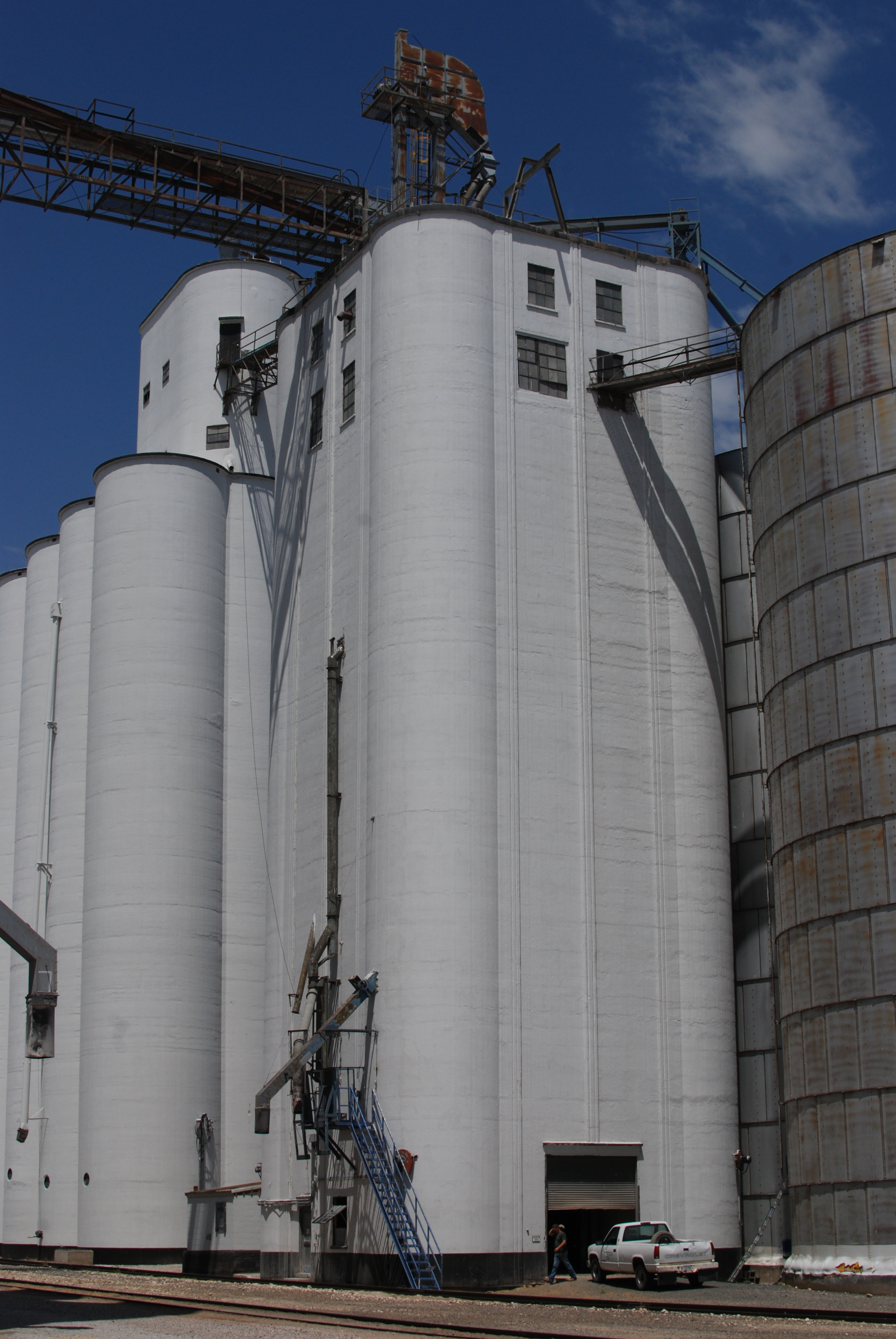
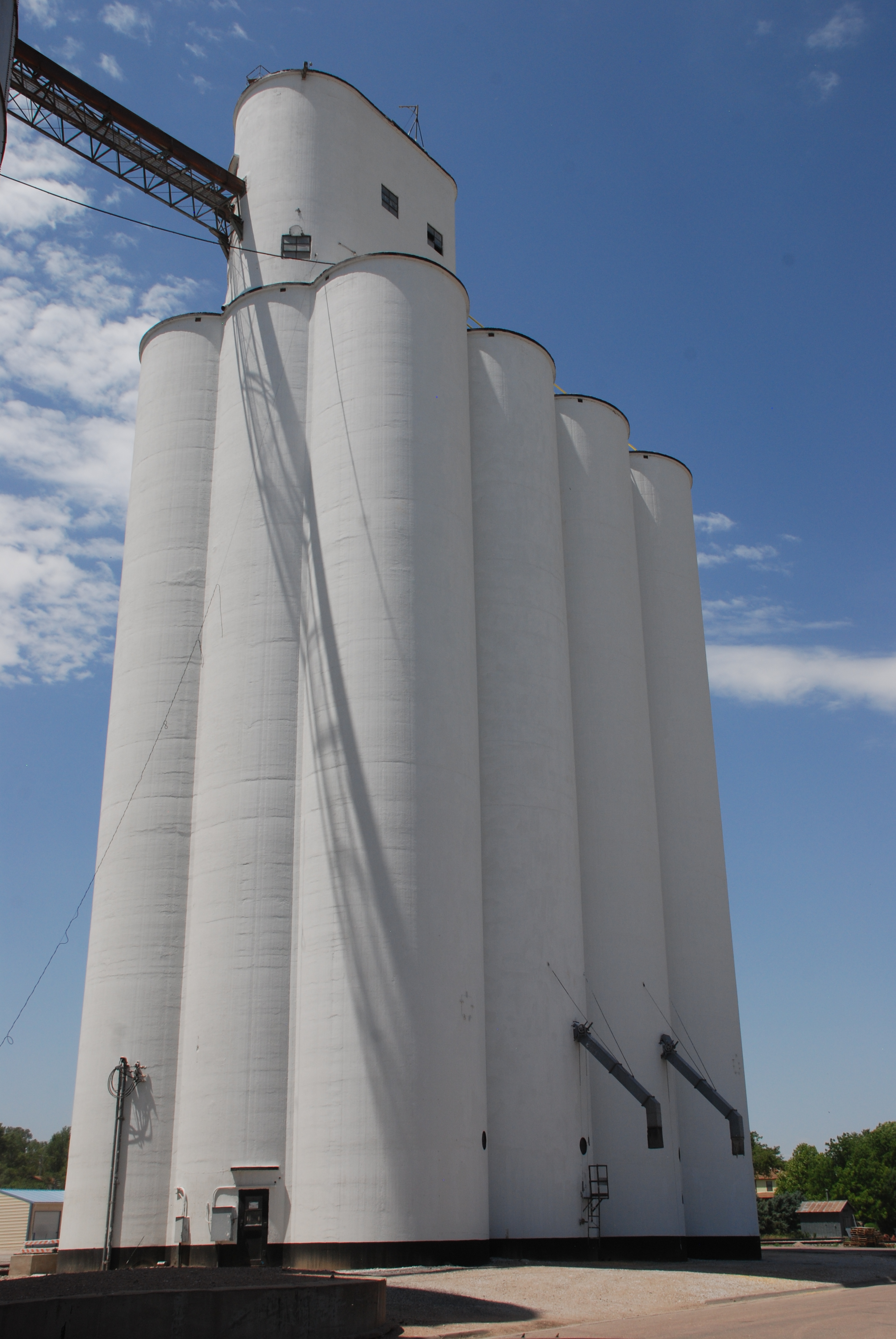
At 7AM on Sunday, demolition charges will echo throughout the refineries and tank farms of South Philadelphia as scrap dealers Camden Iron and Metal implode the headhouse of the last of Philadelphia’s great grain elevators, the Tidewater Grain Elevator at Girard Point. This will leave only the former Reading Company/Tidewater Company elevator at 20th and Shamokin St. to witness to the city’s history as a grain entrepot.

View original post 882 more words

An old wooden elevator comes down at Halsey, Oregon, and shares its secrets

dsc_0317

Halsey, Ore., in early 2012.

Story and photos by Kristen Cart

Elevators such as this one in Halsey, Ore., have elicited interest from photographers and curious travellers for as long as they have existed, especially since they are on the verge of extinction. Technology passed them by back in the early 1940s when most of the new construction in the United States went to slip-formed concrete.

dsc_0924

The remnants of the Halsey elevator, Feb. 2013, in a downpour.

Canada held out, building wooden elevators well into the 1970s, with a minority of them still in service today, and many more long since demolished, abandoned, or burned.

The end has come for the Halsey elevator. After hearing of its demise in an online forum, I recently passed near the town on I-5 and stopped to see the hulking remnant. It was a sorrowful sight, topless and dreary.

But beside it was a more interesting find.

In an empty lot next to the elevator, piled randomly, was the elevator’s leg. It brought to mind a story–a cautionary tale, really–which illustrated why concrete was so attractive to engineers looking for a better alternative.

dsc_0933

The leg from the Halsey, Ore. elevator, piled on the ground.

While exploring elevators in Alberta, Canada, I took a trip to a small town called Milo.

It was a snowy day, and as I gazed up at the lone wooden elevator, a gentleman pulled up in his truck and asked if I needed directions. He introduced himself as Ian Thomson. He was a long-time resident and farmer, and once we got on the topic of elevators, he told me that Milo once had nine wooden elevators lined up along the rail line. The sole survivor, silver-sided and huge, was built in the 1970s. It was still active, and its nearest neighbor had come down a year or two before.

DSC_0598

The lone wooden elevator in Milo, Alberta, Canada.

Ian told a tale of the demise of one of the old wooden houses.

One of Milo’s elevators was decommissioned in winter, years ago. When the leg was torn out, a salvage company tried to remove the conveyor belt to reuse the rubber. Water remained in the pit, and the lower portion of the leg could not be retrieved because it was frozen solid. So they cut the belt off at the top of the ice and hauled off what they could. The owners told Ian that as soon as the pit thawed out, he could have the rest.

It was an early spring day, and a thunderstorm rolled by. A farmer could always use rubber–Ian was thinking of mud flaps for his truck, so when he went to check the elevator that day, he was disappointed to find the leg remnants still frozen solid in the pit. So he left without them. But as he exited the elevator, he noticed a thin tendril of smoke rising from the headhouse.

DSC_0610

Ian Thomson displays his railroad collection.

With gut wrenching dread, he called the owners, but he knew it was already too late. A fire company fought the blaze, but by then the elevator was fully involved, and it burned completely down.

A nagging worry stayed with Ian. While he knew he had done nothing to cause the fire, he was seen leaving the elevator, and he thought his neighbors might wonder about it. But the real culprit was lightning. He needn’t have worried.

Ian Thomson was an honorable member of the community and an esteemed historian, with a proud military heritage. He was, and still is, a true gentleman farmer.

DSC_0593

Alberta wheat country.

The fire danger inherent in wooden elevators spurred engineers to try concrete building methods. Concrete elevators came with their own hazards, but also great advantages, and they remain the premier choice for durable, large scale grain storage.

But we still miss the proud old wooden denizens of the plains.

Vintage photos show aspects of how a grain elevator works

Elevator photos003

Story by Kristen Cart

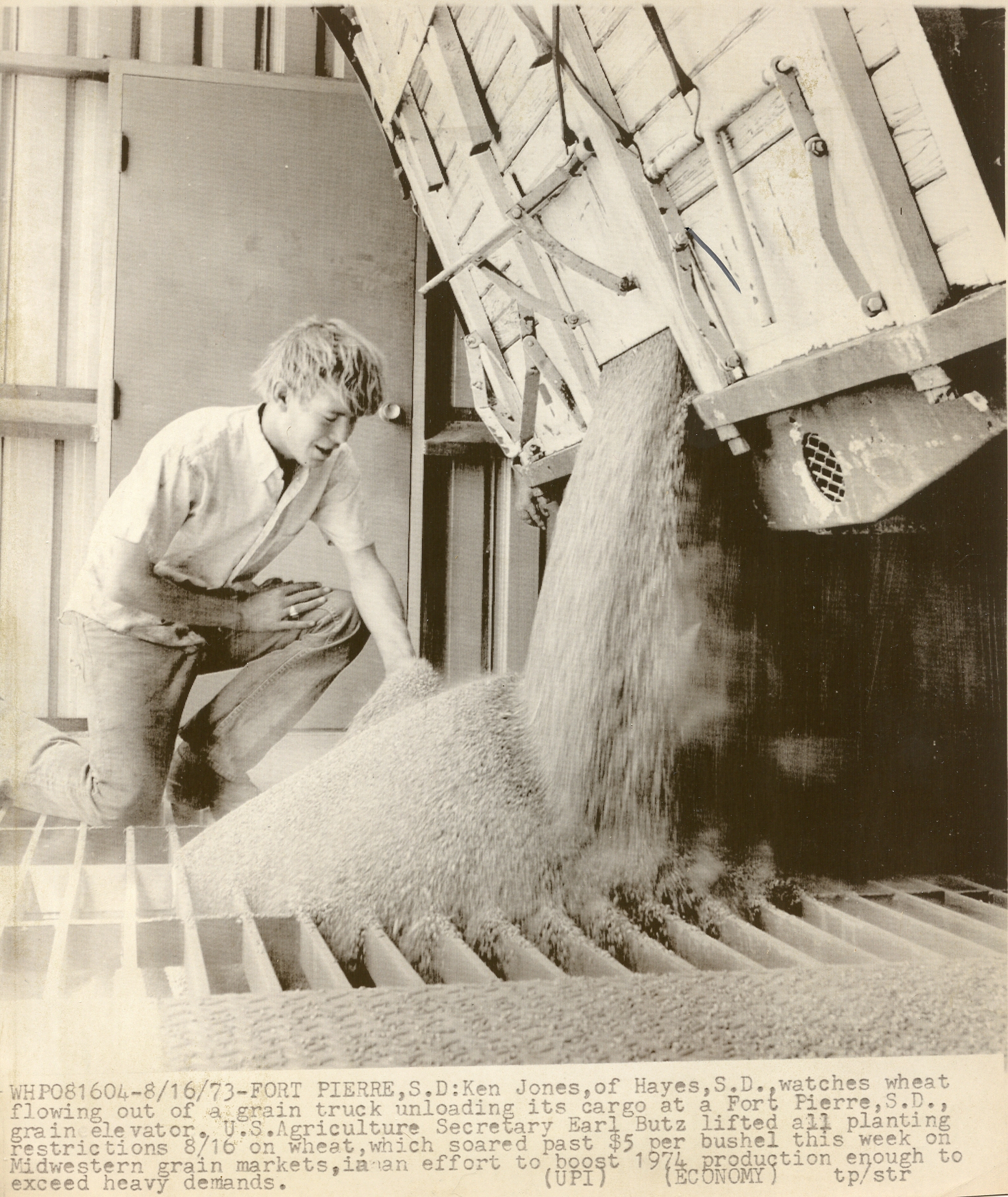
Sometimes a picture is worth a thousand words. Luckily for us, old press photos have come on the market recently that show the inner workings of grain elevators in the past. Not much has changed over the years, since many of the elevators that served in the 1940s and 1950s are still in operation today.

The photo above shows a truck unloading into an elevator pit from the inside of a driveway. A grate covers the pit, and from the pit a leg serves the top of the elevator. A conveyor may also be in operation, delivering grain to the leg, depending on the size of the elevator or annex.

Elevator photos001

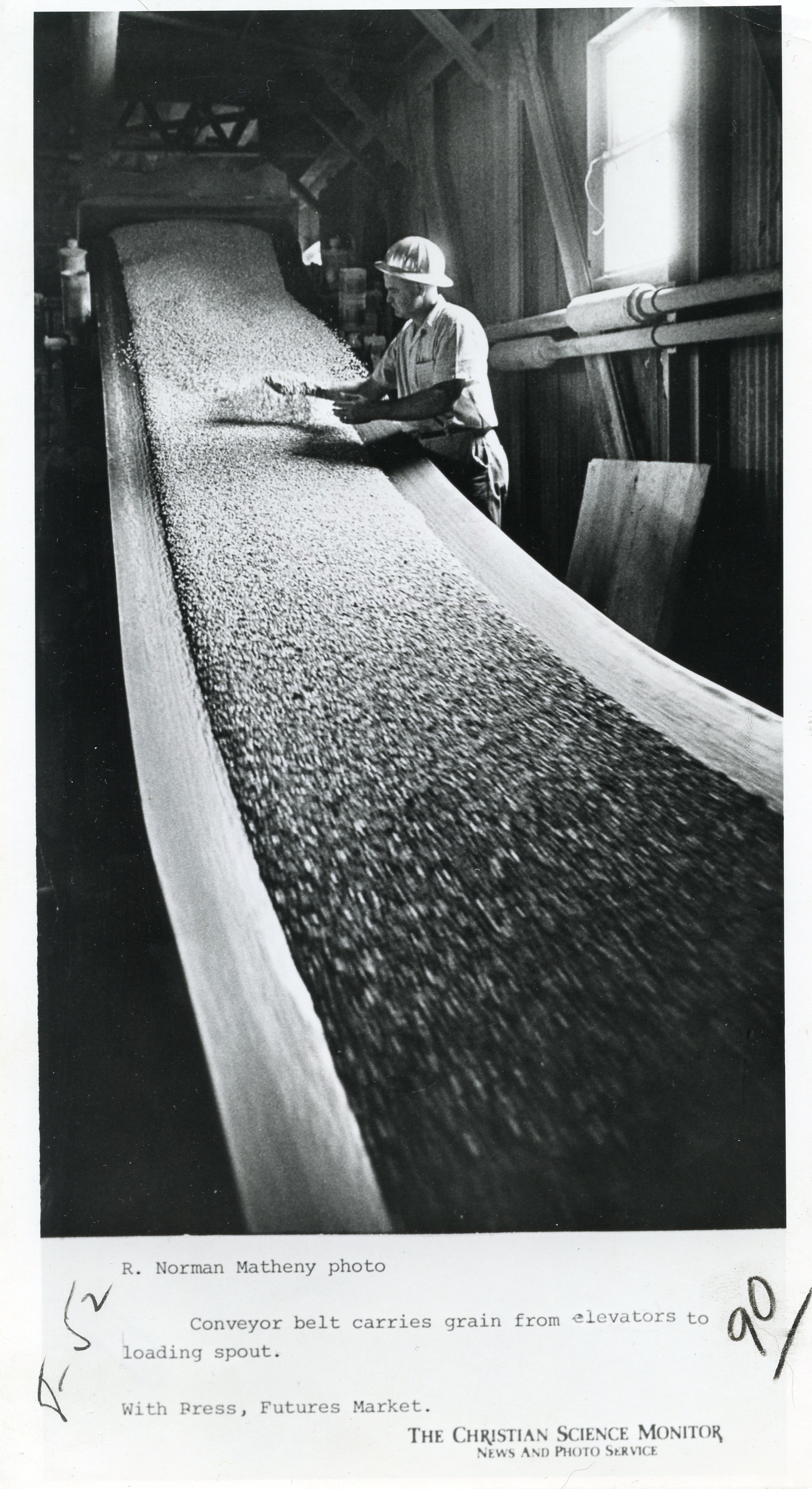
In the next image, you can see a worker beside the conveyor inside what looks like a run. Conveyors can be used in several places in an elevator complex, but they are normally installed in a run that delivers grain from an elevator headhouse for distribution to an annex, or they’re operating on a basement level that takes grain from an annex to the main elevator served by a headhouse and a leg.

Another place for a conveyor is from an elevator to a hopper or chute where a truck or rail car can be loaded. That is the case with this photo.

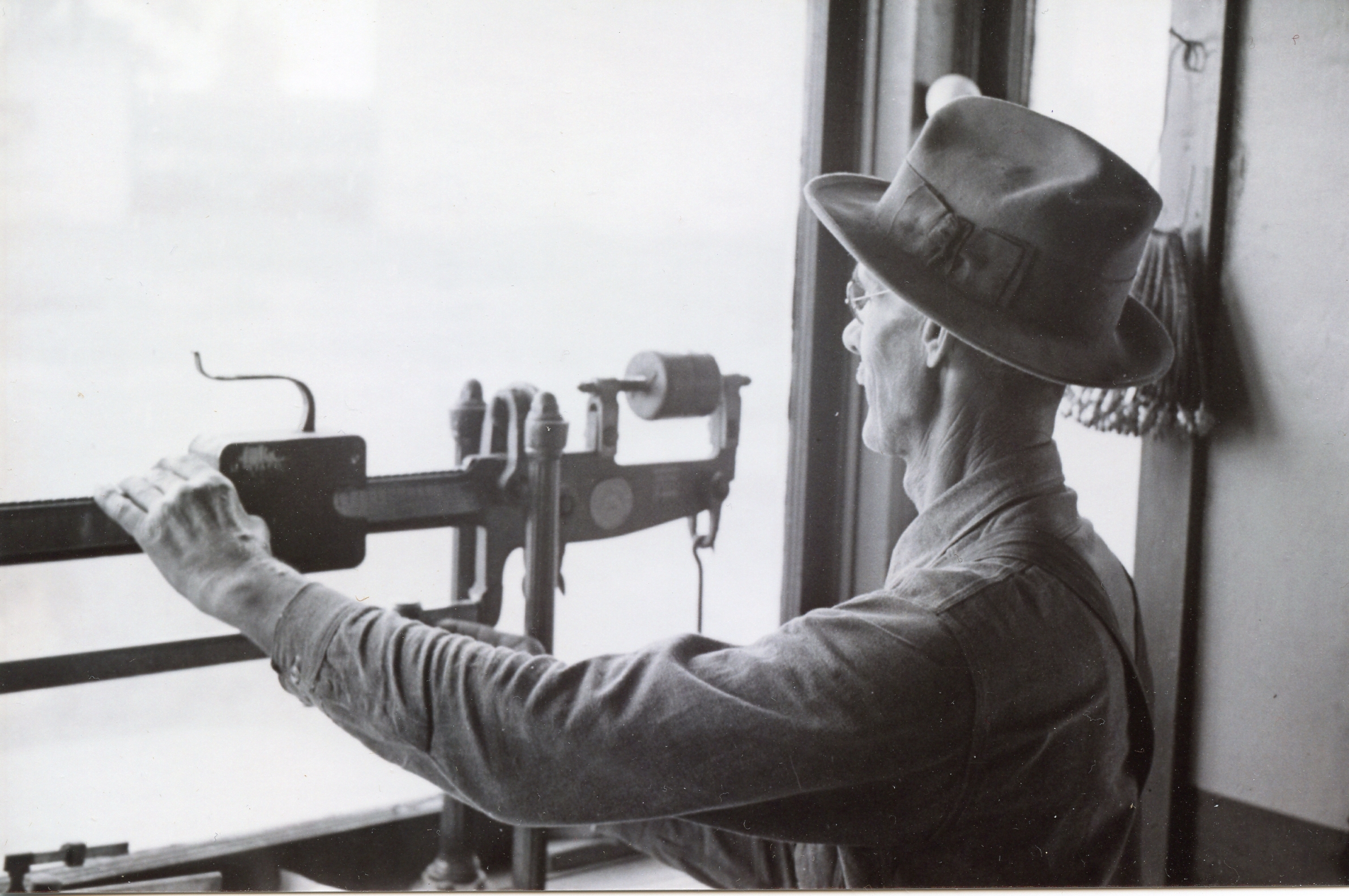
When grain is added to or taken from an elevator, it needs to be weighed and checked for moisture content to keep a strict account for the farmer and the elevator operator. Each truck arriving full will be weighed before delivery and also afterward, with the difference subtracted from the loaded weight to give the net weight of grain. Weight will change with moisture content, so that is an important figure to calculate.

When a truck arrives empty, it is weighed before loading, then weighed afterward to determine the net weight of grain. This process has always been an essential part of elevator operations from the earliest days.

Elevator photos002

Weighing the grain

Hutchinson Foundry, where manhole covers were cast, closed in 1972

mail

Hutchinson Foundry, photo courtesy of Linda Laird

The “foundry” in Hutchinson Foundry & Steel Inc., D and Washington, will be a misnomer after Oct. 1.

Blaming federal safety requirements, the firm has announced it will shut down its gray iron foundry on that date.

Ken Green, general manager, said last week that the measure is being taken because of requirements for environmental air dust handling handed down by the Occupational Safety and Health Administration (OSHA).

Green said that the step is not being taken because of new state air quality requirements.

OSHA has not inspected the Hutchinson foundry. But Green says it would take construction of a new facility to meet the standards which are designed to prevent employees from breathing pollutants.

Hutchinson Foundry, photo courtesy of Linda Laird

Hutchinson Foundry, photo courtesy of Linda Laird

As for the state regulations, Green remains confident that the foundry could meet those regulations. In fact, the state had given preliminary approval for the preliminary design of a scrubber.

The company, which will get a new name, will continue manufacturing structural steel, fabrication and building specialties.

Closing the foundry will mean the loss of 13 employees. But Green expects some of this loss—all of it in the long run—will be offset by the manufacture of a small hydraulic iron worker.

The iron worker was designed and engineered by Harry Oswalt, Garden City, president of the Hutchinson firm. Oswalt hand-built the prototype model which is now in operation at the plant.

Manufacture of the iron worker is expected to begin within six months.

Hutchinson Foundry, photo courtesy of Linda Laird

Hutchinson Foundry, photo courtesy of Linda Laird

The foundry has been working on an arrangement with Wyatt Manufacturing Co., Inc., Salina, whereby the firms patterns and customers will be transferred to Wyatt’s foundry operation.

Hutchinson (Kan.) News, August 13, 1972 

Wauneta, Nebraska’s elevator tells a compelling business story

Wauneta’s original elevator–built by J. H. Tillotson, Contractors, of Denver–is the centerpiece of the complex.

Story and photos by Kristen Cart

In a sense, writing about the elevator at Wauneta, Neb., is saving the best for last. I visited Wauneta in June and held off writing about it, hoping for documentary confirmation that my grandfather, William Osborn, built it. But my dad, Gerald Osborn, said that he did, and when I visited, the clean lines and design details of the straight up elevator confirmed it.  It was without question one of J. H. Tillotson, Contractor’s efforts. My grandfather led the company’s construction effort in the late forties.

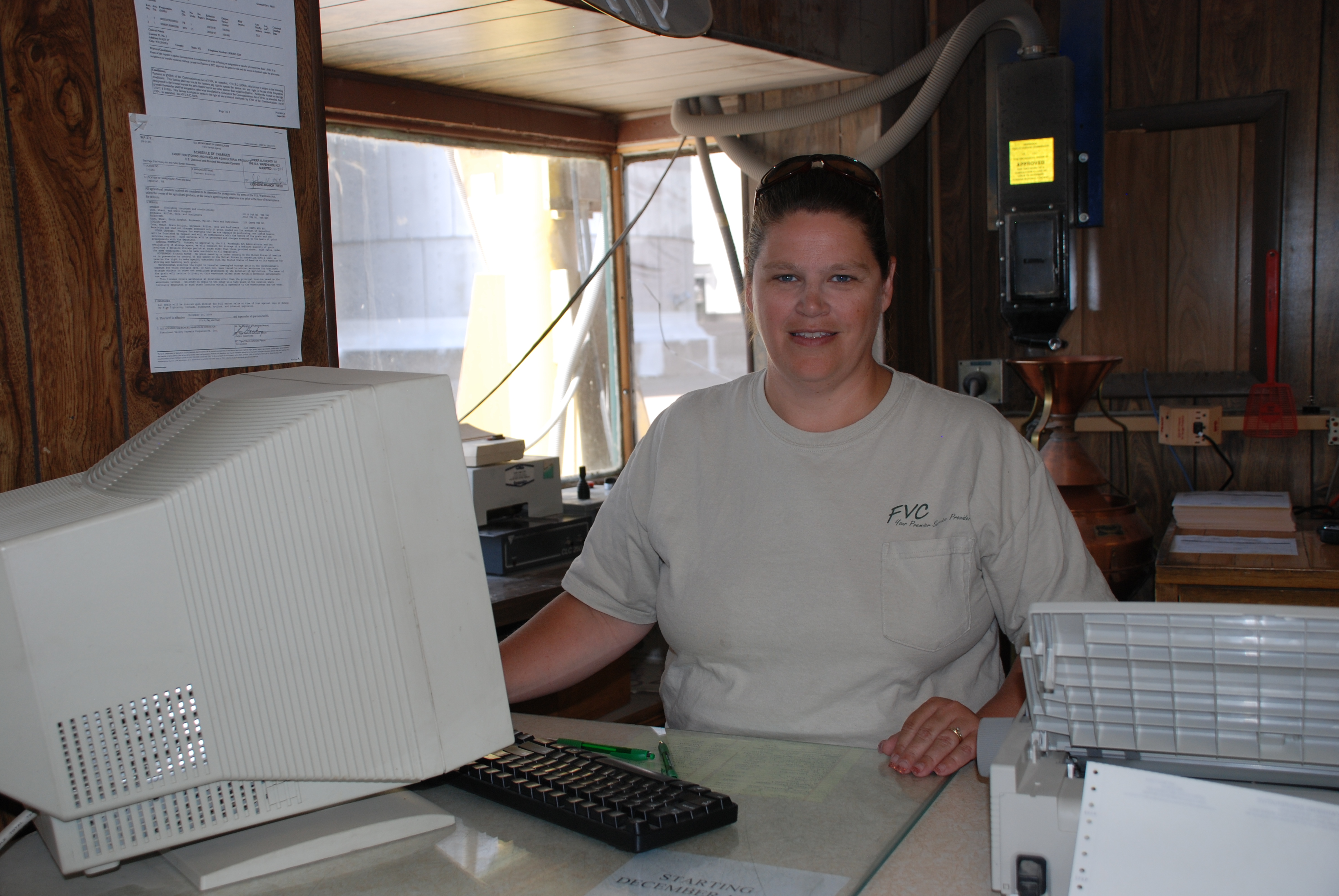
Cindy Fischer of the Frenchman Valley Cooperative

What I found there surpassed expectations. Cindy Fischer warmly welcomed me into the Frenchman Valley Co-op office, and kindly opened up the co-op records room, giving access to the history of the Wauneta elevator. We carefully unrolled blueprint after blueprint on the counter. The records showed that very soon after the original elevator was built, the cooperative found itself short of storage space as the grain boom (helped by federal subsidies) grew. So the co-op went shopping for an annex.

The Treow-Jensen built annex

The familiar name Mayer-Osborn Construction popped out immediately, on an old, yellowed set of blueprints, but the plans did not match what was eventually built. It left me scratching my head until I saw the plans submitted by Treow-Jensen. Ah, hah!  We were looking at competing proposals for the annex, and Mayer-Osborn had submitted two alternatives but was beat out by a lower-cost bidder. Treow-Jensen built Wauneta’s first annex in 1955. Jarvis Construction came in later to complete another annex in 1977.

Gary Rich, who contributes to Our Grandfathers’ Grain Elevators, had visited Wauneta before, and he and I had a protracted debate about what all the blueprints meant, since we found “Holmen and Mayer” on the plans for a building. What we could never settle was the identity of the builder of original elevator, whose plans were nowhere to be found. Eventually, we agreed to leave our diverging interpretations up in the air, all in good humor.

Cindy gave me access to the inside of the straight up elevator. She said that it had been completely redone, so the familiar Hutchinson Foundry manhole covers were absent. The replacement covers gave no indication of the elevator’s builder. Happily, the elevator appears to be ready to take on another sixty or more years of active service.

I wish to thank Cindy Fischer for her kindness and all of her time. We spent a whole morning going through plans, and I borrowed a number of them to be reprinted for my own records. She showed me, for the first time, the sales and engineering aspects of the Mayer-Osborn business. Many of these kinds of records have disappeared over the years, so she afforded a unique opportunity to peer into the past and see Grandpa’s business in a new light.

For that, I am grateful.

Elevator operations

The elevator at Daykin, Nebraska shows a characteristic J. H. Tillotson design

The Daykin, Neb. elevator seems to match an unknown William Osborn photo

Story and photos by Kristen Cart

William Osborn photo ca. 1947

My husband and I took a day trip to look at some elevators in June, letting the kids off the hook and sparing ourselves their groans and complaints as we toured the countryside. Daykin was one of our stops. This J. H. Tillotson, Contractor elevator was built in 1947, according to my grandfather, William Osborn. He listed it among his previous projects when he was interviewed during construction of the McCook, Neb. elevator. As I went over the photographs for this post, I noticed, with excitement, that the photo matches one of grandpa’s unidentified photographs in every detail: The concrete driveway has the same inset from the corners, and the windows of the scale house match perfectly.  A mystery has been solved.

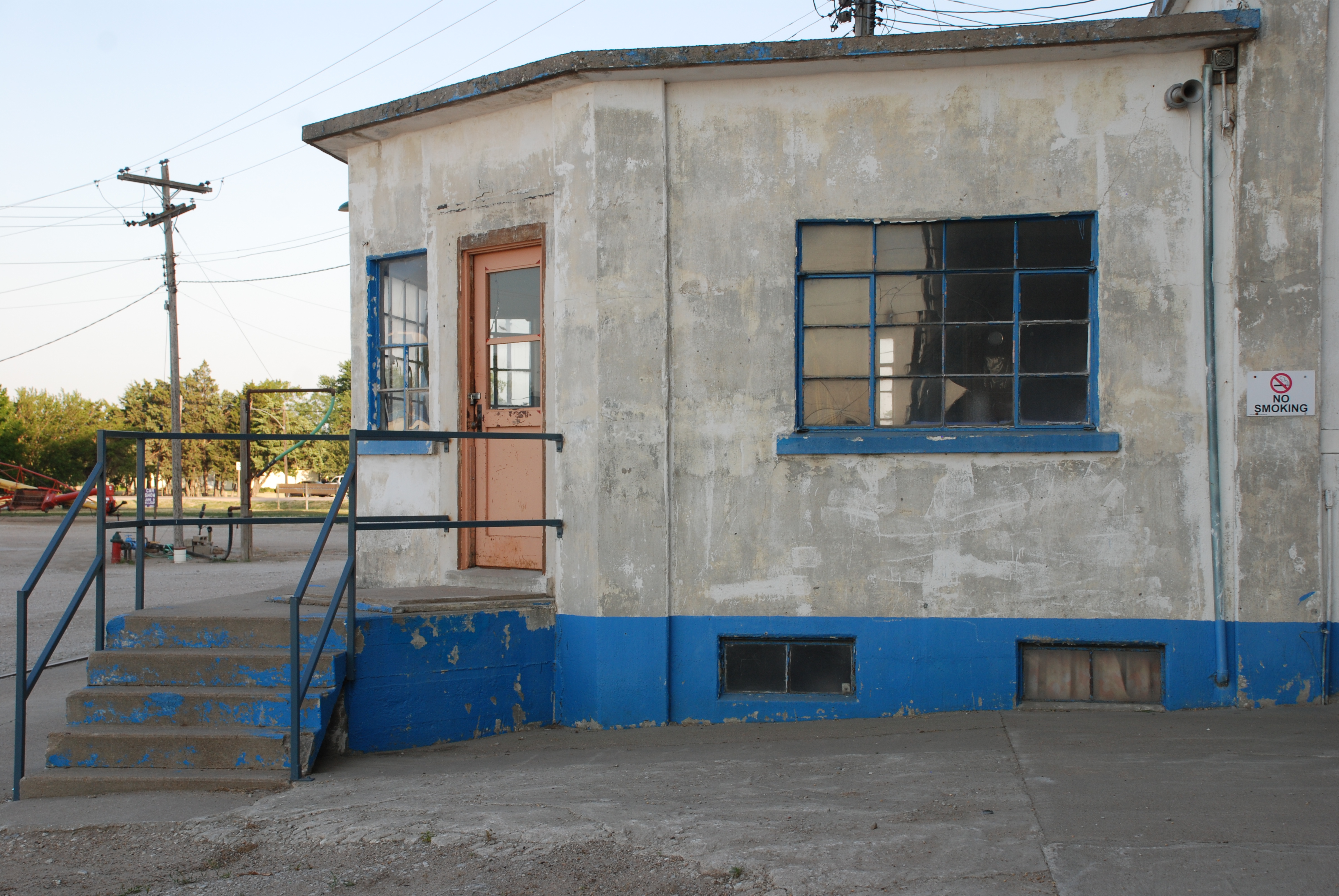
No one was about when we stopped to see the elevator, just before sunset. There was something beautiful about the scale house with its big, multi-paned windows, its blue trim, and its corner detail, with the elevator rising precipitously behind it.  I have admired all of Grandpa’s projects for their spare good looks.  I wonder how he saw these buildings.  It must have given him great satisfaction as he looked upon a completed project–or was it mainly relief? I know he loved tropical fish. He must have appreciated beauty for its own sake–at least a little bit. Was he too close to the elevators to see what I see? In certain light and at certain times, a beautifully done elevator takes your breath away.

Flat storage for corn extends capacity at locations like Mitchellville, Iowa and Traer, Kansas

Story and photos by Kristen Cart

Flat storage at Traer, Kan., for farm equipment, and an unused elevator.

During the heyday of elevator building, no sooner did an elevator go up, than it filled up, and left a town wanting for storage. The first option was to add an annex. But where economics dictated, cooperatives resorted to the simple expedient of horizontal storage. In the Farmers Elevator Guide during the 1940s and 1950s, between the slick ads for elevator builders, companies advertized Quonset-style buildings for flat storage.

A common sight in Nebraska and Kansas are long, flat piles of corn covered in tarps held down with old tires. At one grain facility, I saw a front-end loader filling grain trucks from one end of one of these great corn piles. At another, workmen were hurriedly applying tarp and tires in advance of a rainstorm. It seems the demand for ethanol has once again ramped up corn demand beyond the capacity of vertical storage facilities, or at least the ability to pay for them.

Mitchellville, Iowa: the Heartland Co-op elevator with the former feed mill and dryer. One of the two old flat-storage buildings for corn is in the foreground.

At two of the sites I recently visited, where the Tillotson-built elevators became insufficient for their purpose within a few years, I saw examples of  corrugated-style flat-storage buildings that were added after the original elevators were filled to capacity. These  served during a brief stretch of time until replaced by more modern, efficient bins, when the buildings found other uses. They were well suited for many farm needs since they could house virtually anything and were built to endure, once their corn storage days ended.

Mitchellville, Iowa, a site where an elevator built by Tillotson Construction of Omaha operates, has two such buildings.  They look like ordinary metal buildings, but the tip-off to their special use is the ladder leading to an opening in the roof where the auger operates. Both buildings have new jobs since the large annex additions were built beside the old elevator–one is a machine tool shed, and the other handles seed.

Idaho corn stored under a tarp is loaded onto grain truck.


Then and Now: The J. H. Tillotson elevator at Fairbury, Nebraska

Story and photos by Kristen Cart

Photo by William A. Osborn, about 1948

A current view

Some of the elevators Grandpa built were a little hard to identify, for certain, from his old photos.  Many of his projects were similar in design during the time he worked for J. H. Tillotson, Contractor, of Denver, Colorado.  So seeing an elevator in person,  only tentatively identified with an old black and white photo, and recognizing it, was quite an exhilarating experience.  Fortunately Gary Rich’s sharp eye made the connection between Grandpa’s photo and the elevator at Fairbury, Nebraska.

When I saw it, the Farmers Cooperative elevator did not give a clue to its builder from the outside.  It warned intruders away emphatically with “No Trespassing” signs, and it sported a freshly painted logo, which seemed to indicate that it was still in use. But because it was deserted I had no one to ask.  We knew from a newspaper article, marking the construction progress of the McCook, Neb. elevator in 1949, that my grandfather had previously built the Fairbury elevator.  So when my husband and I went to see for ourselves, I took documentary photos. Later, Gary Rich compared them with Grandpa’s old photos and quickly made the identification, noting the relative position of the railroad tracks, and the loading chute extending beyond the drive way.

The elevator stood beside one of the busiest rail lines I have seen in Nebraska. Freight and coal trains roared by every few minutes.  While spending the better part of an hour photographing every angle, I found a railroad spike, well rusted and tossed aside, and I brought it back to the car for the kids.  I don’t know why I thought it would impress them–when they saw it, they barely glanced up from their video games.  I guess old railroad stuff was more a part of my childhood than theirs.

With a little luck, these kids will remember the long drives through corn and wheat country chasing elevators.  At least they will have a unique perspective on them. Perhaps in their travels, when a towering white structure first peeks over the horizon, they will ask, “I wonder who built it?  And when?”

Gary Rich explains wheat farming in Colorado and Kansas


Heat waves rising over a field of winter wheat in Goodland, Kan. Photo by Kristen Cart.

By Gary Rich

Here is Agriculture 101. I will tell you something about wheat.

There are two types of wheat. You have hard and soft wheat. Hard is considered winter wheat, whereas the soft is considered spring wheat. Winter wheat is planted in August or September. It is harvested the next summer. Spring wheat is planted in the spring, and it is harvested in August or September.

There are different types of winter and spring wheat. Some will produce better yields under normal growing conditions.

Our Colorado wheat fields that were just harvested will not be planted again until August 2013. Farmers leave the field idle for a year. This is done to keep the moisture in the ground, and to preserve some of the minerals for growing. Here in Colorado, it is called dry farming. When they get ready to plant, they will plant the wheat into the ground, without breaking it up.

A view, two days before harvest, of the Page City, Kan., elevator, built by Johnson-Sampson Construction, of Salina.
Photo by Kristen Cart

Where I was reared, in Kansas, it was wet farming.  We had enough moisture, between the rain and snow. Farmers would use a plow, and plow under the last crop remains, then go back over the field with a harrow, leveling out the ground. Then they would come in with a planter and put the seeds into the ground.

In Colorado, we cannot do this, as we do not have the moisture.

Basically, the states that produce hard wheat are Texas, Oklahoma, Kansas, New Mexico, Colorado, western Nebraska, and South Dakota. States that produce soft wheat are North Dakota, Montana, Idaho, Washington, and Oregon.

Those are just a few basic things about wheat.

In Wahoo, Nebr., Tillotson’s elevator finds new life as a cell tower for AT&T

The Wahoo, Nebraska elevator, built by the Tillotson Construction Company of Omaha, Nebraska

Story and photos by Kristen Cart

Another stop on my recent elevator trip was Wahoo, Nebraska. Dad tipped me off that it might be one of Tillotson’s projects. Wahoo is the seat of Saunders County, where Dad lives, and he frequently has occasion to stop there.

Wahoo’s elevator, at first glance, appeared unused. It was closed up tight, and the only indication of any activity was a sign warning workers to stay at least three feet away from any antenna, and to contact AT&T before performing any maintenance or repairs near their equipment.  Ah, hah!  Then I noticed the wires running to the top of the structure. I walked around the elevator, taking pictures.

Next door to the building was a Pet Rescue center, and as a woman was leaving there with a little dog in her arms, I asked her about the elevator.  While she did not know the builder, she said the elevator was privately owned by David Rood, and that at present, the elevator was full of corn.  But she commented that he probably made more money from the AT&T installation. I had heard of cell antennas being installed in every kind of tall building–even church steeples–but it had never occurred to me to look for them atop an elevator.

The next circuit around the elevator produced the answer I was looking for. Right there, adjacent to the sidewalk, in bright blue paint, was a manhole cover.

Some neighborhood teens were hanging around the street, in their cars, and when they saw me kneeling, taking the manhole cover shot, one of the boys shouted out, “What are you doing?”

“Taking pictures of the elevator!” I said.

The young man wanted to know why. When I said it was for a blog, I guess that was enough for him. Anyway, his attention went back to something on his cell phone.

The Wahoo elevator is an attractive feature of the town, fitting naturally with the older buildings along the main street. A man at a local pub, seeing my camera, popped out and said curiosity got the better of him. I told him what I was doing there. I guess a tourist with a camera along the street is a little unusual. And Nebraskans, by nature, like to know who is about.