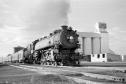
How a fire 30 miles away threatened the historic mill in Downey, Idaho


Fire4

Preston conflagration photos from 2012 courtesy of Ryan Day.

By Ronald Ahrens

In Franklin County, Idaho, the towns of Downey and Preston are about 30 miles apart on U.S. 91. Downey is small, Preston is large. More than 5,000 people live in Preston. It’s the county seat.

As Ryan Day expresses it, “Downey is the black sheep of the family nobody wants to talk about.” 

Ryan, a follower of Our Grandfather’s Grain Elevators, runs the historic mill and elevator complex in Downey, which is a unit of Valley Wide Cooperative. Competing against the operation in Preston was tough. Preston had 24- and 36-inch rollers for barley, and a board member claimed no one could roll barley as well as they did. Preston flaked corn with the same proficiency that Sammy Cahn churned out timeless romantic songs. Preston could even apply molasses to the feed it produced.

This mill in the metropolis was fancy-schmancy.

“They were always the enemy,” Ryan says. 


Jene Day, who operated Downey for about 50 years, finally lured his son back in 2012 to become his successor. A month before Ryan’s first day on the job, the big mill in Preston caught fire and burned down.

“When I started, the building was still smoking,” he says.

The black cloud that had billowed over Preston had a silver lining, though.

“They had just merged with Valley Wide. Luckily, they were insured and able to build a new state-of-the-art mill.”

In 2014 The Capital Press–“The West’s Ag Weekly Since 1928”–celebrated the reconstituted mill’s opening and extolled its efficiency and convenience. The $3-million facility had everything producers and feeders could want: exotic mixes and the quick loading and unloading of trucks, for example.

Such a powerful allure caused a crisis of faith with some of the organic dairymen who had depended on Downey.

According to the the Capital Press, “Mike Geddes a local organic dairy owner [sic], said about a dozen regional organic dairies who now use a dilapidated mill in Downey have asked Valley Wide to process their feed.”

Dilapidated? A black eye for the black sheep!

Preston may be more efficient, but it’s just another unprepossessing steel building with some small steel bins. It lacks any visual distinction whatsoever. In fact, in the photos we’ve seen, it’s darn near invisible.

DSC_0049

Kristen Cart’s photo captures Downey’s Oz-like quality. L. Frank Baum’s Oz books were contemporaneous with much of Downey’s construction.

As stated in an earlier post, Downey’s buildings belong to Oz. The installation should be in our National Register of Historic Places. For that matter it should be registered in Oz, too.

Four years have passed since Preston re-opened. To find out if anything has been done about its going organic, I called up and spoke to feed manager Shaun Parkinson.

“The only reason that we’d do anything is if something happened to Downey,” he said.

In other words Downey has its niche and is in good hands with Ryan Day.

Nothing had better happen.


Shots rang out at the Downey, Idaho, elevator complex in 1964

By Ronald Ahrens

If you think this blog is all about grain dust and elevator specifications, get ready for a murder mystery.

RyanDay

Ryan Day.

Ryan Day, a reader who manages the mill and elevator complex in Downey, Idaho, tells us what happened in an exchange of gunfire there in 1964.

“My mom and dad used to live in a house right next door north to the place,” Ryan says. “They had come home from shopping–it was late at night.

“Dad had been at the elevator for a few months. He noticed a light like a flashlight. He walked over, and it was a body.

“A local deputy lay dead in the middle of the yard. It was Deputy Woodruff, the first officer in [Franklin] County to die in the line of duty.” 

Downey7

“Dad surmised somebody was breaking into the office, so he hustles up and sees a gas trail on the ground from a car that was parked there.

“Deputy Woodruff had put a couple slugs into their gas tank. And they put a couple of slugs into him.” 

Ryan’s parents called authorities.

From Downey, the chase began. It continued about 75 miles through the mountains to Montpelier, in the very southeastern corner of the state.

Downey5“They cornered three fellows and a gal from Chicago going through the states doing a robbery spree,” Ryan said.

The spree ended before the marauders got to Dingle, the last town before Wyoming.

This is how Downey gained lasting fame.

Embellishing his tale, Ryan says, “A detective mag from 1970s had that story.” 

We hope to find a copy somewhere, somehow.

A new belt for the leg, and the Downey, Idaho, plant is good to go

DSC_0049

Photo by Kristen Cart.

By Ronald Ahrens

Ryan Day, a reader of this blog, shared some details about the mill and elevator complex he manages in Downey, Idaho, for Valley Wide Cooperative.

RyanDay

A selfie by Ryan Day.

“I do not have any info on the wooden crib at all,” Ryan says but notes a 1901 casting date on the iron housing of the 24-inch barley roller

He is quite sure about the rest of it, though. 

The six silos–the 50-footers made of riveted steel plates–preceded 1915, he reckons. They hold 11,293 bushels apiece. 

The two 80-foot silos each hold “23,000 bushels and change.” The middle has an overhead bin with capacity of 1800 bushels. 

“Trucks dump right there in the east side of the elevator,” he said. He has a roll-up garage door on south and a slider on north.

Companyjalopy

“Moving rolled barley around the plant in my company jalopy,” Ryan says. “The mill is in the background with the main entrance visible to the left. The Ford is a ’72. We call her Purple.”

He uses a 32-foot scale with balance beam, a device that always makes the Idaho state inspector marvel. It measures loads up to 60,000 pounds and can scale a tractor, which then pulls ahead in order to weigh the tandems. Then the driver backs up and dumps into the pit. 

Up top in the headhouse, a massive 40-horse motor runs the head pulley. “I’m sure it’s original.” 

Updating the leg, the cooperative had a new belt installed last spring. At 132 feet long it spans the distance between head and boot pulleys; it’s made of multi-ply rubber with fabric cordage. He said it’s not as thick as the old belt. Halverson Co., of Salt Lake City, installed it. 

The tall narrow building has a leg; the stepped pit inside has been converted to a corn grinder. 

The wooden crib still bears the faint marking Globe Elevator Co. No. 6. He points out that Globe was responsible for the largest wooden-crib elevator in the States, built in the 1880s at Superior, Wisc. Use this link to view photos from the Library of Congress. The History Channel documented its dismantling in 2013. 

Ryan Day came home and got ‘hootered’ at his historic elevator


Downey7

By Ronald Ahrens, photos provided by Ryan Day

It’s bad enough the man who runs Valley Wide Cooperative’s landmark elevator and mill complex in Downey, Idaho, has to climb a ladder to the headhouse. Being “hootered” by an owl makes things even more precarious.

“I go up there pretty much every month for inventory,” Ryan Day said when we talked on the phone.

RyanDay

Ryan Day shared a selfie.

Getting started the last time, Ryan surprised a barn owl roosting on the truck lift. Both he and the owl survived the encounter without becoming candidates for a viral video. 

The main elevator with the tall, sleek, gleaming headhouse are made of riveted steel plates and date to at least 1915.

So why does he have to climb to the headhouse instead of using the manlift?

Last year, when Valley Wide looked for new insurance coverage, all the estimators’ walkthroughs resulted in reports flagging the manually operated wooden manlift.  

It needed to be removed, they said. Indeed, it might have presented some hazards. So it was cut out and a ladder installed. 

Before going any farther with our story, get this for coincidence: Ryan Day’s grandmother was Beatrice Tillotson. We don’t know of any relation to the Tillotsons of Tillotson Construction Co., of Omaha.

Here is the link to the obituary for Beatrice Jane Tillotson Day.  

Downey3

The Downey elevator has survived flames and smoke.There was a fire, I don’t know when.” Ryan referred to the photo with men in hats. “There’s fire hoses draped around them. You can see smoke coming out of the door.”

He assumes the leg burned up. In those days, the 80-foot-high silos hadn’t been built.

Lingering evidence of fire is found in heat warpage on a couple of bins.

Besides flames and smoke, there were also bullets. But they’re for another post.

Downey1

Day’s father, Elvin Eugene Day, Jr., known as Jene, went to work running this site in 1964 for Downey Grain Growers. It later became affiliated with Farmer’s Grain Growers and eventually Valley Wide.

Today the facility is devoted to production of organic feed. “The mill survived due to the fact there was a vacuum of organic dairies in our area,” Ryan said. Representatives of an organic dairy came through with their pitch, saying, “We can highball you through the system.”

Ryan works alone at the site, milling feed for the dairy cows from barley, organic soy, canola (not grown locally), ground corn, and depending on the season, a lactation mineral. 

It might seem that a man who grew up in Downey and whose father ran the mill and elevator, would have been foreordained to run it himself.

Trucks3

Ryan Day: “Here’s one of our local farmers and my pit and scale area.”

“Back in junior high, I swept floors, mopped, helped bag grain,” Ryan says. “I wouldn’t do any [barley] rolling, that was always my dad’s job.”

But after high school, when Jene suggested coming to work with him, Ryan said, “No way, dad, I’m going out to see the world.” 

He did leave Idaho. “I made it as far as Laramie.” He went to trade school for auto upholstery but found it unsatisfying to make a hobby into an occupation. Then he got into industrial painting. 

In 2012 he joined Valley Wide and three years ago replaced Jene, who is retired.

“Now I can’t think of a better job I’ve had. Everything in that place is historical. It’s in my blood.” 

Reader shares details of his elevator and mill in southeastern Idaho

DSC_0049

Story by Ronald Ahrens, photos by Kristen Cart

The focus of Our Grandfathers’ Grain Elevators is the reinforced-concrete elevators built by Mayer-Osborn Construction Co., of Denver, and Tillotson Construction Co., of Omaha. Anything we can find on J.H. Tillotson, Contractor, is also part of the quest.

But the more we learn about elevators, the more we like all of them–especially old wooden ones. But steel? That’s new for us.

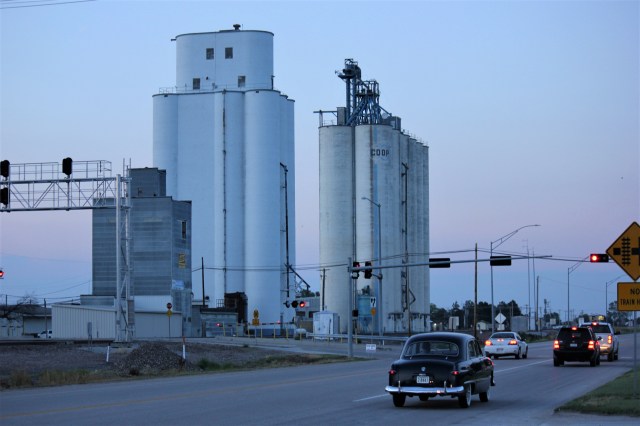
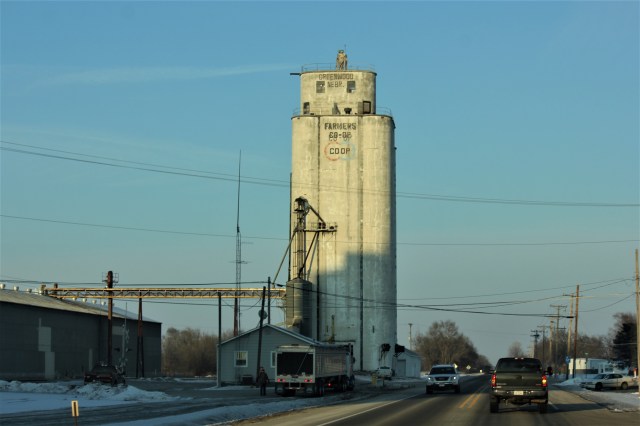
DSC_0037For said reason we present Kristen’s photos of a venerable operation in Downey, Idaho. This is one-of-a-kind hybrid complex of metal-clad wooden buildings and gleaming steel silos. A conspicuous ovalized Oz-like headhouse is freakish-tall but not inelegant.

Ryan Day runs this installation of Valley Wide Cooperative. Mark the company’s locations from Jackson, Wyo., in the east to Chehalis, Wash., in the west, and from Cedar City, Utah, in the southwestern corner of the plateau of the Colorado River, north to Salmon, Idaho, which happens to be a drive of 7 hours and 45 minutes to the Salmon River.

It just so happens that Ryan Day reads this blog. Commenting on one of our Texas-Oklahoma Road Trip posts, he introduced himself: 

“I happen to be a second generation miller at the Valleywidecoop organic mill in Downey, Idaho. I enjoy reading your posts for the reason that I too have elevators in my blood. The old mill I run now was practically a family affair as I was growing up as the Day family is all that ran it haha.

“Sadly, I’m all that’s left to run a worn out wooden crib mill and a steel tanked 123,000 thousand bushel elevator that time seems to have forgotten. I took over from father so he could finally retire 3 years ago and have loved every minute of it!”

DSC_0075

It’s a amazing coincidence that Kristen had gone there. Too bad she and Ryan hadn’t met, but she saw no one during her visit.

Oh, and we have to share Kristen’s photo of the filling station-in-ruins across the street from the mill and elevator. The lighting conditions were hard to match for drama. Besides, in a way, feed and fuel go together.

Listen on KOSU, from Stillwater, as we talk about road trip discoveries

IMG_9388

By Ronald Ahrens

Kelly Burley, news director of KOSU, called me up from Stillwater to talk about the recent road trip, focusing on the sites I visited in western Oklahoma.

He requested a couple of photos (seen here) with captions for KOSU’s home page.

Burley said the full interview would post on the station’s site, and an edited version would run as an insert during a broadcast of “All Things Considered.”

IMG_9351

Above, Pond Creek, Okla. Here, Tillotson’s first concrete elevator (right), 1939, Goltry, Okla.

Indeed, he was true to his word. The link to the 25-minute version is embedded here. The page will open in a new window.

Kristen and I have been blogging since December 2012, but this is our first media coverage and we’re pleased.

Omahan’s ancestor ran 2 elevators–perhaps even Vinton St.

William Leslie Temple Farmers National Grain Coop, Omaha, NE Oct 3, 1933

Kim David Cooper, a friend of Our Grandfathers’ Grain Elevators, has shared not only his oil paintings depicting Tillotson’s Greenwood, Neb., elevator but also some family history.

As he explains …

Since we’re talking grain elevators … my Great Grandfather, William Leslie Temple, managed them. It was most of his life’s work. William Leslie Temple Farmers National Grain Coop, Omaha, NE Oct 3, 1933 detail 2

Two different large ones in Omaha. One on 16th street near Carter Lake and one just north of I-80 and west of I-480. 16th one still active, I believe the other one is not.

Here’s the group picture from 1933. Quite a group of characters. Looks to be many different nationalities represented.

William died in 1963 at the age of 85–on his birthday, working in his garden.

We believe the one just north of I-80 and west of I-480 is the Vinton Street elevator built by Tillotson Construction Co. in 1947.

It would be a remarkable coincidence if Cooper’s great-grandfather ran a Tillotson-built elevator.

William Leslie Temple Farmers National Grain Coop, Omaha, NE Oct 3, 1933 detail

As we see in this inset photo, the 16th Street elevator was part of Farmers National Grain Corp.

Cargill: Trading the World’s Grain, by Wayne G. Broehl, tells us more:

Farmers National was formed in 1929 as “a new central organization to bring together cooperatively owned elevators, terminals and wheat pools and farmer-directed sales agencies into a single unified marketing organization. In early 1930 centralized units also were formed for cotton and livestock, and later, similar national associations were formed for wool, beans, pecans, sugar beets, fruits and vegetables.”

The 16th Street elevator will require further investigation.

Many thanks to Cooper for sharing this family photo and revealing the probable link between our families.


Update on redevelopment of the Mayer-Osborn elevator in Tempe, Ariz.

IMG_0607

We have discovered news in the Arizona Republic about progress at the derelict Hayden Mill and Mayer-Osborn grain elevator site in Tempe.

As the Republic’s story reveals, a developer plans to refresh the buildings and make a multipurpose facility that will entail converting the elevator into a hotel.

We visited Tempe in 2012 and posted this story and photos.

And we spoke a few months ago to John Southard, historic preservation officer for the city of Tempe, discussing some details of the project.

This is a beautiful, sleek elevator that integrates the headhouse into the main house in a singular manner and represents Mayer-Osborn at the top of their game.

We plan to return to Tempe in a few weeks to get the low-down, and of course we will report further right here at Our Grandfathers’ Grain Elevators.

Final thoughts after 1,800 miles, 20 grain elevators, and one Czech sausage

IMG_9438

By Ronald Ahrens

As Kristen Cart and I have been blogging about Our Grandfathers’ Grain Elevators since 2012, she has been able to make the most of her Midwestern location by visiting “our” elevators in Iowa and Nebraska. But I live near Palm Springs, Calif., which is much better known for its midcentury modern houses. Down in the southern end of the valley they grow dates, grapes, strawberries, and leafy greens. No need for an elevator there.

Texas-Okla Logo 04I had only been to the Mayer-Osborn elevator in Tempe, Ariz., and Tillotson Construction Co.’s 1947 terminal in my hometown of Omaha. (Also, a superficial look-see at an elevator-mill complex in Colton, Calif., about an hour from my house.)

So I’ve been winging it.

The 1,800-mile road trip from April 15 to 22, 2018, was an education. I had to go about 1,000 before the first visit to one of “our” elevators in Hereford, Tex. But in the next 84 hours I visited 18 more locations, saw for myself the distinctions from one to the next, and learned a great deal.

IMG_9415

Workbench and storage in Pond Creek, Okla.

Subsequent conversations with my uncles, Chuck and Tim Tillotson, have sharpened those distinctions.

And of course, as I’ve been at my desk writing the posts in this series, I’ve pored over the company records as never before.

My takeaway from all this can be distilled into a few points.

  1. The people I met in Canyon, Bushland, and Booker, Tex., are super-smart and know their business inside and out. In Conlen, Tex., an employee named Jamie said the elevator there was “older than dirt.” In Meno and Pond Creek, Okla., I was encouraged by the astuteness of Matthew Thomsen, Tracie Rhodes, and Jeff Johndrow. They’re not so different from the leaders I interview in my assignments as a reporter for automotive and business magazines. I could see them in Silicon Valley or Detroit.
  2. IMG_9421

    Pond Creek basement.

    Seeing the elevators–most of them in pretty good shape–and watching the work is gratifying. The first Tillotson concrete elevator, in Goltry, Okla., has not been operational for about a decade. But the fourth one ever built, in 1941, is still in use at Medford, Okla., and is looking at its 80th birthday in 2021. I’m sure my grandfather, Reginald O. Tillotson, would be proud. Kristen’s grandfather, William Osborn–who may have worked on some of these jobs when he was with Tillotson and who built one of the elevators that greeted me in Follett–would be the same. They did a splendid thing.

  3. On the Great Plains of the Texas Panhandle and western Oklahoma, it’s quite possible to see how these grain castles, some as high as 175 feet, changed the landscape. We know it happened in a 15-year period between Tillotson’s first effort at Goltry and 1954, when most of the building was done. Excepting the intensive effort to out-produce the Germans and Japanese during World War Two–the period from 1942 to 1944 when no elevators were built–the transformation happened even faster. If at the moment you weren’t in view of a grain elevator, you soon would be.

It was a propitious moment to do this road trip. Most of the elevators were still going about their noble business, but 20 years from now they’ll be reaching what we conceive as their maximum life-cycle. I fear that more and more of them will stand as decrepit monuments. Someone asked if they’ll be knocked down. The answer is that I didn’t hear any of the farmers’ cooperative employees mention a budget for pulverizing, in the case of Tillotson’s 350,000-bushel elevator at Farnsworth, Tex., 1,875 cubic yards of concrete and 127 tons of reinforcing steel.

IMG_9404

Tillotson Construction Co. manhole cover and other detail from Pond Creek.

Perhaps a good lesson comes from the news that Ford Motor Co. has acquired the Michigan Central terminal in Detroit. This building, abandoned for decades, became the chief emblem of “ruins porn,” those photos of the Motor City’s decrepitude. Ford will restore the building over four years and devote some space to its expanding innovations hub in the city.

We can only hope for the same with elevators. Not that Ford would be involved, but that the innovators we’ve written about–vertical farmers, property developers, recreation entrepreneurs–will find new uses or refine old ones.

Here I extend a big salute to the readers who’ve followed along on our road trip series. Your companionship and comments have been appreciated.


Leaving Oklahoma and finding vexing likeness between 2 elevators in Medford


IMG_9461

By Ronald Ahrens

After Tillotson Construction Co. had built their first three modest concrete elevators on the Goltry plan starting in 1939, it became time to attempt a big one at Medford, Okla.

Texas-Okla Logo 04In 1941 the Omaha company upsized with a 212,000-bushel single-leg elevator in Medford. Tillotson’s records say they also built an identical companion elevator in Thomas, Okla., which had been too far south from my route across the state’s western region and must be reserved for a future visit.

I had just been in Pond Creek; now, on my way out of Oklahoma, I headed north to Medford. “Located in a wheat-growing region, Medford served as an agricultural trade center with a flour mill and several grain elevators,” Wikipedia reports. “By 1909 the local economy supported three banks and three weekly newspapers.” 

The elevator complex run by Clyde Co-op Association loomed on the horizon. This would be the last stop on my road trip–the 20th elevator in all. (I haven’t even mentioned stopping in Tucumcari, N.M., the very first site visit even before reaching Canyon, Tex.; that elevator had manhole covers embossed with the name Bleater Construction, of Amarillo.) I’d learned by now not to jump to the conclusion about what I was seeing.

IMG_9459

The south elevator, foreground, merits the adornment of wheat stalks. 

Indeed, here were two elevators and a storage annex at 567 Hwy. 81. So which one was the House of Tillotson? Turning to the company records, we find the ’41 giant had eight tanks, or silos, of 15.5 feet in diameter that rose 120 feet from the loamy earth. 

The cupola, or headhouse, towered further, being 21.5 feet wide, 48.5 feet long, and 33 feet high.

The job consumed 1,845 cubic yards of concrete and 82.5 tons of reinforcing steel.

On the scene I met Jacob States, a lanky young native of Medford who had worked for Clyde Co-op for a while but maybe too short a period to have developed a wealth of historical knowledge.

Alas, I came away with no photos of manhole covers from inside either house. I did snap one of a Johnson-Sampson plate on the storage annex.

The south elevator appears to be of the same general style but a larger capacity, and it has the larger headhouse. The north elevator looks as if it matches the dimensions listed in Tillotson records.

This morning, two months after my visit to Medford, I phoned the Co-op and spoke to Jenna, who said both elevators are operational.

I hate to end the road trip reports on a note of uncertainty. What can be told for sure  is that the total cost less commission for the Medford elevator was $41,888.37. The workers received 30 cents per hour straight time and 60 cents overtime.

In all, the job required 25,630 man-hours. Total payout was $11,015.50 for an average of 42.9 cents per man-hour.

The Thomas elevator, being identical, required 836 fewer man-hours (streamlined procedures?) and cost $41,275.28.

IMG_4850

The Czech sausage sandwich in question.

Rather than conducting a more thorough site visit, I needed to find a lunch spot and then get going in order to make it to my sister’s house in Omaha before bedtime. Jacob States had said I’d find no fast food in Medford, but he failed to mention Smrcka’s Dairy Shack on the north edge of town. In this one-of-a-kind restaurant I ordered a delicious Czech sausage sandwich and sauerkraut, along with friend and a limeade, for only $8.38.

“Have a nice day. Please come again,” says the sales receipt. I don’t know when that will happen, but indeed I’d like to come back to conduct further evaluations here an about 10 other Tillotson sites like Thomas, which I had to bypass.