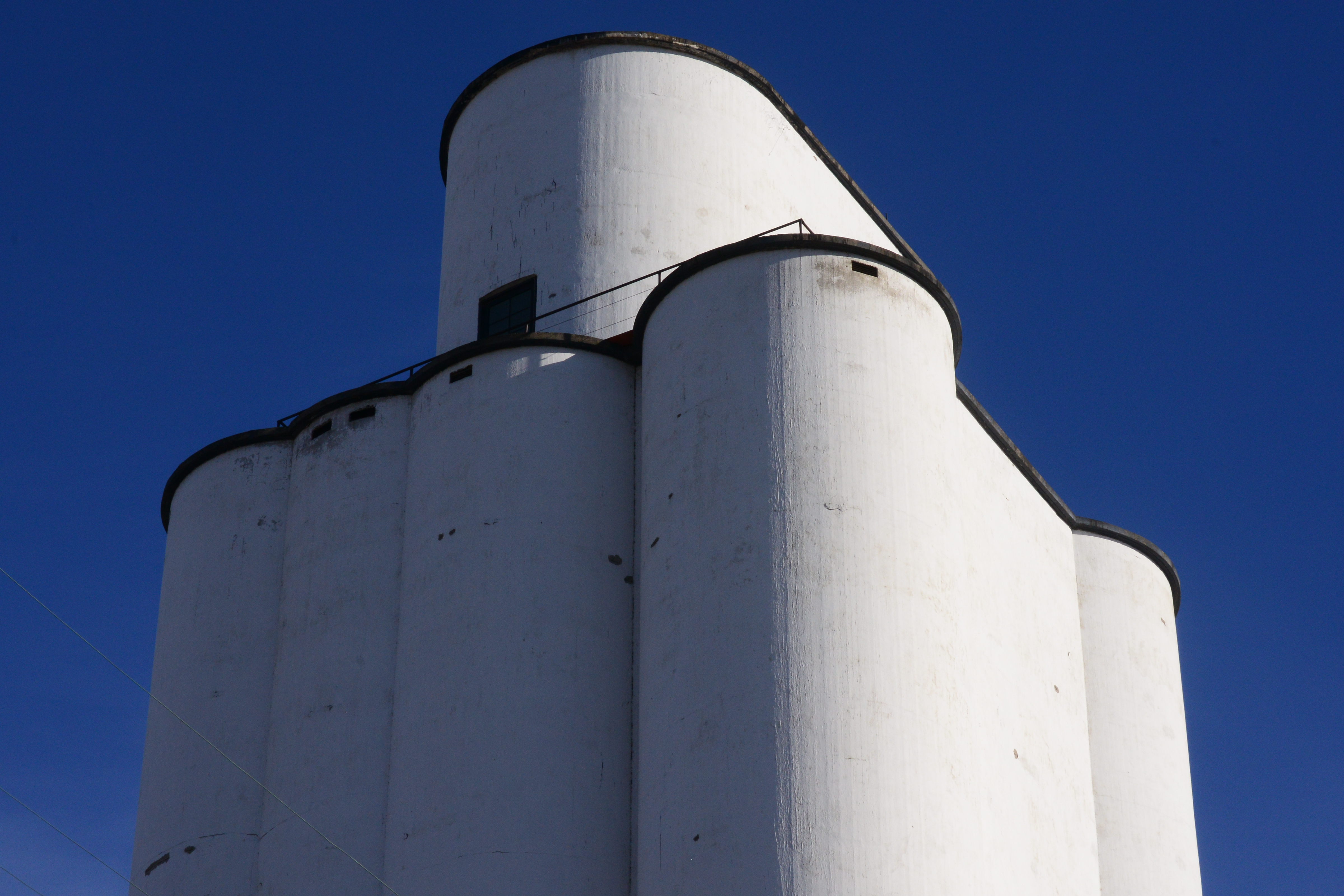
In 1954, near the boom’s end, Albert City, Iowa, had a gleaming concrete elevator

Albert City, Iowa

By Ronald Ahrens 

Looking at this photo of Tillotson Construction Company’s 252,000-bushel elevator, completed in 1954, it’s easy to imagine the pride and awe of a small town’s few hundred residents.

Albert City is in northwest Iowa on a spur from Route 3, not far from Storm Lake in Buena Vista County. The Tillotson’s had also built that same year in nearby Pocahontas, where there was tragedy.

The Albert City job went more smoothly as the structure rose far above the tallest elms, although Uncle Charles Tillotson, who recently dug up this photo, has written about his frightening dismount from the formwork during a storm.

Uncle Michael Tillotson has also recollected about working here:

“The following summer (1954) we went to Albert City, Iowa, 75 miles North of Council Bluffs. We rented rooms in a private home. We worked with a 20 something guy that ran the winch pulley bucket to the top of the elevator as it progressed, and brought building materials down. We also rode the bucket up and down to get on deck. The elevator bens were 125 feet to the top with a Head-House of 75 on top of that.”

Company records show the elevator was built according to the same plan used in Pocahontas. This entailed eight outer bins that were eighteen feet in diameter and, contrary to Uncle Mike’s reckoning, 120 feet tall. Altogether, some 2091 cubic yards of concrete were reinforced by 106.57 tons of steel.

The bins rose from a main slab 21 inches thick and 60 x 72.5 square feet in area. It supported a gross loaded weight of 12,974 tons.

The cupola, or headhouse, was 23 feet wide, 58 feet tall, and 40 feet long.

Albert City was a single-leg elevator. Its head pulley was 72 inches in diameter and turned at 42 rpm. A 40-horsepower Howell motor supplied more than enough energy to turn it.

Twelve-inch-wide cups on a six-ply, 14-inch-wide belt carried up the grain that was dumped by incoming trucks. The 12-foot-wide driveway had two dump grates: 9 x 6 feet and 9 x 14 feet.

In 1954, Tillotson also built in Dacoma, Lahoma, Orienta, and Weatherford, Okla.; Booker, Tex.; Ensign and Montezuma, Kan.; Bellwood, Neb.; and Glidden, Goldfield, Newell, Manson, Pocahontas, and Iowa Falls, Iowa.

These were among Tillotson’s last elevators–the records close out with work in 1955–and they represented nearly everything the company knew about building.

A visit to Google Maps shows the elevator is still standing, which is to be expected given the Herculean effort needed to knock down all that reinforced concrete. But it appears idle. Given what we’ve learned about the limitations of midcentury elevators and today’s need for greater storage capacity and quicker unloading, that would make sense.

Nevertheless, it endures as a handmade monument, and a rich human history goes with it.
This ‘continuous pour’–and the marching band–would delight our grandfathers

By Ronald Ahrens

Photo by AC Martin.

Photo by AC Martin.

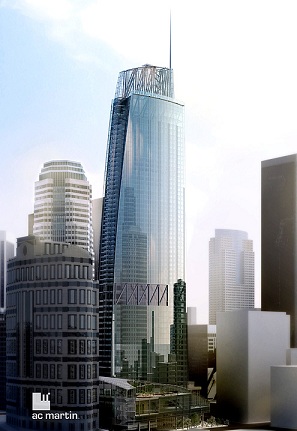
A  USA Today insert in my Feb. 6 edition of the Desert Sun newspaper carried this story about the new tower under construction in Los Angeles. The news will be of interest to the concrete enthusiasts among our readers.

The report on the 1100-foot Wilshire Grand project describes how the the foundation slab will be laid on Feb. 15: “The project will attempt to set a Guinness World Record with the largest continuous concrete pour ever… More than 2,100 truckloads will deliver 21,200 cubic yards of concrete weighing 82 million pounds.”

A typical Tillotson elevator–for example, Albert City, Iowa–needed 2091 cubic yards of reinforced concrete. That’s just under one percent of what’s going into the 100-foot-deep hole on Wilshire Boulevard. I’m trying (without success) to picture 100 grain elevators compressed in there.

The USC band will precede the first truck to the site.  It is not recorded that any band ever marched to the opening of an elevator job.

Nor is it believed a swimming pool topped any elevator, as will be the case at Wilshire Grand.

Technical complications will arise during the pour, and a quite amazing means of addressing them has been devised, as you will read in the story.

I mentioned all this to Uncle Chuck Tillotson and shared the clipping with him. He said that my grandfather Reginald had foreseen for Tillotson Construction Company a commercial future beyond elevator construction.

Applying their expertise with concrete in different applications would only have been natural, but it’s doubtful  he foresaw anything quite this big.

And I’m sure he didn’t think about anyone taking a dip while 1100 feet above the city.

In Argentina, we encounter a colorful solution for abandoned elevators

IMG_8907

Story and photos by Ronald Ahrens

I went to Rosario, Argentina, the first week of January for a magazine assignment, and the group I was with ended up having lunch on the bank of the Rio Paraná, a big muddy river capable of handling large cargo ships for carrying grain and coal. Like so much else about this land of the Pampas, the Paraná reminded me of something you’d find in the Midwestern United States–specifically, it was perhaps wider than the Missouri River but not quite up standard set by the Mighty Mississippi.

IMG_8906As we had earlier driven into this large city–Argentina’s third-largest, with nearly 1.3 million people–I noted a couple of grain elevators, including what looked like a huge wooden one. But I was being herded with a group of reporters following the Dakar, a marathon rally for motorcycles, cars, and trucks. Rosario sprawls over 70 square miles, so there was no way I’d be able to make my way back there from the hotel where we were staying near the river.

How surprised was I when we went from the Juan Manuel Fangio Autodrómo, where the Dakar teams were set up before the rally’s start, to have lunch? The destination was a restaurant affiliated with the Museo de Arte Contemporáneo de Rosario–the museum of contemporary art. We parked on the riverside boulevard, Avenida Estanislao López, and as soon as we started walking I saw the colorful bins of a made-over elevator.

The art museum is integrated into the elevator!

IMG_8908I didn’t come away with any specifics, although it did occur to me to look for manhole covers that might have been cast with the builder’s name. I saw none, though.

As for the rest I hope these pictures tell the story.

By the way, Argentinians are very proud of their beef, and I was told repeatedly in advance of the trip that I should be sure to eat the beef because it’s out of this world. I did have a couple of nice steaks, but there’s no difference from U.S. beef.

IMG_8910

This tower, attached to the elevator, faces out to the river.

And this footnote: the passenger next to me on the flight home said the countryside has changed since the Chinese market for soy opened up–fewer grassy pastures, more fields with the crop. Presumably, there would also be changes in the way cattle are finished for market. Anyway, that explains why so much of Argentina looked like western Kansas, minus the farmhouses and barns.

The countryside is curiously devoid of buildings; everybody lives in town.

The Tillotson elevator at Vail, Iowa, is fully explained in builder specifications

The ubiquitous curved headhouse exemplifies the Tillotson style at Vail, Iowa

The curved headhouse exemplifies the Tillotson style at Vail, Iowa.

Story and photos by Kristen Cart

DSC_2984

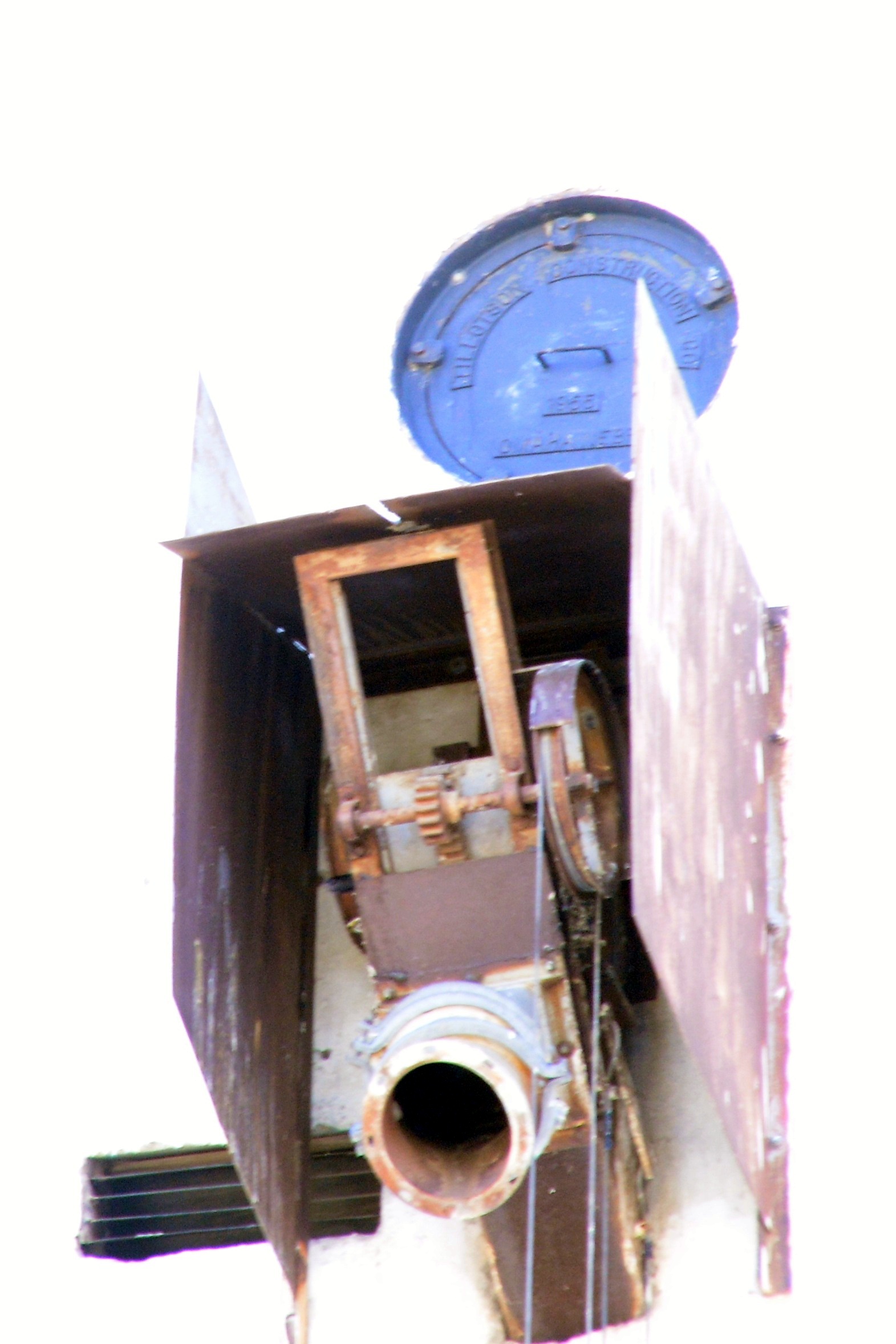
An overexposed image brought out the Tillotson name on the blue port cover.

During our travels, we are always on the lookout for a Tillotson elevator, so coming across the Vail elevator in the eastern part of Iowa during a Thanksgiving visit was a pleasant surprise.

The trademark curved headhouse came into sight at a distance, and with some excitement we pulled over near the elevator, hoping to find an embossed manhole cover to confirm the builder. Painted blue, about halfway up the side above a loading spout, was a steel cover with its stamped name, “Tillotson Construction Co., 1955, Omaha Nebr.,” faintly visible in the late afternoon shadow.

We needn’t have looked. The Vail elevator is among the structures detailed in the Tillotson concrete elevator specifications, which span over fifteen years.

In a brisk, chill wind, I took some quick photographs (interrupted briefly when a railroad employee warned me to keep a respectful distance from the tracks), and then I dashed back into the warmth of the truck. “Vail, Iowa,” was a familiar name. When I checked, I found it was listed in the rich store of information that Tim Tillotson provided.

Eureka!

DSC_3006Below are the specifications for the elevator at Vail, Iowa, built in 1955.

The elevator was built using the “Manson plan,” which specified 5 bins with a 16 ft diameter and 120 ft height, a 13 x 17 ft driveway, a dust bin and fan, a dryer bin, and 16 bins and overflow.

Capacity per Plans (with Pack) 152,000 bushels

Capacity per foot of height 1,551 bushels

Reinforced concrete/plans (Total) 1,552 cubic yards

Plain concrete (hoppers) 27 cubic yards

Reinforced steel/Plans (includes jack rods) 69.5 tons

Average steel per cubic yard of reinforced concrete 89.8 pounds


Steel & reinforced concrete itemized per plans

Below main slab 5,457 lb/64 cu yd

Main slab 19,460 lb/186 cu yd

Drawform walls 88,017 lb/1087 cu yd

Work & driveway floor (including columns) 1,988 lb/18.5 cu yd

Deep bin bottoms 5,261 lb/28.5 cu yd

Overhead bin bottoms 2,949 lb/22.1 cu yd

Bin roof & Extens. roofs 5,287 lb/35.8 cu yd

Scale floor (complete) 292 lb/4.8 cu yd

Cupola walls (including leg and head) 5,590 lb/63.0 cu yd

Distributor floor 1,530 lb/11.0 cu yd

Cupola roof 1,760 lb/14.0 cu yd

Miscellaneous (track sink, steps) 1,107 lb/15.0 cu yd

Construction details

Main slab dimensions (Drive length first dimen.) 54 x 51 ft

Main slab area (actual outside on ground, less pit) 2,482 sq ft

Weight of reinforced (total) concrete (4,000 lb/cu yd + steel) 3,173 tons

Weight of plan concrete (hoppers 4,000 lb/cu yd) 96 tons

Weight hopper fill sand (3,000 lb/cu yd) 615 tons

Weight of grain (at 60 lb per bushel) 4,560 tons

Weight of structural steel & machinery 18 tons

Gross weight loaded 8,462 tons

Bearing pressure 3.4 tons per sq ft

Main slab thickness 24 in

Main slab steel (bent) number 9 at 7 inches

Tank steel at bottom (round tanks) number 4 at 12 inches

Lineal feet of drawform walls and extensions 526 ft

Height of drawform walls 120 ft

Pit depth below main slab 16 ft 3 in

Cupola dimensions (W x L x Ht.) 22.25 x 42.5 x 26.5 ft

Pulley centers 152.75 ft

Number of legs 1

Distributor floor Yes

Track sink Yes

Full basement Yes

Electrical room Yes

Driveway width–clear 13 ft

Dump grate size 5 x 9 and 15 x 9 ft

Columns under tanks size 16 inches square

Boot — leg & head Concrete


Machinery Details

Head pulley size 72 x 14 x 4 9/16 in

Boot pulley size 72 x 14 in

Head pulley rpm 42

Belt 330 ft, 14 in 6 ply calumet

Cups 12 x 6 in at 10 1/2 in

Head drive Howell 30 horsepower, 4

Theoretical leg capacity (cup manufacturer rating) 6,440 bushels per hour

Actual leg capacity (80 percent of theoretical) 5,150 bushels per hour

Horsepower required for leg (based on above actual capacity plus 15 percent for motor) 23.8 hp

Man lift 1.5 horsepower Ehr

Load out scale 10 bu

Load out spout 8.25 inch W.C.

Truck lift 7.5 horsepower Ehr

Dust collector system Fan → Bin

Cupola spouting 10 inch diam.

Driveway doors Two overhead rolling

Conveyor Provision


Also Built

Main slab includes 3 in pile cap 23 cu yd

Split one overhead bin

Dust bin and fan

Hang pit 3,126

Special track sink

Piling

How a 1950 elevator matches advanced farming practices in Cordell, Oklahoma

DSC_2318Story and Photos by Kristen Cart

Once we discovered that the Cordell, Oklahoma elevator was built by Mayer-Osborn, it became a priority to pay a visit.  Luckily an opportunity presented itself when I went shopping for an Australian Shepherd puppy for my son Jesse. Deadra Buffing breeds lovely pups at Horse Creek Aussies right there in Cordell, and we found the right dog, so off I went on a puppy mission, first flying to Oklahoma City then driving two hours west to Cordell. (I’m sure there were breeders closer to home, but this coincidence was too good to pass up.)

DSC_2335But the first stop was the Mayer-Osborn elevator. After a quick tour around the outside with my camera, I stepped inside the Wheeler Brothers Grain Company office. There, Jim Balzer greeted me. He was more than happy to share his insights and long experience with the Cordell elevator. His stint at the elevator spanned a number of owners, beginning in 1979 with General Mills.

General Mills sold their Oklahoma operations in about 1984, including elevators at Cordell, Bessie, Carrier, Reading, and the terminal at Enid. Logan Farms bought the Cordell elevator from General Mills, then Johnson’s Grain bought it. Goodpasture, out of Texas, owned it for awhile. Wheeler Brothers finally bought it in 1996 or 1997.

After 1984, a truck spout was added on the west side of the elevator, and the train spout on the east side was remodeled using salvaged parts. The old wooden doors were also replaced with metal ones. Jim said the elevator is holding corn for the first time, an atypical crop for the area, but a sign of the times due to ethanol subsidies.

DSC_2333

Jim Balzer has worked at the Cordell elevator since 1979. The small elevator has stood as long as he can remember.

The structure is completely unique, having two driveways. It’s special features are its two legs, each rated at 5,000 bushels per hour, to achieve an unload rate of 10,000 bushels per hour. Most elevators of this size and age have long since retired because of limitations in their loading rates, if not for their lack of capacity. Jim said their newer, larger elevator at Cordell, when running “full out” with its single leg, only surpassed the old elevator by a little bit at 11,500 bushels per hour.

In the past, all manner of vehicles would line up to unload their grain at Cordell. The earliest were horse-drawn wagons, used in the old wooden elevator days (before Jim’s time, he noted), where the farmers would scoop the grain manually into the pit. Jim showed me a bit of concrete foundation by the tracks where the wood elevator used to be. A slow leg was no problem then, because the choke point of the process was the farmer’s shovel.

Years later, after the concrete elevator was built, farmers drove their trucks in and unloaded them much more quickly. They would queue up in the hot sun and wait their turn, while Jim’s young daughter brought them cold pop from a wagon.

Now, nothing much smaller than a semi-tractor trailer will bring grain, and the leg speed is much more crucial. Rail cars are also serviced at the small elevator. The Cordell elevator was far ahead of its time, able to keep up with advances in farming practices. It is a testament to the forethought of the original designers that the Mayer-Osborn elevator still meets the need.

The Mayer -Osborn Construction Company is identified on the manhole cover

The Mayer-Osborn Construction Company is identified on the manhole cover.

Dennis Russell reflects on his brother Jim’s tragic death on the Murphy, Neb., elevator

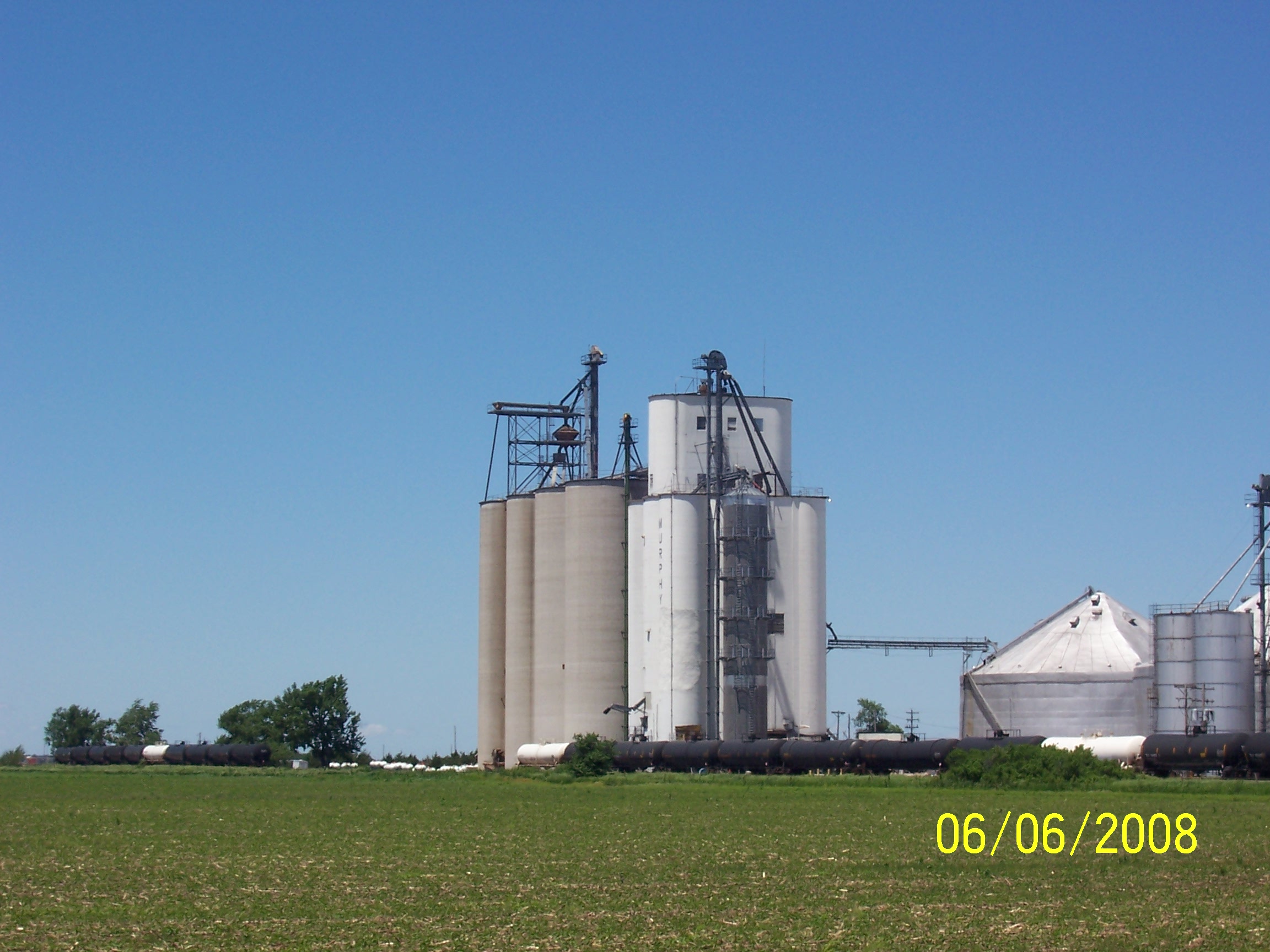
This photo, provided by Kurtis Glinn, shows Tillotson Construction's Murphy elevator in the early 1960s. Note the ground storage of grain sorghum on the right.

This photo, provided by Kurtis Glinn, shows Tillotson Construction’s Murphy, Neb., elevator in the early 1960s. Note the ground storage of grain sorghum on the right, and the old wooden elevator on the left.

By Ronald Ahrens  

A recent telephone conversation with Dennis Russell, who lives in Plano, Tex., revealed more details about the Russell family and his brother Jim, who died in an accident during construction of the Murphy, Neb., elevator. Dennis was the youngest of eight brothers: Bob, Roger, Jim, Jack, Byron, Bill, and Mark.

Their father William, born in 1900, had done construction on ammunition depots during World War Two, Dennis recalled. William, known as Bill, went to work for Tillotson Construction Company at an unknown date after the War.

“He worked for them a long time,” Dennis said. “He left Tillotson’s and started Mid States Construction Company with Gordon Erickson and another individual. I think he was a partner for a brief period and then ran jobs for them as a superintendent until his retirement.”

The name was changed to Mid States Equipment Company. Grain elevators and feed mills were the main specialties. Bill Russell retired in 1972, but he “always had fond memories working for Tillotson, I know that,” Dennis said. “I remember he was awful fond of Mary.”

Jim Russell’s promising future cut short 

Dennis was born in 1949. “My whole life was elevators. We moved every year from ’59 till I graduated high school.”

All the Russell brothers worked on elevators, Dennis recalled. “I worked on those quite a bit myself every summer.”

“Jim, he was third-oldest, he died in, like, ’58 in Murphy, Neb., right outside of Aurora. There was an article about that in the Aurora paper at the time. We lived in Vermillion, South Dakota, but that summer I was in Aurora, we were staying with Dad. I remember Mom taking that phone call.”

At the time of his death in a freak accident (the links below tell the story), Jim was married to Shirley, a nurse, and had one year of law school remaining at the University of South Dakota.

More details on the Nebraska elevator site where Jim Russell died

By Kurt Glinn

I was the manager at the Aurora Cooperative Murphy location in central Nebraska. I was told from the old timers in the area that were around when the elevator was built in the late-’50s [that an] accident happened there, shutting down construction for about a week.

The Aurora Coop's Murphy elevator and annex. Jim Russell died in a fall during the elevator's construction.

The Aurora Coop’s Murphy elevator and annex. Jim Russell died in a fall during construction.

Murphy is no more than an elevator along the railroad now. It is six miles west of Aurora, Neb., or fifteen miles east of Grand Island, Neb.

Thank you for a wonderful site. One of my first bosses was a man by the name of Willis “Bill” Maahs. He was a superintendent for Tillotson into the early ’60s when he stayed in Aurora and  became operations supervisor for Aurora Co-op. He helped build the Murphy elevator and the Aurora elevators. There are two Tillotson houses in town, as well as the feed mill in Aurora.

I have always been intrigued with the workings of the old concrete houses versus the new bigger faster ones, although I know how farming and the grain business view them.

Concrete grain elevators are very highly regarded in the industry as the most permanent. My reference is to the older, smaller, multi-bin elevators of 20,000- to 25,000-bushel bins versus the newer 250,000- to 300,000-bushel bins being built.

The industry has come along way in the last fifty years: the ability to jack the forms with hydraulics, the diameter of the bins, the height and capacity of legs. Putting all the equipment outside of the structures rather than enclosing everything in the house, which has saved many elevators from the disaster of explosions, et cetera.

Farmers are into a newer generation also, thirty-five years and younger. They want fast unload and large unloading pits.
The ag industry as a whole had seen large improvements in the size and capacity of equipment, making some of the smaller, older elevators almost impossible to use.

I find the older ones more interesting because they were what started a new generation from wood houses to concrete. Building work floors and platforms from concrete rather than steel and expanded metal. All is my own opinion as to why I enjoy the first generation of concrete grain elevators in the ag industry.

A freak accident led to the fatal fall of Bill Russell’s son

The Aurora Coop's Murphy elevator and annex. Jim Russell died in a fall during the elevator's construction.

The Aurora Cooperative’s Murphy elevator and annex. Jim Russell died in a fall during the elevator’s construction. Photo by Kurt Glinn.

Story by Ronald Ahrens

My uncle, Tim Tillotson, recalls some details of the death of a son of Bill Russell, a superintendent for Tillotson Construction Company. Russell was the father of eight sons in all. The accident occurred in the 1950s.

Although he can’t remember which job [it was the Aurora Cooperative’s Murphy location in central Nebraska] or when it happened, Uncle Tim, who was not present at the time, recalls from on-the-scene reports that two of Russell’s sons were running the night crew.

The two were working with a storey pole, a measuring device of ancient origin. In this case, the storey pole was a metal tape, and it was used to verify the height of vertical sections. One son was on top, fifty-five feet up, feeding the tape down to the other on the ground.

“It was blowing in the wind, and he was letting it out,” Uncle Tim says. “The wind caught it to some power lines, and it gave him a jolt.”

A fall to the ground ensued.

“One side of him hit the Georgia buggy, which kind of spun him around. He was conscious on the ground, saying he thought he’d broken a leg. But by the time the ambulance got there, he’d died of shock.”

Uncle Tim suggests the likelihood of a brain hemorrhage as well.

Mayer-Osborn’s proposals were rejected at Wauneta, Nebraska

DSC_0790

Mayer-Osborn Construction lost their bid to build this annex.

Story and photos by Kristen Cart

Our blog contributor Gary Rich was the first to visit Wauneta, Neb. in the hunt for elevators built by Mayer-Osborn Company and J. H. Tillotson, Contractor. He discovered that the Frenchman Valley Co-op had retained original documentation including blueprints for the original elevator, and the two annexes, which all still operate today. The various documents painted a confusing picture. Gary told me enough that I knew I needed to get down there and see for myself, which I finally did in October of 2012.

The builder of the original elevator was unclear, but presumably J. H. Tillotson had built it, based its appearance.  Mayer-Osborn soon returned with a proposal for the first annex, and a close reading of those documents seemed to indicate that the first elevator was completed by the same people, which at that time worked for the J. H. Tillotson, Contractor operation. But nothing definitive was found to that effect–even the manhole covers of the main house were blank after a renovation.

FVC BP6aThe most interesting discovery was a set of blueprints and drawings completed by Mayer-Osborn for their annex that was never built. Their proposal was submitted twice, once in 1950 and once a few years later, but the town finally decided on a different contractor after some delay. For some reason, the co-op retained all of the paperwork at the site. This blueprint, dated Feb. 17, 1950, was the first of these designs.

The co-op has retained the original written contract proposals, which will be detailed in a later post. It would be very interesting to discover what held up the original building plan. Because the annex finally went up in about 1957, it’s possible that the co-op just waited too long and built the annex after the demise of the Mayer-Osborn Company. The existing annex looks much like the original proposal. Did they show another company the plans, and ask, “How close can you come to this design?”