Tag Archives: slip-formed concrete
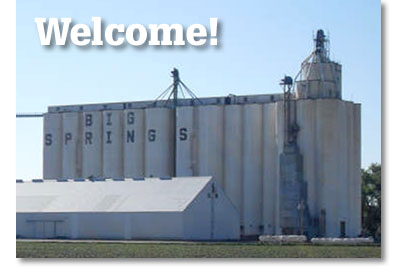
Tillotson Construction completes Big Springs sorghum plant
Farmers’ Elevator Guide, August 1951
Later additions were made to the original structure, increasing storage capacity by hundreds of thousands of bushels.
Mr. MrCroden said the elevator at Roggen, Colorado, bears many similarities to Big Springs.
Additional note: We don’t know why Hastings, Nebraska is given as the location of Tillotson Construction Co., which had its headquarters in Omaha.
Related articles
- One of Tillotson’s biggest elevators under way in Dallas Center (ourgrandfathersgrainelevators.com)
Tillotson gets 50,000-bushel Paullina elevator under way
Farmers’ Elevator Guide, June 1949
Related articles
- Men wanted in Paullina, Iowa, by Tillotson Construction in 1949 (ourgrandfathersgrainelevators.com)
One of Tillotson’s biggest elevators under way in Dallas Center
DALLAS CENTER–Work has started on a 250,000-bushel concrete elevator for Dallas Center Farmers Cooperative Company. It will be 166 feet tall and is being built by Tillotson Construction Company at a cost of $151,000.
Located west of the firm’s south elevator, it is 56×70 in base dimensions.
Aeration equipment will be included in each of the ten 23,000-bushel bins, Manager Don Brown reports.
Farmers’ Elevator Guide, circa September 1955
See another recent images from Dallas Center:
Related articles
- Boxholm manager foresees timely completion of Tillotson Construction’s new elevator (ourgrandfathersgrainelevators.com)
In Hutchinson, foundries create cast of thousands of manhole covers
Castings Plants Held Not Needed
Hutchinson’s industrial development is apparently not wanting in respect to foundries and the manufacture of metal castings.
Interviews with managers of two local firms bear this out. Frank Hulet of M.W. Hartmann Manufacturing Co., 120 North Adams, and Joe O’Sullivan, Sr., of Hutchinson Foundry and Steel Co., Washington and D, both report the Hutchinson market does not near utilize their capacities for production.
“We have more capacity available than is being utilized by local firms,” said Hulet. His company produces gray iron, alloy iron, brass, bronze and aluminum castings. In 1957 they produced 600 tons of gray iron and alloy castings. They did business in Oklahoma, Colorado, Texas, Nebraska and Missouri.
Hulet pointed out that at the present time they are capable of producing over twice that amount. The company has a second plant at 400 West 2nd in Hutchinson.
M.W. Hartmann Manufacturing Co. makes castings for such industries as hydraulic, agricultural, farm equipment, oil field and municipal. “We furnish our own castings, too,” Hulet said.
O’Sullivan said the work of the Hutchinson Foundry and Steel Co. deals principally with municipal and farm implement castings. They also make iron water well screen.
“The local demand is not over 20 per cent of our production for this area,” said O’Sullivan. He felt that production in their field was more than adequate for Hutchinson needs.
Hutchinson Foundry and Steel Co. is equipped for the heavier type casting work. They meet municipal, highway and agricultural needs and do more outlying area business than local business.
Hutchinson has three main foundry firms, the third being Kraus, Inc., 305 South Monroe.
Hulet summed up the job Hutchinson foundries are doing in meeting local needs when he said, “In comparing Hutchinson’s three foundries with other larger cities having less, I feel there is no need for industrial development here along these lines.”
Hutchinson News, January 22, 1958
Note: Manhole covers used in elevators built by Mayer-Osborn Company and J.H. Tillotson, Contractor were made by Hutchinson Foundry. In 2011, a new foundry was announced as a complement to Hutchinson’s growing wind energy industry.
Related articles
- Ports and plaques provide clues about an elevator’s builder (ourgrandfathersgrainelevators.com)
Boxholm manager foresees timely completion of Tillotson’s new elevator
Boxholm, Iowa–Manager Bud Lane reported that the new 200,000-bushel Farmers Cooperative Elevator Company’s concrete elevator will be completed on July 15. Tillotson Construction Co. of Omaha is the builder.
The structure will rise 150 feet with storage tanks standing 120 feet high.
The firm will have 256,000 bushels of space with the new unit.
Farmers’ Elevator Guide, 1954-1955 library volume
♦ ♦ ♦
Note: The Boxholm Farmer’s elevator was founded in 1900, according to a 2004 article in the Dayton Review. On October 25, 2004, the elevator–now expanded–took in 145,422 bushels of grain, the new single-day record at this location. For the entire 2004 harvest season, more than 2 million bushes were taken in.
On November 16, 2009, two workers were injured when a grain dryer exploded at the Boxholm elevator. See the report from Des Moines station KCCI.
Related articles
- Tillotson Construction’s Ralston, Iowa, project ‘progressing nicely’ in 1939 (ourgrandfathersgrainelevators.com)
Kristen’s visit to her grandfather’s elevator in Blencoe, Iowa
Story and photos by Kristen Osborn Cart
When I was out to Nebraska with the kids to see my Mom and Dad in 2011, we took the long way home to Illinois and stopped at Blencoe, Iowa, to see the grain elevator.
Dad helped to build it with Grandpa and Mayer-Osborn Company in the summer of 1954, just as he was starting his last year of college.
Blencoe is a tiny Monona County town of about 200 people. It’s just off Interstate 29, halfway between Council Bluffs and Sioux City.
In March of 1954 Mayer-Osborn won the contract from Blencoe Co-operative Company, worth $153,000, to build the 259,000-bushel facility. It featured a stepped, rounded headhouse.
Dad and his brother Dick laid the rebar during the concrete pour as the elevator went up. Dad had to go back to school before construction was finished because football practice was getting under way.
On my visit, I stopped at the office, where they had a notebook with the fifty-year history of the cooperative. They were proud of their elevators at Blencoe, and the folks there showed me around. 
This elevator is very similar to the elevator Grandpa built in McCook, Nebraska.
Related articles
- Mysteries surround the origin of Mayer-Osborn Company and its first elevator (ourgrandfathersgrainelevators.com)

Tillotson Construction hurries to meet deadline in Aurora, Nebraska
Contracts for new elevators at Aurora and Murphy were let by the Aurora Cooperative Elevator Co. The Aurora 250,000-bushel concrete elevator will be built by Tillotson Construction Co. of Omaha. The 33,000-bushel plant at Murphy will be erected by Black, Sivalls & Bryson, Kansas City, Mo., bolted steel tank construction company. The cooperative has a government contract to store grains for three years and the elevators must be completed by September 15 to meet terms of the contracts. The Murphy elevator will be in use by mid-July.
Farmers’ Elevator Guide, July 1950 
By January of 1955, it was reported that the co-op was operating a new, 271,000-bushel addition built by Tillotson, bringing overall capacity to 551,000 bushels.
Related articles
- Open house to welcome Tillotson Construction’s large elevator at Rock Valley (ourgrandfathersgrainelevators.com)
In 1945, William Osborn worked on Tillotson Construction’s elevator in Giddings, Texas
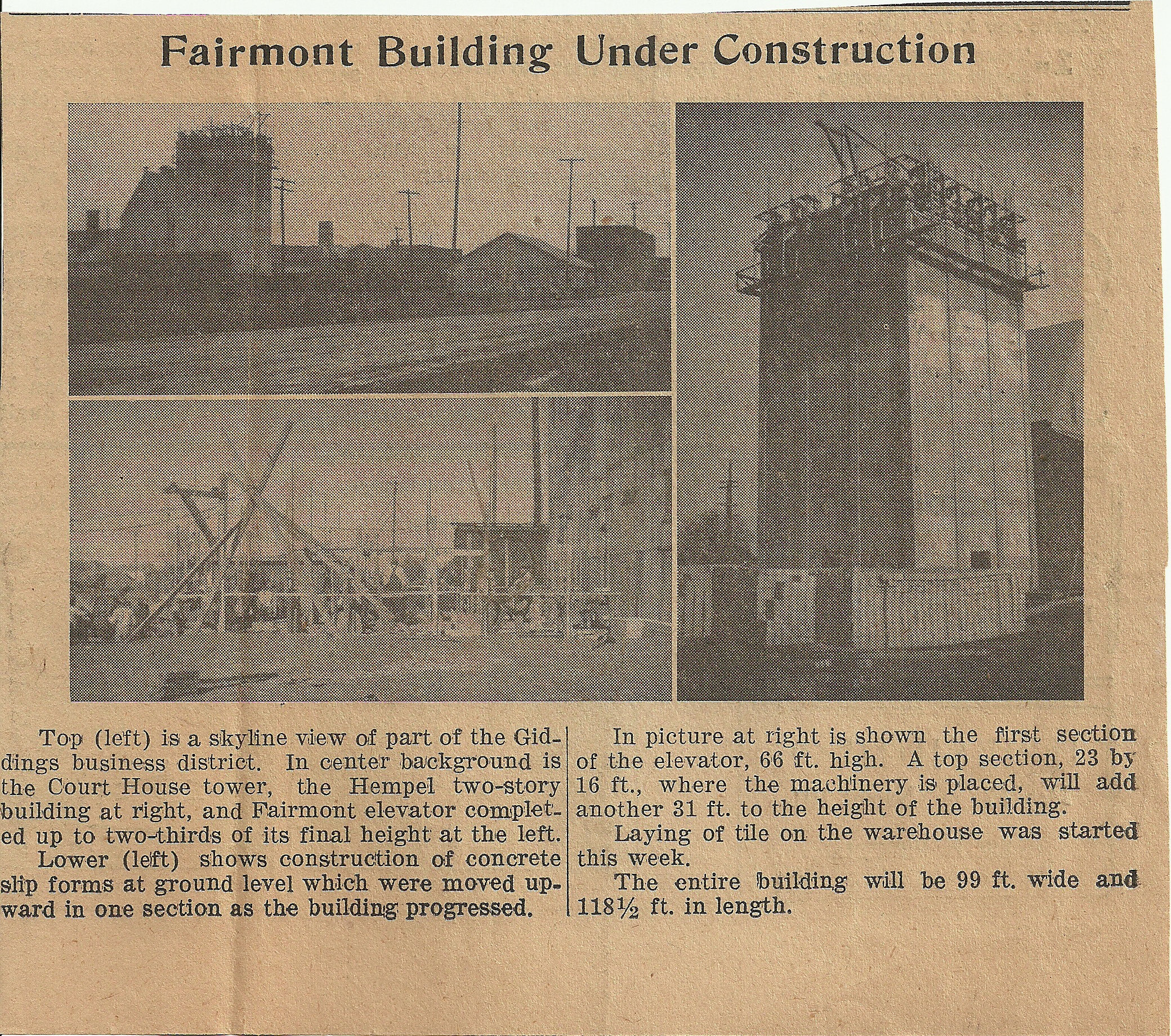
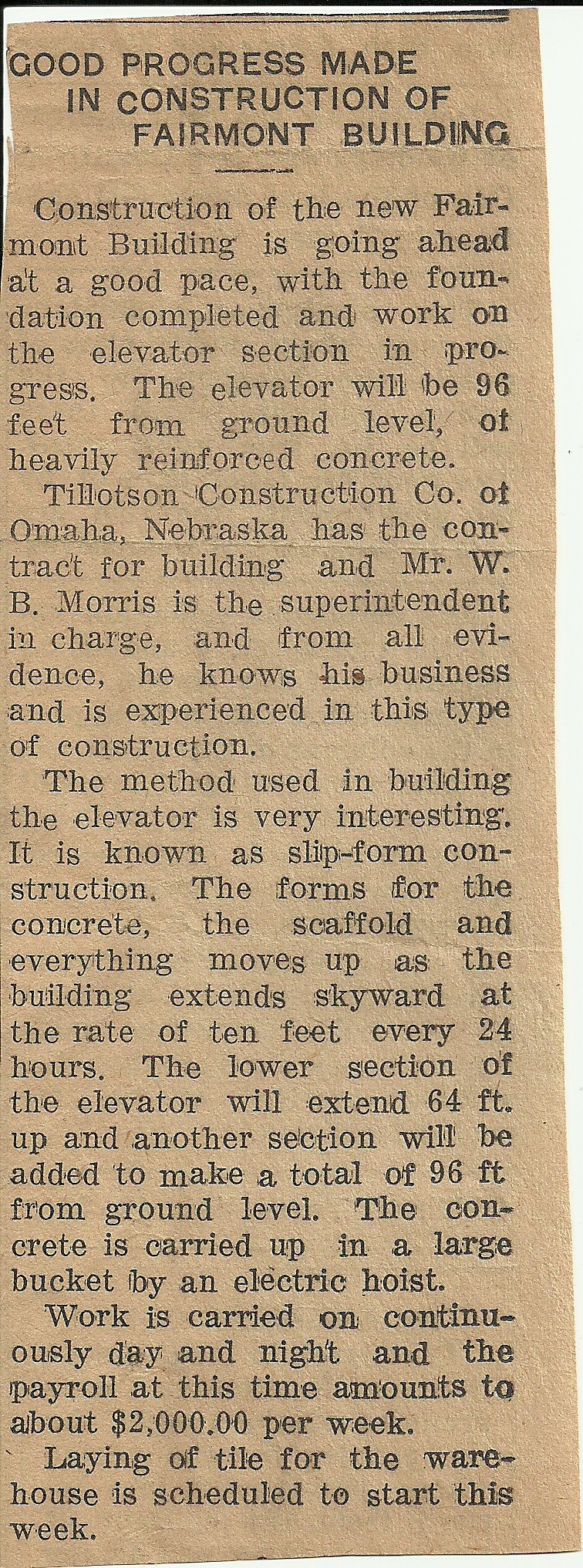
This elevator at Giddings, Texas, called the Fairmont Building, is the only one I have pictures for that my grandfather built when he worked for Tillotson Construction Company of Omaha. It would have been built in 1944 and 1945, when my dad turned eleven years old. Dad went to visit my grandpa William Osborn at Galveston in the spring of 1945 during this project. — Kristen
Note: Nutrena bought Fairmont Foods’ plant in Giddings in 1955.
Related articles
- William Osborn’s photo of the Kanorado, Kansas, elevator (ourgrandfathersgrainelevators.com)
J.H. Tillotson’s Fairbury elevator, slowed by rain during construction, will miss 1947 harvest
These clippings were among William Osborn’s papers. They come from the Fairbury (Nebr.) Daily News, a long-defunct paper, and appear to have run in the summer of 1947. The article “Rain Hampers Work At New Elevator Site” gives a good summary of the construction methods used on the Farmers Union elevator. The name J.T. Tillotson Contractors, as it appears in the article, should be J.H. Tillotson, according to other records.