In Monument, Kansas, the elevator is closed to visitors and its story sealed

Story and photos by Kristen Cart

I approach this post with a little bit of trepidation, since the Monument, Kan., elevator does not invite tourists–even those with family connections. It is operated by a large corporation which primarily supplies corn for ethanol. It seems that an overly inviting manager might be risking his job, so I contented myself with photos taken from off of the property. But I was able to cobble together some information about it, from a variety of sources. Suffice it to say, it would not be prudent to reveal all of them.
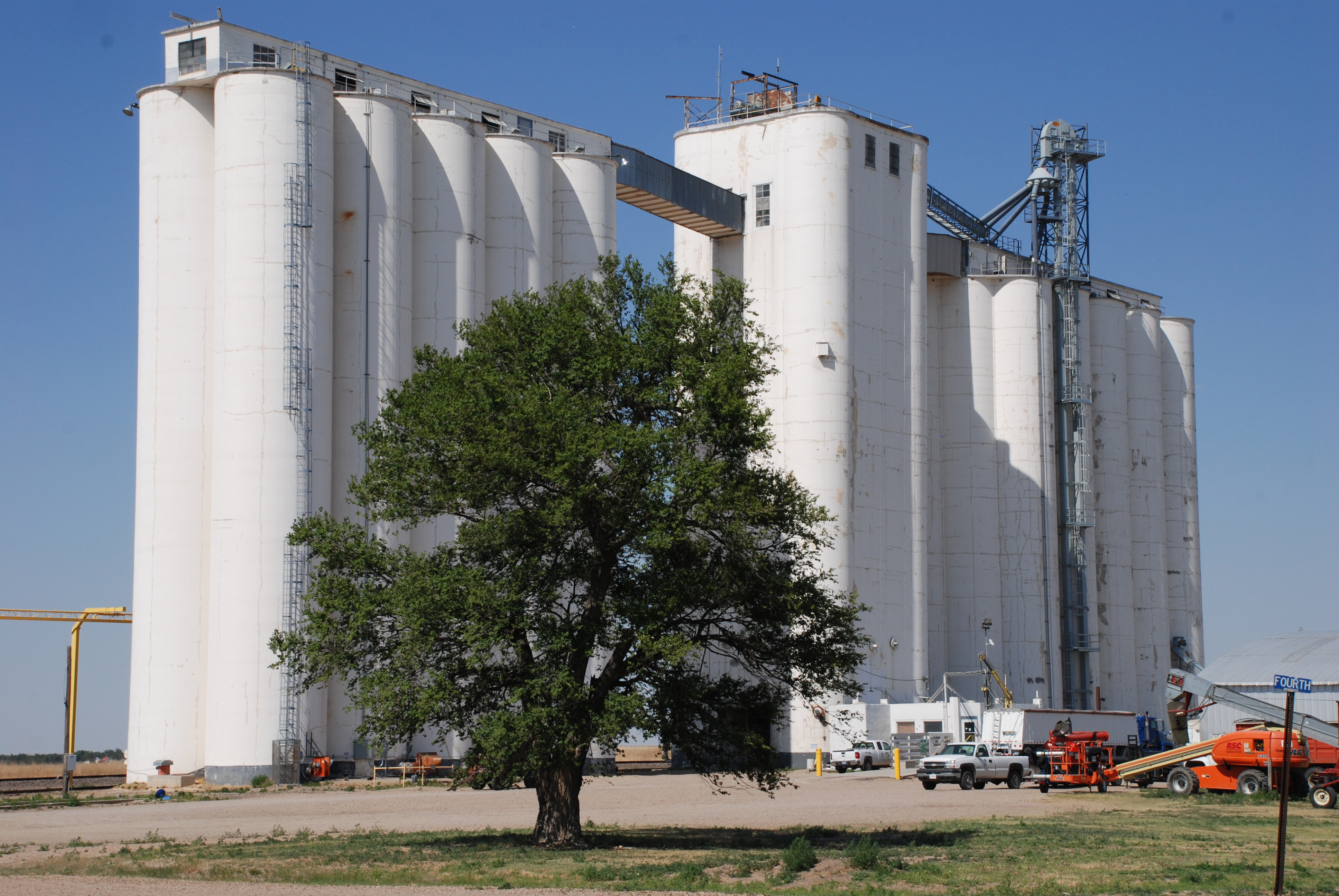
A view of the Monument, Kan., elevator, taken from off-property. Visitors weren’t permitted at the facility.

I was able to determine the builder for the stand-up elevator with its integral head house. The manhole covers are stamped with the company name of J. H. Tillotson, Denver, Colo. The annex on the left has unmarked ports, but the annex on the right has man-hole covers stamped with the company name Mayer-Osborn. I did not see any of the ports for myself, so I am relying on secondhand information. But my grandfather apparently made a return trip after building the original house.

The original elevator was built for a Mr. Bertrand, whose son is still living. The elevator once had a brass plaque installed, which has since been removed and may still be with the Bertrand family. There were also early photographs of the elevator, and it is believed that they went with the plaque.

I spoke with a gentleman named Fred Wassemiller, who said, “These elevators were the best thing going–they should have kept building them.” He also said it was too bad that the “old-timers around here are gone.”

Apparently, they could have told me a lot.

Gary Rich’s analysis reveals subtle aspects of Mitchellville, Iowa, elevator operation

Story by Gary Rich
Photos by Kristen Cart

There are several possibilities as to why Heartland Co-op’s Mitchellville, Iowa, elevator would only use rail service for shipping out its grain. The most obvious one is that this might be a shuttle operation. Whether corn or soybeans, the company that receives the grain might have a contract with the elevator specifying shipment of a certain number of carloads per week. It is probably a larger-name company, and they could be paying for the shipping charges. This would keep their operation from having to shut down for lack of grain.

The photos appear to show nine or ten covered hopper cars at the elevator’s far right. In the view at top, we see yellow markings on the rail on the elevator track. This is known as the “clearance point.” You can’t have cars sitting beyond these markings without “fouling” the main line. The following links to lexicons of railroad terminology will explain both terms:

http://www.icrr.net/terms.htm
http://cfr.vlex.com/vid/214-7-definitions-19944901

Here’s an illustration why it’s cheaper to move grain by rail. The amount of grain in one covered hopper car leaving the elevator equals three semi-trailer loads. If you load ten hopper cars, you’re probably looking at an equivalent of around thirty-three or thirty-four semi-trailers. If the plant that receives the grain is over 200 miles from Mitchellville, it would take more than a week to move all that grain over the highway.

Indeed, if the plant is 200 miles away, you also have to consider the amount of time a trucker can work. He wouldn’t be able to cover two round-trips per day. And besides, the trucker’s charge of something over $4.00 per mile might erode all profit for the grain operation.

Tillotson Construction’s Mitchellville elevator is a key part of Heartland’s grain operation

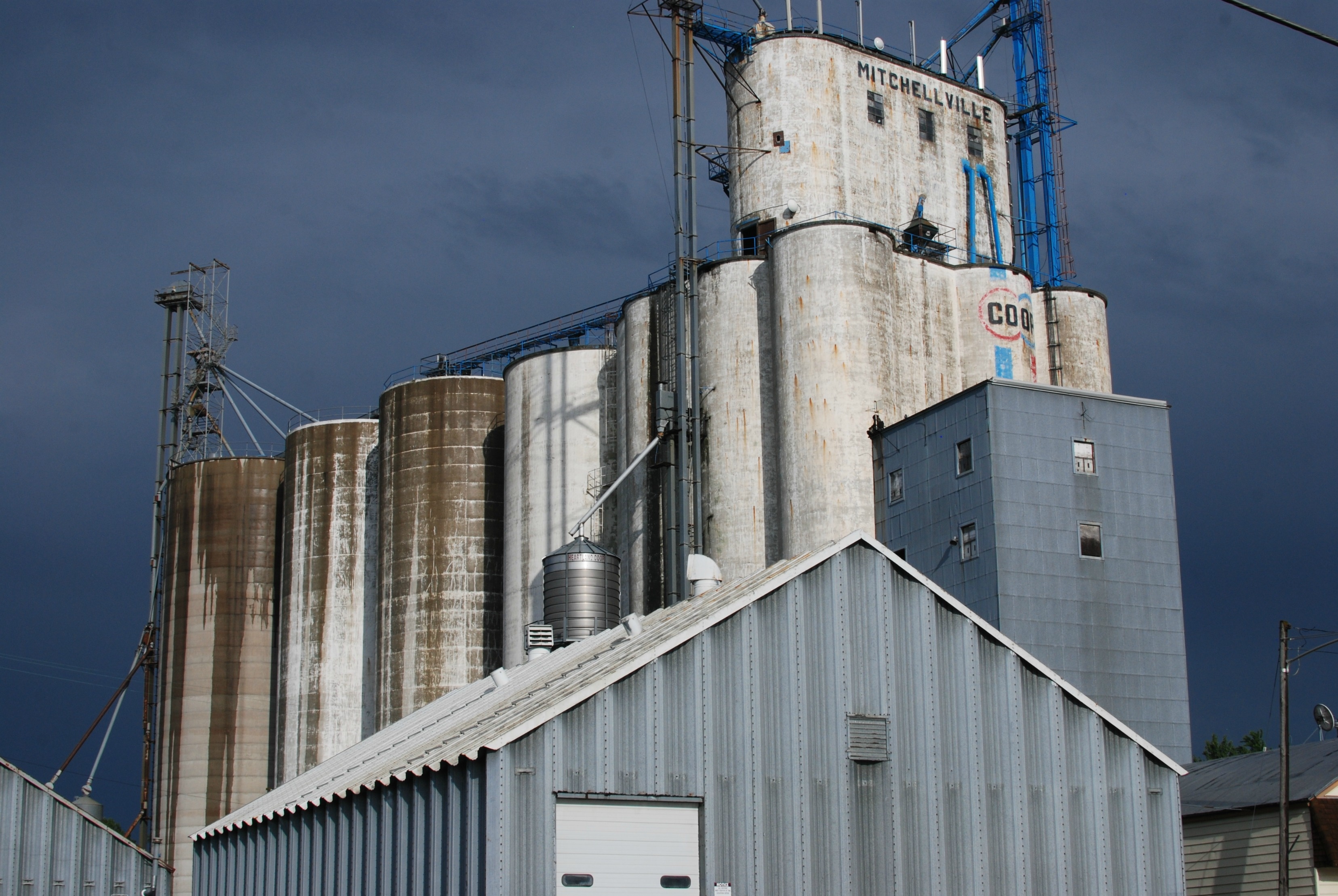
The Heartland Cooperative elevator complex at Mitchellville, Iowa.

Story and photos by Kristen Cart

The Mitchellville elevator is visible from Interstate 80, and the rounded head house drew my attention as we headed through Iowa on our way home from our recent trip out West. “Just one more stop, OK, kids?” I said, and they answered with groans. I think I promised ice cream to quell the protest.

The main elevator built by Tillotson Contruction Company of Omaha, with grain drier.

I parked the van, air conditioner running, in a shady spot and hopped out with my camera. Thunderheads threatened nearby, but the storm seemed to be moving off, and the sun peeked out and illuminated the scene. I took advantage of the beautiful light to photograph the elevator.  As I finished up, I saw a truck rounding the corner from an alley into the gravel lot beside the elevator, so I flagged the driver down to ask if he knew anything about it. We were in luck.

The driver introduced himself as Ed Baldwin, a grain truck driver for Webb Farms. He was more than happy to talk about the elevator, having trucked “at least two million bushels” in and out of Michellville. Bill and Stan Webb own the farm, and Ed purchased his truck from their father who used to truck his own grain. Ed gave me a quick outside tour of the elevator property.

The Younglove annex viewed from the driveway.

Ed explained the Heartland Cooperative operation at Mitchellville. He did not know the builder of the “head house,” as he termed the main elevator, but he knew the adjacent annex was built by Younglove in 1972.  The bins had numbers and he pointed out the function of each one. All the way to the left was a new bin with its own leg that was built in the 1980s and used for damaged corn. Immediately to the right of it, on one end of the Younglove annex, was a bin dedicated to soybeans. The rest of the annex held corn, with the main house taking all the wet corn since it gave access to the grain drier.

The Younglove annex is placarded with the date of construction.

During harvest, the employees kept a grueling schedule filling the bins, especially during a wet year. Jim Dietrich, grain manager for Heartland Co-op at Mitchellville, would pull a twenty-four hour shift to accept the grain into the main elevator and dry it. The drier had a capacity of seven thousand bushels per hour, which would limit the amount of grain that could be taken in. Ed said the main house would take seven semi loads per hour of grain that needed to be dried. Shipments from the elevator were by rail, unless capacity was reached and grain needed to be trucked.  Trucking would be the exception for Mitchellville’s operation.

McCook’s J. H. Tillotson-built elevator is still all original, down to the light fixtures

J. H. Tillotson built this attractive elevator at McCook, Neb. in 1948.

Story and photos by Kristen Cart

Kelly Clapp explains how levers and pulleys are used to distribute grain.

The straight-up elevator at McCook, Nebraska, was built for a private owner in 1948. J. H. Tillotson, Contractor, of Denver, Colorado, was tapped for the project, and it was completed just a year before the Mayer-Osborn Construction Company of Denver built the nearby Frenchman Valley Cooperative elevator. My grandfather, William Osborn, was a superintendent for Joe Tillotson at the time, just before going on to form the Mayer-Osborn Company with Gene Mayer, so both projects were his.

Kelly Clapp, a Frenchman Valley Co-op employee, opened up the elevator so I could look inside. A trapped pigeon stood  in the doorway when it opened, blinking in the unaccustomed light. It fluttered off when we went in. What I saw was state of the art for 1948.

The elevator leg, which lifts grain from the pit to the top of the bins.

The elevator stands by itself and is unique since no renovation has ever been done to it. The elevator is original, right down to the light bulbs, Kelly said. It operates as it always has. It only takes corn when the other McCook elevators are full. The elevator is cleaned right before harvest, so the manhole covers, stamped “J. H. Tillotson, Denver,” were off and the bins were open.

The elevator has basic electrical functions such as lighting, and the conveyors and the leg are motor-operated, but all of the controls for it are manual. Levers and pulleys operate in the driveway to direct grain chutes to load corn into a waiting truck, and a similar arrangement at the top of the man-lift directs grain into the proper bin while loading the elevator.

The interior of the driveway, with the leg to the right.

This elevator is a completely intact example of our agricultural past–as fascinating as a water-driven grist mill from the century before. Structures of concrete and steel, built for industrial purposes, don’t merit a historical marker or national designation, but they are just as significant as an ancient town hall or a dignified farm house. I think I prefer the plain functionality of the grain elevator.

Although the heat wave imperils harvests, irrigation might not come to the rescue

A pivoting irrigation system near distributes water over an Oklahoma field that will soon be plowed and planted.

Story and photos by Gary Rich

ABC World News reported July 5 on effects of the extreme heat that has stretched from Colorado throughout the Midwest. Correspondent Alex Perez talked with Manhattan, Ill., farmer Dave Kestel, who said that without rain in the next couple of weeks his corn crop would be history. The report observed that three-quarters of the U.S. is in drought. There is not much hope for any moisture in the upcoming weeks.

Humans must have water. Crops must have water for growth. When you do not have water, things will perish.

Some agricultural land is irrigated. But there have been complaints that the farmers are reducing the water tables. Colorado has banned irrigation along the South Platte River. Farmers in Weld County requested that Governor John Hickenlooper issue an emergency order authorizing irrigation so their crops can be saved, but he replied that he lacks authority to do so.

Eastern Colorado, western Kansas, and the Oklahoma panhandle, as well as many other areas, use pivot irrigation. The farmer taps a well for water, which is distributed over a field through a pivoting sprinkler arm. From the air, these irrigated areas appear as lush circles. The outskirts of the circles are left barren.

Corn is used for animal feed, making ethanol, and other uses. If this 2012 corn crop fails, it will affect not only agriculture, but other industries as well. If we have a corn shortage, foodstuffs and products made from corn will rise in price. The drought will affect other crops, too, such as milo, sunflower seeds, soybeans, and even popcorn.

One wonders: with so much of the United States having a drought, are we headed into another Dust Bowl era, like the 1930s? We certainly hope not!

The J. H. Tillotson-built farm elevator at Traer, Kan., is still standing, but idle

Grafel Farm elevator, built by J.H.Tillotson, Contractor, at Traer, Kan.

Story and photos by Kristen Cart

The road to Traer, Kan., was a bit obscure. The town is south of McCook, Neb., across the border, on unpaved secondary roads. It took some navigating to get close to the elevator, and then to find the right road, once the elevator peeked over the farm fields. We were rewarded with a handsome, squared-up, tall elevator on a lonely rail line in a winding creek valley surrounded by farmland. I hopped out of the van in a grassy parking area and started to take pictures. A truck was parked at the weighing house by the elevator. I knew this was a private farm, and it always had a privately owned elevator, from the time my grandfather built it. So I wanted to make my presence known.

The elevator leg and bins.

When we visited McCook’s elevator earlier in the day, worker Kelly Clapp told me the Traer elevator was still in operation. But his information was about two years out of date. Don Grafel, who greeted me when I entered the elevator office, chuckled when I asked if the elevator was working. “I wish a tornado would take it down,” he said.

Don had started working at the Traer elevator as a kid. His family now leases the farmland from a granddaughter of the Anderson family, who had the elevator built, and as part of the deal, the Grafel family had to buy the elevator. The Grafels operated it for a number of years.

The elevator was retired two seasons ago, Don said. The problem with the elevator was twofold. It had been built in a flood area with a high water table, and the measures taken during construction to account for the water had started to fail. It had leaking problems during wet years. But worse, the elevator was slow. Don said the elevator could take a semi-load at a time in the pit, which was good, but it would take an hour to load the bins. Fifteen years ago, the Grafel farm placed metal bins on high ground above the town. That handled the water risk, but Don said that even those bins were falling behind demand because of slow loading.

“J. H. Tillotson, Contractor, Denver” is stamped on the interior manhole covers.

Shirley Nichols, who also worked at the office, was keenly interested in the history of the elevator. I had a treat to offer her. Russell Anderson, who commissioned the elevator, wrote a letter of recommendation for my grandfather’s new company on May 6, 1949. The Traer elevator was an example of Grandpa’s work before he went out on his own after working for J.H. Tillotson, Contractor. I gave a copy of the letter to her along with a photo my grandfather took during the elevator construction. In return, she gave me another construction photo and some historical pictures of the town.

Finally, my hungry and thirsty children came into the office, and the visit was pretty well over. Don’s brother Greg came in after meeting my husband in the parking lot. He wondered who had dropped by. But it was time to get on the road again, before the complaints got too shrill.

The good people of the Grafel farm made us feel very welcome, and gave us a window into the Traer elevator’s past. I’m glad we were able to see it while it still stands.

Related Articles 

Gary Rich explains wheat farming in Colorado and Kansas


Heat waves rising over a field of winter wheat in Goodland, Kan. Photo by Kristen Cart.

By Gary Rich

Here is Agriculture 101. I will tell you something about wheat.

There are two types of wheat. You have hard and soft wheat. Hard is considered winter wheat, whereas the soft is considered spring wheat. Winter wheat is planted in August or September. It is harvested the next summer. Spring wheat is planted in the spring, and it is harvested in August or September.

There are different types of winter and spring wheat. Some will produce better yields under normal growing conditions.

Our Colorado wheat fields that were just harvested will not be planted again until August 2013. Farmers leave the field idle for a year. This is done to keep the moisture in the ground, and to preserve some of the minerals for growing. Here in Colorado, it is called dry farming. When they get ready to plant, they will plant the wheat into the ground, without breaking it up.

A view, two days before harvest, of the Page City, Kan., elevator, built by Johnson-Sampson Construction, of Salina.
Photo by Kristen Cart

Where I was reared, in Kansas, it was wet farming.  We had enough moisture, between the rain and snow. Farmers would use a plow, and plow under the last crop remains, then go back over the field with a harrow, leveling out the ground. Then they would come in with a planter and put the seeds into the ground.

In Colorado, we cannot do this, as we do not have the moisture.

Basically, the states that produce hard wheat are Texas, Oklahoma, Kansas, New Mexico, Colorado, western Nebraska, and South Dakota. States that produce soft wheat are North Dakota, Montana, Idaho, Washington, and Oregon.

Those are just a few basic things about wheat.

In Wahoo, Nebr., Tillotson’s elevator finds new life as a cell tower for AT&T

The Wahoo, Nebraska elevator, built by the Tillotson Construction Company of Omaha, Nebraska

Story and photos by Kristen Cart

Another stop on my recent elevator trip was Wahoo, Nebraska. Dad tipped me off that it might be one of Tillotson’s projects. Wahoo is the seat of Saunders County, where Dad lives, and he frequently has occasion to stop there.

Wahoo’s elevator, at first glance, appeared unused. It was closed up tight, and the only indication of any activity was a sign warning workers to stay at least three feet away from any antenna, and to contact AT&T before performing any maintenance or repairs near their equipment.  Ah, hah!  Then I noticed the wires running to the top of the structure. I walked around the elevator, taking pictures.

Next door to the building was a Pet Rescue center, and as a woman was leaving there with a little dog in her arms, I asked her about the elevator.  While she did not know the builder, she said the elevator was privately owned by David Rood, and that at present, the elevator was full of corn.  But she commented that he probably made more money from the AT&T installation. I had heard of cell antennas being installed in every kind of tall building–even church steeples–but it had never occurred to me to look for them atop an elevator.

The next circuit around the elevator produced the answer I was looking for. Right there, adjacent to the sidewalk, in bright blue paint, was a manhole cover.

Some neighborhood teens were hanging around the street, in their cars, and when they saw me kneeling, taking the manhole cover shot, one of the boys shouted out, “What are you doing?”

“Taking pictures of the elevator!” I said.

The young man wanted to know why. When I said it was for a blog, I guess that was enough for him. Anyway, his attention went back to something on his cell phone.

The Wahoo elevator is an attractive feature of the town, fitting naturally with the older buildings along the main street. A man at a local pub, seeing my camera, popped out and said curiosity got the better of him. I told him what I was doing there. I guess a tourist with a camera along the street is a little unusual. And Nebraskans, by nature, like to know who is about.

Maywood, Nebraska: another Mayer-Osborn landmark meets its end

Photo by Kristen Cart

By Kristen Cart

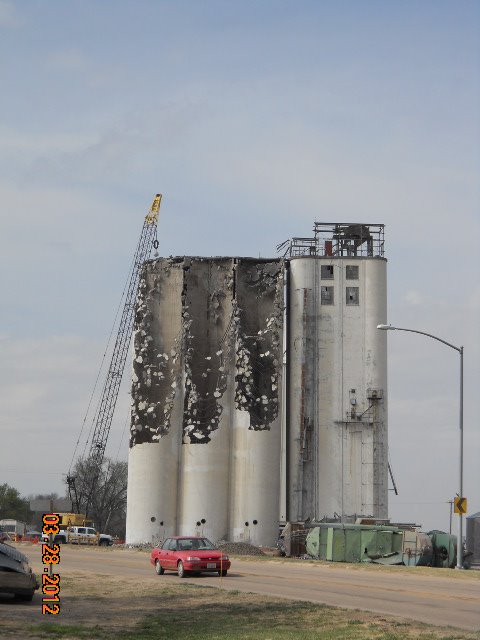
The old Maywood, Nebraska, elevator with its annex built by Mayer-Osborn Contruction Company of Denver, Colorado, was demolished in March of this year. I had planned the trip to see the elevator before its scheduled demolition in 2013. When we arrived in town, I expected to see the familiar straight-up J. H. Tillotson, Contractor-designed elevator with its annex beside it, but it was nowhere to be found. But I saw bulldozers and a football field-sized area framed with rubble piles, with corn impacted into the flat scraped ground. Not good.

Inside the Ag Valley Co-op office, business was in full swing. A truck pulled up, and a corn sample was vacuumed up and tested inside the building as I watched. Newer elevators were handling all of the grain. Turena Ehlers and Charla Werkmeister, employees of the co-op, told me how it went.

Photo by Julie Cox Hazen

The old Mayer-Osborn annex had a pretty good lean and some leaking problems, so it had been slated for destruction first, with the status of the main elevator left in question. But the main elevator was losing chunks of concrete and was deemed a hazard, so it came down soon after the annex. Forest River Colonies, of Fordville, North Dakota, a Hutterite-owned company, tore down the elevator and its annex, with the scrap going to Columbus Metals in Kearney, Nebraska. My hopes were dashed for recovering an intact manhole cover with my grandfather’s Mayer-Osborn company name on it.

Photo by Julie Cox Hazen

The demolition was quite an event for the town. Carol Wood put together a photo montage and hung it at the Maywood town offices. Bill Schnase picked up pieces of the rubble for his daughter to paint, to preserve the image of the elevator on concrete. Everyone had photos of the demolition. Julie Cox Hazen, Bill Schnase’s niece, shared hers with me.

Luckily, Gary Rich visited the elevator last year, taking photos of it in its last year of useful service. It’s type had been surpassed for a long time by newer, faster grain storage facilities of all kinds.

Most of Grandpa’s smaller projects are reaching the end of their service lives. So we are capturing their last moments, mostly, but not always, in the nick of time.

Jerry McBride worked at Wauneta’s elevator in the ’60s before repairing cars

Jerry McBride at Bob’s Repair Service in Wauneta, Nebraska

Story and photos by Kristen Cart

On the way out of town after visiting the Wauneta, Nebr., elevator complex, we noticed a rather striking old building, which was an auto repair garage, currently owned by Robert Jones, and called Bob’s Auto Repair and Service, at 512 S. Tecumseh.

I stopped to take pictures. A man came out, introducing himself as Jerry McBride, and asked if I liked old buildings. I said I did, and that I had a particular interest in old elevators, having visited Wauneta’s that day. He invited me in to see the shop. It had been built in the 1920s, Jerry said, and mostly knocked down by a tornado sometime before the 1950s, when it was rebuilt and an extension added.

All of this happened before Jerry was employed there.

Wauneta’s original elevator

He said that he had been hired by Ivo Valentine Pennington in about 1962. Before that he was employed as a “broom man” at the Wauneta elevator for six months or so, making fifty cents an hour. Cleanliness was of utmost importance at the elevator. Wauneta gained the reputation for having the cleanest elevator in the state, Jerry said. Unclean elevators would catch fire, or worse, blow up. He kept the elevator clean, as dust free as possible, but it was nevertheless hard and dirty work and did not pay well, so he quit and looked into the possibility of going to school. Then I.V. Pennington offered him a job and all the training he would need to become a mechanic.


The shop today is an old-fashioned one that doesn’t take new cars. Parts could be machined there, and many of the tools had been manufactured by hand, to accommodate old cars.

Even the cash register was old–as Jerry pointed out, he did not have to close for a power outage, because the register still worked.

It struck me that Jerry McBride had first worked in this shop when the Wauneta elevator was less than ten or fifteen years old and the first annex was new. The repair shop was already old by then. Except for some modern tooling, the shop does not appear to be very different than in the 1960s.