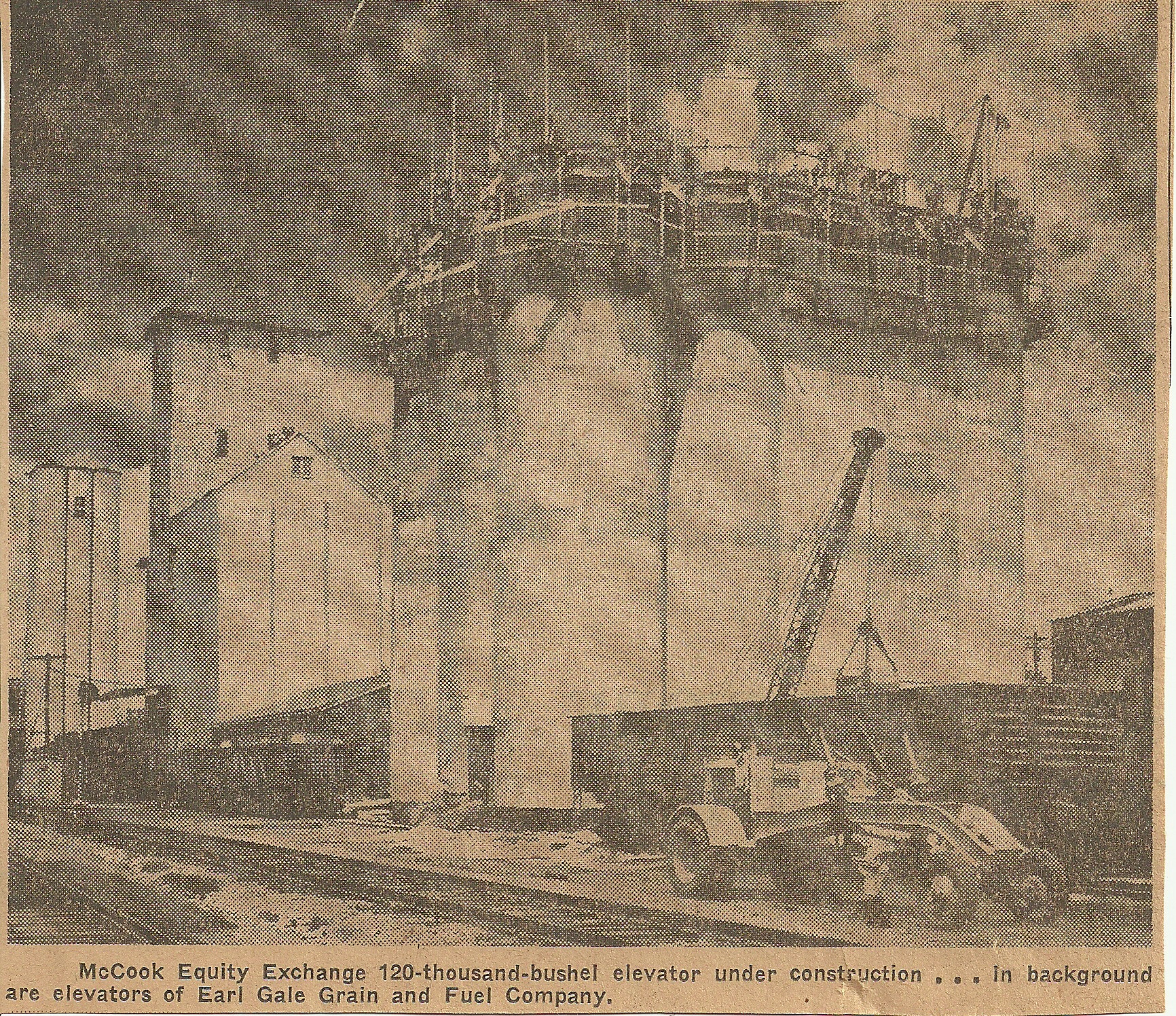
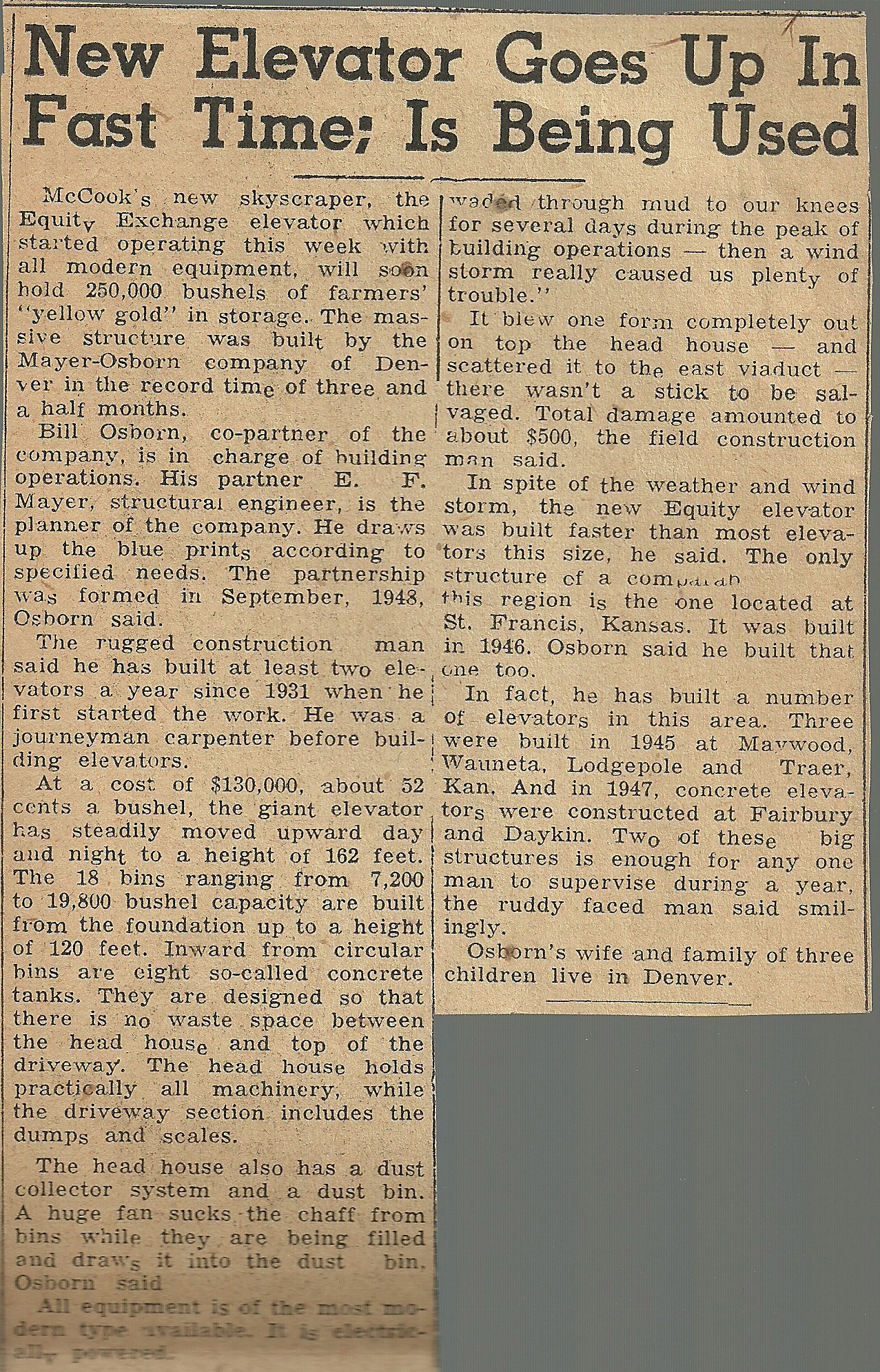
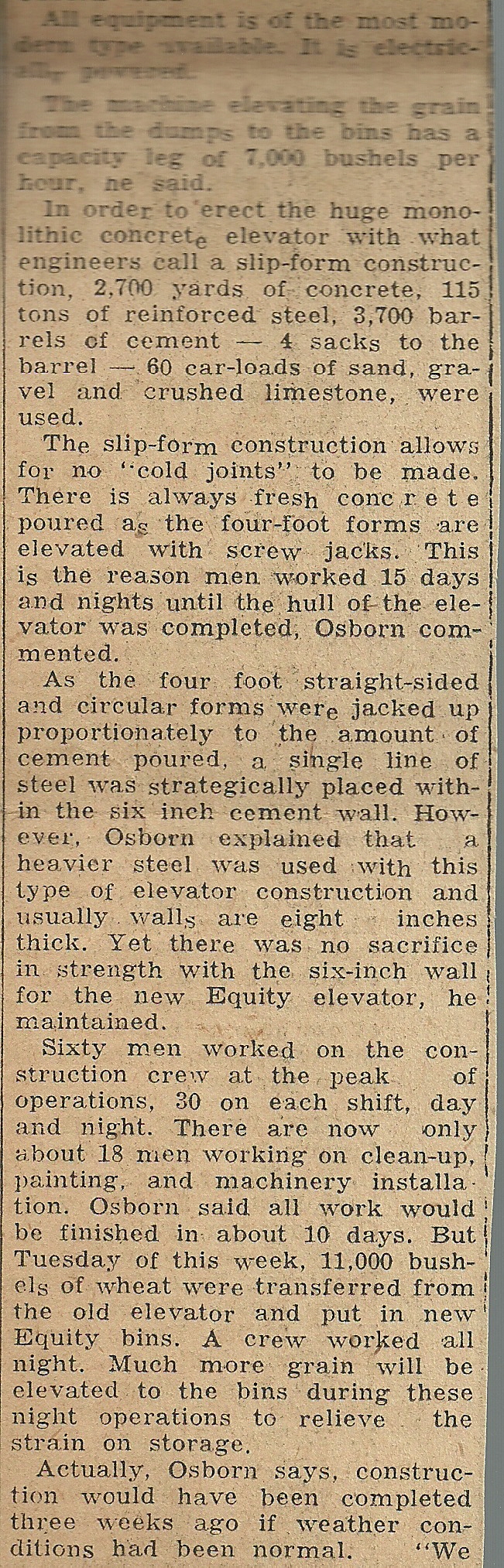
J.H. Tillotson’s Fairbury elevator, slowed by rain during construction, will miss 1947 harvest


These clippings were among William Osborn’s papers. They come from the Fairbury (Nebr.) Daily News, a long-defunct paper, and appear to have run in the summer of 1947. The article “Rain Hampers Work At New Elevator Site” gives a good summary of the construction methods used on the Farmers Union elevator. The name J.T. Tillotson Contractors, as it appears in the article, should be J.H. Tillotson, according to other records.


Men wanted in Paullina, Iowa, by Tillotson Construction in 1949

Back Alley, Paullina, Iowa, by Jim Hamann

MEN WANTED for construction work on Concrete Grain Elevator, 90¢ per hour, 10 hours a day, 6 and 7 days a week. Time and ½ over 40 hours.

Tillotson Const Co. at Paullina, Ia.

The Alton, Iowa Democrat, Thursday, May 5, 1949

Editor’s note: In 2008, an explosion and fire injured a customer at the new elevator in Alton.

This map shows the incorporated and unincorpor...

Image via Wikipedia

Tillotson Construction wins Rock Valley contract, loses $870 judgment for employee’s injuries

Photo by Rock Valley city administrator Tom Van Maanen

East Elevator To Be Sold At Public Auction Saturday

Directors of the Farmers Elevator company decided last week to sell the red (east) elevator structure to make way for the new concrete storage elevator. Included also will be a feed shed and the driveway office structure.

Various and sundry pieces of equipment are being offered for sale, either before or during the public auction, scheduled to be held this Saturday, starting at 2:00 p.m.

The elevator building to be sold has a 15,000 bushel capacity and Manager Owen Manning has pointed out that the driveway and office would make a good machine shed. The feed shed measures 30 by 48 feet. See the advertisement on another page for the list of machinery and equipment up for sale.

Manager Manning said that the contract for the new concrete storage building had been awarded to the Tillotson Construction company of Omaha and that work on the structure will begin on or about June 1. The building is due to be completed about September 15 and work may be far enough advanced to permit acceptance of grain for storage about September 1.

Rock Valley Bee, Thursday, April 27, 1950 

♦ ♦ ♦

Sioux County Courthouse News 

In the case of Winfield Kenneth Bagley vs Tillotson Construction Company & American Mu. Liability, the court approved the compromise settlement between the parties in which the defendants are to pays $870.00 to plaintiff for injuries he received to his foot, while employed at Rock Valley, Iowa by the Tillotson Construction Co.

Sioux Center News, Thursday, August 16, 1951 


Tillotson Construction’s Ralston, Iowa, project ‘progressing nicely’ in 1939

Ralston, Iowa–The work on the new annex at the Farmers Elevator is progressing nicely. The Tillotson Construction Company of Omaha will soon have it ready to store grain.

Carroll (Iowa) Daily Herald, Wednesday, September 13, 1939

Note: The New York Times visited Ralston in 2006 for a story about inadequate storage capacity in the face of madly expanding corn production.

Tillotson Construction builds new elevator in Glidden, Iowa

Glidden—The Tillotson construction company, Omaha, started work Saturday on a new reinforced concrete elevator for the Farmers Co-Operative elevator at Glidden.

Carroll (Iowa) Daily Times Herald, Monday, April 11, 1949

Glidden—As part of an expansion program at the Glidden Farmers Co-operative company, work begun April 13 on a reinforced concrete elevator with a 100,000 bushel capacity is progressing rapidly toward completion.

About 20 feet higher than the present buildings, the new elevator will be situated east of them. With the additional storage space the company, for several years the largest co-operative elevator owned and operated in Iowa, will be able to take care of a large amount of corn and beans grown extensively in the Glidden area.

The 100-ft.-high main storage part of the new elevator is up, and bin bottoms are being covered with concrete and hopper fill.

Approximately 35 men are working 10 hours a day on construction of the new elevator, which is under the direction of the Tillotson Construction company of Omaha.

It is expected to be completed by July or August.

Carroll (Iowa) Daily Times Herald, Wednesday, June 22, 1949 


How does a grain elevator work?

By Gary Rich

First of all, let me explain how an elevator actually works. The grain is dumped from a truck through the grates. The area below the grate is called the pit. The leg runs from the pit to the head house. On the leg is a thick rubber belt with buckets or cups. When the leg is started, the belt will move through the pit. The cups will fill up the grain and take it to the head house. As the leg reaches the top, it will arch, the cups will be up side down. When the cups turn to go back down towards the pit, they empty the grain on a conveyor belt. The cups will be facing downward, until the cups reach the pit and the will right themselves, filling up with more grain.

The run is the conveyor belt between the elevator and a storage annex. The run will have walls on the side of conveyor. They could be completely covered, too. Workers will set up the run, to a certain bin. There are openings at each bin. There is generally a door that they can open, so the grain will fall into the bin. They will put another piece of metal on the run, which acts like a chute. Thus, when the grain gets to the proper bin, and the grain hits the chute, the grain will move toward the opening of the run, and the grain will empty into the bin.

Sometimes, there will be a short conveyor belt that can be put under the main conveyor belt from the elevator. It is the same method. The grain will hit the chute, then through the opening, onto the second conveyor belt, which has a rise to it, and it will dump the grain into the bin.

Kristen mentioned that the bins are sloped. Most bins are built this way. You can think of it as self cleaning, as all the grain will come out the bottom of the bin. Now, if they built the bin flat, most of the grain can be removed. However there will still be about three feet of grain that is away from the bottom opening. Then some one has to climb through the manhole into the bin and they must shove the grain through the opening at the bottom. This is the only way that you can empty a flat bin.

The storage annex always has a basement. There is a conveyor belt that runs from a bin, back to the elevator, then up into a hopper. Most elevators have two separate hoppers. One will load a rail car and the other one can load a truck. If you did not have this conveyor belt, you could not unload a bin.

The area where the run is located is enclosed. If you look at a photo of a grain elevator with a storage annex, you will see an enclosed area above the storage annex. Outside this area, the bins are covered with concrete. Inside the run, either part of each bin will be open, or they could have metal slabs that cover the bins.

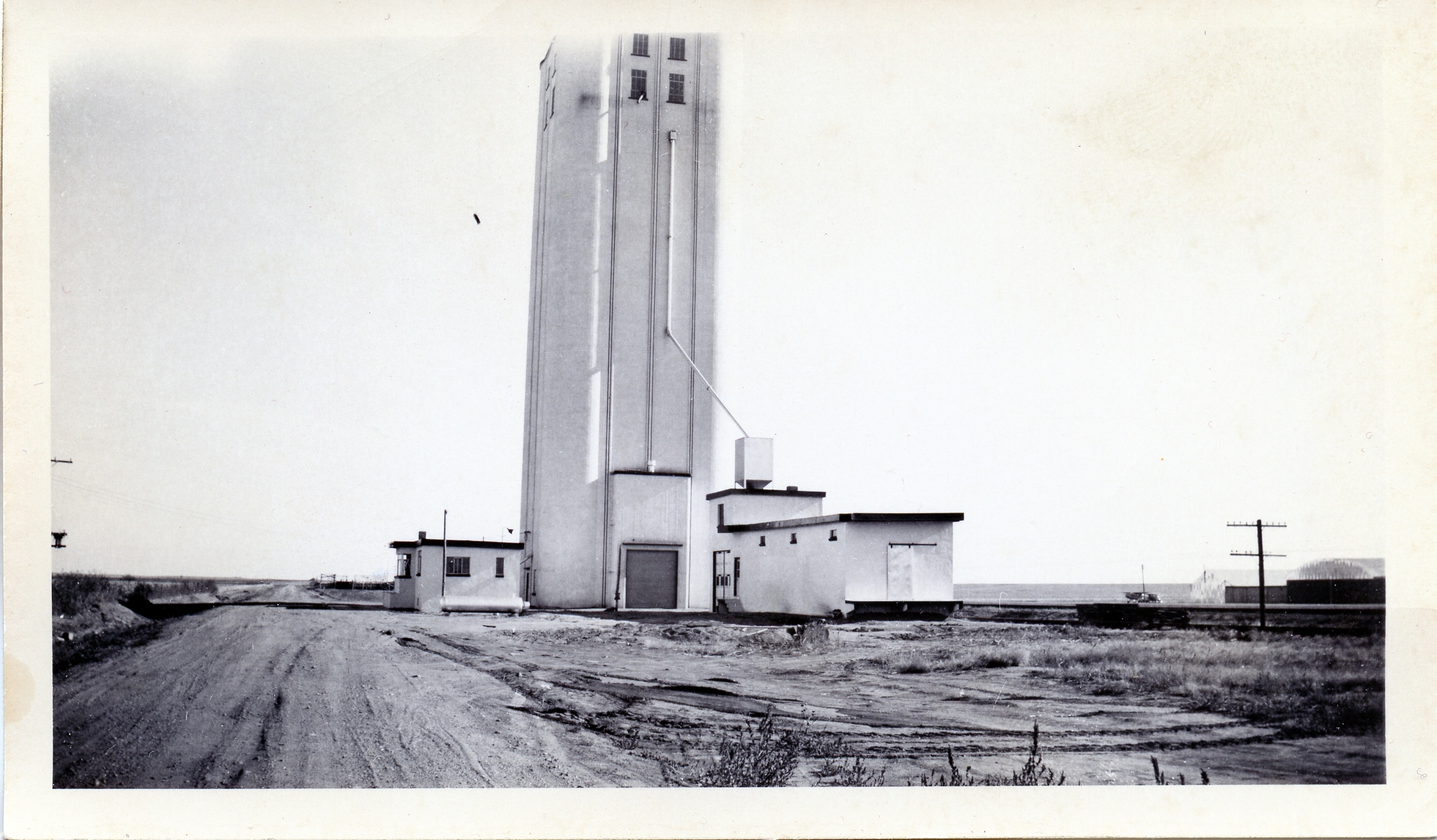
William Osborn’s photo of the Kanorado, Kansas, elevator

By Kristen Osborn Cart

This is an image that was in my grandfather’s papers when he died. It was his photo, since he was the only photographer in the family. This was the only elevator image he identified on the back. The caption was “Kanorado, KA, 125,000 bu.” I know Grandpa worked on it because he photographed it. We know it was built before March of 1947, which was the month Joe Tillotson died.

Grandpa was working for Tillotson Construction of Omaha as late as the fall of 1944 through the spring of 1945, when Giddings, Texas, was built. Dad visited Grandpa on the Giddings job, so he was able to date it–they visited in early 1945, the spring, when Dad turned eleven years old. That means the Kanorado elevator was built circa 1945 to 1947.

It may be hard to find information on Joe Tillotson’s business because he was independent for such a short time–even though there were quite a few elevators to his name.

¶ Ronald’s note: While posting this, I gave Kan-o-RAY-do a call and was told that original records pertaining to the elevator’s construction burned in an office fire.


130-foot fall claims Larry Ryan’s life in Pochahontas, Iowa

Worker Is Killed in Fall From Elevator

Pochahontas, Iowa –(AP)–A 130-foot fall from the top of the Farmers Co-operative Elevator, under construction here, claimed the life Wednesday of Larry Ryan, 20, of Cassville, Mo.

Ryan, an employe of Tillotson Construction Co., Omaha, was operating a hoist used to raise supplies to the top of the elevator. Cause of the accident was not immediately learned.

Muscatine (Iowa) Journal

Thursday, July 29, 1954