At Tillotson’s Albert City, Iowa, job, a deckhand’s pendulous moments

This photo, provided by Kristen Cart from Osborn family archives, shows a deckhand standing nonchalantly on elevator formwork. Kristen believes the picture may have been taken in Giddings, Texas, in 1945.

This photo, provided by Kristen Cart from Osborn family archives, shows a deckhand standing nonchalantly on elevator formwork. Kristen believes the picture may have been taken in Giddings, Texas, when Tillotson Construction Co. built there in 1945.

Story by Charles J. Tillotson

Reinforced-concrete grain elevators used the slip-form method of construction, whereby a wooden form system was built on the ground, having the footprint required to configure the grain-storage tanks.

Once the forms were in place and the vertical lifting and jacking system assembled, laborers began installing rebar and pouring cement into these forms.

When the forms were filled to the top–about four feet–the lifting and slipping commenced by turning screw jacks placed strategically throughout the formwork. After this procedure of vertical form lifting and rebar setting and cement pouring began, it never stopped until the structure reached its intended height, usually between 100 and 120 feet.

thThis process was the intended norm but was oftentimes interrupted by a myriad of problems, which caused the form-slipping to come to a halt. One of these instances occurred one night when I was eighteen or nineteen, working as a deckhand in Albert City, Iowa, for the family’s construction company.

The structure had reached about eighty feet in height when the electrical power supplying the lighting system and other machinery was cut off by a huge summer storm distributing lots of rain and wind throughout the area.

All personnel, including myself, were stranded on the stationary deck with little else to do but wait out the storm and the return of power.

A few hours of waiting produced a carload of my friends that had arrived on the surface. They were yelling for me to come down and join them. The only possible way to get off the tower was the vertical “ship’s ladder” that was installed in sections on the side of the rising structure.

Access to this emergency ladder was gained by going over the side of the formwork to the finishing scaffold below. Here, a rope was suspended down to the uppermost section of the ship’s ladder. The length of the rope was normally long enough so that a person could slide down it and gain hold of the ladder’s top rung.

I say normally the rope was long enough, based on the fact that the ladder sections were routinely placed sufficient to keep pace with the ever-vertical movement of the concrete structure.

However, as I soon discovered on this particular stormy night, the norm didn’t prevail. I hopped over the side of the formwork and reached for the rope hanging from the finishing scaffold’s frames. It was pitch black, and the wind was blowing to go along with heavy rain, but I was able to find the rope and swing off the side.

The first thing I discovered was that the wind was so strong, it blew me sideways and shoved me around the bin tank.

When the gusting stopped, I was able to line up vertically above the supposed location of the ship’s ladder.

So, undeterred, I slid down the rope—but not very far before another gust of wind blew. I had to stop sliding down and let it subside.

This process went on for a number of iterations, and as I slowly went down the rope, I began to wonder where the top of the ladder was exactly.

I was running out of rope.

With about three feet left, I really started sweating–I still couldn’t see the top of the ladder.

Because I had become somewhat exhausted while sliding down, swinging back and forth like a teabag, I knew I couldn’t crawl back up to the scaffold.

Now I reached the very end of the rope, and a big blast of wind blew me away and around the tank. When that gust stopped, I flew back around and by sheer luck found purchase with my foot on the top rung of the ladder. Another blast hit me, but with my foot hooked under the top rung, I stabilized myself.

With my strength ebbing, if I was going to survive, I had to make an attempt to release the rope, drop down along the ladder, and catch a rung. (Any rung would do.) So, with trepid emotions, I let go of the rope and dropped.

The testimony of my luck (and strength and skill of course) is that I am able today to relate this harrowing story.

As I released the rope I yelled up to the top of the tower to alert other personnel that they shouldn’t attempt to do what I had done. I’m sure I saved someone else’s life besides my own that night.

But the message of this story is that constructing grain elevators in the early days was filled with these types of unsafe conditions where protection of life was not as important and took a back seat to getting the job done.

There was grain being harvested in the fields, and it needed a place to be stored. The nation was on the upswing, growing by leaps and bounds, and in need of being fed.

My woulda, coulda, shoulda grain elevator opportunity in Tonkawa, Oklahoma

IMG_9327

Story and photo by Ronald Ahrens

I am the type of person who goes around the country saying funny (as in odd) things to people.

It was June of 2011, six months before Kristen Cart and I found each other and first contemplated launching a blog about our grandfathers’ grain elevators. I was riding my motorcycle from Michigan to California. Instead of following I-44, I cut across the northern Oklahoma prairie on US-60. On this route the small city of Bartlesville features a Frank Lloyd Wright tower, which I visited.

My next stop was for dinner in Tonkawa, a small town of about 3250 people. It’s a mile off the highway just east of I-35.

Adapted from Wikipedia's OK county maps by Set...

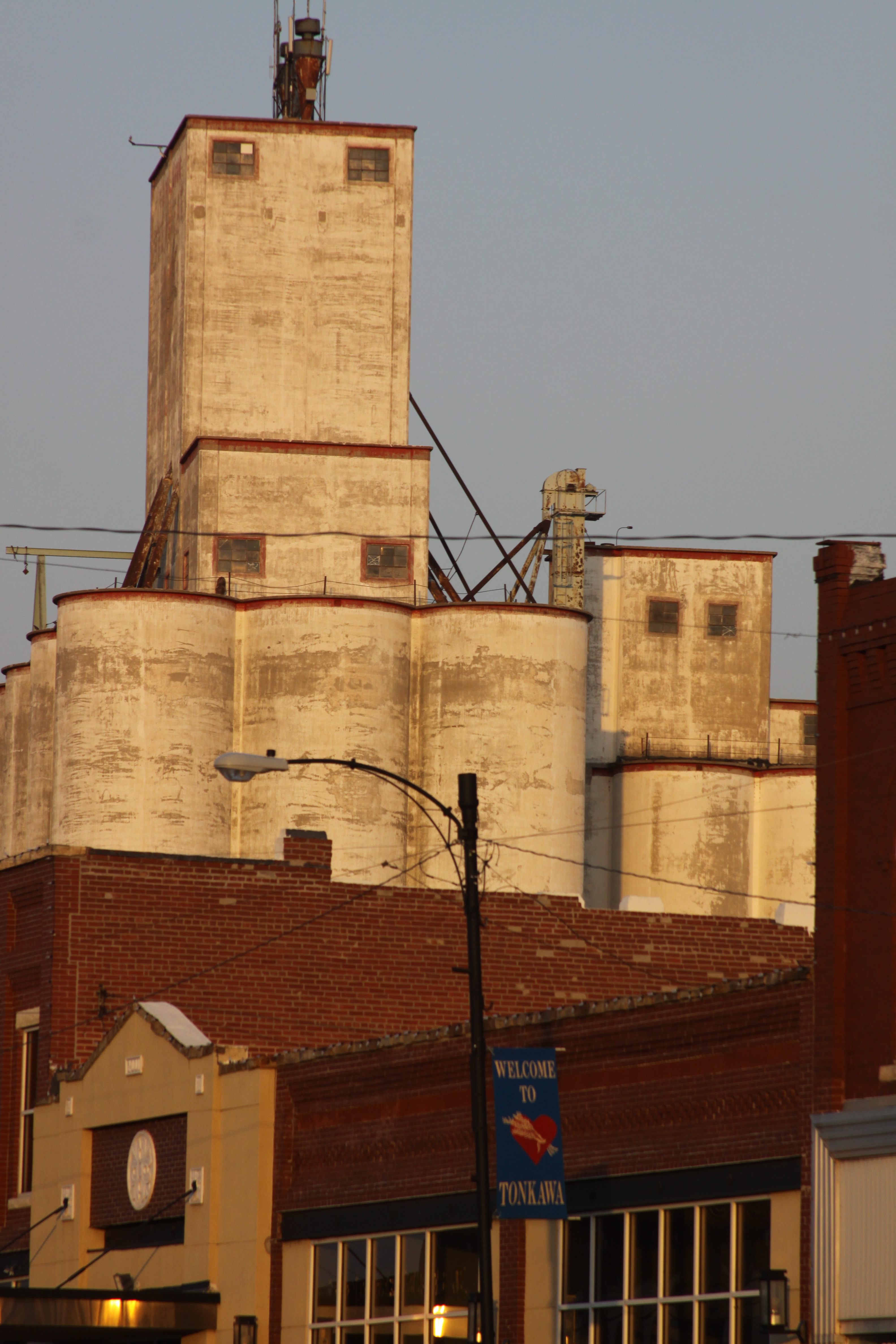
Parking my bike outside a Mexican restaurant, I noticed the huge elevator towering over the downtown buildings.

Once I got seated in the restaurant and ordered from the menu, I told the waitress I was going out for a minute to take a picture.

“My grandfather used to build elevators like that,” I said.

She looked at me as if to say, “What elevator?”

It might be possible to live in Tonkawa and never notice the commanding headhouse and dozen or more bins. I walk around inside my house without seeing the art that hangs on the walls or the cobwebs that hang in the corners.

At the time, I had no thought of snooping around after dinner, while there was still some daylight, and searching for embossed manhole covers or some other means of identifying the builder. I didn’t yet know about embossed manhole covers.

Not that this appears to be one of Tillotson Construction’s jobs. My cursory search for information has turned up nothing, and the number I found for the co-op responded with a fax tone.

Maybe our readers can pitch in on this one.

But odd remarks will not be tolerated!

The J. H. Tillotson elevator at Linn, Kansas, stands unused, idled by regulatory changes

The elevator built by J. H. Tillotson is flanked by later additions.

This handsome elevator built by J. H. Tillotson is flanked by later additions.

Story and photos by Kristen Cart

While the concrete elevator at Fairbury, Neb., was being built, rising by nine feet every twenty-hour workday, the elevators no more than thirty miles away at Hanover and Linn, Kan., were also nearing completion, according to a newspaper clipping found in my grandfather’s papers. J.H. Tillotson, Contractor, based in Denver, had all three projects going for the 1947 harvest.

Though we knew my grandfather, William Osborn, worked as superintendent at Fairbury, my dad didn’t remember his father working on the two Kansas elevators, so in October  2012, I took a swing through Kansas to investigate them.

The Chalmers and Borton elevator at Linn is still in use.

The Chalmers & Borton elevator at Linn is still in use.

The first elevator that came into view in Linn was a 1950s-vintage Chalmers & Borton structure of about 250,000-bushel capacity, judging from its appearance. Across the town square, a couple blocks away along an extinct railroad bed, was another elevator that did not fit my notion of any J. H. Tillotson design, since it sported a rectangular head house. I peered at it from all angles, straining to see any lettering on the manhole cover about halfway up, without much success. I thought perhaps the old J. H. Tillotson elevator hadn’t survived and that I was too late, as had happened at Maywood, Neb.

Finally, I drove over to the co-op office to learn more. Jeff Wiese, the location manager for the York-based United Farmers Cooperative, kindly agreed to answer questions about the old elevator. Jeff said he had worked for the local elevator cooperative since 1994, first in petroleum, then as an implement dealer, and finally as manager in 2000. In 2005, UFC took over from the Farmers Cooperative Equity Association, which, in turn, was formed when the Linn Cooperative Exchange joined with Greenleaf.

Jeff said that when the old elevator was first built, farmers thought they would never fill it, but new capacity was needed almost immediately. To my surprise, he said the manhole covers on the interior of the elevator were embossed with “J. H. Tillotson, Denver, Colo.,” though I was not able to go inside and see them. The old elevator was still there, graceful and sturdy, but locked up and no longer used.

The unusual square head house incorporates stylish details.

The unusual square headhouse incorporates stylish details.

The Tillotson elevator fell victim to economic realities after the Occupational Safety and Health Administration (OSHA) ordered safety upgrades under new federal rules. The agency had taken a keen interest in elevator operations since the 1998 DeBruce elevator explosion in Wichita, Kan., and many safety regulations stemmed from the analysis of that accident. Dust management and cleanliness became paramount. The Linn elevator’s older, lower-capacity design meant it could no longer earn its keep after the cost of improvements, so it retired after the 2011 growing season, now finally empty of its last harvest of wheat.

This type of elevator also commonly required a safety upgrade for its man lift. Everywhere the old elevators are still operating, new OSHA-mandated safety cages enclose the man lifts, ostensibly to prevent certain types of injuries or death.

It is fair to say that the old Linn elevator is endangered, and will be torn down as soon as it is convenient.

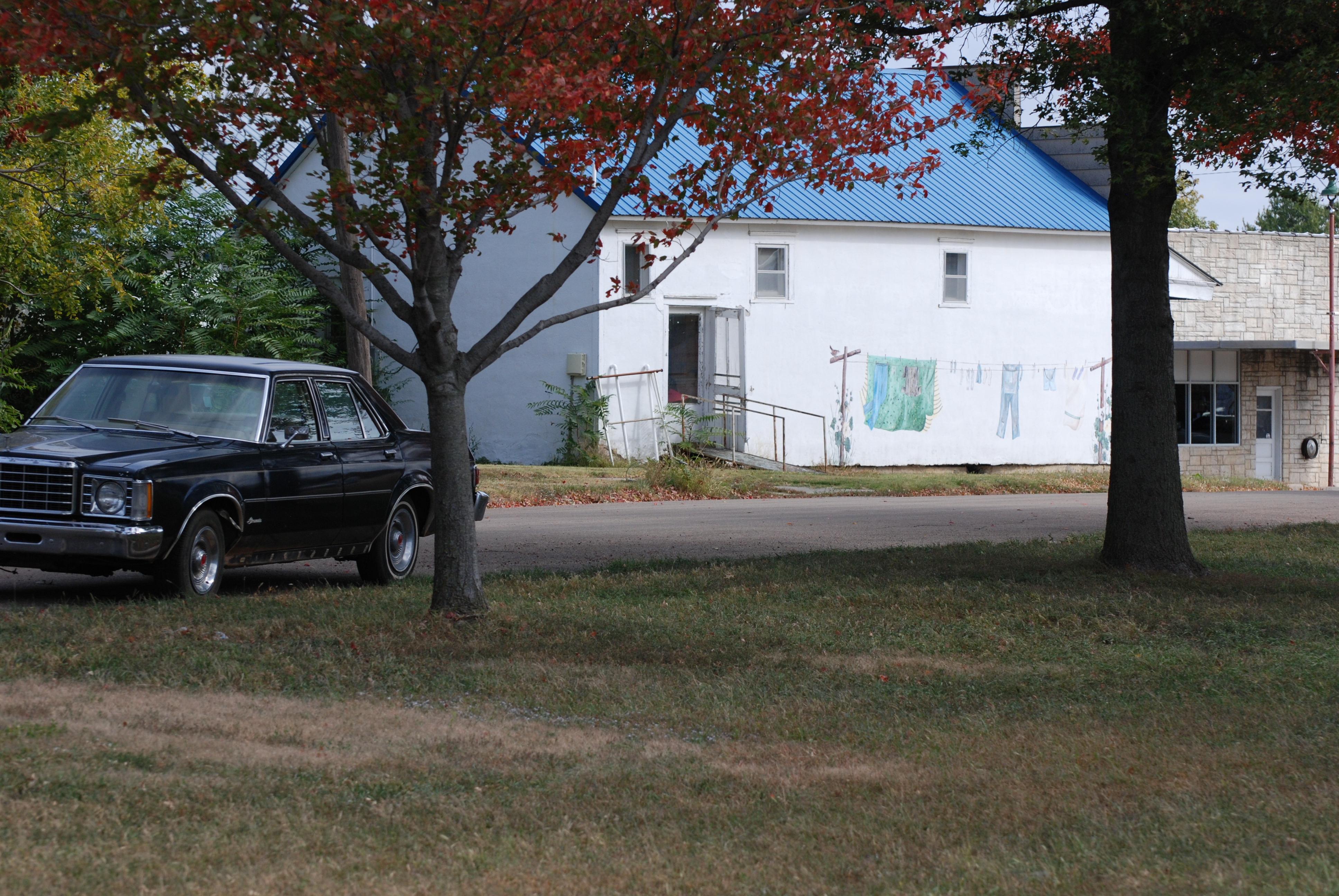
A nearby house with painted mural.

It seems a shame that another Kansas landmark, nestled and quite at home amid tidy houses and bustling businesses, should soon disappear. Beside it is a home painted with a mural depicting gaily flapping laundry on a clothesline, and across the street stands a grocery. A neatly mowed park occupies the old railroad right-of-way.

The elevator has been there as long as most people can remember. Luckily, I was able to pay my respects, and tip my hat to my grandfather’s stately work of long ago, before it passes into memory.

DSC_0884

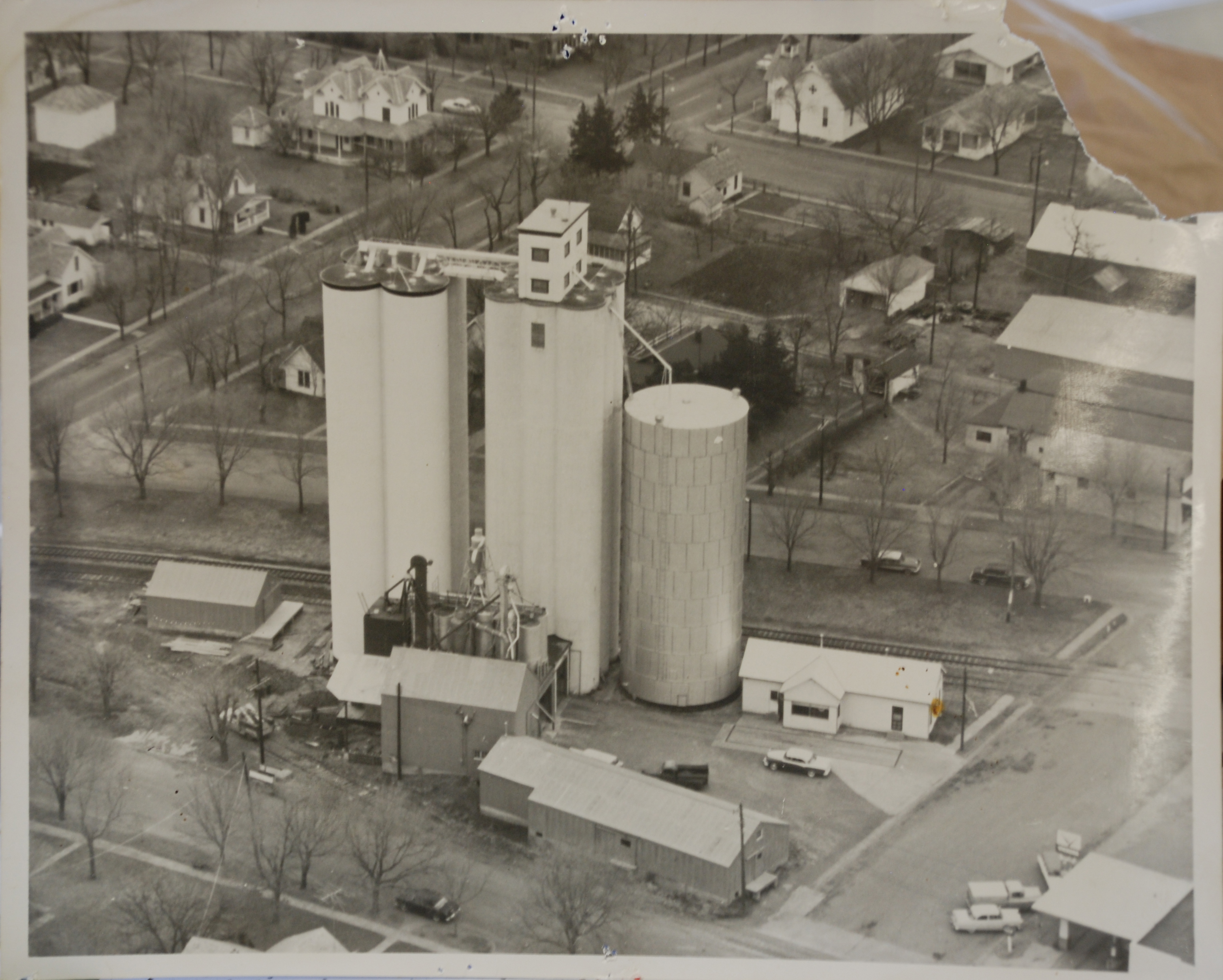
An old aerial view of the Linn, Kan., elevator after the annexes were added. Note the old vehicles in the photo.

Our grandfathers’ construction companies managed to escape the dreaded ‘blowout’

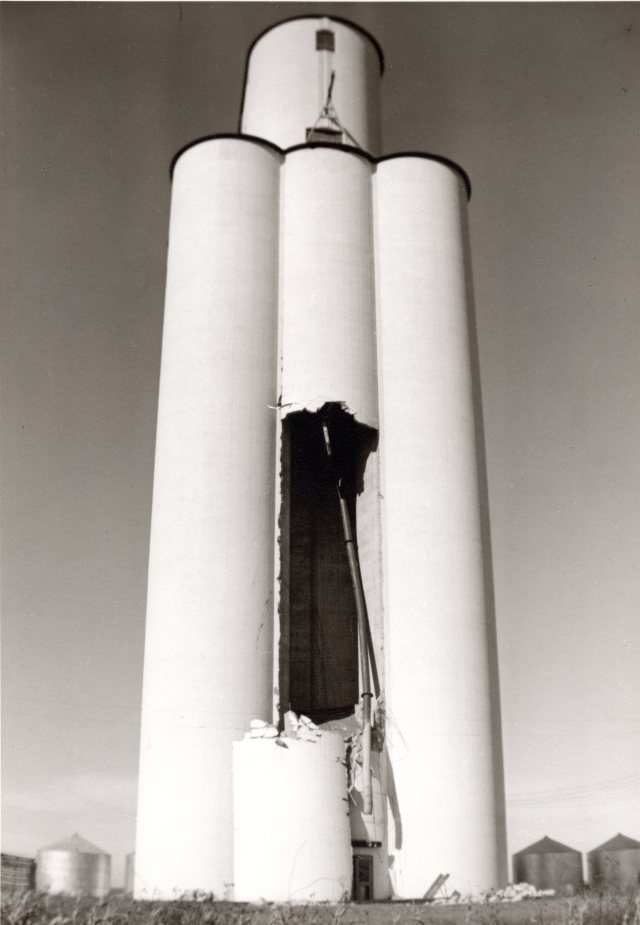
Written on the back of this photo: "This is the Bird City elevator that busted. This is the one Parrish built."

Written on the back of this photo from the Linda Laird Collection: “This is the Bird City elevator that busted. This is the one Parrish built.”

Story by Gary Rich

Vickroy-Mong built the Bird City, Kan., elevator in 1950. It was ready for that year’s wheat harvest. But sometime afterward, the elevator had a blowout.

A nightmare for any elevator builder, a blowout can happen if too little rebar is used when pouring the concrete. There is a lot of pressure on the bins once you put grain in them. And the weakest point is on the outside.

As you see in the photo, part of the outside section fell to the ground. The grain would have spilled out, too. Note that some grain remains inside the bin.

Chalmers & Borton received the contract for the repair work here. It is unknown if they fixed only the damaged bin or found others were flawed.

The Chalmers & Borton superintendent was W. Grammer. The job number was 50-K-62. Work began later in 1950, probably by fall.

The Bird City elevator wouldn’t have been good advertising for Vickroy-Mong. It’s not known if they built any other elevators.

A house of slip-formed concrete was Reginald Tillotson’s pet project in 1950

Tillotson Home

By Ronald Ahrens

An early post on this blog included John Hassman’s recollection of design and construction of the house Reginald Tillotson built on a hilltop north of Omaha’s Florence neighborhood:

“While in the office I [was] trained by the office engineer to design buildings and was the major designer with R.O. to build his new home in Florence, Neb. Many mornings he would arrive with new ideas of what he wanted changed in the house, and we would start all over. Starting in Nov. 1950 we began construction on the new house. The foremen were kept busy in the winter doing that work. All using a concrete house with the ideas we used in Elevator Const. That was the coldest, windiest place to work in December. I left to go the the Air Force because I was about to be drafted in the middle of the Korean War.” 

The house, of course, still stands, and is the home of Michael Tillotson, youngest son of Reginald and Margaret.

It did not incorporate Tillotson Construction’s signature rounded headhouse!

As a grandchild who spent a lot of time there, I always though it was remarkable because of the use of glass blocks as a design feature. The entire second floor was reserved as a music and game area. And despite the single garage door, there was a second “lane” to the right when you drove in.

But Uncle Mike always had it blocked with his relics.

Good corn is good news at Altoona, Iowa

DSC_0378(1)

“Nice corn” goes straight into storage without a stop in the dryer.

Story and photos by Kristen Cart

One of the elevators on my list to see was the facility built in Altoona, Iowa by Tillotson Construction Company. It was reported to be the near-twin of the elevator in Mitchellville, Iowa. It is located about a half-mile south of I-80 in Altoona, just east of Des Moines, off an exit prominently marked by a Bass Pro Shops Outdoor World. Its business partner, the Bondurant elevator, stands about a mile away, on the north side of the Interstate. Farmers Cooperative operates both elevators.

Farmers Co-op, instantly recognizable by its trademark “FC”, is the largest Co-op in Iowa with more than sixty locations. It employs four full-time truckers in the local area serving Altoona in addition to the farm trucks that serve the location.

DSC_0372

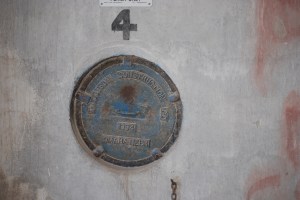
The manhole cover on bin number 4 indicates the builder and year of construction.

The Altoona elevator was built in 1954. The manhole covers, furnished by the Hutchinson Foundry, of Hutchinson, Kan., indicate the builder and the year of construction. Most of the covers are inside the elevator, but there is one also on the outside near the ground, which is typical of Tillotson elevators. A large grain dryer flanks the elevator on the east side.

DSC_0399

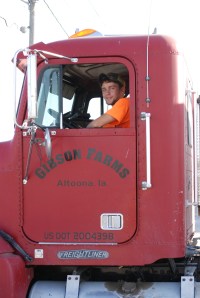
Jacob Holloway, driver for Gibson Farms, paused for a photo after delivering grain.

When I stopped to visit in October, Pat Printy, a thirty-year employee of the Farmers Co-op, shared some of the history of the elevator. He also explained the elevator’s operations during harvest and the significance of good corn.

Sam Wise, former mayor of Altoona, owned the elevator before the cooperative purchased it in 1963 for $175,000. Farmers Co-op began operating the elevator in 1964. About ten years ago, the elevator headhouse had to be rebuilt because of cracking concrete, but it still retains its Tillotson-style rounded contours. The elevator is currently used for beans and corn.

A truck came up to deliver corn while I visited. Pat Printy vacuumed a sample into the building and tested it for moisture content. He placed a scoop of it on the counter for me to see.

“Nice corn,” Pat commented. I asked why. He said it was dry enough to store, at about 14 percent moisture content. Corn with a moisture content of 14 percent or less was dry enough to go into storage without drying, and depended on the right weather conditions to arrive already dry from the field. If the moisture content was over 15.5 percent, the corn would be in danger of spoilage if it was not dried right away.

Exceptionally wet corn could become a problem because the dryer could only treat 2,500 bushels per hour. Each truck holds about 950 bushels, so during a wet harvest the dryer would become a bottleneck. Pat said the dryer at Altoona was an old one, but the dryer at Bondurant was newer and much faster.

The elevator was busy the day I stopped by, both accepting corn and moving beans out for transfer into the larger Bondurant elevator about a mile away. Ninety-five percent of the bean harvest was already in, and the Altoona elevator needed to make room for some nice, dry corn.

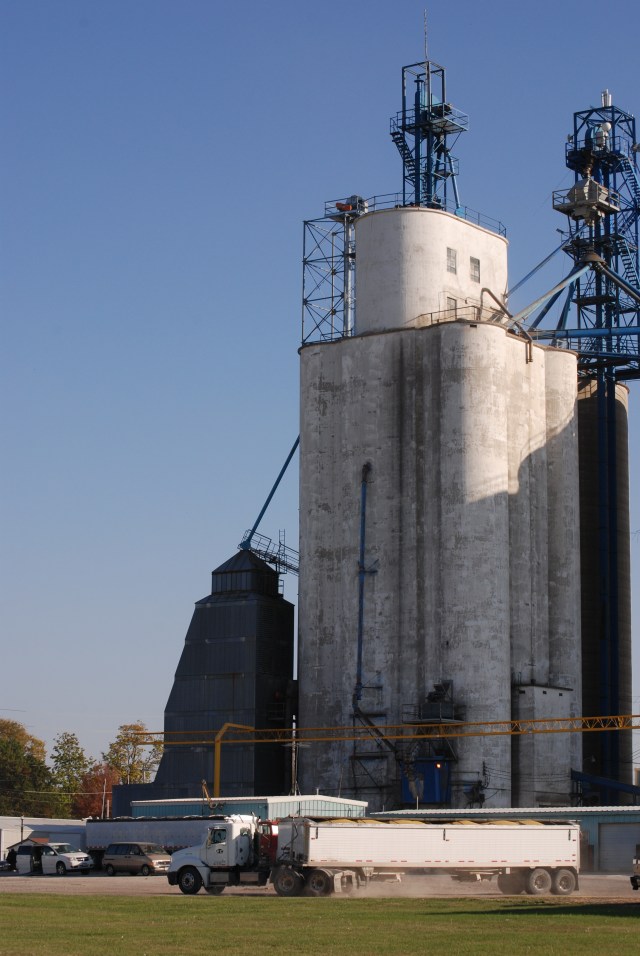
The Altoona, Iowa elevator built by Tillotson Construction of Omaha

A grain truck driver pointed out that Tillotson Construction Company’s Altoona, Iowa, elevator, seen here, is very similar to another of the company’s creations, which is found in Mitchellville, Iowa.

Tillotson Construction’s postwar business card, in full color, is a story in itself

Scan0005

By Ronald Ahrens

Reginald Tillotson’s business card from the years after World War Two demands some interpretation.

The splashy color side—perhaps a bit of an extravagance, although surely effective when handed to a co-op manager in a remote district—presents the image of what we’re sure is the Vinton Street elevator. Completed in 1947, this South Omaha elevator with its unusual, towering headhouse, would be a showcase for any builder.

On the back, above the rule, the range of Tillotson Construction’s services is spelled out. We don’t yet know much about the mills and warehouses but hope some information will turn up.

Below the rule, we find the six-character telephone number from the alphanumeric dialing days. Local exchanges were assigned prefix names from Bell Telephone’s mostly generic list. Besides Atlantic, Omaha exchanges were named Jackson, Prospect, Regent, and so on.

Seven-digit numbers replaced Omaha’s alphanumeric plan in 1960. The Atlantic exchange received the numerical prefix of 341.

Numerical postal zones, introduced during World War Two, were replaced when the national zip code system was introduced in 1963.

Reginald Oscar Tillotson was widely known as Mike. It could have been that Reginald was too exotic for the time and place, so he picked the nickname for himself.

Hutchinson Foundry, where manhole covers were cast, closed in 1972

mail

Hutchinson Foundry, photo courtesy of Linda Laird

The “foundry” in Hutchinson Foundry & Steel Inc., D and Washington, will be a misnomer after Oct. 1.

Blaming federal safety requirements, the firm has announced it will shut down its gray iron foundry on that date.

Ken Green, general manager, said last week that the measure is being taken because of requirements for environmental air dust handling handed down by the Occupational Safety and Health Administration (OSHA).

Green said that the step is not being taken because of new state air quality requirements.

OSHA has not inspected the Hutchinson foundry. But Green says it would take construction of a new facility to meet the standards which are designed to prevent employees from breathing pollutants.

Hutchinson Foundry, photo courtesy of Linda Laird

Hutchinson Foundry, photo courtesy of Linda Laird

As for the state regulations, Green remains confident that the foundry could meet those regulations. In fact, the state had given preliminary approval for the preliminary design of a scrubber.

The company, which will get a new name, will continue manufacturing structural steel, fabrication and building specialties.

Closing the foundry will mean the loss of 13 employees. But Green expects some of this loss—all of it in the long run—will be offset by the manufacture of a small hydraulic iron worker.

The iron worker was designed and engineered by Harry Oswalt, Garden City, president of the Hutchinson firm. Oswalt hand-built the prototype model which is now in operation at the plant.

Manufacture of the iron worker is expected to begin within six months.

Hutchinson Foundry, photo courtesy of Linda Laird

Hutchinson Foundry, photo courtesy of Linda Laird

The foundry has been working on an arrangement with Wyatt Manufacturing Co., Inc., Salina, whereby the firms patterns and customers will be transferred to Wyatt’s foundry operation.

Hutchinson (Kan.) News, August 13, 1972 

It looks like a Tillotson elevator in Bird City, Kansas, but it’s a surprise instead

Wheeler, KS 044 copy

Story and photos by Gary Rich

I wanted some information about the Bird City Equity Co-op elevator that is now operated by Frontier Ag, Inc. Bird City is located on U.S.-36 in Cheyenne County, Kan., which is in the very northwestern corner of the state.

The Bird City elevator features a rounded headhouse.

The Bird City elevator features a rounded headhouse.

I was positive this elevator was built by Tillotson Construction Company, of Omaha, Neb. I called the elevator manager prior to my trip and drove to Bird City on Dec. 7. Upon arriving I went into the office. It was noon, so the whole crew was having lunch. I introduced myself to the manager. One employee told me there was a plaque on the outside of the elevator. I have never seen a plaque on a Tillotson elevator. I guess I should have had some qualms at this point that it wasn’t a Tillotson elevator.

We walked out to the elevator. The plaque, dated 1950, showed the elevator was built by Vickroy-Mong Construction Company, of Salina, Kan. Another interesting thing: the manhole covers in most elevators were produced by the Hutchinson Foundry, of Hutchinson, Kan, but these were made in Salina by Wyatt Manufacturing.

There have been other stories in our blog about elevators that Mayer-Osborn built and another construction company that was building identical elevators. This company was Johnson-Sampson Construction Company, of Salina, Kansas. Now, we have Vickroy-Mong building a Tillotson-lookalike elevator.

It has been demonstrated that the curved headhouse was a Tillotson signature. Did someone leave the Tillotson operation and branch out on his own, or were the plans sold to Vickroy-Mong?

In the future, I plan on photographing the Bird City elevator in more detail and will compare it closely to a Tillotson elevator.

Stay tuned for more information.

Editor’s note on Dec. 14: The reference desk at the Salina Public Library has come through with information that Carl Vickroy and Raymond Mong were partners in a company located on South 9th Street, according to the Salina city directory of 1950. Additionally, it’s possible that the Hutchinson Foundry produced the manhole covers for Wyatt Manufacturing. 

Wheeler, KS 049 copy

Concrete’s prevalence in elevator construction was ‘just a matter of time’

Photo from The American Grain Elevator: Function & Form, by Linda Laird, courtesy of Grain Elevator Press.

Photo from The American Grain Elevator: Function & Form, by Linda Laird, courtesy of Grain Elevator Press.

The American Grain Elevator: Form & Function

By Linda Laird
(Grain Elevator Press, 120 pages, $23)

Because men with shovels weren’t quite up to the task of unloading farmer’s wagons and filling rail cars with wheat or corn, grain elevators became prevalent after railroads pushed through the American grain belt in the 1870s. A line elevator, each with a mechanical leg that lifted the grain for distribution, was put up on nearly every rail spur on the prairies and plains.

imagesIn those days, elevators were made of wood in studded or crib-style construction. Although many of those buildings were clad with galvanized steel, they remained vulnerable to the prodigious quantities of sparks thrown off by visiting locomotives.

Seeking reliably fireproof structures, some buildings tried brick but found it “not a satisfactory solution,” reports Linda Laird in The American Grain Elevator: Form & Function. (Order here.) The book published earlier this year supplies useful perspective on trends as well as carefully detailing how a grain elevators works.

Ceramic tiles strengthened by steel bands have been used in building elevators, and iron and steel structures stand here and there in defiance of rust. In the latter case, several good examples from Kansas are shown by Ms. Laird, who has a background in historic preservation and devoted herself to photographing 1200 elevators in the Sunflower State.

But as she notes in her deftly written book, from the time of Peavy’s Folly, an 1899 experimental elevator near Minneapolis, the solution was at hand and “it was just a matter of time before the use of concrete would revolutionize the grain storage business in America.” Concrete was costly, but lower insurance rates helped in the recovery of costs. Much to the dismay of insects and rodents, which were always a problem at wooden elevators, the editors of influential periodicals like Grain Dealers Journal encouraged the new material’s use. Low-cost government financing later became available.

Specialized crews skilled in the slip-form technique began to create towering silos topped by fantastic cupolas, or headhouses, of varying heights. Farmers’ co-op elevators were modest jobs. Others were epic affairs like the half-mile-long, 18.3-million-bushel terminal in Hutchinson, Kan., where Ms. Laird lives.

Frank photos and helpful drawings make the results vivid, but historic images documenting the rise of Chalmers & Borton’s massive annex at Topeka, Kan.–an exercise that took just seven days in 1955–are the coup de grace.

Thanks to Ms. Laird’s splendid work, it’s easier now to understand what our own grandfathers accomplished, and how they did it. From heaps of lumber and steel on flat ground by the tracks, they ascended skyward, leaving behind functional, impermeable buildings that are also enduring monuments to enterprise and bounty.

— Ronald Ahrens