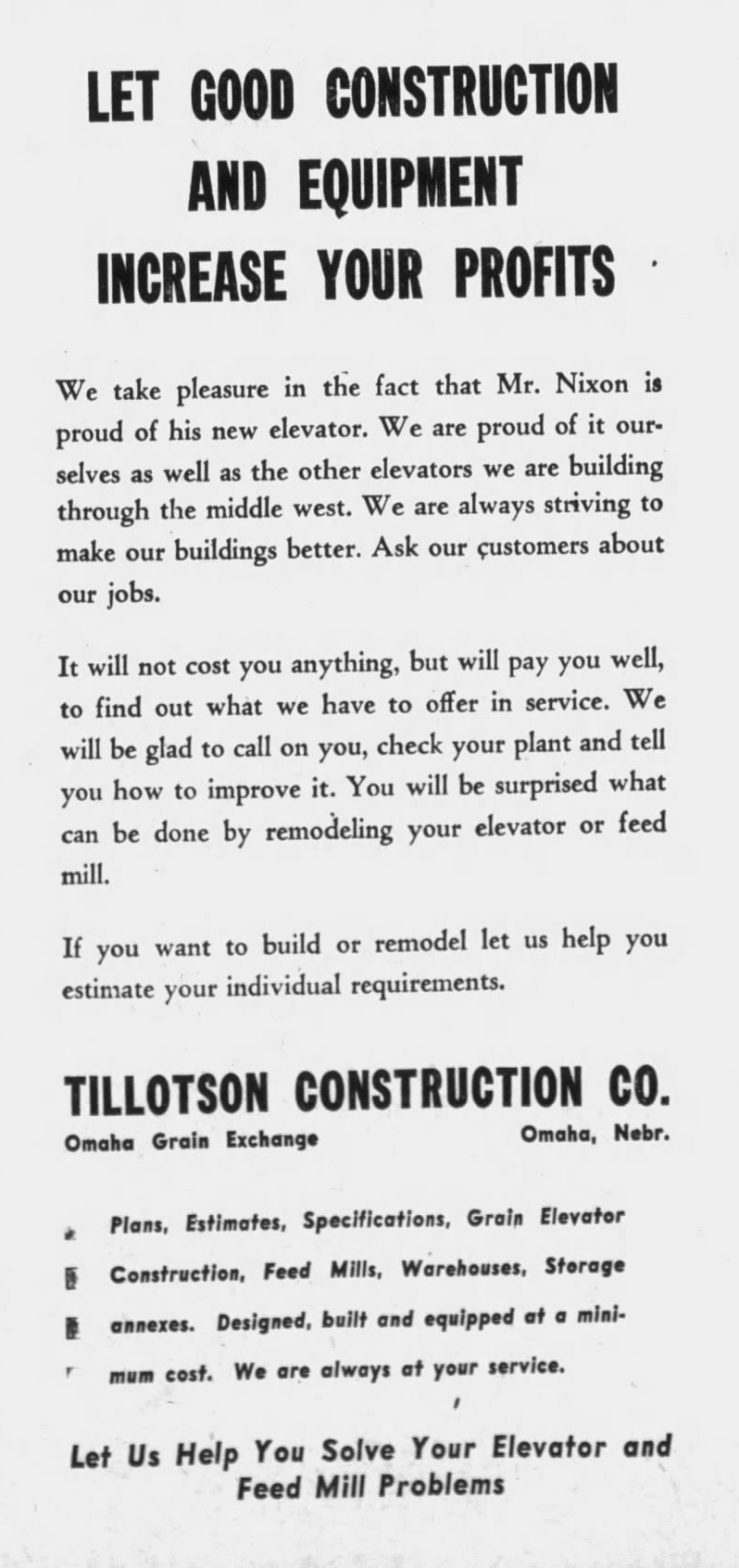
Tillotson Construction Co. was one of several organizations that welcomed Nixon Truck Grain Market at 27th and O Streets in a Dec. 1, 1938 Omaha Daily Journal-Stockman ad. “Let good construction and equipment increase your profits,” the Tillotson ad line advised.
Just 30 days later, another paper, The Daily Record, carried the brief notice of a leasing agreement between A.A. Nixon & Co. and Tillotson for machinery and equipment. Value of the lease was $1,808.24.

With questions on why a prosperous company like Nixon would lease, we tabbed Brad Perry, who’s a good friend of Our Grandfathers’ Grain Elevators, to explain. Brad has had a career in finance, which he described in an email:
With the Farm Credit meltdown of the mid 1980’s, the 12 District Banks for cooperatives merged with the central Bank for Cooperatives, headquartered in Denver. Then it was renamed CoBank.
More history: There were 12 Farm Credit Districts, roughly similar to the Federal Reserve Districts. Each District had a Federal Land Bank with local Land Bank Associations, a Federal Intermediate Credit Bank with Production Credit Associations, and a Bank for Coops (BC). The central bank handled the large loans that exceeded the District Banks for Coops’ lending limits.
All this changed after the farm crisis of the late 1980’s. There are now a total of six District Banks, including CoBank.
I was at the Omaha BC from 1975 to 1987. In 1980, OBC started a consulting company to work with coops in our District, which was Iowa, Nebraska, South Dakota, and Wyoming. At the depth of the farm crisis, I took the consulting company private. I’m still trying to fully retire, but have a couple clients I can’t say no to!
Q. Was it customary to lease machinery and equipment from the builder of an elevator?
A. I’m betting that the elevator’s owner didn’t have adequate funds to pay for everything, so the equipment was leased to him/her. That was not unusual. Why the equipment? It could be pulled out and re-sold.
Q. It looks like individual grain merchants like Nixon monopolized the market in grain distribution.
A. You’re about right on the grain merchants and monopolizing the grain business. The primary one was Cargill, along with the flour millers. Pillsbury, Washburn (Gold Medal), and so on. On the Northern Plains, there was also Peavey. Most of them were in cahoots with the railroads. There really wasn’t any government action that broke them up, but their predatory pricing. That gave rise to farmer-organized cooperatives and locally owned grain companies. The federal government did come in to the grain business in the early 1930s–the Great Depression. They created the Federal Grain Company to buy surplus stocks, i.e. wheat. Some of those elevators still stand and are still in use.
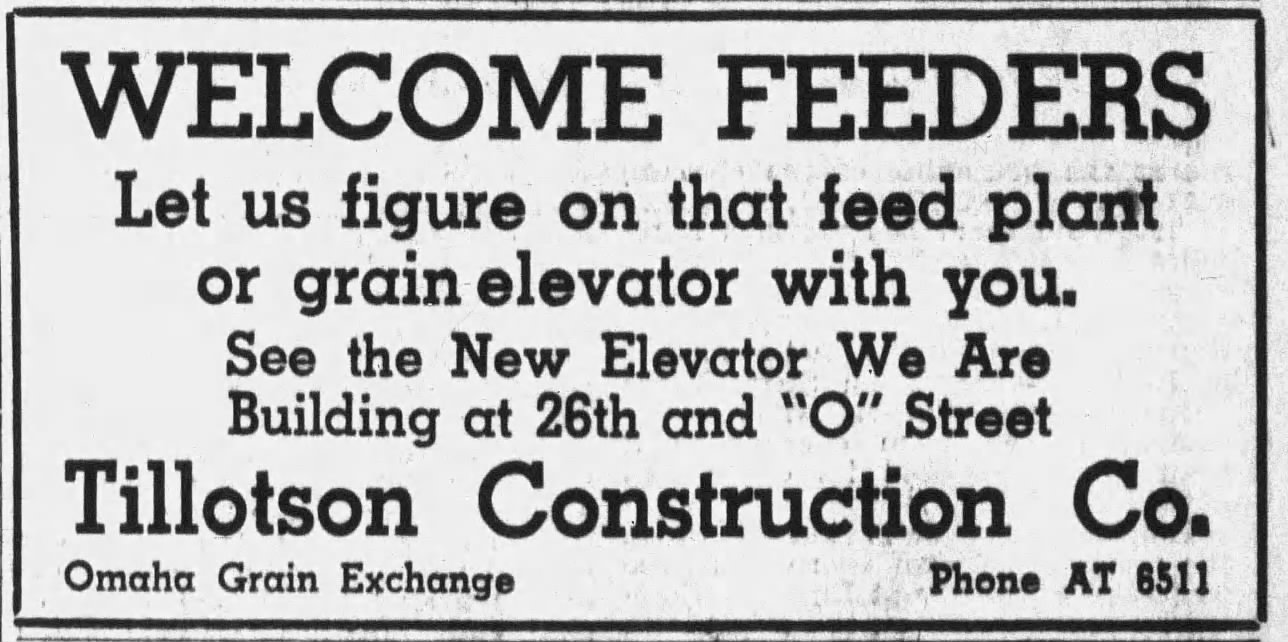
Q. It also looks like we’ll be on the road in a few weeks, and that could lead through southwestern Kansas, where Tillotson built elevators in a string of small towns.
A. On your Kansas trip, southern Kansas has some of the oldest concrete elevators in the country. All were built for wheat. As you know, there are mammoth elevators in Salina, Hutchinson, Topeka, and Wichita–particularly Haysville just South of Wichita. On or within 25 miles of U.S. 81/I-35 are four of the five largest elevators in the world. These are in Salina, Hutchinson, Haysville, and Enid, Okla. All were paid for by Commodity Credit Corporation storage payments.
Q. Besides the bountiful grain production, why are they concentrated there?
A. It was not unusual for wheat to be stored as long as 10 years. All wheat into the “terminals” came in 40-foot boxcars from area elevators. You’ll notice larger elevators the farther west you get. Notice Dodge City. It was too far away from the terminals, so they built more storage locally. You’ll see the same in Garden City, Ulysses, and other southwest Kansas towns.


 Our Grandfathers' Grain Elevators