It’s official: Mayer-Osborn built Big Springs’ original concrete elevator

Story and Photos by Gary Rich

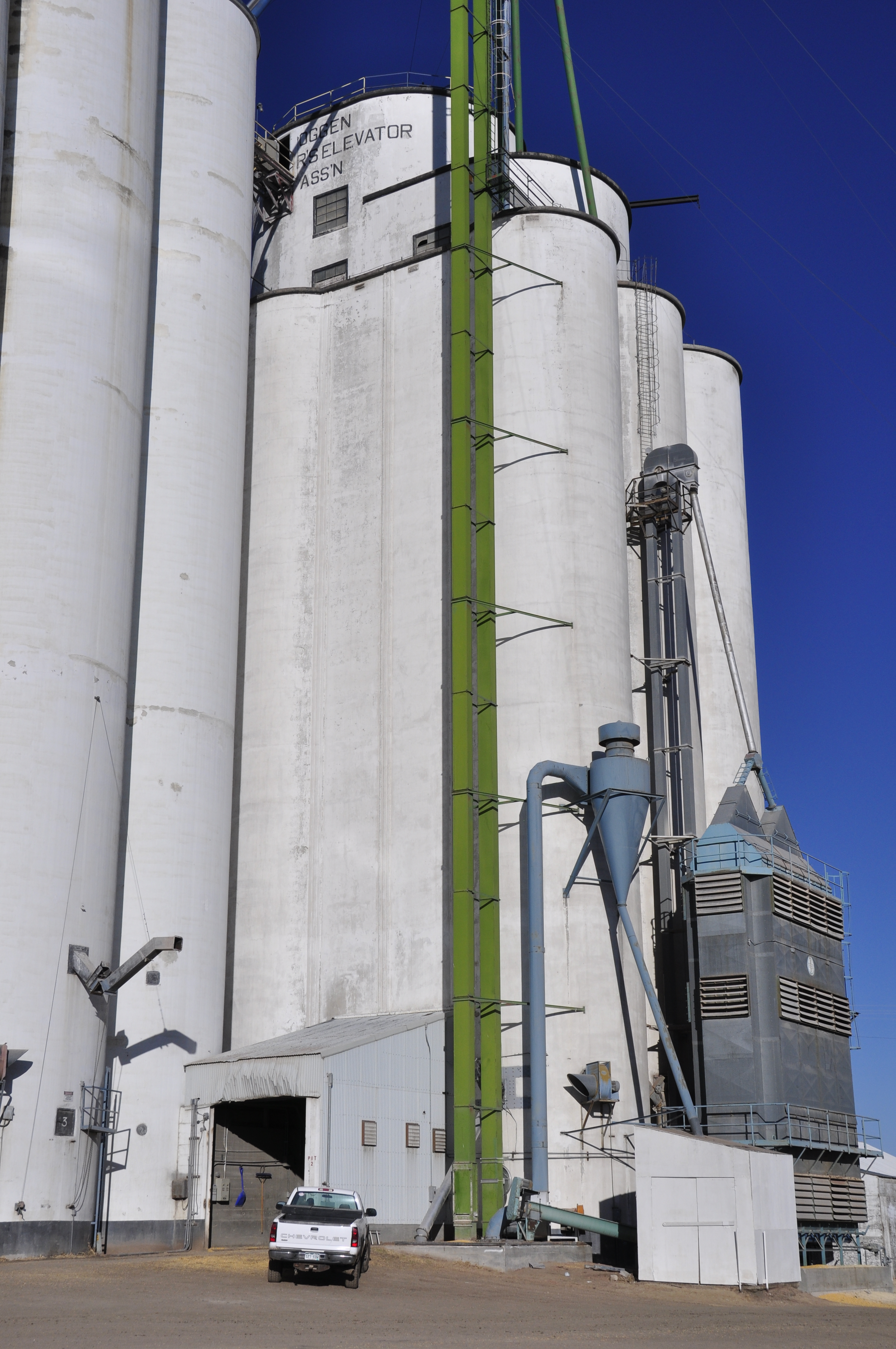
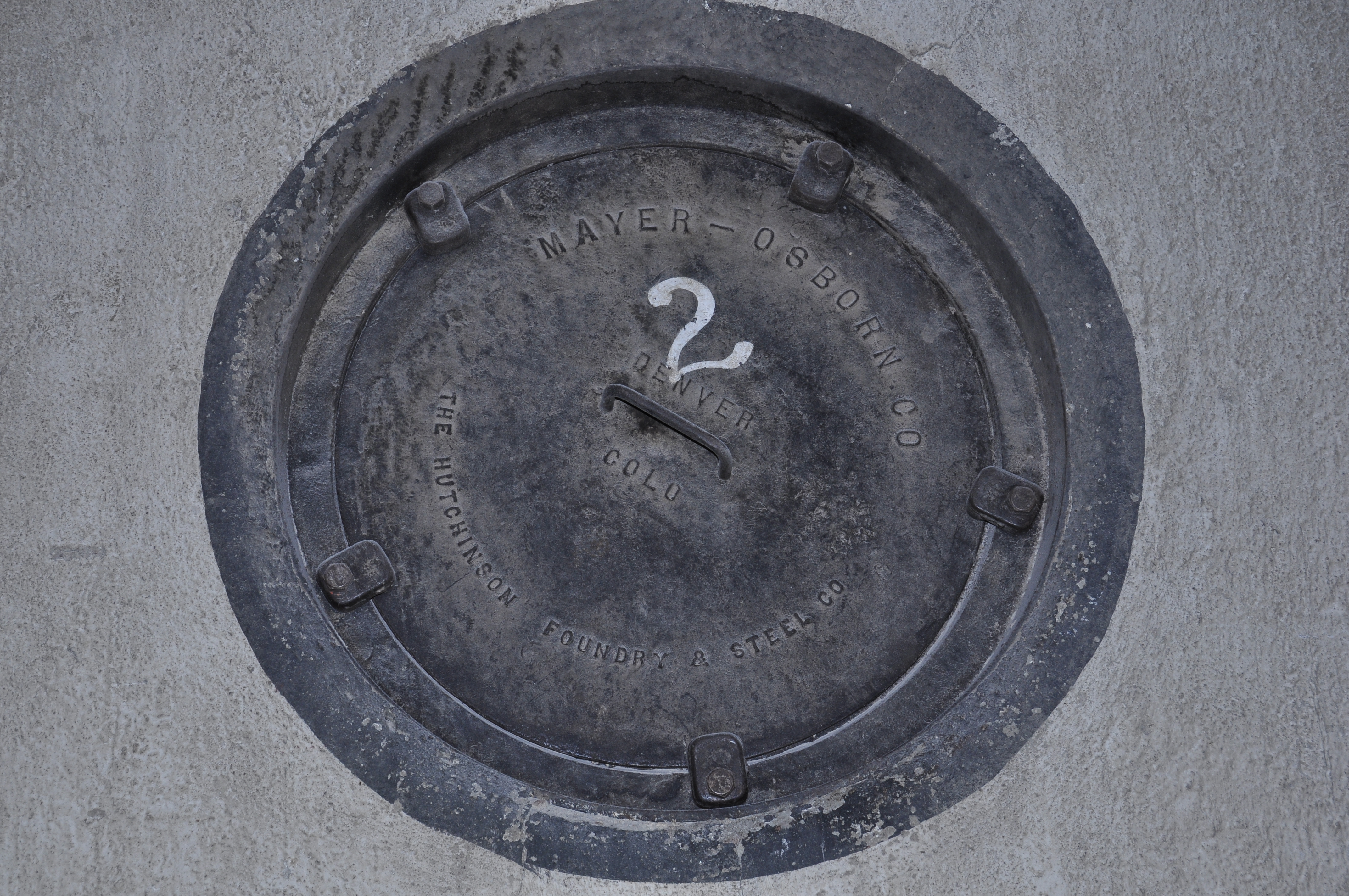
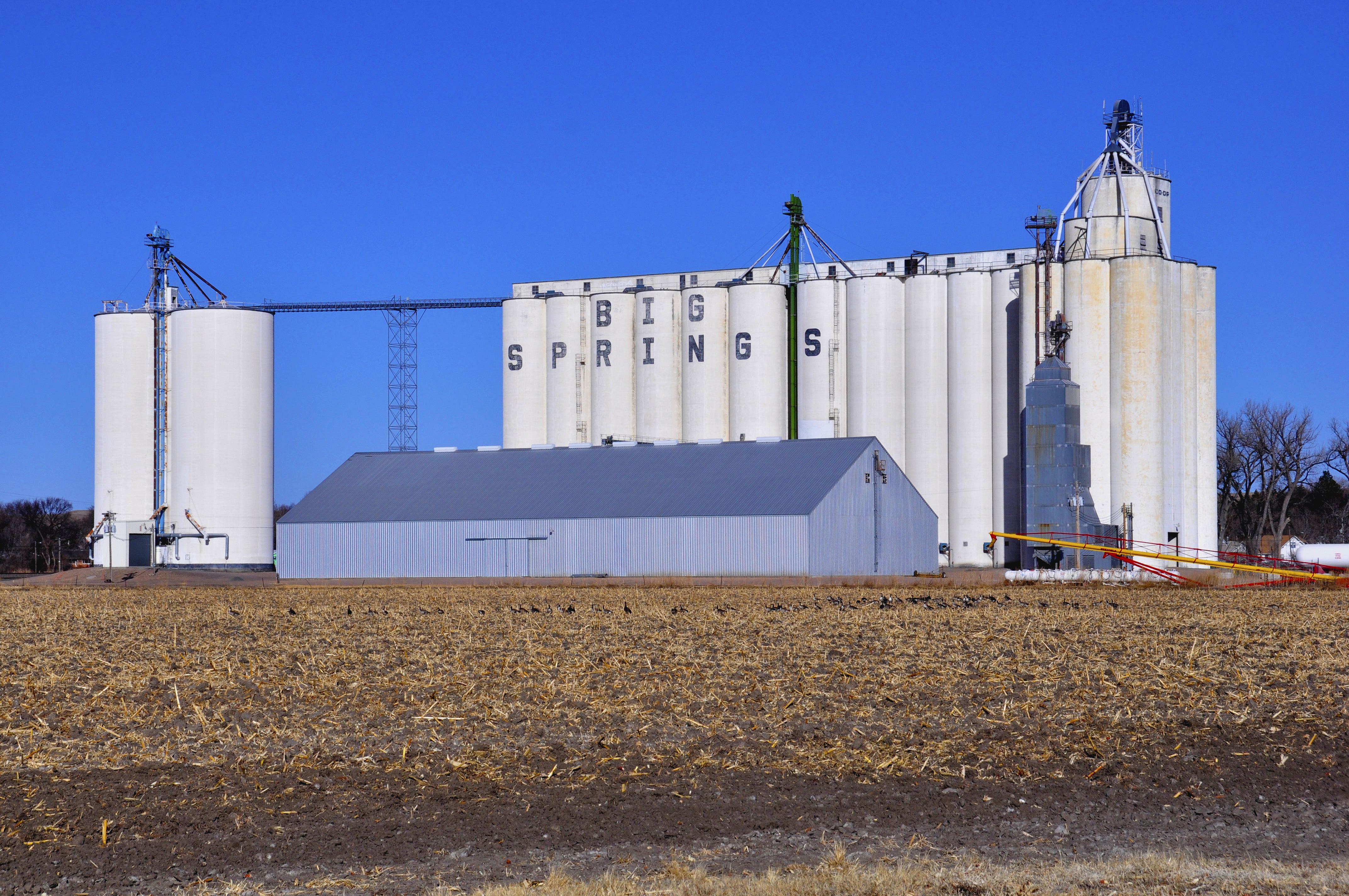
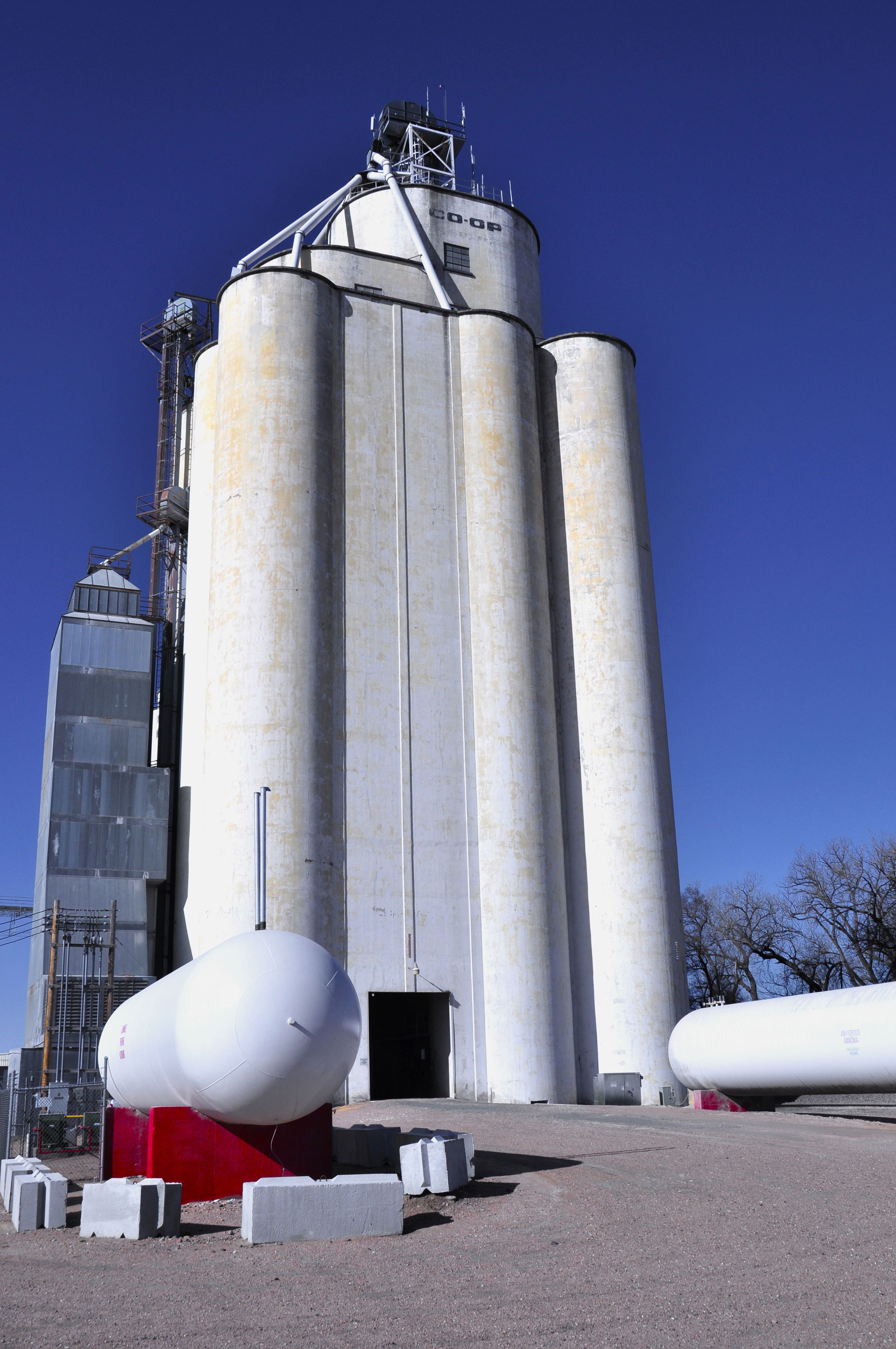
Who built the Big Springs elevator? The winner is Mayer-Osborn Company. The manhole covers have Mayer-Osborn on them. It was built in 1951.This structure is today called Elevator 1. A six-bin annex was added afterwards. I do not know who built it. There were no manhole covers.

Another annex was built by Mid States. They call this Elevator 2. It has its own leg. This annex has about sixteen bins.

Mid States also built the third annex, which has its own leg, too. There are two huge bins. 

I asked manager Larry McCroden about the primary crops raised around the area. The two biggest crops are corn and wheat. Secondary crops were sunflower seeds, for making sunflower oil, and millet. Some oats were grown, but there hasn’t been any oats tendered to the Co-Op for the past four years. Most years, corn was the number-one crop with wheat coming in second. I would say that there was about twenty percent more corn than wheat. One year was an exception. I believe it was 2008. Farmers delivered more wheat than corn that year.

The Big Springs Co-Op is independent–no other elevators in any towns. It says a lot that an independent Co-op can survive during without merging or being taken over.

In Chase County, we meet Gary State, an elevator construction veteran

By Gary Rich

Editor’s note: Gary is recently returned from a fact-finding foray in Nebraska.

I stopped at the Chase County courthouse in Imperial, Neb., looking for the dates when the elevators were built in Imperial, Enders, and Wauneta. They did not have much information about the build dates. The only info they have in their records is that the old office building for Frenchman Valley Co-op was done in 1946. The FVC built a new office across the street from the old one.

The ladies on the courthouse staff told me to stop in at the FVC office and talk with Gary State, who might have the dates. Mr. State went to work for Mid States building grain elevators and feed plants. I do not know if it was just Mid States or Mid States Construction. He was living in Imperial when he started working for them.

Map of Nebraska highlighting Chase County

I explained about Tillotson Construction Company, of Omaha, J.H. Tillotson, Contractor, of Denver, and Mayer-Osborn Company. He gave me some leads. He told me that Hugh O’Grady is still alive and lives in Omaha. Mid States was started by a man name Erickson. He had seven sons. Six of the sons ended up working for Mid States. One son died at a construction site. He said Jack Russell was a superintendent. He thought that he was living in Seward, Neb.

Mr. State built the second annex, or elevator number two, at Big Springs, and then elevator number three.

He told me that he built the Woolstock, and Goldfield, Iowa, elevators; the feed plant at Fruita, Colo.; and elevators at Garrison and nearby David City, Neb. At the other end of the Cornhusker State, he built the west elevator in Imperial. After the west elevator was finished, he left Mid States and he went to work for the Co-op. This is the reason that he is working for FVC.

♦ ♦ ♦

Okay, here is another thing. I thought that when a construction company built an elevator that they did everything. This is not true. Mr. State told me about a company based at York, Neb. This company did all the belts inside the elevators, all around Nebraska, no matter who the builder was. So we know the belts were installed by a separate company. Now I am wondering if a separate company was onsite to install the leg as they built the elevator up. Or did the general contractor install the leg?
Mayer-Osborn’s new elevator will tower over the Burlington tracks at Roggen

Photos by Gary Rich

Excavation will start Monday morning on a strictly modern 250,000 bushel grain storage plant at Roggen to be constructed for the Farmers Grain & Bean association, a farmers cooperative. The association stores and markets at Roggen the grain grown by hundreds of southeastern Weld county wheat growers.

The new building will tower 160 feet in the air and architects’ drawings show that its beauty will equal its great utility. Mayer Osborn company of Denver has the general contract for the elevator.

Site is 50 feet east of the present 80,000 bushel elevator of the association. Both elevators are served by the main line of the Burlington railroad.

Construction will be of concrete and steel of multiple slip design. Capacity can be enlarged indefinitely from year to year as need arises.

Marvin Jones, manager of the Farmers Grain & Bean association, said Friday night that the company is also building a similar but smaller structure at Byers on the Denver Kansas City line of the Union Pacific east of Denver. Byers elevator will hold 150,000 bushels.

Jones said that the new elevator will be ready for use by the time the 1950 harvest starts. He said the wheat crop in the Roggen, Kiowa and Prospect districts is looking fine. He said there had been very little damage from wind and that this was confined to the sandier soils of the district.

Present elevator of the association at Roggen will be kept in use giving the association 880,000 bushel storage at Roggen. Allowing 1500 bushels to a carload this is the equivalent of 220 carloads capacity.

The Greeley (Colo.) Daily Tribune, April 6, 1950

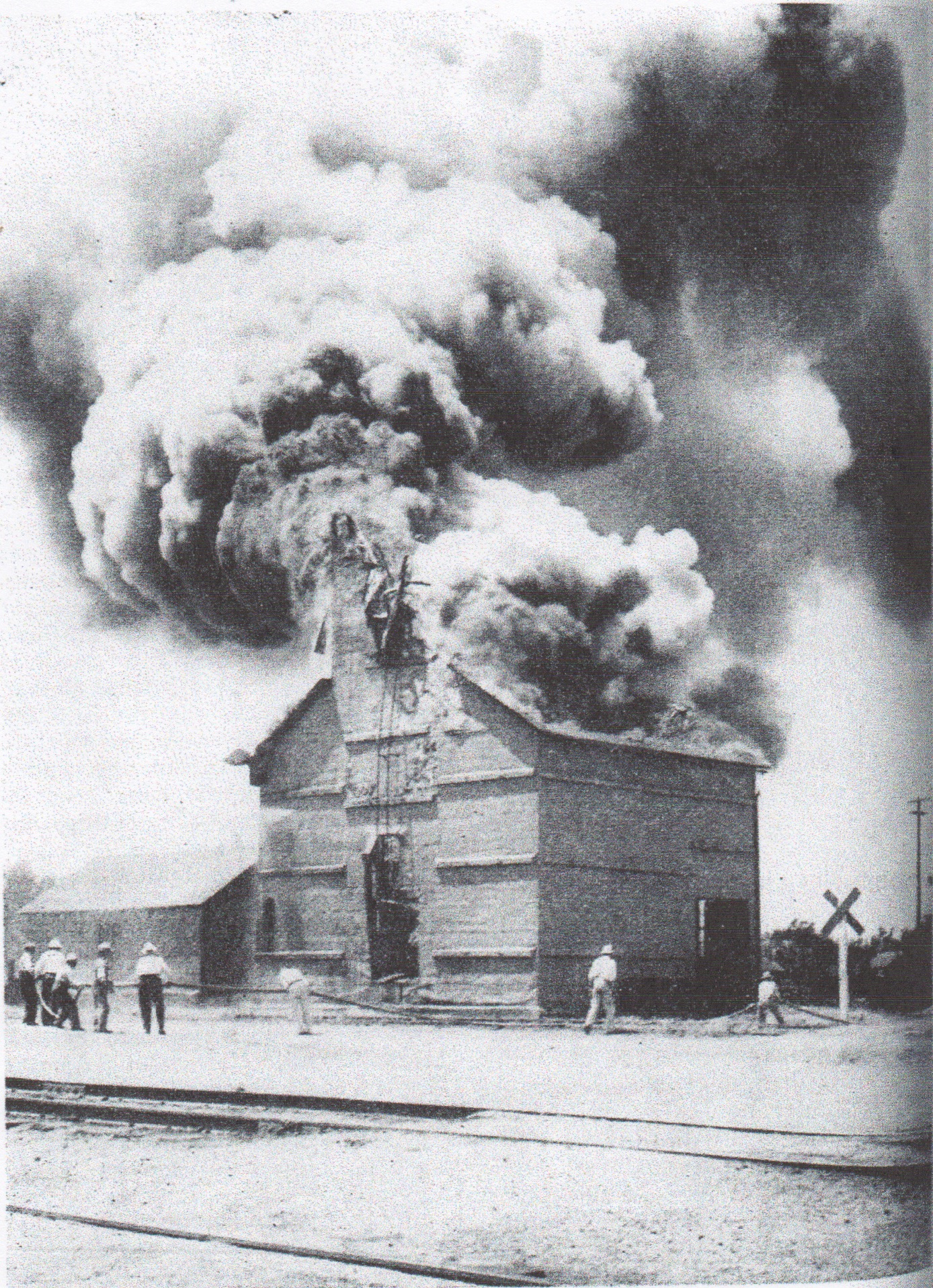
Listing fire perils to wooden elevators highlights pluses of slip-formed concrete

This photo appeared with Mr. Gustafson's cautions in 1939.

By Ronald Ahrens

Concrete grain elevators offered more to the local farmers’ cooperatives than greater storage capacity: the risk of fire was vastly reduced, too. Several of the construction notices on this blog, for instance, one about the new elevator in Wapello, Iowa, point out that the new slip-formed elevator was replacing a wooden one destroyed by fire. A 1957 press photo available on eBay for $15, which is beyond our budget, shows the smoldering ruins of a wooden elevator beside an unscathed concrete one.

An October 5, 1939 article in Farmers’ Elevator Guide listed the gamut of threats to a wooden elevator. The occasion was national Fire Prevention Week. C.W Gustafson, chief engineer of the Mill Mutual insurance company’s Fire Prevention Bureau, wrote that “grain elevators are unfortunately one type of plant in which fire prevention is a year ’round problem rather than one which requires special attention only one week out of the year.”

Mr. Gustafson’s list started with the advice that bearings in the elevator head and conveyor belts should be oiled daily in order not to overheat. “It is not sufficient to simply ‘slop’ oil on the bearing, but the oiler should make certain that the oil actually reaches the interior where it will do some good,” he wrote.

Other important no-no’s:

  • No smoking: “We often see farmers congregated in the elevator driveway or approaches and the tendency to discard cigarette and cigar stubs and matches without regard for their ultimate resting place is evident.”
  • Bad housekeeping: neatness improves safety.
  • Overworked electric motors: they should be cleaned weekly with compressed air, Mr. Gustafson wrote, and if blown fuses are a problem, a “competent electrician” should be called in if available.
  • Elevator legs: check that the head pulley is operating smoothly and the belt isn’t rubbing against the legging.

The following passage deserves to be delivered whole.

When dumping trucks
Request the driver to shut off the motor of his truck. Considerable oil and gasoline is usually spilled in the driveway, particularly from gravity feed truck engines and ignition of this accumulation by sparks from exhaust or backfire would result in a fire difficult to extinguish. Signs calling attention to this rule are available from your Mill Mutual insurance office.

Nowadays, we don’t notice trucks leaking as much fuel as in 1939.

Mr. Gustafson’s practical advice concluded with the suggestion that the elevator operator return in the evening after supper to look in the cupola and basement to see that all is well. “Many fires are detected by observing this rule,” he wrote.

Pulling the switches on lighting and power circuits when leaving was a final recommendation.

Greenwood elevator welcomes 250 at open house

Photo by Kristen Osborn Cart

GREENWOOD (Nebr.)–The Farmers Union Cooperative Association held open house at the new concrete elevator which has capacity for 128,000 bushels of grain. Manager Floyd H. Gove and assistant M.L. Griffith conducted 250 through the plant. Doughnuts, cookies and coffee were served in the basement.Farmers’ Elevator Guide, November 1951

J.H. Tillotson’s Fairbury elevator, slowed by rain during construction, will miss 1947 harvest


These clippings were among William Osborn’s papers. They come from the Fairbury (Nebr.) Daily News, a long-defunct paper, and appear to have run in the summer of 1947. The article “Rain Hampers Work At New Elevator Site” gives a good summary of the construction methods used on the Farmers Union elevator. The name J.T. Tillotson Contractors, as it appears in the article, should be J.H. Tillotson, according to other records.


Government loans, subsidies led to elevator construction boom in 1940s and 1950s

The following observations come after Kristen’s recent foray in the University of Wisconsin library:

English: Chicago Board of Trade at night, phot...

The trip to check out the Farmers’ Elevator Guide was interesting. There is no index, so I have just scratched the surface. But this is an interesting twist on things: through the Forties and Fifties, the farmers’ cooperatives were a way of doing business along the lines of a union. There are articles about Washington’s involvement (that went so far as to prohibit all commercial building in the nation at one point, excepting elevators!) that makes today’s meddling seem mild by comparison.

Some of these articles, when I get back to Madison, are a must for the politics of the times that made this boom happen. Both the bumper crops that were bolstered by price supports, and various government loan programs and grain storage subsidies, made the business quite a going thing until it didn’t quite work any more. The Chicago Board of Trade complained we were on the road to Socialism. (And we were.) Much of the debate and business news made its way into the Farmers Elevator Guide.


130-foot fall claims Larry Ryan’s life in Pochahontas, Iowa

Worker Is Killed in Fall From Elevator

Pochahontas, Iowa –(AP)–A 130-foot fall from the top of the Farmers Co-operative Elevator, under construction here, claimed the life Wednesday of Larry Ryan, 20, of Cassville, Mo.

Ryan, an employe of Tillotson Construction Co., Omaha, was operating a hoist used to raise supplies to the top of the elevator. Cause of the accident was not immediately learned.

Muscatine (Iowa) Journal

Thursday, July 29, 1954