Flat storage for corn extends capacity at locations like Mitchellville, Iowa and Traer, Kansas

Story and photos by Kristen Cart

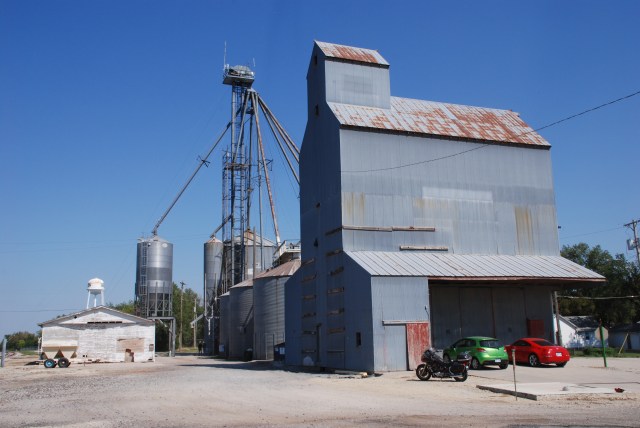
Flat storage at Traer, Kan., for farm equipment, and an unused elevator.

During the heyday of elevator building, no sooner did an elevator go up, than it filled up, and left a town wanting for storage. The first option was to add an annex. But where economics dictated, cooperatives resorted to the simple expedient of horizontal storage. In the Farmers Elevator Guide during the 1940s and 1950s, between the slick ads for elevator builders, companies advertized Quonset-style buildings for flat storage.

A common sight in Nebraska and Kansas are long, flat piles of corn covered in tarps held down with old tires. At one grain facility, I saw a front-end loader filling grain trucks from one end of one of these great corn piles. At another, workmen were hurriedly applying tarp and tires in advance of a rainstorm. It seems the demand for ethanol has once again ramped up corn demand beyond the capacity of vertical storage facilities, or at least the ability to pay for them.

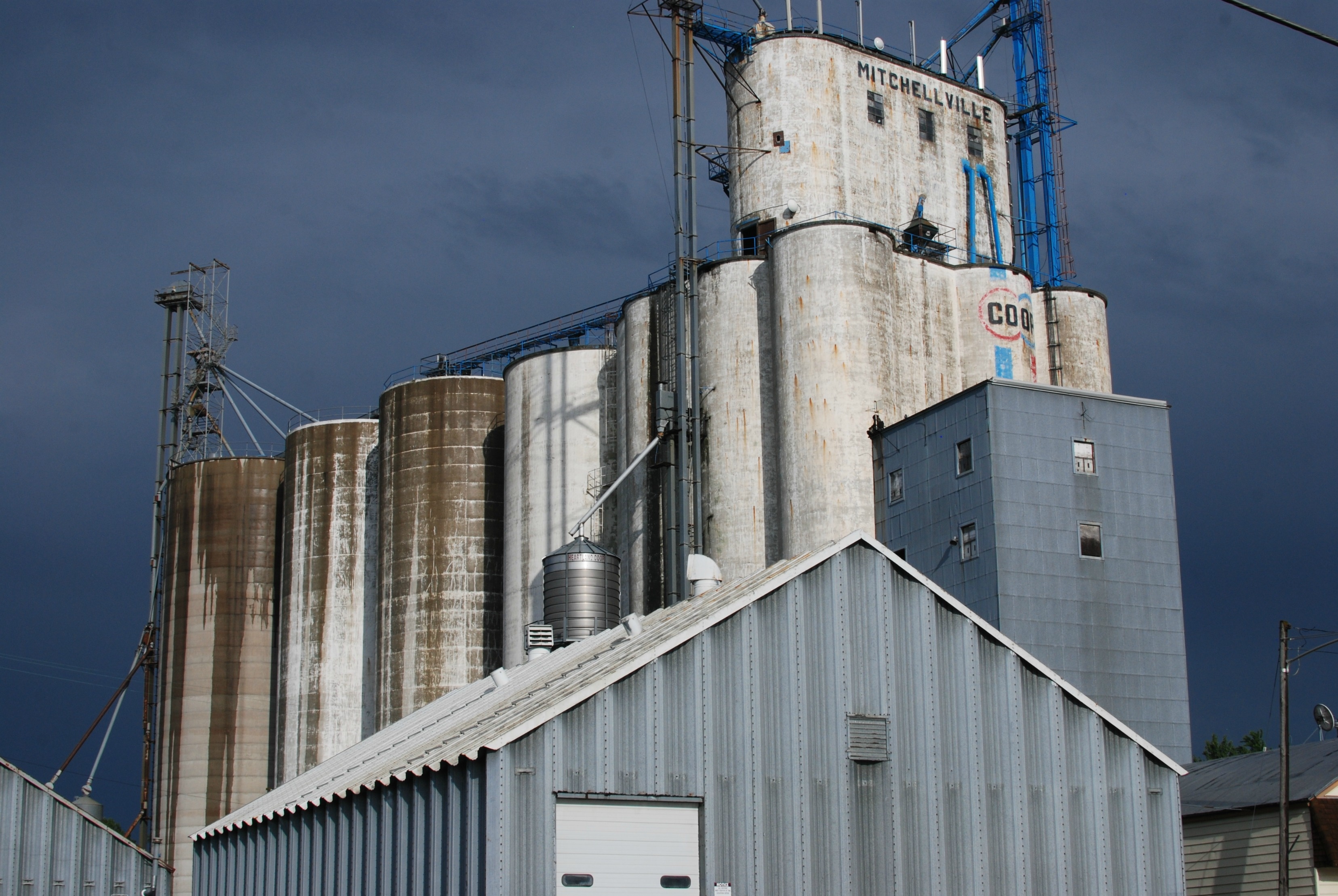
Mitchellville, Iowa: the Heartland Co-op elevator with the former feed mill and dryer. One of the two old flat-storage buildings for corn is in the foreground.

At two of the sites I recently visited, where the Tillotson-built elevators became insufficient for their purpose within a few years, I saw examples of  corrugated-style flat-storage buildings that were added after the original elevators were filled to capacity. These  served during a brief stretch of time until replaced by more modern, efficient bins, when the buildings found other uses. They were well suited for many farm needs since they could house virtually anything and were built to endure, once their corn storage days ended.

Mitchellville, Iowa, a site where an elevator built by Tillotson Construction of Omaha operates, has two such buildings.  They look like ordinary metal buildings, but the tip-off to their special use is the ladder leading to an opening in the roof where the auger operates. Both buildings have new jobs since the large annex additions were built beside the old elevator–one is a machine tool shed, and the other handles seed.

Idaho corn stored under a tarp is loaded onto grain truck.


Gary Rich’s analysis reveals subtle aspects of Mitchellville, Iowa, elevator operation

Story by Gary Rich
Photos by Kristen Cart

There are several possibilities as to why Heartland Co-op’s Mitchellville, Iowa, elevator would only use rail service for shipping out its grain. The most obvious one is that this might be a shuttle operation. Whether corn or soybeans, the company that receives the grain might have a contract with the elevator specifying shipment of a certain number of carloads per week. It is probably a larger-name company, and they could be paying for the shipping charges. This would keep their operation from having to shut down for lack of grain.

The photos appear to show nine or ten covered hopper cars at the elevator’s far right. In the view at top, we see yellow markings on the rail on the elevator track. This is known as the “clearance point.” You can’t have cars sitting beyond these markings without “fouling” the main line. The following links to lexicons of railroad terminology will explain both terms:

http://www.icrr.net/terms.htm
http://cfr.vlex.com/vid/214-7-definitions-19944901

Here’s an illustration why it’s cheaper to move grain by rail. The amount of grain in one covered hopper car leaving the elevator equals three semi-trailer loads. If you load ten hopper cars, you’re probably looking at an equivalent of around thirty-three or thirty-four semi-trailers. If the plant that receives the grain is over 200 miles from Mitchellville, it would take more than a week to move all that grain over the highway.

Indeed, if the plant is 200 miles away, you also have to consider the amount of time a trucker can work. He wouldn’t be able to cover two round-trips per day. And besides, the trucker’s charge of something over $4.00 per mile might erode all profit for the grain operation.

Tillotson Construction’s Mitchellville elevator is a key part of Heartland’s grain operation

The Heartland Cooperative elevator complex at Mitchellville, Iowa.

Story and photos by Kristen Cart

The Mitchellville elevator is visible from Interstate 80, and the rounded head house drew my attention as we headed through Iowa on our way home from our recent trip out West. “Just one more stop, OK, kids?” I said, and they answered with groans. I think I promised ice cream to quell the protest.

The main elevator built by Tillotson Contruction Company of Omaha, with grain drier.

I parked the van, air conditioner running, in a shady spot and hopped out with my camera. Thunderheads threatened nearby, but the storm seemed to be moving off, and the sun peeked out and illuminated the scene. I took advantage of the beautiful light to photograph the elevator.  As I finished up, I saw a truck rounding the corner from an alley into the gravel lot beside the elevator, so I flagged the driver down to ask if he knew anything about it. We were in luck.

The driver introduced himself as Ed Baldwin, a grain truck driver for Webb Farms. He was more than happy to talk about the elevator, having trucked “at least two million bushels” in and out of Michellville. Bill and Stan Webb own the farm, and Ed purchased his truck from their father who used to truck his own grain. Ed gave me a quick outside tour of the elevator property.

The Younglove annex viewed from the driveway.

Ed explained the Heartland Cooperative operation at Mitchellville. He did not know the builder of the “head house,” as he termed the main elevator, but he knew the adjacent annex was built by Younglove in 1972.  The bins had numbers and he pointed out the function of each one. All the way to the left was a new bin with its own leg that was built in the 1980s and used for damaged corn. Immediately to the right of it, on one end of the Younglove annex, was a bin dedicated to soybeans. The rest of the annex held corn, with the main house taking all the wet corn since it gave access to the grain drier.

The Younglove annex is placarded with the date of construction.

During harvest, the employees kept a grueling schedule filling the bins, especially during a wet year. Jim Dietrich, grain manager for Heartland Co-op at Mitchellville, would pull a twenty-four hour shift to accept the grain into the main elevator and dry it. The drier had a capacity of seven thousand bushels per hour, which would limit the amount of grain that could be taken in. Ed said the main house would take seven semi loads per hour of grain that needed to be dried. Shipments from the elevator were by rail, unless capacity was reached and grain needed to be trucked.  Trucking would be the exception for Mitchellville’s operation.

In Wahoo, Nebr., Tillotson’s elevator finds new life as a cell tower for AT&T

The Wahoo, Nebraska elevator, built by the Tillotson Construction Company of Omaha, Nebraska

Story and photos by Kristen Cart

Another stop on my recent elevator trip was Wahoo, Nebraska. Dad tipped me off that it might be one of Tillotson’s projects. Wahoo is the seat of Saunders County, where Dad lives, and he frequently has occasion to stop there.

Wahoo’s elevator, at first glance, appeared unused. It was closed up tight, and the only indication of any activity was a sign warning workers to stay at least three feet away from any antenna, and to contact AT&T before performing any maintenance or repairs near their equipment.  Ah, hah!  Then I noticed the wires running to the top of the structure. I walked around the elevator, taking pictures.

Next door to the building was a Pet Rescue center, and as a woman was leaving there with a little dog in her arms, I asked her about the elevator.  While she did not know the builder, she said the elevator was privately owned by David Rood, and that at present, the elevator was full of corn.  But she commented that he probably made more money from the AT&T installation. I had heard of cell antennas being installed in every kind of tall building–even church steeples–but it had never occurred to me to look for them atop an elevator.

The next circuit around the elevator produced the answer I was looking for. Right there, adjacent to the sidewalk, in bright blue paint, was a manhole cover.

Some neighborhood teens were hanging around the street, in their cars, and when they saw me kneeling, taking the manhole cover shot, one of the boys shouted out, “What are you doing?”

“Taking pictures of the elevator!” I said.

The young man wanted to know why. When I said it was for a blog, I guess that was enough for him. Anyway, his attention went back to something on his cell phone.

The Wahoo elevator is an attractive feature of the town, fitting naturally with the older buildings along the main street. A man at a local pub, seeing my camera, popped out and said curiosity got the better of him. I told him what I was doing there. I guess a tourist with a camera along the street is a little unusual. And Nebraskans, by nature, like to know who is about.

Faked out in American Falls, Idaho

Chalmers and Borton elevator at American Falls, Idaho.

During one of my recent road trips, I came upon a beautiful concrete construction elevator in American Falls, Idaho.  It looked much like the stand-alone elevators built by Tillotson Construction of Omaha, with an added annex.  It is in full operation.  I explored the elevator complex from about 7:30 am, and stayed on site as workers reported for their 8:00 am shift.  It was a very handsome elevator in the early morning light.  In its details it looked like a Tillotson elevator, except for the rectilinear head house, which is not unknown for a Tillotson or Mayer Osborn built elevator, but would be unusual.

As the shift started, I stopped at the elevator office to ask about the builder.  The worker smiled and pointed out the brass plaque by the door.  It was built by our grandfathers’ arch rival company, the ubiquitous Chalmers and Borton based in Hutchinson, Kansas.  Gary Rich pointed out one time that it seemed that wherever he found a J.H. Tillotson or Mayer Osborn elevator out in Kansas or Colorado, hard beside it would stand a Chalmers and Borton annex.  The companies played hard ball and competed for every contract.  Dad said, when I asked if Grandpa’s Mayer Osborn Construction of Denver, Colorado ever worked with Chalmers and Borton,  that “oh, no, they were his biggest competitor.”

Greenwood Nebraska’s straight-up elevator by Tillotson Construction of Omaha.

The elevator at Greenwood, Nebraska, built by Tillotson Construction of Omaha, is very reminiscent in its style to the elevator in American Falls.  I guess form followed function, and each company offered a product similar in its details–often the deciding factor was the bid price.  This Chalmers and Borton elevator certainly faked me out.  But it stands as a beautiful example and deserves notice.

Searching for Mayer-Osborn’s office in Denver produces a good possibility

Story and illustration by Kristen Osborn Cart

Looking for the original offices my grandfather used while putting up elevators for a living, I checked maps for the buildings that stood at the old Mayer-Osborn Company addresses. Google gives a bird’s-eye view. The newer address at 5100 York, in Denver, has no building and seems to be a parking lot full of junker cars and abandoned trailers. There is a small white cinderblock-looking building next door that might be that old, but it is nothing to speak of. I am sure the old building where William Osborn and his partner Gene Mayer located their business is long gone.

The address at 1717 E. Colfax has a handsome, two-toned, tan-and-brown brick building, three stories high, with a glass-brick corner feature on each floor and a style very like some of the better buildings from the Forties and Fifties. It has white-framed windows. It looks like it could have been newly built, if it was their office back then. A mural painted on the side looks like old Nebraska historical scenes, and a canvas awning shades the entry.

If I were any good at all at remembering architectural terminology from my college art history class, you would have a pretty good idea what it looks like just from my description.

Alas, there’s no way of knowing from a photo exactly when it was built, and whether Mayer-Osborn set up there in the old office of Holmen and Mayer, but I suspect so. The building would have made a very presentable impression on clients who came in looking for a reputable, established elevator construction company.


Budd Gauger recalls delivering grain to the Wauneta elevator

Budd Gauger, who was born in 1930, grew up on a farm fifteen miles from Wauneta, in southwestern Nebraska. He went on to have a career as a newspaperman in Lincoln and Toledo. Here, in his lyrical style, he recalls details from his trips to the old Wauneta elevator. Mayer-Osborn’s plans for a new concrete elevator were approved, in 1949, by Farmers Coop Exchange (FCE), which merged with  Frenchman Valley Cooperative in 1990.

By Budd Gauger

Fourth of July means fireworks, but wheat farmers examine their fields hoping no fireworks such as lightning destroy their crops. They have decided to start the harvest.

When?

Now!

♦ ♦ ♦
 

I was assigned by my father to drive the big truck, usually a Chevrolet, hauling wheat to elevators in town. I realized that I had down time or wasted time when sitting in the fields waiting to load or at the elevator waiting to unload, so I enrolled in correspondence courses (this was in the ’50s) from Midland and Dana Colleges. A cousin, Thelma Gauger, taught me some words of shorthand, which came in handy for a journalist conducting an interview of newsmakers, so I sometimes practiced in the truck.

Frenchman Valley Co-op elevator complex at Wauneta. Photo by Gary Rich.

Wheat harvests come quickly and leave quickly on a march from Texas to Manitoba.

If the wheat was dry we could easily go most of the night in the fields. Sometimes I would stretch out atop my “gold” (wheat) in the back of the truck, and look at the soft-friendly of the moon, looking at me and billions of stars.

I marveled at the height of the elevators, not quite skyscraper high, but big nevertheless. They took a sample of wheat to make sure it wasn’t rotten. The price depended on the condition of the kernels.

Dacoma account documents co-op’s contract with Tillotson Construction

The following account comes from the history of the Dacoma, Oklahoma, farmers’ cooperative, which appears on the organization’s website:

The first concrete elevator was constructed in the year 1941 at a cost of $27,700 by Roberts Construction Company with a 100,000-bushel storage capacity. This was the north section of the west elevator. On March 12, 1945, it was voted by the Board to build a new office building. This was just west of the present building.

Adapted from Wikipedia's OK county maps by Set...

Business was now increasing and also the need for additional storage. A second concrete elevator was built in 1948 as an annex to the south of the first, west elevator. This was built at a cost of $52,000 by Roberts Construction Company, increasing storage another 100,000 bushels. In 1949, the authorized capital stock was raised to $100,000. The steel building housing the wheat cleaner and feed storage was built in 1950 for $8,000.

Continuing united efforts of management and membership saw another expansion necessary. In 1954, following a vote of the stockholders, the contract was signed with Tillotson Construction Company for a new 250,000-bushel concrete elevator. This new one to be located to the east of the office at a cost of $138,971. In 1956 the Authorized Capital stock was raised from $100,000 to $600,000.

Tillotson’s Vinton Street shows just how neighborly an elevator can be

Story and Photo by Ronald Ahrens

So many elevators are in small towns that visiting one in a big city is a bracing experience.

Tillotson’s Vinton Street elevator is at the bottom of a hill right in the midst of an Omaha residential neighborhood. The concrete silos stretch two whole blocks from Vinton on the north to Valley Street on the south.

The southernmost of the annexes leans hard against Interstate 80’s westbound lane.

To the east are bungalows and yards and gardens on the downslope from 32nd Street to 34th Street.

And the resident of any of the houses to the west, going uphill from 35th Street, get a whole faceful of imposing grain elevator.

Viewing Tillotson’s Vinton Street elevator from the ground up in Omaha

Story and photos by Ronald Ahrens

One word stays in mind after my May 10 visit to Tillotson Construction Company’s Vinton Street elevator in Omaha: mighty. This elevator exudes mightiness.

The headhouse soars to an exaggerated height, towering above the residential neighborhood and looking down upon Interstate 80, which is just 100 yards to the south. 

The delicately rounded corners present a contrast to the otherwise stalwartly rectilinear character of the tower. From the look of it, I wouldn’t have been surprised to learn there were offices up there: people tapping away at keyboards, making trades, issuing policies.

It looks modern and well-designed and I can imagine how proud the Tillotsons were when they completed it.

I don’t know what year this was built. During my first twenty-one years, which were spent in Omaha, I passed this elevator umpteen times without having any idea that my grandfather’s company had built it.

Now knowing what I do, finding the manhole covers with the company’s name was a thrill.

Not knowing many other things, it would be interesting to learn the answer to questions about the elevator’s various fixtures and appurtenances. What is that big jobbie-do at the very top and when was it set there? Why are the windows located where they are?

Of course the Vinton Street elevator has received national attention because the annexes have become the canvas for a public art project; the nonprofit organization Emerging Terrain has commissioned artists to create themed banners that have been draped over the silos, and in fact a crew was just finishing up the last hanging when I arrived.

It’s a pity to see the elevator in disrepair, and I found myself wishing it would receive some attention, too.

Oh, what a fresh coat of paint and new panes of glass would do for the appearance!