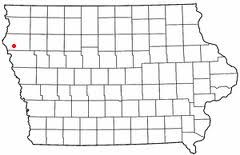
Marvin Richards falls 105 feet from Hinton elevator

Iowan Killed in Fall from Grain Elevator

Sioux City (AP) — Marvin Richards, 28, of Hinton died in a hospital here Friday shortly after he had fallen 105 feet from the top of a grain elevator at Hinton.

Richards was employed by the Tillotson Construction Company of Omaha. He was working on a scaffold atop the nearly completed elevator of the Farmers Elevator Company.

He apparently lost his balance and fell 105 feet to the concrete top of a hopper.

Cedar Rapids Gazette, October 1, 1954

♦ ♦ ♦

Special note: The obituary of Mr. Richards’s sister Deloris E. Holtz.

News of recent developments in Hinton are found on Younglove’s site, including a picture of the original elevator.

Farmers’ Elevator Guide reports Tillotson Construction’s record Montevideo project

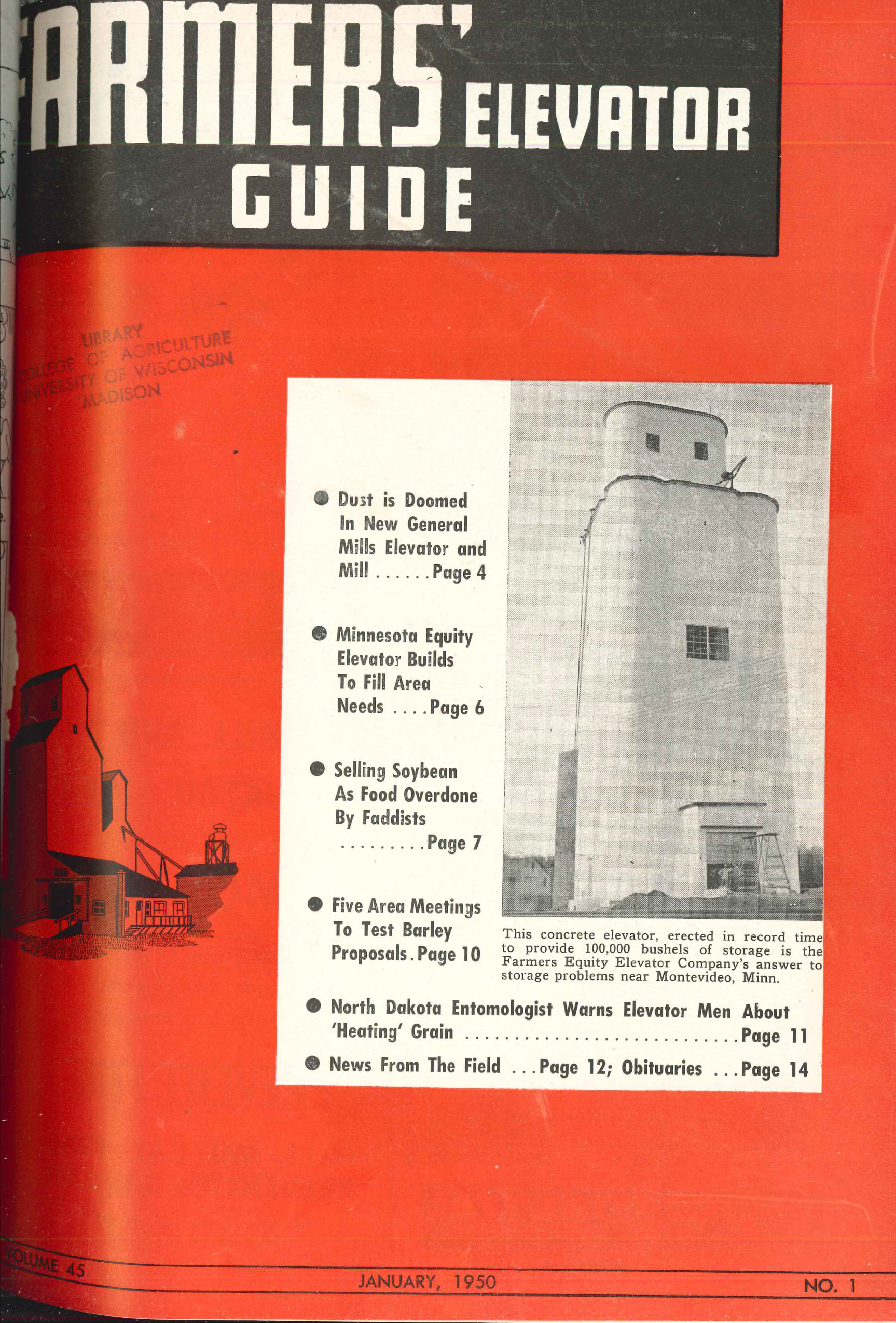
The following story and photos are reproduced from library copies of the January 1950 edition of Farmers’ Elevator Guide:

Complete Service: Minnesota Equity Elevator Builds to Fill Area Needs
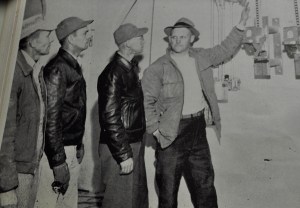
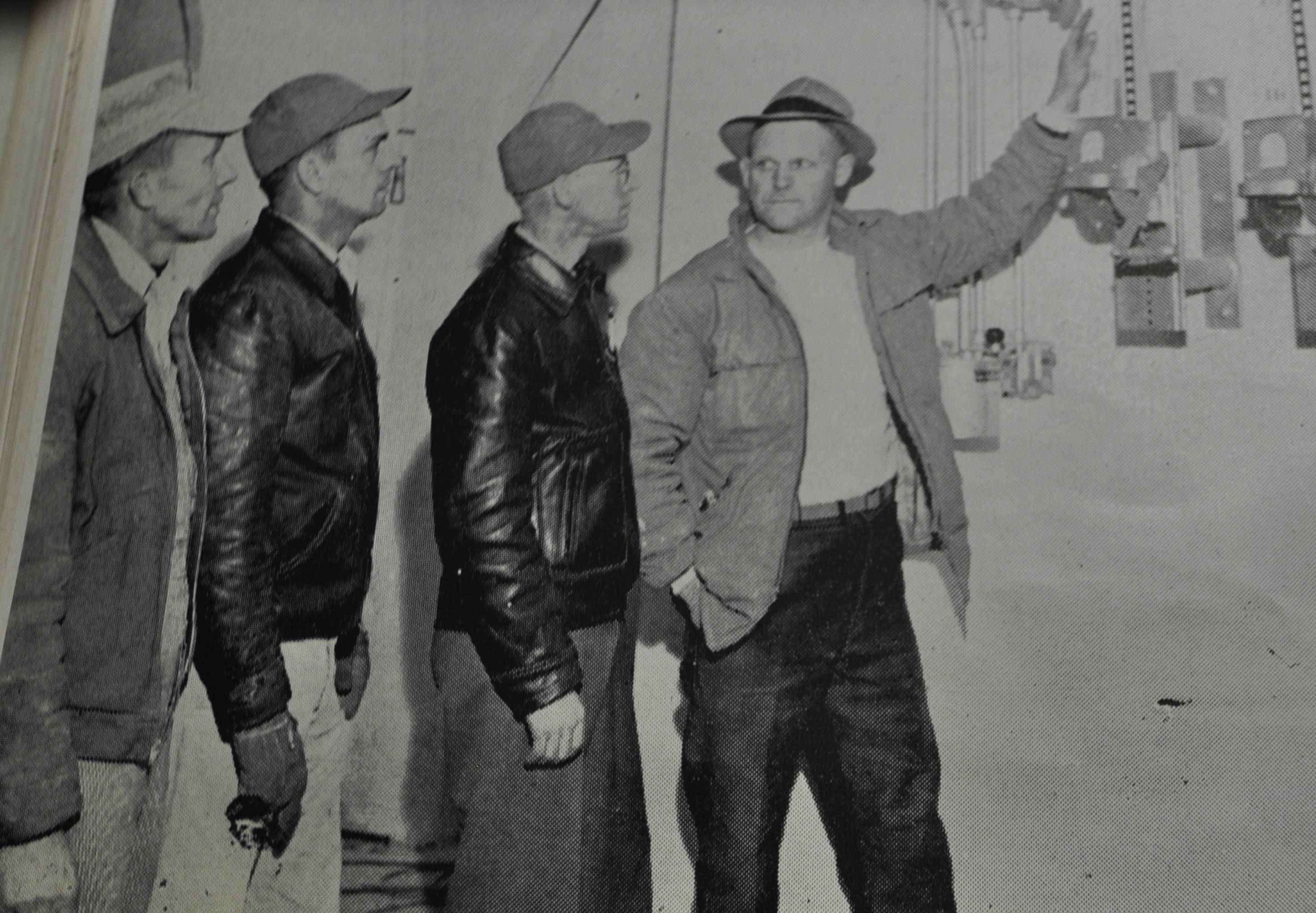
Tillotson Construction's Bill Russell, far right, instructs (from left) Stanley Kittleson, Adrian Dahl, and Merlynn Nelson on operation of the elevator's distributor controls.

Moving quickly to establish itself as the principal district elevator for grain handling, the Farmers Equity Elevator Co. of Montivideo, Minn., has a new 100,000-bushel capacity concrete elevator in full operation after a whirlwind effort to get it built to meet needs of the fall harvest.

When it became apparent that existing facilities in the area left room for a vast expansion to handle grain crops, the Farmers Equity Elevator Company decided to expand its plant which had only 25,000 bushels of capacity.

The project, begun late in August, was rushed to completion by Tillotson Construction Co. of Omaha, Neb, in record time. Concrete pouring by round-the-clock crews was completed in nine days and four hours. This bettered by 18 hours any previous accomplishment for an elevator of this size.

The structure is 102 feet high and has a cupola 29 feet high. It has 17 bins.

Installed during erection was a $15,000 corn drying plant and, on the midway level, a $10,000 grain cleaning installation. This included a large Crippin sieve machine, a large Superior cleaner, a Slurry grain treater and other equipment.

The new building houses a weighing and sampling room but the offices of the company are in the old quarters.

Sliding tubular forms were used to permit the rapid construction.
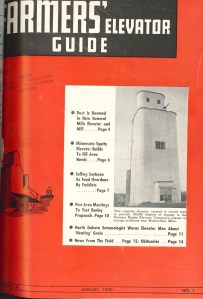
The plant cost $120,000 including $10,000 for piling costs, but other equipment raised the total to $134,000. Features include a 50-ton, 50-foot long scale with lighted dial and printomatic type registering beam. It has two concrete elevating legs each with 30 h.p. head drive and elevating capacity of 5,000 bushels per hour dumping into a Gerber distributing system. Its dump pit has two sections each built under the driveway and extending 12 feet below ground. All bins are hoppered to discharge into pit.

Two large cleaners installed are a Superior cylinder subterminal size machine for coarse grains and a Crippin screen cleaner for flax. All grains will be commercially cleaned before loading out to add profit to operations. The mills can be adjusted for farm seed cleaning in spring months. Gravity is used to feed mills from above and to distribute grain into bins below before loading to cars.

A 400-bushels-per-hour new type Campbell corn dryer was installed at a cost of $15,000. Some 50,000 bushels of the government loan 1949 corn crop were taken in and dried.

The new elevator was dedicated Dec. 29 with President J.W. Evans, also president of the American Soybean Association, presiding.

In 1945, William Osborn worked on Tillotson Construction’s elevator in Giddings, Texas

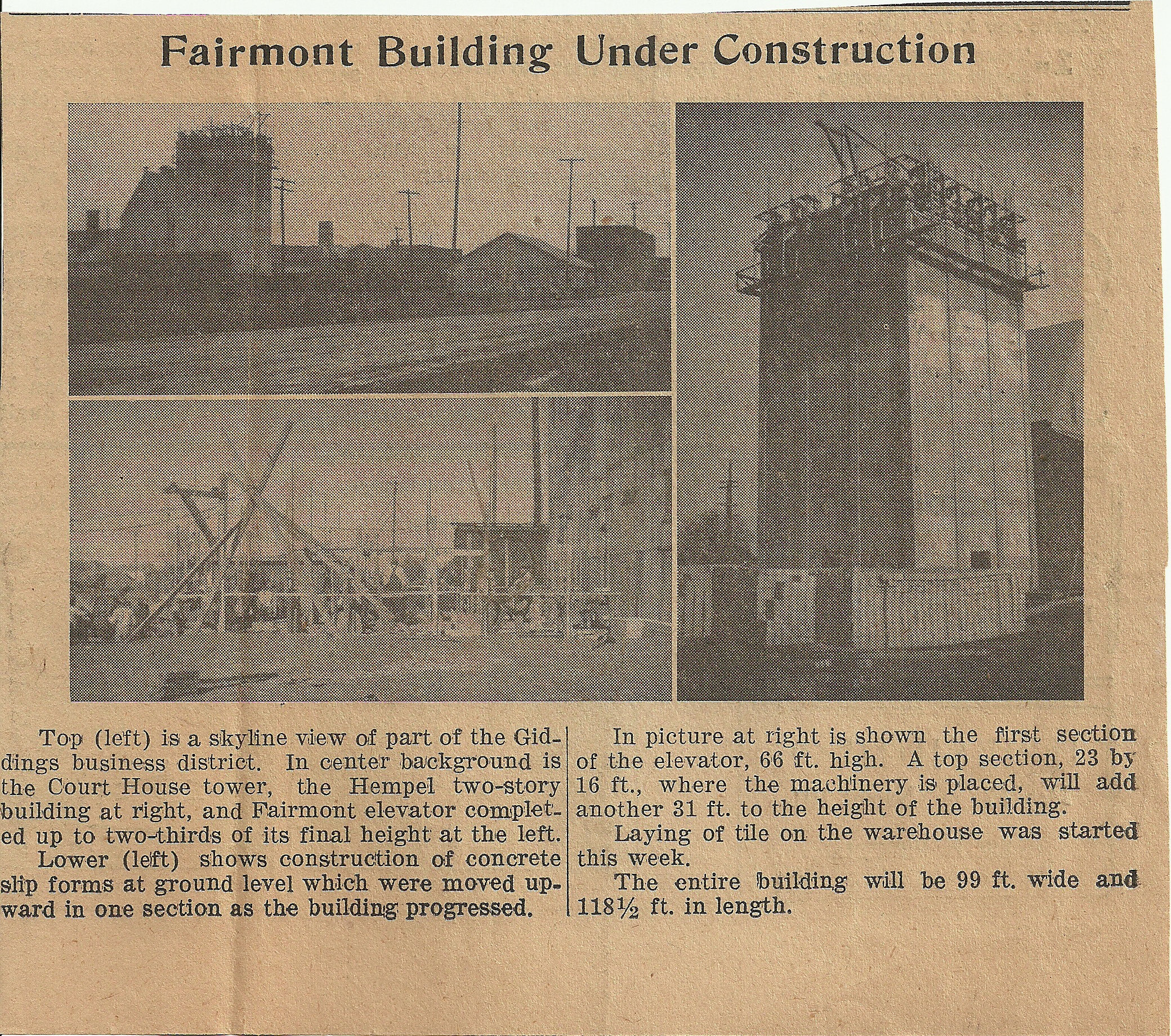
Map of Texas highlighting Lee CountyThis elevator at Giddings, Texas, called the Fairmont Building, is the only one I have pictures for that my grandfather built when he worked for Tillotson Construction Company of Omaha. It would have been built in 1944 and 1945, when my dad turned eleven years old. Dad went to visit my grandpa William Osborn at Galveston in the spring of 1945 during this project. — Kristen

Note: Nutrena bought Fairmont Foods’ plant in Giddings in 1955.

Men wanted in Paullina, Iowa, by Tillotson Construction in 1949

Back Alley, Paullina, Iowa, by Jim Hamann

MEN WANTED for construction work on Concrete Grain Elevator, 90¢ per hour, 10 hours a day, 6 and 7 days a week. Time and ½ over 40 hours.

Tillotson Const Co. at Paullina, Ia.

The Alton, Iowa Democrat, Thursday, May 5, 1949

Editor’s note: In 2008, an explosion and fire injured a customer at the new elevator in Alton.

This map shows the incorporated and unincorpor...

Image via Wikipedia

Painting a concrete grain elevator in Lincoln, Nebraska

Merle Ahrens, uncle of Ronald Ahrens, has written an account of his summer of 1955, which was spent on a scaffold with another of Ronald’s uncles, Michael Tillotson, youngest son of Reginald and Margaret Tillotson:

After graduating from Omaha North High School in 1955, I went to work for Tillitoson Construction on a grain elevator in Lincoln, Nebraska, with Michael Tillotson. I was paid $1.25 an hour.

Merle at home

Merle Ahrens in 2011, at home in Titusville, Fla.

I remember the first day on the job we had to go to the top of the grain storage tank—at least 100 feet—on a bucket that was used to haul up concrete. The bucket was connected to the swinging boom at the top by a wire cable. The cable went to a stationary, manually operated, rotating spool, which wound up the cable to lift the bucket. The operator let it free-fall down, seeing how close to the ground the bucket and riders could get before hitting the brake. It was a scary ride with four or five other workers standing on the rim of the bucket, especially the free fall down. Thankfully, it didn’t take long to get used to.

At the top, there were no rails around the edges nor any safety provisions like you see today, just one jack rod sticking out of the surface to hold on to as you got on and off of the bucket. The first day, I spent a lot of time holding onto that rod looking over the side.

When Michael and I started work, all the concrete pouring was complete and we were given the task of painting the outside of the whole elevator. We painted it using a lime-base whitewash. We had to crawl over the edge of the top of the tank onto a flying scaffold. The scaffold was held up by a pair of rope block-and-tackles connected to a pair of wood beams that were extended about two feet over the edge of the tank. The wood beams extended about ten feet inboard and were weighed down with sandbags to keep the scaffold from falling. The scaffold was made up of a pair of two-by-twelve boards with a metal frame at each end and two-by-four railings around it. The rope block and tackles were attached to the scaffold on the ground. We had to pull the scaffold up to the top every time for each ten-foot width we painted. There was an old man on the ground who mixed the paint and pulled it up to us in a five gallon bucket. He had a harder job than we had. All we had to do was brush on the paint and pull the rope to release the half hitch that held up the scaffold and let gravity work to lower it. The “flying” part of flying scaffold was when the wind was blowing. You would fly halfway around the tank.

Every night we would take off our Levi’s and stand them in a corner. There was so much paint on them! Yet one pair lasted all summer.

After a couple of months we finished painting the elevator in Lincoln and went to David City to paint another grain elevator. This time we used a new latex paint. It was very slow-drying and the wind kicked up a lot of dust. The elevator ended up white with grey stripes.

We kept hearing of accidents at other sites. One man was said to have fallen from a plank used to walk between the top of two tanks. He was wearing new boots and slipped. Another was killed when roofers removed the sandbags holding the beam for the flying scaffold so they could hot-tar the roof. A couple more were hurt while riding on a bucket and the clamps holding the cable slipped. The clamps were installed wrong. I do know for a fact that one worker at Lincoln was hit in the face when a five-gallon bucket with concrete in it fell while he was using a rope and pulley to lift it overhead.

At the end of the summer, Michael went back to North High, and I went to work for the Union Pacific Railroad.

Merle Ahrens

January 9, 2012

December 1950: Tillotson Construction’s Jess Weiser weds Lavonne Wiemers in Palmer, Iowa

Miss Lavonne Wiemers, daughter of the late Mr. and Mrs. B.R. Wiemers, and Jess Weiser, son of O.S. Weiser of El Reno, Oklahoma, were married Friday evening, Dec. 22, in St. Paul’s Lutheran church in Palmer, the Rev. R. Wagner performing the ceremony.

Miss Darlene Wiemers was maid of honor, and bridesmaids were Mrs. Kendall Peterson of Fonda and Mrs. George Mart of Estherville, all sisters of the bride, and Miss Norma Schoon of Palmer, friend of the bride.

Flower girl was Janet Peterson, and ring bearer was Tommy Mart, nephew of the bride.

Roger Osborne and George Christian served as attendants to the bridegroom. Ushers were Paul Wiemers and Kendall Peterson.

Following the ceremony a reception was held at the Palmer Legion hall for 75 guests.

Mrs. Weiser, a graduate of Palmer high school, has been employed in Palmer. The bridegroom graduated from Yukon, Okla., high school and served in the Air Transport Command for three years. He is employed by the Tillotson Construction Co. Mr. and Mrs. Weiser will make their home in Storm Lake.

Pomeroy (Iowa) Herald, January 11, 1951

Maxine Carter leaves Tillotson Construction to wed

Miss Maxine Carter, daughter of Mr. and Mrs. Leland Carter of Corning, Iowa, and Russell L. Bentley, so of Mr. and Mrs. Edgar Bentley of Marathon, Iowa, were united in marriage Saturday morning, October 8, by Rev. C.D. Reed, in the First Methodist church in Council Bluffs, Iowa.

Miss Catherine Dakir of Omaha, Nebraska, was bridesmaid, and William LePine, also of Omaha, Nebr., was best man.

The bride wore a toast color suit with green accessories. Her corsage was light pink roses tinted with brown. The groom wore a dark blue suit.

The bride was a graduate of Corning high school in 1948, then attended Commercial Extension Business College in Omaha, Nebr., graduating in April, 1949. She was then employed as secretary to the Tillotson Construction Company of Omaha until the 7th of October.

The groom graduated from Marathon high school in 1947, then attended National Railroad School in Omaha, graduating in July, 1949. He is now with the Chicago, Milwaukee, St. Paul and Pacific railroad.

The couple are waiting until the groom gets his first vacation for their honeymoon.

We extend our sincere congratulations to the newly weds.

Adams County (Iowa) Free Press, Oct. 13, 1949

130-foot fall claims Larry Ryan’s life in Pochahontas, Iowa

Worker Is Killed in Fall From Elevator

Pochahontas, Iowa –(AP)–A 130-foot fall from the top of the Farmers Co-operative Elevator, under construction here, claimed the life Wednesday of Larry Ryan, 20, of Cassville, Mo.

Ryan, an employe of Tillotson Construction Co., Omaha, was operating a hoist used to raise supplies to the top of the elevator. Cause of the accident was not immediately learned.

Muscatine (Iowa) Journal

Thursday, July 29, 1954