Linking together preassembled formwork came after pouring an elevator’s slab

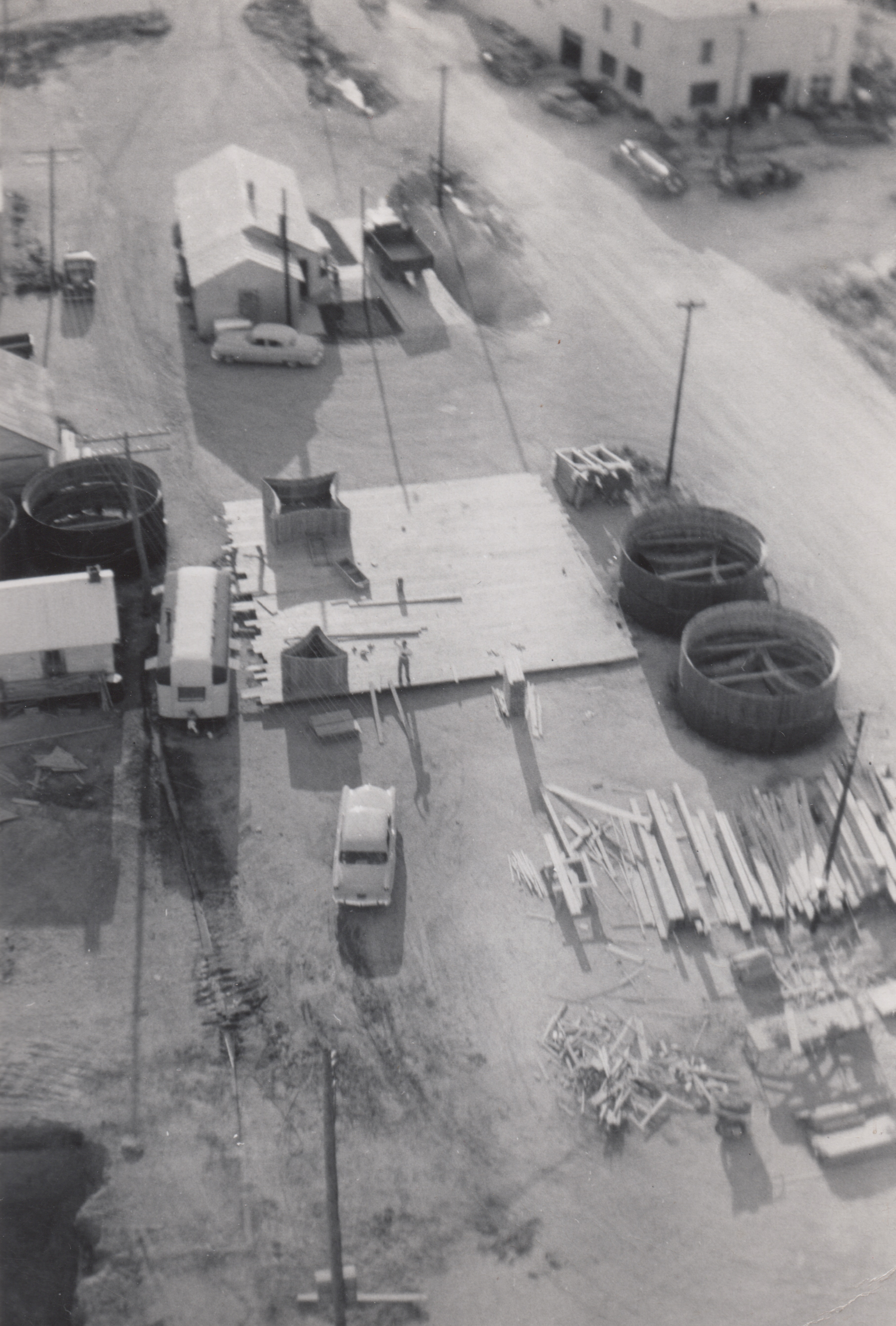
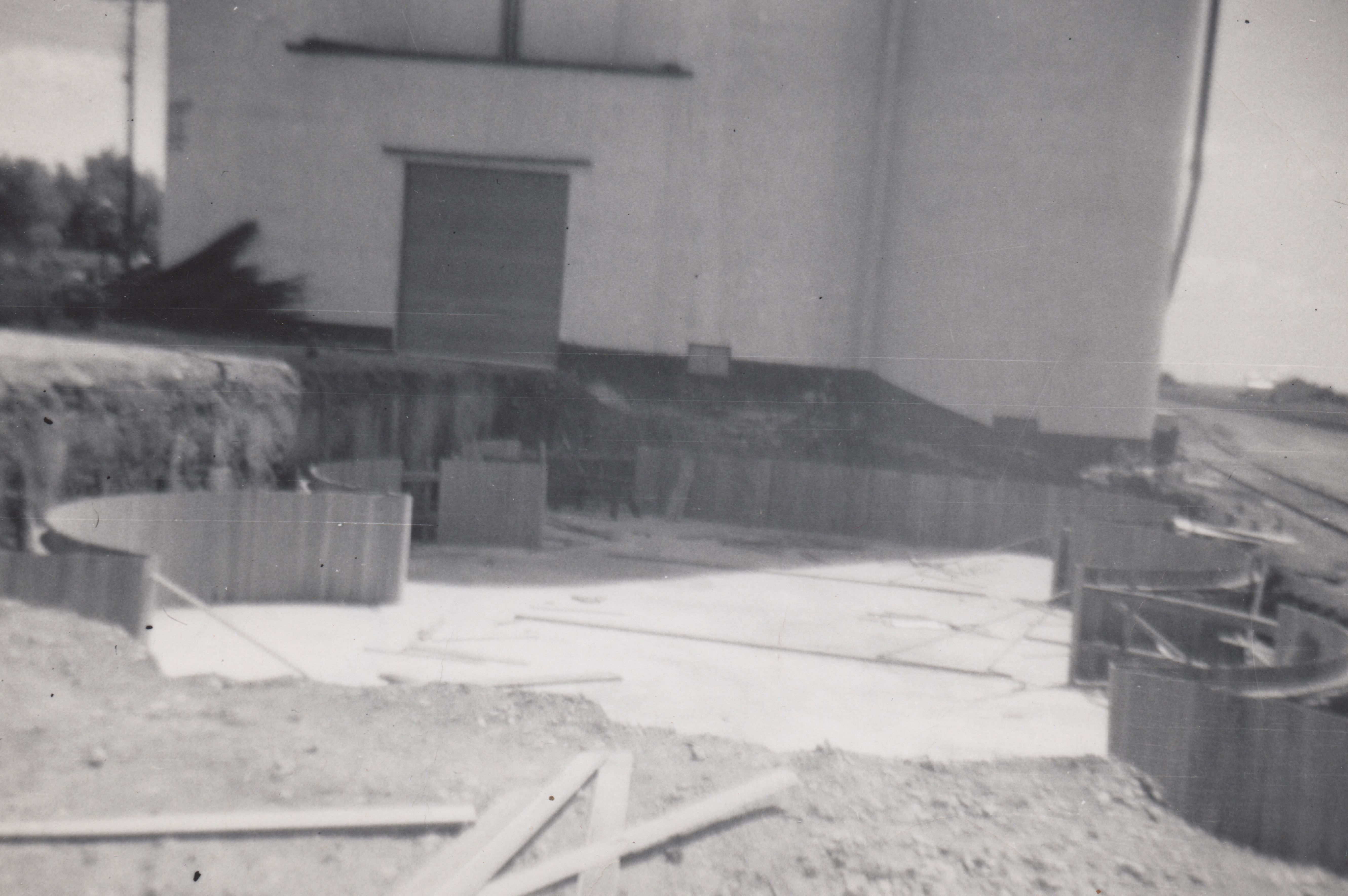
Initial formwork for new grain bins at Flagler in 1953.

Initial formwork for Tillotson Construction’s new annex of grain bins at Flagler, Colo., in 1953.

Editor’s note: The following explanation by Charles J. Tillotson helps to answer the question of how a grain elevator is built.

The excavation you see in the picture was dug for the foundation and floor slab of the annex at Flagler. Once the slab is poured, the forms that have been built are moved onto the slab where further carpentry is used to connect all the formwork together and construct the supplemental formwork such as horizontal ribs, jack yokes, et cetera, to make an integral form, all assembled into a uniform unit and capped entirely with a walking deck, also of wood.

Oftentimes the job site did not lend itself to building the major portion of the formwork simultaneously with the excavating and placement of the foundation (lack of space, topography, et cetera). So all of the formwork had to be built in place after the new floor was poured, which slowed the construction time of the overall build-out of the elevator.

Taking it from the top at Tillotson Construction’s annex in Flagler, Colorado

Scan

This photo from the Tillotson Construction Company archives shows the staging deck, on which all formwork was built to ensure it was dead level. The square section was probably the form for a conveyor or bucket shaft, or for a man lift. The triangular section, called a groin form, was made for the void where two rows of bin forms were placed together. The excavation hole for the new annex is seen, lower left, at the foot of the 252,000-bushel elevator the company built in 1950, modeling it after their one in Pond Creek, Okla. 

By Ronald Ahrens

In 1953, my grandfather Reginald Tillotson decided to send his three sons, Charles, 18, Tim, 16, and Mike, 13, to work on an annex to the Flagler, Colo., elevator Tillotson Construction Company had built three years earlier.

My grandmother Margaret didn’t like the idea.”You can’t send those kids out there,” she protested.

“It’s about time they grew up,” Reginald said.

Indeed, my uncles were sent, leaving Omaha in a new Ford and pulling the travel trailer that would be their home for the next few weeks.

“I don’t remember that he even came out,” Uncle Tim said recently of Reginald.

From left, Tim and Chuck Tillotson and La Rose Tillotson Hunt in 2012.

From left, Tim and Chuck Tillotson and La Rose Tillotson Hunt in 2012.

While Charles and Tim labored on the formwork that rose toward the sky, Mike stayed in the trailer, which doubled as their bunkhouse and the job office. His task was that of timekeeper.

“I don’t recall him bein’ out there when we was jackin’ and pourin’,  jackin’ and pourin,'” Tim said, although he did recall him reading hot rod magazines.

Once the pouring started, it couldn’t stop. A cold joint between concrete that had already set and a new pour wasn’t at all desirable, for it would leak.

“You had to treat that damn good when you started over,” Tim said.

Work went on in twelve-hour shifts. As the concrete was dumped out of a Georgia buggy–a V-shaped tub riding on large wheels behind a U-shaped handle–someone with a spud hoe would follow the pour and work the concrete, releasing the air from around the rebar. “The only way you shut down was an emergency,” Tim said. Lightning, for example, was an emergency because it was attracted to the rebar being used to bolster the concrete.

_DSC0033_9425The crew was made up of some trusted old hands and an assortment of locals. “You never knew who you were workin’ next to,” Tim said.

He remembers the local sheriff asking himself why he should put up anyone in the jail when they could work and earn their keep. One of the convicts toiling alongside Tim had a funny thought. “You think you can hang onto that hoist handle hard enough if I push you off?” he said.

Any number of mishaps could occur. “You ought to see one of them Georgia buggies go off the top,” Tim said. “Or the cotter pin come off the wheel and the wheel go off.”

At ground level the pour was made in six-inch increments, but the speed increased as the elevator rose.

To keep the screw jacks on the same plane and maintain plumb, the crew used a water-level system on the deck. A clear hose was fed by water from a 55-gallon drum. Tim said the hose had a level “that you marked before you ever pulled off the ground. And believe it or not, you’d get one hundred and some feet up, and you’d be plumb!”

Gordon, Nebraska’s elevator was built in a classic Mayer-Osborn style

The Mayer-Osborn elevator, identified by manhole covers inside the driveway, stands in front of Chalmers and Borton additions

The Mayer-Osborn elevator, identified by manhole covers inside the driveway, stands in front of Chalmers and Borton additions.

Story and photos by Gary Rich

Farmers Co-op operates these elevators. The co-op is based in Gordon, Hay Springs, and Hemingford, Neb.

The elevator in the foreground was built by Mayer-Osborn Construction Company, based in Denver. The completion date is not known.

The elevator in the background was built by Chalmers and Borton Construction, based in Hutchinson, Kan., in 1958. The company built a second elevator, west of these elevators, as well as a couple of annexes.

A side view of the Mayer Osborn elevator

A side view of the Mayer Osborn elevator.

By Kristen Cart

This stepped up headhouse design was first rolled out with the elevator in McCook, Neb., built in 1949 by Mayer-Osborn Construction Company. The style was featured in the Mayer-Osborn ad that ran in the early 1950s in the Farmers Elevator Guide.

The Gordon elevator showcased the rounded headhouse construction method adopted by Tillotson Construction for their later projects, but it is not known which company pioneered the cost saving technique.

From his home in Colorado, Gary Rich investigated this elevator on a trip east to photograph a number of Midwestern elevators. Gary has been instrumental in identifying a large number of Mayer-Osborn, Tillotson Construction, and J. H. Tillotson projects, pursuing the history of the elevators with as much passion as he puts into his excellent photography.

We are indebted to him for his relentless pursuit of good information, now contained in this blog.

Tillotson Construction’s signature, the curved headhouse, was a practical matter

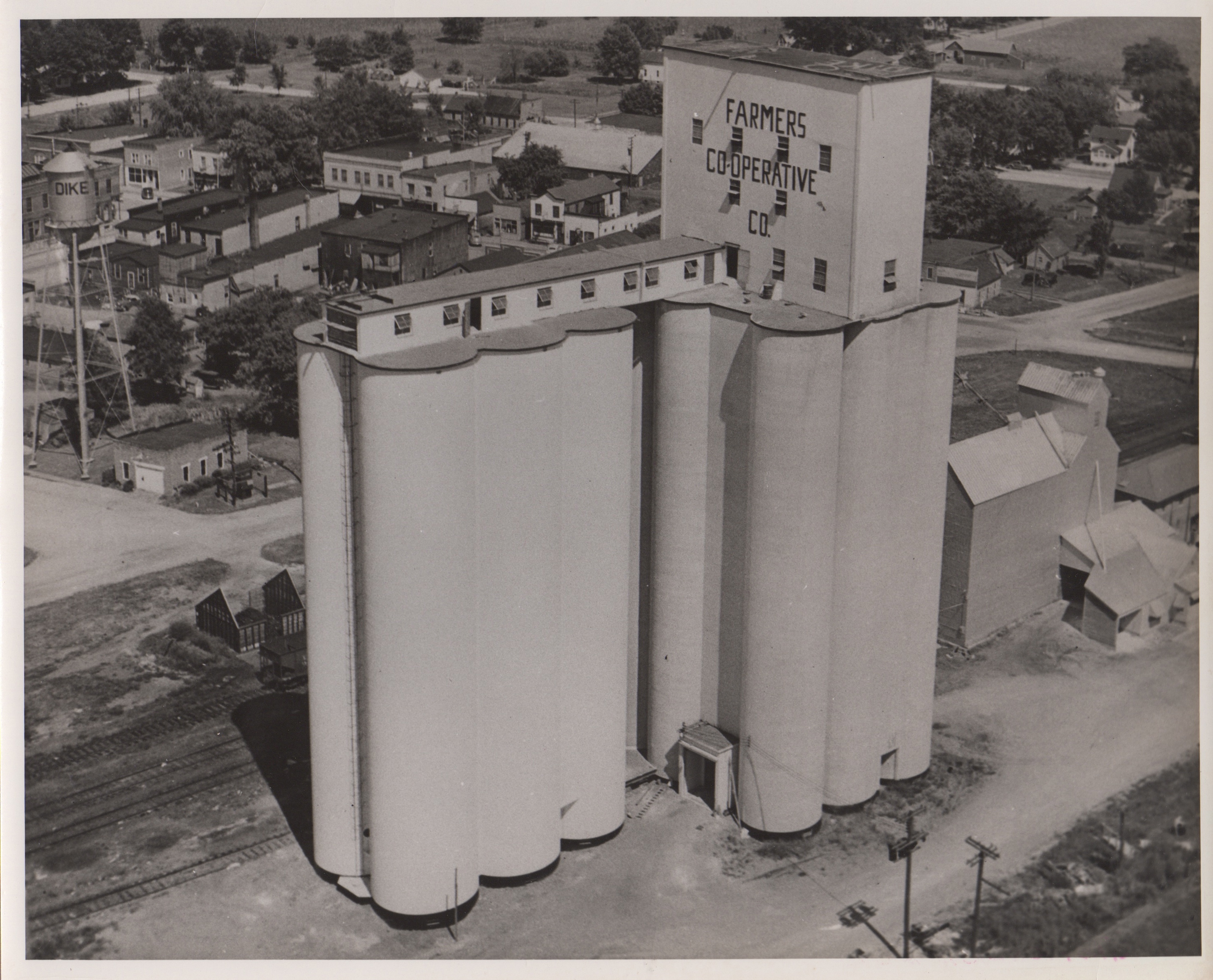
The main house of Tillotson Construction's elevator at Dike, Iowa, built in 1946 (annex, left, 1949), is crowned by a rectilinear headhouse.

The main house of Tillotson Construction’s elevator at Dike, Iowa, built in 1946 (annex, left, 1949), is crowned by a rectilinear headhouse. 

In this post, Charles J. Tillotson explains how his father, Reginald Tillotson, president of Tillotson Construction Company, developed the curved headhouse design.

It would be nice to say that the curved walls were created by Dad for aesthetic reasons and leave it at that.

However, a number of factors actually influenced the design, those being:

  1. Re-use of the curved yokes (the horizontal framework supporting the vertical forms used during slip-form construction of the storage bins).
  2. Building square corners into concrete slip-form construction proved to be more difficult than curved corners.
  3. Placing horizontal reinforcing steel for square corners entailed bending it at a ninety-degree angle and then manhandling it into position, whereas with the curved forms, the horizontal reinforcing steel could be inserted much easier by sliding it into position.
Tillotson's Aurora, Neb., elevator, built in 1950, has a curved headhouse.

Tillotson’s Aurora, Neb., elevator, built in 1950, has a curved headhouse.

For numbers two and three above, keep in mind that all horizontal reinforcing steel, or rebar, was placed by hand (anywhere from twelve to sixteen inches) during the slip-form process, all while the forms were being slipped vertically by screw jacks.

The horizontal steel had to be placed rather quickly throughout the entire structure, so that the steel bars were approximately in alignment from the beginning of placement throughout the structure and back to the beginning point.

On large projects, steel placement was divided into segments with a team captain in charge of each, and all captains would then synchronize their start times for installing the rebar.

Slip-form construction involves a great deal of detailed labor to carry out specific functions while the forms are being jacked vertically in constant motion. It used to be about five to six inches per hour.

History is preserved in pictures at St. Francis, Kansas

Story by Kristen Cart

Farmers line up their grain trucks at St. Francis, Kan.

Farmers line up their grain trucks at St. Francis, Kan.

One of the most pleasant surprises at the St. Francis Mercantile Equity Exchange was their historical record preserved in pictures. In its hundred-year history, the exchange has maintained a continuous presence on the site of the present elevator, and has seen many changes in technology. Fortunately, photos exist that document the old way of doing things, and  Shirley Zweygardt, the site grain manager, was kind enough to provide copies.

In this photo dated 1951, an old wooden elevator stands immediately behind the concrete house. It was demolished to make room for the second bank of concrete bins, built in 2000.

In this photo dated 1951, an old wooden elevator stands immediately behind the concrete house. It was demolished to make room for the second bank of concrete bins, built in 2000.

It is always a fantastic find when you locate a pictorial history of an elevator.

A picture album, filled with historical treasures, which Shirley Zweygardt was pleased to share

A picture album, filled with historical treasures, which Shirley Zweygardt was pleased to share

I had already acquired a 1947 dated postcard depicting the elevator, so we knew its age. These additional photos, dated on the reverse “1951,” show its stately beauty. They depict two additional wooden elevators, which have long since disappeared. The vintage automobile in the foreground of the first image substantiates the date of the caption. Without the car, this photo would appear timeless, even though it was taken shortly before the addition of the first annex built by Chalmers and Borton.

Another view, dated 1951

Another view, dated 1951

It was quite a lovely thing; by 1951, the largest known elevator built by J. H. Tillotson, Contractor, was celebrating its fifth year, and was still white and stark against the sky. The elevator at McCook, Neb., was only two years old when this photo was taken, and my grandfather, builder William Osborn, had gone on to other projects with the Mayer-Osborn Construction Company.

Shirley Zweygardt told me an elderly resident of the town had preserved these photos in an album, which she brought to the elevator office, where they became part of the records of the equity exchange. The prints, reproduced here, were duplicate copies, now part of my growing library of historical images.

The visit to St. Francis was a happy one, capping an October 2012 elevator tour. This elevator marked the pinnacle of J. H. Tillotson’s construction career. Impressive still, it is a fitting monument to the skill, ambition, and industry of its builders.

In 1946, Tillotson Construction built a mighty elevator in Kingfisher, Oklahoma

Scan

By Ronald Ahrens

In 1946, Tillotson Construction Company, of Omaha, built a grain elevator in Kingfisher, Oklahoma.

Kingfisher, a town of 4500 people, lies about forty-five miles northwest of Oklahoma City.

Company plans list the reinforced concrete elevator’s capacity at 240,000 bushels.

The elevator, seen on the left in the photo in a view from the northeast, was built on an expanded version of Tillotson’s standard Medford plan, with one leg. Two driveways pass through the center of the house.

Storage was calculated at 2400 bushels of grain for each foot of height.

Adapted from Wikipedia's OK county maps by Set...

A call to the elevator was answered by Linda in the office. She dug out a 50-year history of the co-op, published in 1984.

It says that in 1946 the co-op “wrecked” its old 34,000-bushel elevator, preserving the office and sale house, and erected a new 250,000-bushel elevator. (No telling how to account for the 10,000-bushel difference between the company’s records and the co-op’s history.)

The published history includes a 1955 “skyline view” photo that may be the same picture as above. Note the stained, north-facing, outer walls of the Tillotson elevator, indicating it had been in use for some time, while the elevator to the right is obviously brand new.

The Tillotson elevator is presently known as the south elevator. The wooden buildings no longer exist at the site. In recent times, the Kingfisher Co-op Elevator first merged into a regional organization and is now part of a conglomerate.

An old wooden elevator comes down at Halsey, Oregon, and shares its secrets

dsc_0317

Halsey, Ore., in early 2012.

Story and photos by Kristen Cart

Elevators such as this one in Halsey, Ore., have elicited interest from photographers and curious travellers for as long as they have existed, especially since they are on the verge of extinction. Technology passed them by back in the early 1940s when most of the new construction in the United States went to slip-formed concrete.
dsc_0924

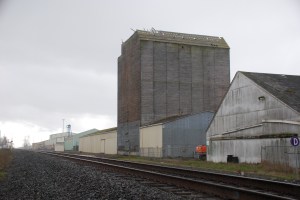
The remnants of the Halsey elevator, Feb. 2013, in a downpour.

Canada held out, building wooden elevators well into the 1970s, with a minority of them still in service today, and many more long since demolished, abandoned, or burned.

The end has come for the Halsey elevator. After hearing of its demise in an online forum, I recently passed near the town on I-5 and stopped to see the hulking remnant. It was a sorrowful sight, topless and dreary.

But beside it was a more interesting find.

In an empty lot next to the elevator, piled randomly, was the elevator’s leg. It brought to mind a story–a cautionary tale, really–which illustrated why concrete was so attractive to engineers looking for a better alternative.

dsc_0933

The leg from the Halsey, Ore. elevator, piled on the ground.

While exploring elevators in Alberta, Canada, I took a trip to a small town called Milo.

It was a snowy day, and as I gazed up at the lone wooden elevator, a gentleman pulled up in his truck and asked if I needed directions. He introduced himself as Ian Thomson. He was a long-time resident and farmer, and once we got on the topic of elevators, he told me that Milo once had nine wooden elevators lined up along the rail line. The sole survivor, silver-sided and huge, was built in the 1970s. It was still active, and its nearest neighbor had come down a year or two before.
DSC_0598

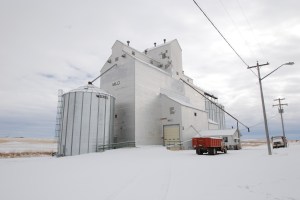
The lone wooden elevator in Milo, Alberta, Canada.

Ian told a tale of the demise of one of the old wooden houses.

One of Milo’s elevators was decommissioned in winter, years ago. When the leg was torn out, a salvage company tried to remove the conveyor belt to reuse the rubber. Water remained in the pit, and the lower portion of the leg could not be retrieved because it was frozen solid. So they cut the belt off at the top of the ice and hauled off what they could. The owners told Ian that as soon as the pit thawed out, he could have the rest.

It was an early spring day, and a thunderstorm rolled by. A farmer could always use rubber–Ian was thinking of mud flaps for his truck, so when he went to check the elevator that day, he was disappointed to find the leg remnants still frozen solid in the pit. So he left without them. But as he exited the elevator, he noticed a thin tendril of smoke rising from the headhouse.

DSC_0610

Ian Thomson displays his railroad collection.

With gut wrenching dread, he called the owners, but he knew it was already too late. A fire company fought the blaze, but by then the elevator was fully involved, and it burned completely down.

A nagging worry stayed with Ian. While he knew he had done nothing to cause the fire, he was seen leaving the elevator, and he thought his neighbors might wonder about it. But the real culprit was lightning. He needn’t have worried.

Ian Thomson was an honorable member of the community and an esteemed historian, with a proud military heritage. He was, and still is, a true gentleman farmer.

DSC_0593

Alberta wheat country.

The fire danger inherent in wooden elevators spurred engineers to try concrete building methods. Concrete elevators came with their own hazards, but also great advantages, and they remain the premier choice for durable, large scale grain storage.

But we still miss the proud old wooden denizens of the plains.
Discovering the J. H. Tillotson elevator at St. Francis, Kansas, as a centennial looms

DSC_0248(2)

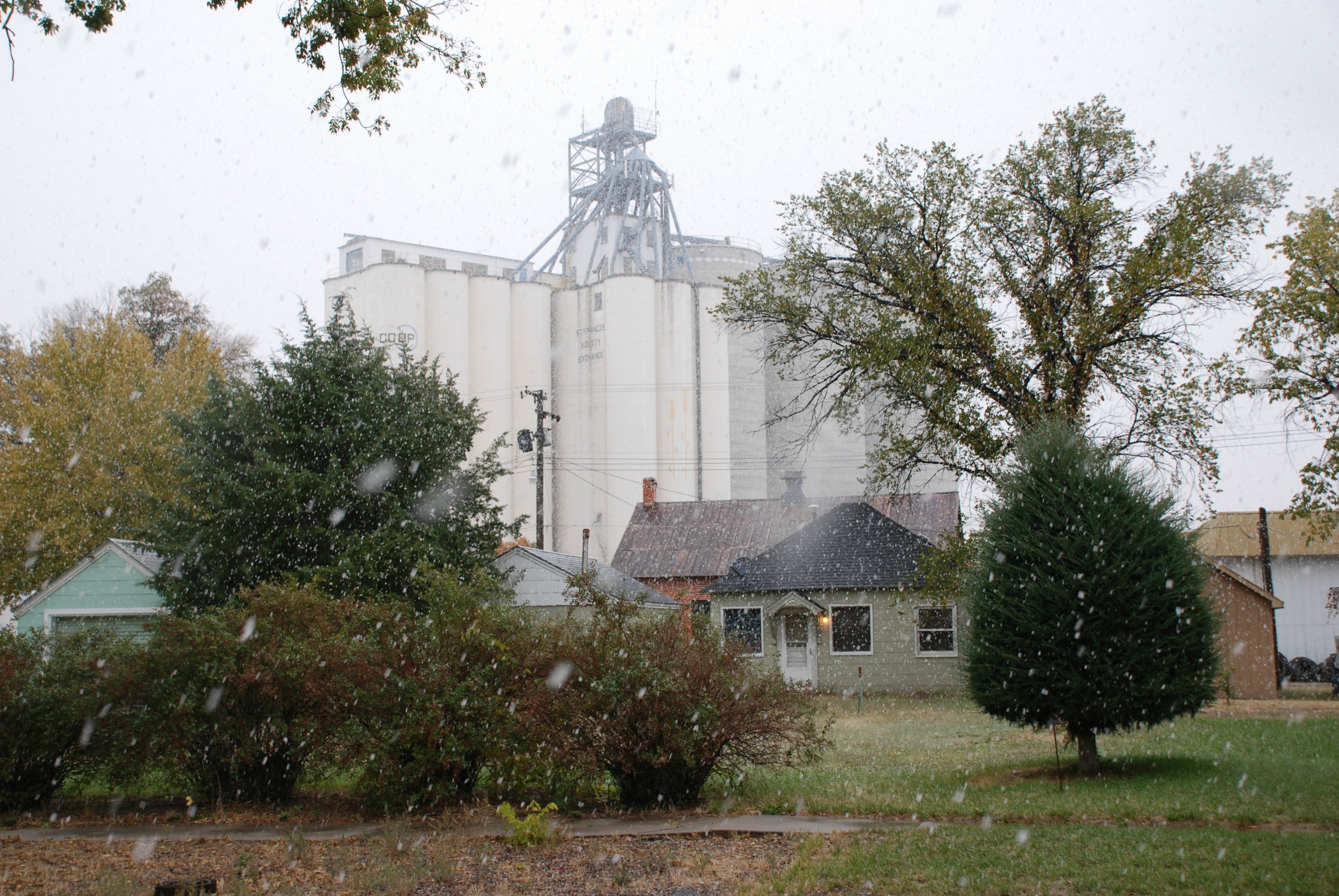
The J. H. Tillotson elevator in St. Francis, Kan. is nestled between two annexes.

Story and photos by Kristen Cart

St. Francis, Kan., stayed on my mind for months after I failed to find any sign of the work of my grandfather, William Osborn, on our first visit.

Out on the western end of Kansas, the town was well clear of any route our family would take on the way to somewhere else. It was a very intentional stop on our itinerary. On our first visit, we took a wide loop, arriving just after sundown, and we lost the opportunity to investigate further than one cursory look at the wrong elevator. The visit to St. Francis was shelved for several months, and I almost didn’t go, but when I did, I made sure to be there before nightfall.

The weather caught up, however.

DSC_0224(1)

St. Francis Mercantile Equity Exchange grain merchandiser, Shirley Zweygardt.

This time, I headed toward the highest structure in town. By the time I pulled up to the elevator office, fat flakes of snow wafted down and splotched the truck’s windshield, melting on contact with the ground. It was October, and the trees, which still held their leaves, were a golden brown backdrop for the early snow. I shook off the cold and entered the co-op.

A surprise awaited. A long-time employee of St. Francis Mercantile Equity Exchange, Shirley Zweygardt, greeted me at the door. Raised on a farm just down the road, she was intimately familiar with the elevator’s history and purpose, so in 1979, when a job opportunity arose, she was glad to fill in where needed.

It has been a happy arrangement. Shirley started as a bookkeeper, then worked in grain accounting and is presently in charge of grain merchandising. She has seen the St. Francis Mercantile Equity Exchange through many changes over the years.

She asked me to sit down and have some coffee, and she shared her experiences of working around the old St. Francis elevator.

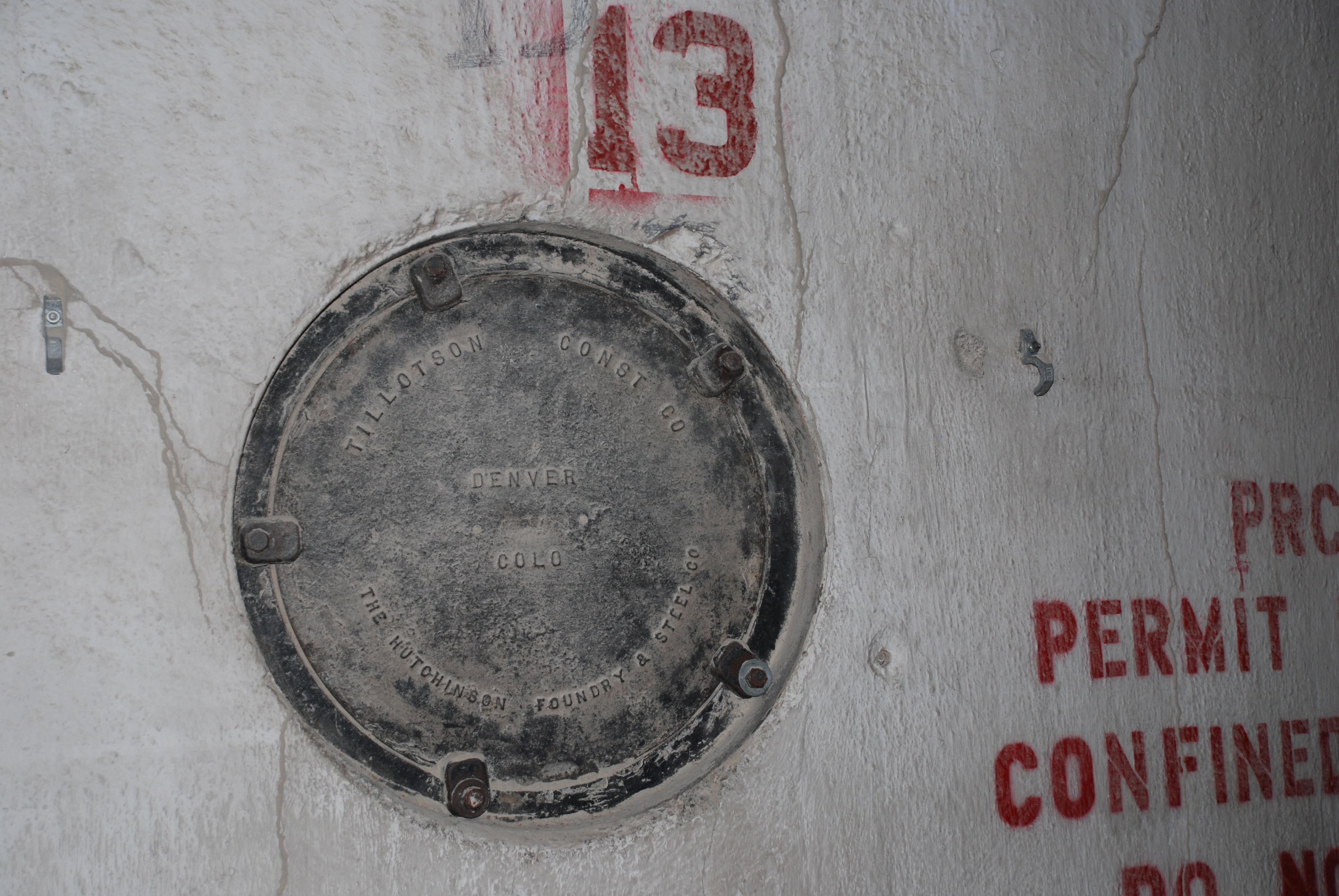
The manhole cover on the interior of the driveway identifies the builder

The manhole covers on the interior of the driveway identify the builder.

St. Francis Mercantile Equity Exchange was incorporated in 1913. As slip-formed concrete construction methods advanced, the equity exchange looked for a company to build their first concrete elevator. Once it was completed in 1946, their quarter-million-bushel elevator was the biggest and most modern in western Kansas. It more than doubled the storage capacity of its lesser neighbors. And lo and behold, it was built by J. H. Tillotson, Contractor, of Denver, with the construction supervised by my grandfather, William Osborn.

It was not the only grain storage on the site for long. Soon, the capacity proved to be too little for the 1940s and 1950s boom years, so Chalmers and Borton came along and built the first annex.

Later, the site incorporated a flat storage facility which only holds wheat, since its air system does not ventilate adequately for moist corn. A second three-bin annex was built in 2000, using the same old technique of lifting concrete up to a dump cart that ran on a track around the perimeter of the rising elevator. It was completed just before the onset of a seven-year drought, and it took a few good harvest years to recoup the investment, since the annual wheat yield was too low at first to fill the bins.

Wall Street would not be the only beneficiary of perfect prognostication. The present snowfall was gladly welcomed in St. Francis.

The St. Francis Mercantile Equity Exchange will be celebrating its 100th anniversary this year. It has been and is the cornerstone of the town, and the center of business and economic life. Stay tuned for a little more of the history, and wonderful images, of this fine elevator, which Shirley kindly shared.

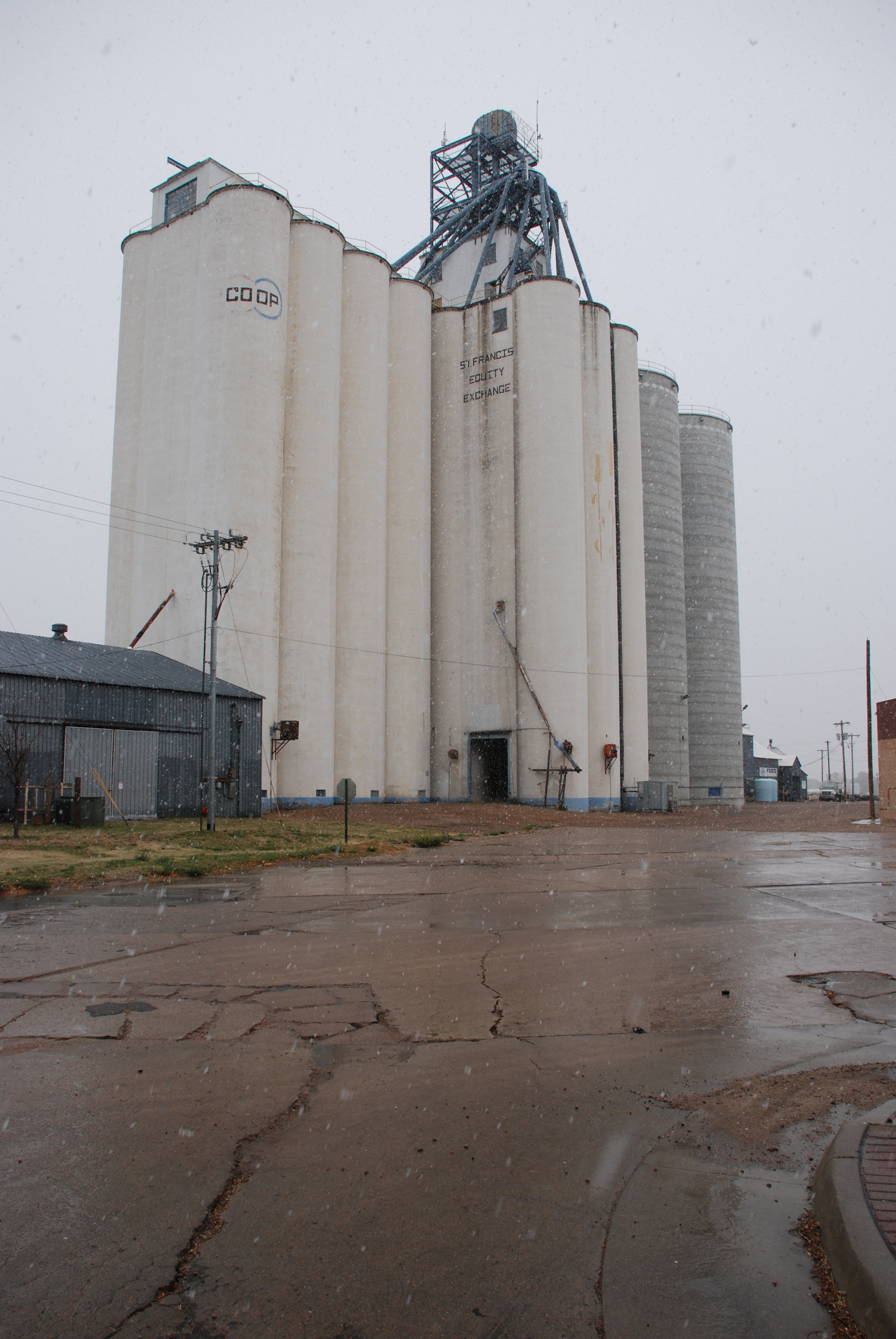
The Chalmers and Borton annex is in the foreground, and the new annexes are behind the main house.

The Chalmers and Borton annex is in the foreground, and the new annex bins are behind the main house. The flat storage shed is on the left.

Vintage photos show aspects of how a grain elevator works

Elevator photos003

Story by Kristen Cart

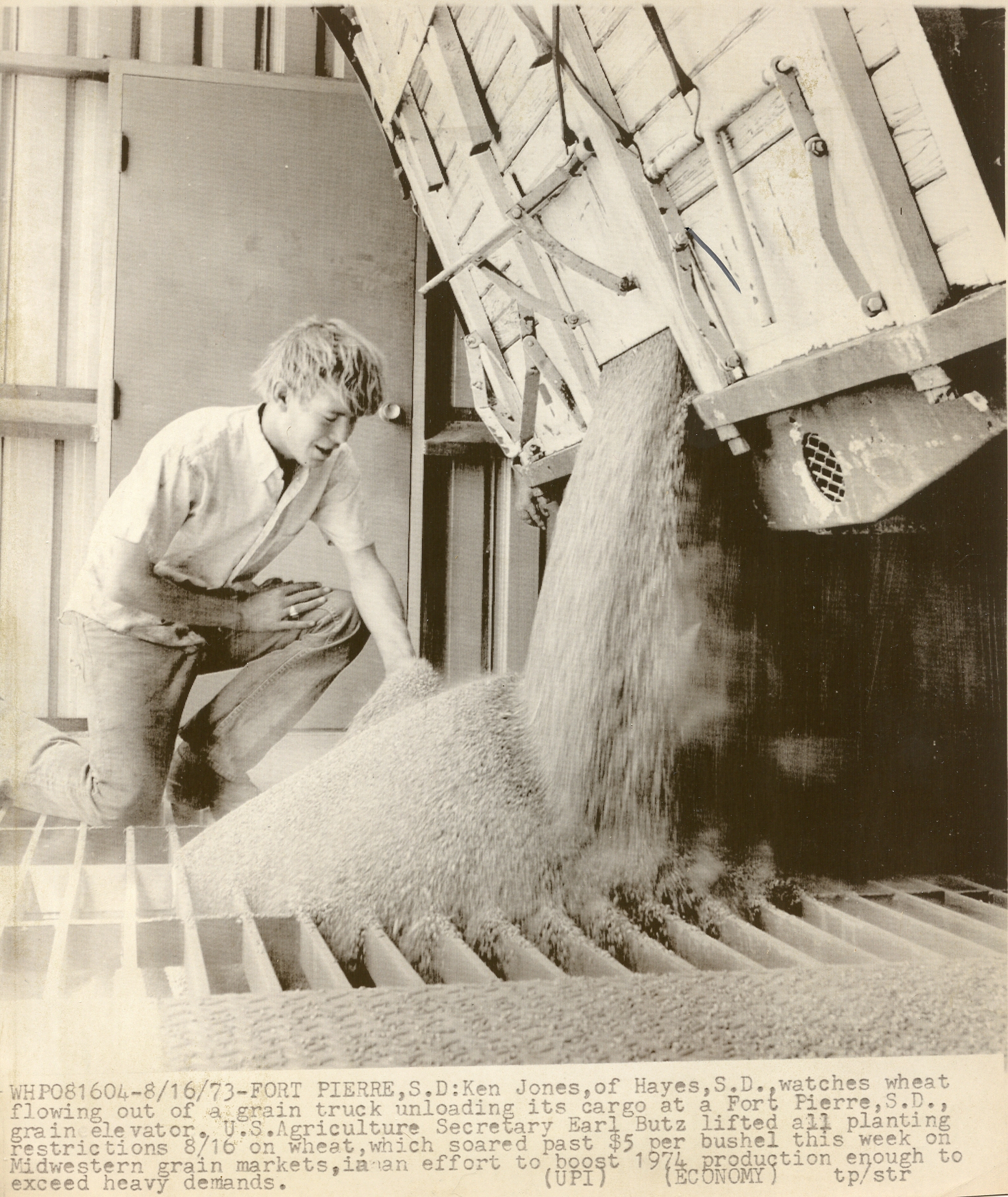
Sometimes a picture is worth a thousand words. Luckily for us, old press photos have come on the market recently that show the inner workings of grain elevators in the past. Not much has changed over the years, since many of the elevators that served in the 1940s and 1950s are still in operation today.

The photo above shows a truck unloading into an elevator pit from the inside of a driveway. A grate covers the pit, and from the pit a leg serves the top of the elevator. A conveyor may also be in operation, delivering grain to the leg, depending on the size of the elevator or annex.

Elevator photos001

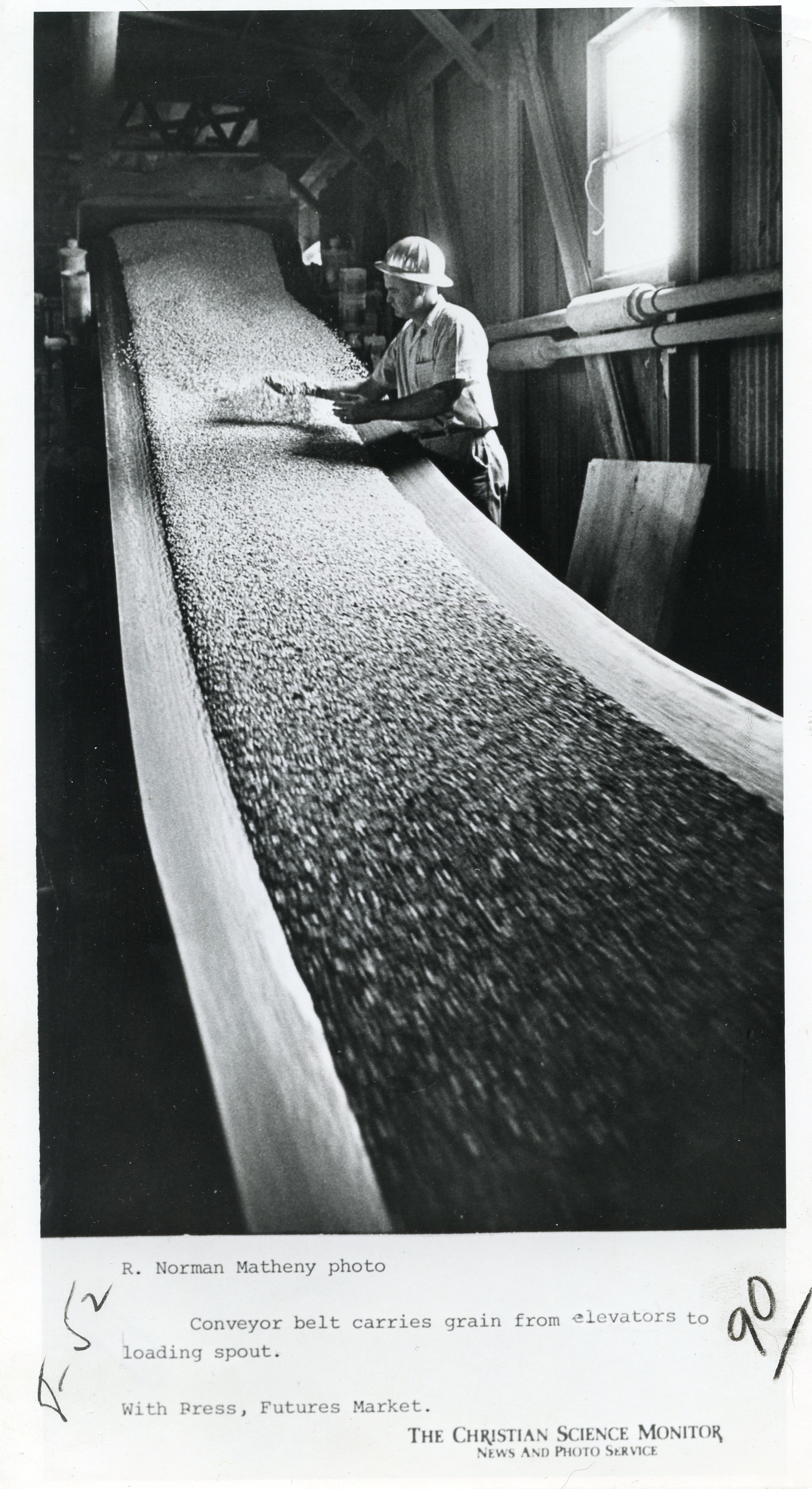
In the next image, you can see a worker beside the conveyor inside what looks like a run. Conveyors can be used in several places in an elevator complex, but they are normally installed in a run that delivers grain from an elevator headhouse for distribution to an annex, or they’re operating on a basement level that takes grain from an annex to the main elevator served by a headhouse and a leg.

Another place for a conveyor is from an elevator to a hopper or chute where a truck or rail car can be loaded. That is the case with this photo.

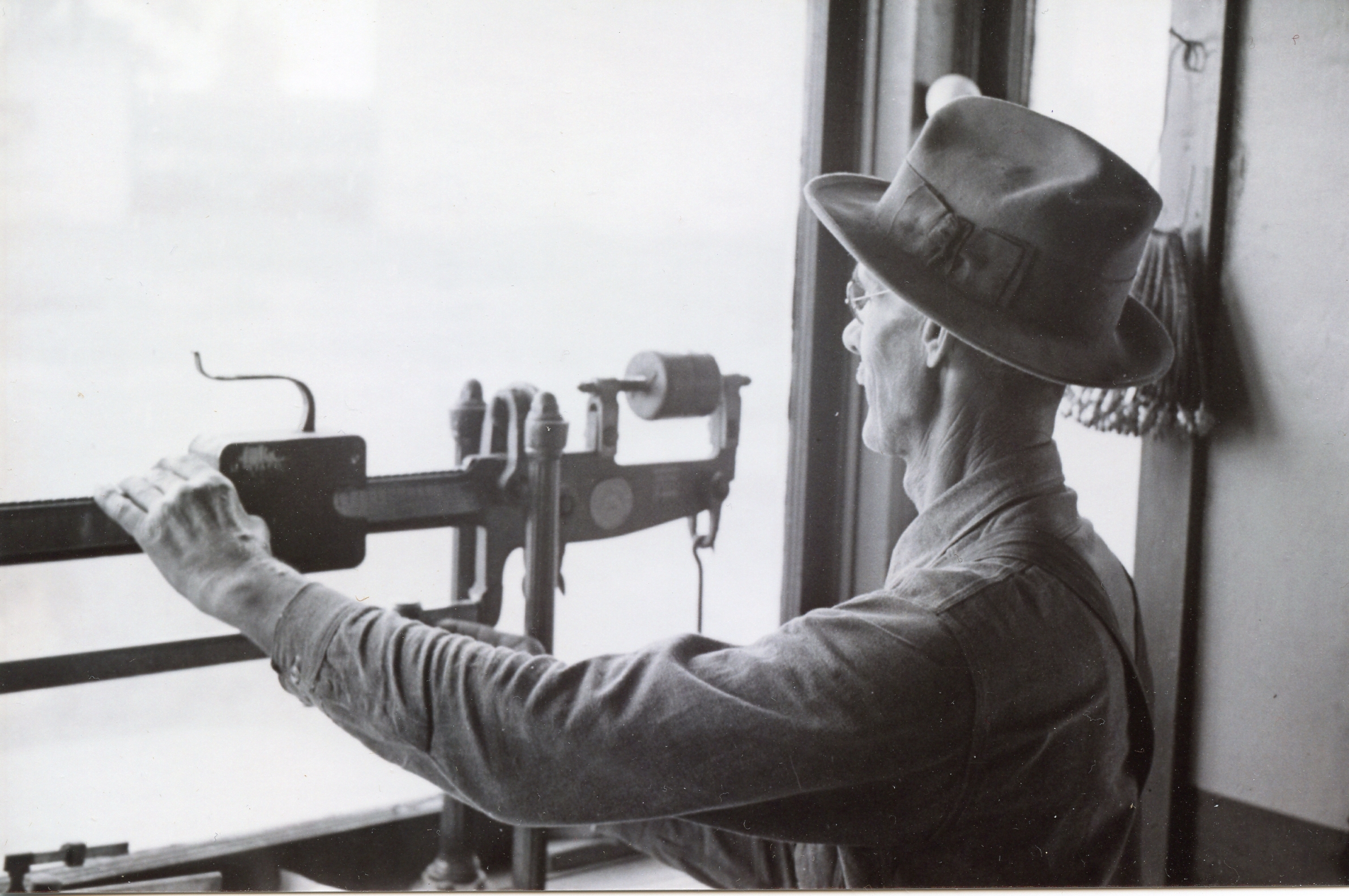
When grain is added to or taken from an elevator, it needs to be weighed and checked for moisture content to keep a strict account for the farmer and the elevator operator. Each truck arriving full will be weighed before delivery and also afterward, with the difference subtracted from the loaded weight to give the net weight of grain. Weight will change with moisture content, so that is an important figure to calculate.

When a truck arrives empty, it is weighed before loading, then weighed afterward to determine the net weight of grain. This process has always been an essential part of elevator operations from the earliest days.

Elevator photos002

Weighing the grain

My woulda, coulda, shoulda grain elevator opportunity in Tonkawa, Oklahoma

IMG_9327

Story and photo by Ronald Ahrens

I am the type of person who goes around the country saying funny (as in odd) things to people.

It was June of 2011, six months before Kristen Cart and I found each other and first contemplated launching a blog about our grandfathers’ grain elevators. I was riding my motorcycle from Michigan to California. Instead of following I-44, I cut across the northern Oklahoma prairie on US-60. On this route the small city of Bartlesville features a Frank Lloyd Wright tower, which I visited.

My next stop was for dinner in Tonkawa, a small town of about 3250 people. It’s a mile off the highway just east of I-35.

Adapted from Wikipedia's OK county maps by Set...

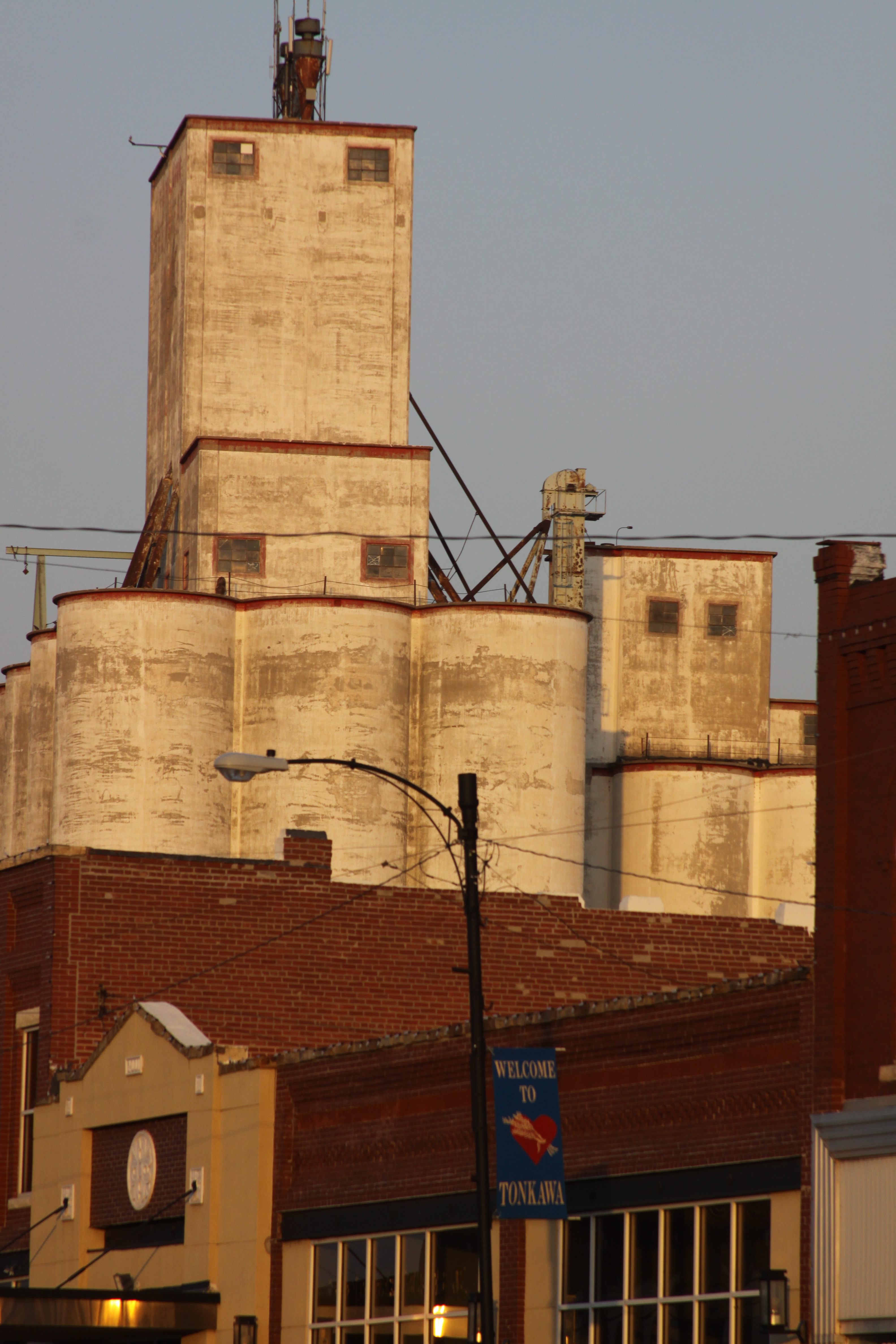
Parking my bike outside a Mexican restaurant, I noticed the huge elevator towering over the downtown buildings.

Once I got seated in the restaurant and ordered from the menu, I told the waitress I was going out for a minute to take a picture.

“My grandfather used to build elevators like that,” I said.

She looked at me as if to say, “What elevator?”

It might be possible to live in Tonkawa and never notice the commanding headhouse and dozen or more bins. I walk around inside my house without seeing the art that hangs on the walls or the cobwebs that hang in the corners.

At the time, I had no thought of snooping around after dinner, while there was still some daylight, and searching for embossed manhole covers or some other means of identifying the builder. I didn’t yet know about embossed manhole covers.

Not that this appears to be one of Tillotson Construction’s jobs. My cursory search for information has turned up nothing, and the number I found for the co-op responded with a fax tone.

Maybe our readers can pitch in on this one.

But odd remarks will not be tolerated!