Hunting trips afford opportunities for two types of photography

DSC_0889Story and photos by Kristen Cart

We live far from the preponderance of the nation’s grain elevators. Time and money are not unlimited, so it takes a good excuse to go look at elevators when the family has other things on the agenda. Western hunting expeditions are a splendid source for such excuses, so once or twice on each trip, I sneak in an elevator stop.

On a typical trip west, when you have a camera and the inclination to take pictures, vistas of country living make you suddenly pull over, disentangle the camera strap from the seatbelt, and send snack wrappers tumbling to the floor. A few epithets escape your lips when you find the ISO is still set for the moon shot of the night before, but unless a fleeing bird made you stop, the problem is quickly fixed.

DSC_0502In the hotel at night you eagerly page through the day’s images, occasioning a few more blue words, but often great satisfaction. You have elevators and neat old buildings, and you also have scenery. The rest of your family members roll their eyes and talk about elk and pheasants and bird dogs.

The fruits of your labor make it worth the effort–especially if you come home with beautiful pictures and meat for the freezer.

On the eve of another hunting trip, here are a few photos from earlier trips, including the odd elevator picture or two that slipped into the mix.

DSC_0501

DSC_0967 DSC_1009 DSC_1026 DSC_1038 DSC_1168 DSC_1180 DSC_1215

The Pocahontas, Iowa, elevator remains a lovely monument to Tillotson ingenuity

DSC_6547

Story and photos by Kristen Cart

The Tillotson elevator at Pocahontas, Iowa, first came to our attention as the site of a tragic accident where a young construction worker lost his life. Larry Ryan fell to his death because he tripped while crossing from the elevator to the annex on a makeshift wooden walkway, according to fellow workers. He wore brand new work boots and some speculated that they contributed to the accident. The young hoist operator was twenty years old when he fell 130 feet to his death from the top of the nearly completed annex in 1954.

I finally had the opportunity to see the site for myself this past summer. We took a wide detour north of our regular route from Nebraska to Illinois–it added a good four hours driving time, not counting the stops. My young cheering section (the kids) were not cheering about the extra road time.

DSC_0637

Upon our arrival in Pocahontas, a town along Lizard Creek in north central Iowa miles away from any major state thoroughfares, we immediately noticed the Tillotson elevator and its trademark rounded headhouse. The annex stood beside the original elevator, rising higher (by 10 feet) than its 120 foot companion, and gleaming with clean whitewashed concrete. It showed no sign of its sorrowful beginnings.

Later additions, including an elevator with headhouse, a flat storage shed, old steel hoppers, and modern steel bins with external legs, surrounded the two concrete structures.

The Tillotson elevator and annex were flanked on one side by a quiet street with an old church and ancient maple trees. The bustle of grain trucks was absent on the Sunday afternoon of our visit, and the co-op office was closed. Only the elevator exhaust fans pierced the silence.

We circled the complex, taking a number of photographic views, before going on our way.

We have the specifications for both the 1949 elevator and its 1954 annex. The annex construction record is detailed here.

DSC_0616

The Pocahontas annex was built with six 18-foot diameter, 10-foot spread by 130-foot high bins; with a basement; the bins were flat bottomed, built with 30-inch belt conveyors and tripper.

Planned capacity (with pack) was 222,440 bushels; translating to 1,863 bushels of capacity per foot of height. The total reinforced concrete, per plans, was 1,366 cubic yards. Plain concrete for hoppers, per plans, was 9.5 cubic yards, and reinforcing steel used, including jack rods, was 69.59 tons.

The design specified the average quantity of reinforcing steel used for the whole annex, which was 101.89 pounds per cubic yard of concrete.  Actual planned amounts were then itemized for various components of the structure:

Main slab: 27,017 lbs. steel/219 c.y. concrete

Drawform walls: 30,708 lbs. steel/990 c.y. concrete

Overhead bin bottoms: 9,957 lbs. steel/70.5 c.y. concrete

Bin roof and extension roofs: 6,740 lbs. steel/44 c.y. concrete

Cupola walls: 3,747 lbs. steel/33 c.y. concrete

Cupola roof: included in walls

Bridge/Tunnel: 1,020 lbs. steel/9.5 c.y. concrete

DSC_6510

Dimensions and weight of the annex and its components were laid out also. The main slab was 52′ x 60′, for an actual outside area on the ground of 2,946 square feet.

The weight of reinforced concrete, calculated at 4,000 pounds per cubic yard of concrete plus steel, was 2,801 tons. The plain concrete was also calculated at 4,000 pounds per cubic yard and totaled 19 tons. The weight of the hopper fill sand was 177 tons.

When the weight of grain was added to the specifications, at 60 pounds per bushel (for Pocahontas, the grain load would total 6,660 tons), the planned gross weight of the annex could be predicted. Twelve tons of steel and machinery were added to the total, for a planned gross weight, loaded, of 9,669 tons.

From these figures, bearing pressure was calculated to be 3.28 tons per square foot.

To handle all of that pressure, the main slab was made 24 inches thick. It was built with #8 steel, placed at 6″ c.c. spacing. Tank steel and bottoms (for round tanks) used #4 steel at 9″ c.c. spacing.

The drawform walls, with extension, measured 411 linear feet, and 130 feet in height. Cupola dimensions were 16′ x 56′ x 8 1/3′.

Since this was an annex, distribution of grain was accomplished through the main elevator leg and thence by belt conveyors and a tripper. Many of the items expected for elevator specifications were absent for an annex. For machinery, the annex had top and bottom belts, rated at 600’/min or 3,000 bushels per hour. 7 1/2 horsepower drives were used for a total load rate of 9,000 bushels per hour.

Loading rates are key for grain storage operations, since they determine how quickly trucks or rail cars can unload and be on their way. Slow elevators become obsolete. The Pocahontas operation was at the leading edge of technology with its shiny new 1954 annex, and to this day it provides quick, efficient service.


Bruce Selyem, an old hand in elevator photography, is still in the game

DSC_0065

Ione, Oregon

Story and photos by Kristen Cart

An eagerly awaited package arrived in the mail the other day. I opened it to find Bruce and Barbara Selyem’s 2016 elevator calendar–a vivid sampling of the photography work that Bruce has done over the years. Barbara Selyem called me to see if I would like one this year–I am an old customer, and I get one every year. So of course I asked her to send it.

Thirteen carefully selected images grace the calendar, and it does not disappoint.

DSC_0697

Indus, Alberta, Canada

Selyem Enterprises also produces framed elevator images for home and business, and if I bought everything I liked, I would run out of wall space very quickly. Bruce has documented many beautiful old wooden elevators in the United States and Canada that have gradually disappeared. Over the 20-plus years Bruce has been shooting elevators, most of the structures have only his photos to remember them by.

DSC_0557

Mossleigh, Alberta, Canada

If my kids had anyone to blame for the numerous side trips, excursions, and stops we have made to take pictures of wooden elevators in the wild, Bruce Selyem would top their list. I have studied his website carefully to plan for elevator photography trips in Idaho and Oregon. Many times the kids have admonished me for the odd elevator stop on the way to Nebraska. I can’t help it. They are beautiful.

Though not many of my wooden elevator photos have been published here, there is quite a collection of them. It is a passion, and I come by it honestly.

My grandfather, William Osborn, took many photos when I was a little girl. I remember the bellows on his camera, the camera body he carefully set up on a tripod, and his advice to sit still. He would pull the Polaroid photo out of the back of the camera while he started his buzzing timer. The hand on the timer would move interminably, and I would stand on tip-toe, eagerly awaiting the magic moment. Then he would peel the negative away and voila, a damp image would emerge, which I would hold gingerly by the edges while it dried.

As a girl, I wondered at the photo of his first elevator in McCook, Nebraska, that he built for Mayer-Osborn. I never knew I would combine his love for photography with his life’s work one day, and share all of it here.

To check out the photography of Bruce Selyem, visit his website at grain elevator photos. Bruce and Barbara Selyem welcome you.

DSC_0674

A concrete beauty. Nyssa, Oregon

Elevator investigations move farther afield with a side trip to Alta, Iowa

DSC_0579

The trademark rounded headhouse identifies the Tillotson elevator, shown here behind the office and truck scale.

Story and photos by Kristen Cart

It is getting harder to visit our grandfathers’ elevators. All of the elevators within a half hour either side of the I-80 corridor have already been exhausted, so a stop for photography requires real planning and extra gas, time, and effort, even when piggybacked on our normal family visit to Nebraska.

The trip to Alta, Iowa, required just such an extra investment in driving time. The town and its Tillotson elevator is just north-west of Storm Lake in the northwestern corner of the state, and is not, quite frankly, on the way to anywhere.

DSC_6488

The Tillotson elevator in Alta, Iowa, where the old structure is mostly obscured by later bins.

I wonder how our kids put up with it. This trip in particular required over an hour’s northward jaunt before angling generally east-northeast, with a 30-minute divot or two along the Nebraska-to-Illinois route. Each detour took in wayward sites, including Alta.

DSC_0593

A look up the rail line opposite the Tillotson elevator revealed the historical trappings of town, with a backdrop of new grain bins.

It is normally a 10-hour drive to get home from visiting their grandparents, but this elevator excursion would tax my children’s patience for several more hours. To be fair, we got an extra early start. But that meant the serious backseat fidgeting would start sooner.

You would think that I would study Tillotson records first, and inject some discipline and efficiency into planning our route.

But no, that task was left for after the trip, so I could see how closely we approached several sites without seeing them.

I don’t think the kids minded the near misses–but they’ll get to see the countryside again when we go through to mop up the strays.


The Tillotson elevator in Hinton, Iowa, is fully upgraded to fulfill today’s mission

DSC_0444

Story and photos by Kristen Cart

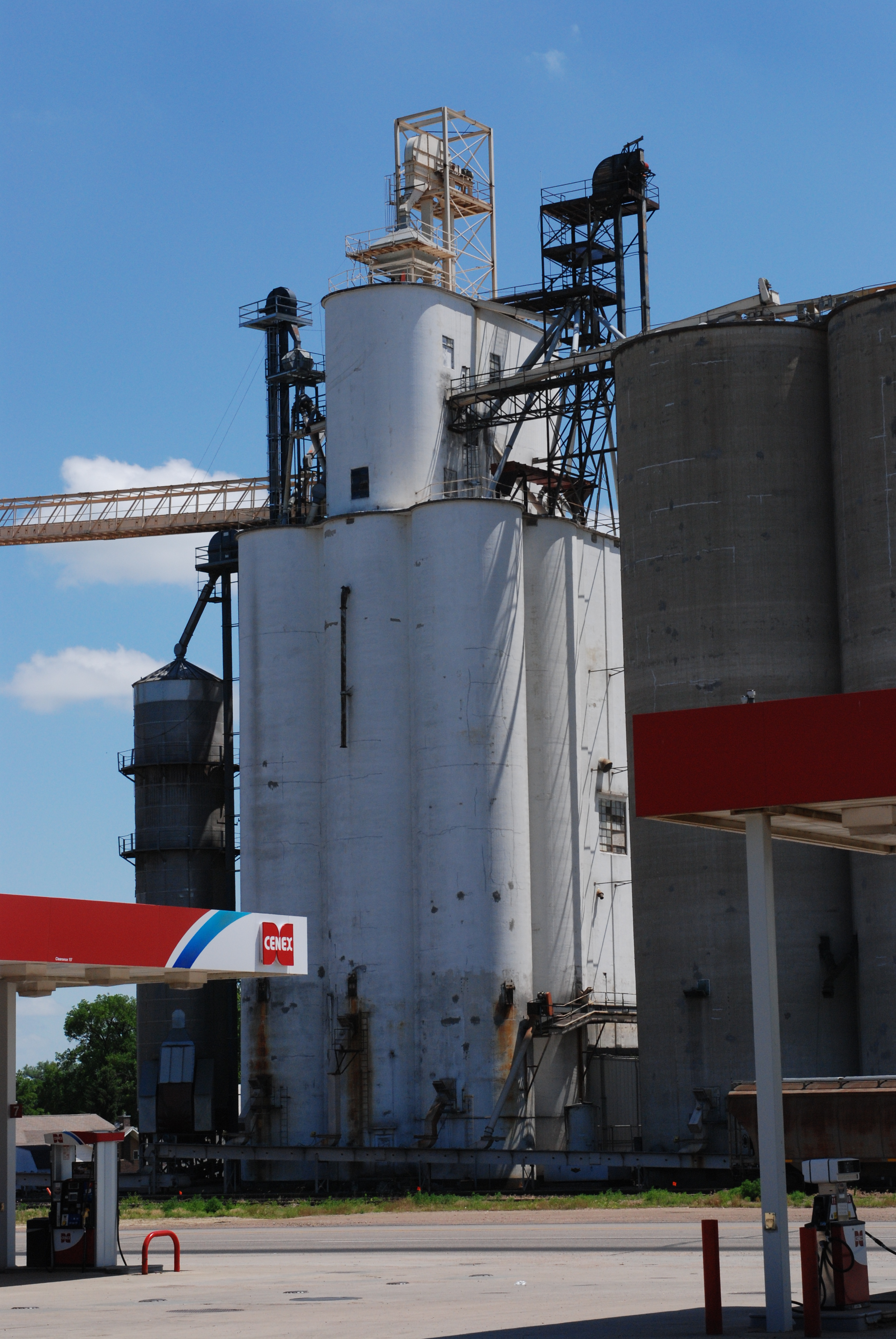
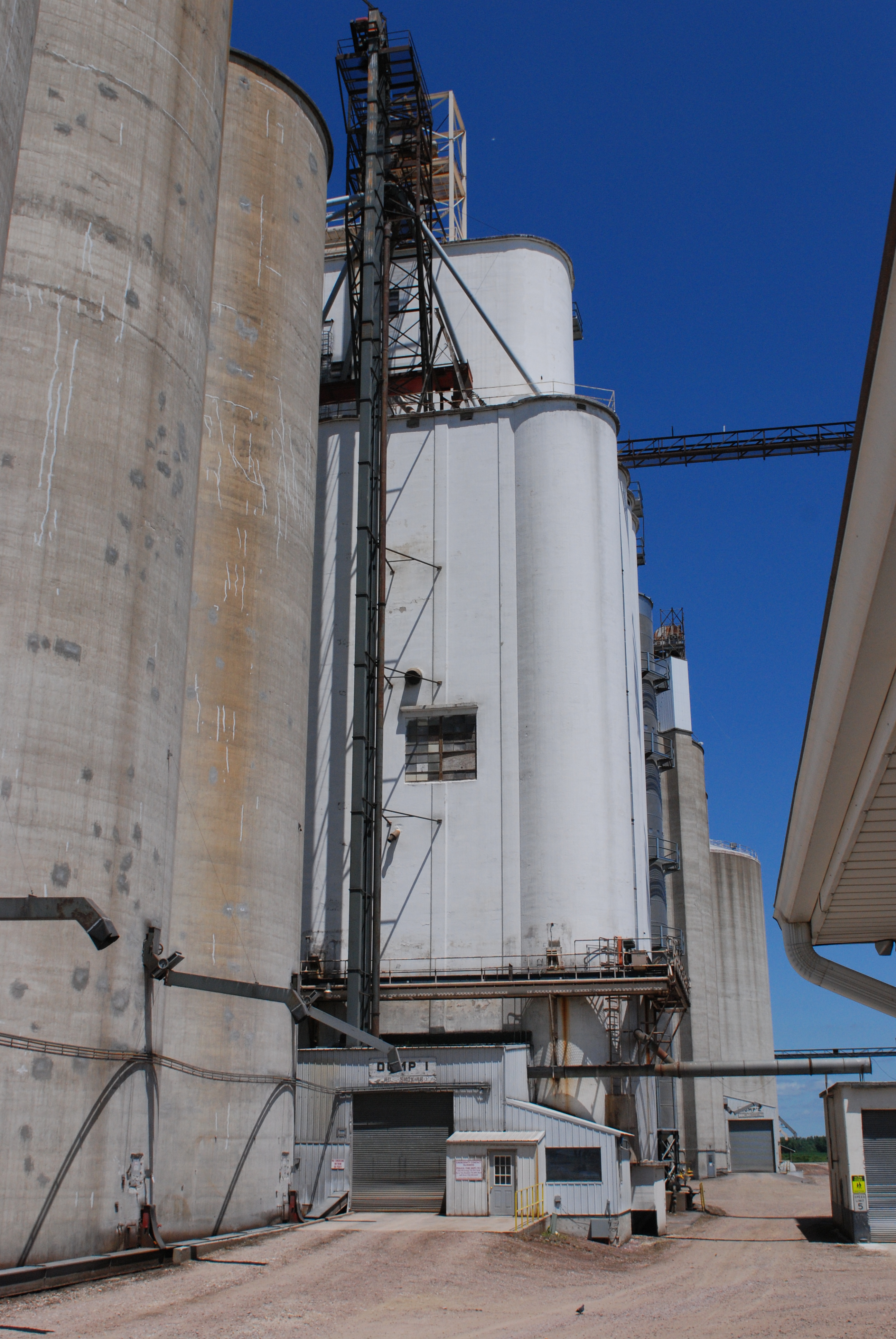
The Hinton, Iowa, grain elevator, anchoring the eastern verge of town along U.S. 75 in western Iowa, looks very little like it did when it first rose in a continuous pour over the flat surrounding farmland. Conveyors and legs and platforms stick out at odd angles from the headhouse–distribution central for the sprawling complex of elevator, drier, and annexes. The long row of grain storage bins and equipment deeply overshadows the eastern side of the highway, which zips past the center of town without a nod to the businesses along the main streets to its west.

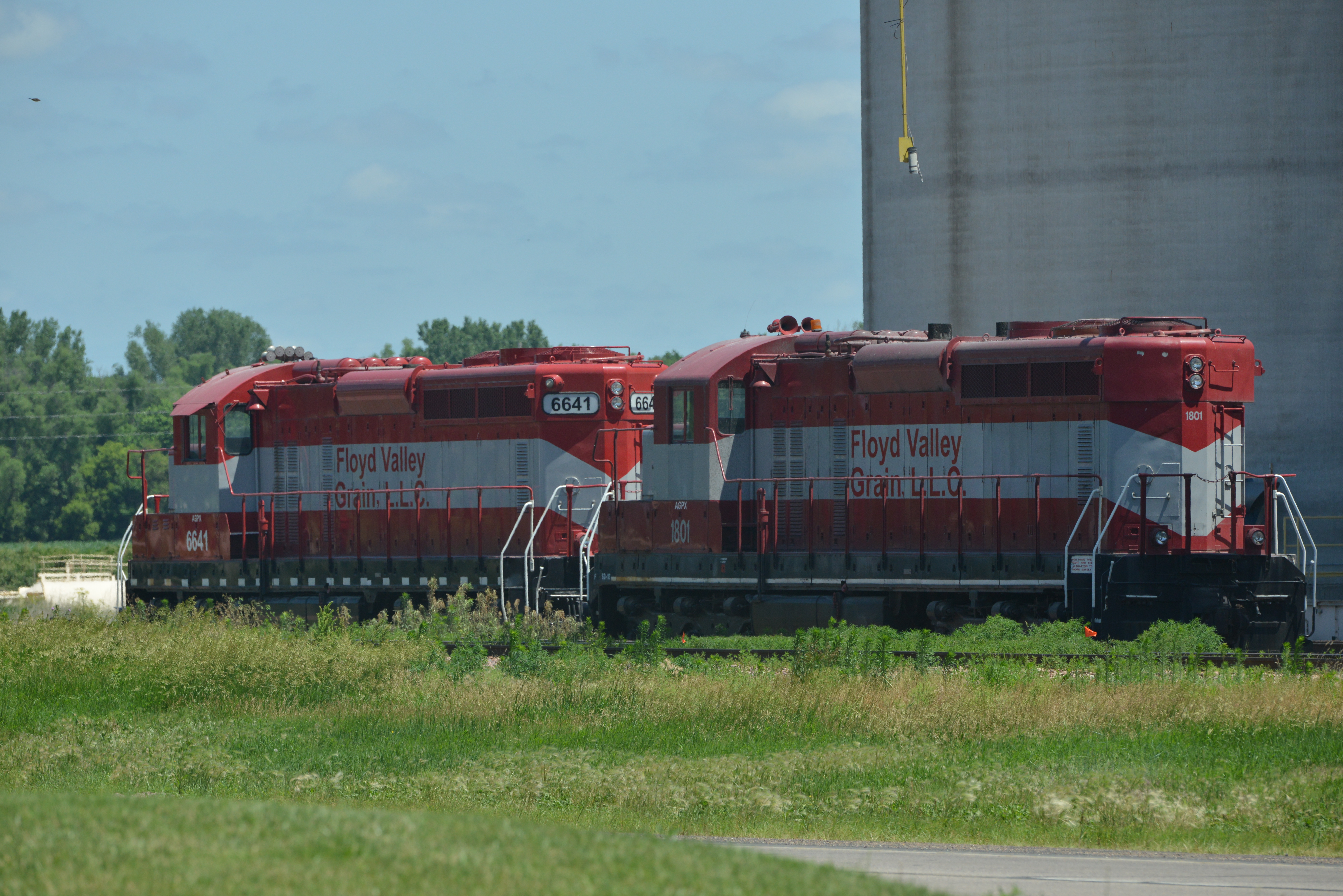
An elevated conveyor crows in red lettering, “Floyd Valley Grain, L.L.C.,” where it may be easily read from the road. To drive the point home, two dedicated locomotives parked upon the nearby rails are painted bright red in the company colors and sport the company name. This cooperative, the advertising seems to say, is the true center of town.

DSC_6412Innovation and modernization bristle from every side of the old Tillotson elevator. The externally installed legs (the parts of an elevator that lift the grain during the loading process) are a later modification taken to prevent grain dust fires: the moving parts that may heat up, such as bearings and motors, are no longer confined in an enclosed space with combustible grain dust. The various conveyors connect to newer annexes that were built when the storage demand outgrew the original elevator. The entire complex has become a far greater enterprise than our grandfathers, builders of the original structures, ever envisioned.

I paged through the Tillotson Construction Company records, preserved in handwritten and carefully photocopied pages, looking for the building specifications for the original Hinton elevator. Unfortunately they were not preserved with the rest. But we know it is a Tillotson elevator from a news item about an accident at the construction site where a man fell to his death in 1954. Perhaps records pertaining to the subject of a potential lawsuit were not with the rest of the file.

The elevator follows a well-tested design, and like the majority of the later Tillotson elevators we have studied, it still serves. It is a fitting testament to the engineering pioneer that was Tillotson Construction Company.

DSC_0455

The demise of Mayer-Osborn Construction remains an enduring puzzle

Audrey, Gerald, William and Alice Osborn, ca. 1950

Audrey, Gerald, William and Alice Osborn, circa 1950.

Story by Kristen Cart

Some mysteries are not meant to be solved. Perhaps it is a natural outgrowth of my grandmother’s tight-lipped discretion where evil tidings were concerned. I can remember the disapproving purse of her lips if I broached the wrong topic–it was wise to move on.

Albert Skoog as a boy

Albert Skoog as a boy

Alice Christoffersen married William Osborn in the 1920s. All anyone in our family could know about those times was conveyed in the pleasant images of a young couple goofing around by the lake and fishing. In later pictures you could see the pained expression of a long-suffering middle-aged woman, but her concerns were private, at least when they brought bad memories to mind.

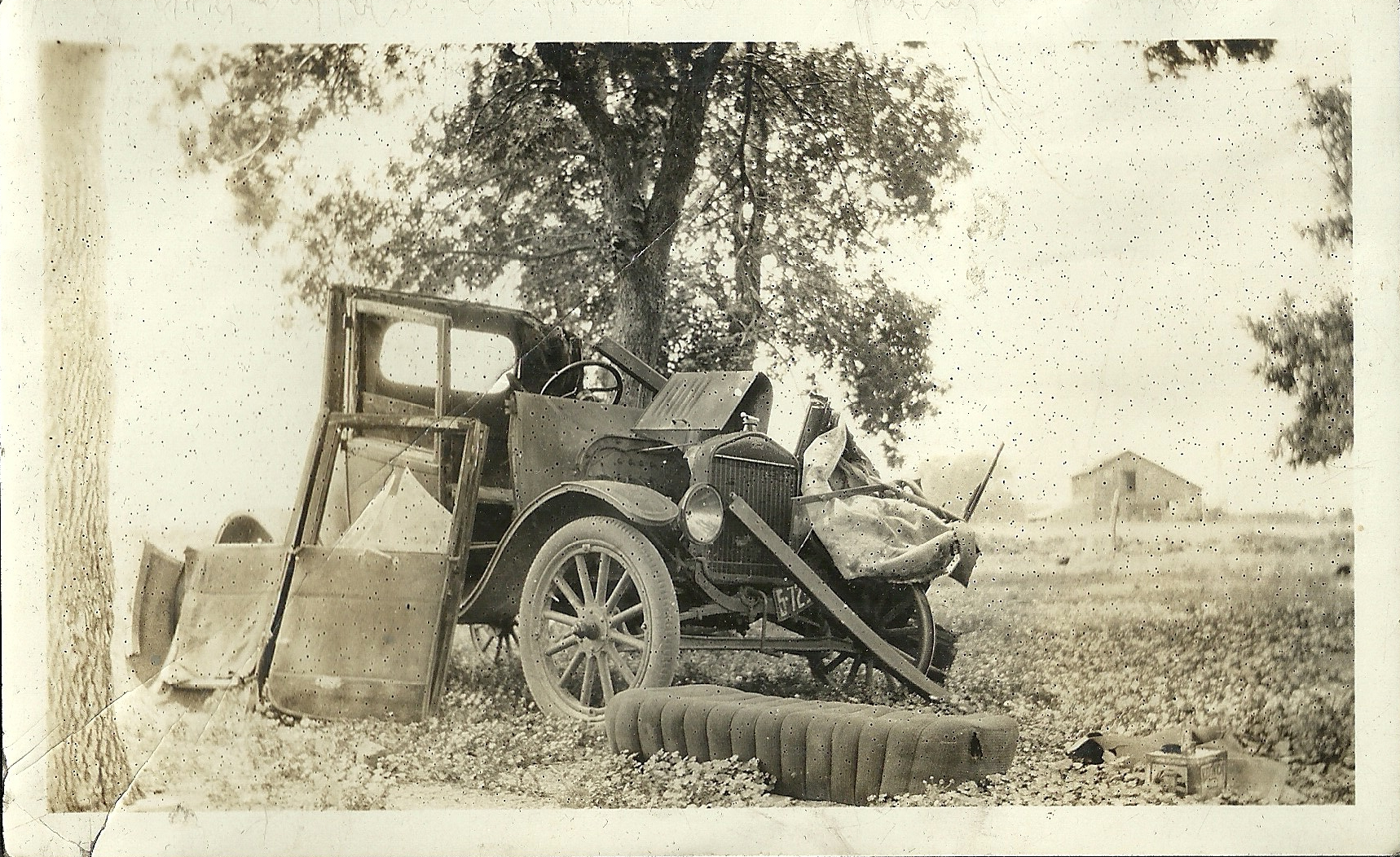
My dad, Jerry Osborn, was quite amazed to find he had a deceased great-uncle, whose name had never been spoken in front of him. Alice Christoffersen’s maternal uncle, Albert Skoog, died young from injuries sustained in a horrific automobile crash when she was a young woman. The story was relegated to the darkest recesses, never to be mentioned again.

“Albert Skoog Dies from Effects of an Auto Accident

Had Lived Nearly Ten Months with a Broken Back

After living nearly ten months with a broken back, during which time he suffered untold agony, Albert Skoog, 42, formerly and employee of the Fremont Stock Yards, died at the home of his sister, Mrs. James L. Christoffersen, south of Fremont. Death was due to injuries sustained in a automobile accident on the Lincoln Highway about a mile east of Fremont last October….”

The article went on to describe the accident and his medical treatment. He died in the family home of Alice’s parents.

This image was found among Grandma's pictures. It was the car her uncle wrecked in an ultimately fatal accident.

The wreck fatally injured Albert Skoog, who died months later from a broken back. Grandma had this photo of the car in an album that once belonged to her mother.

No stone marks his grave. It took many years to locate pictures of him, preserved by a different branch of the Christoffersen clan. Images of the wrecked car also survived, tucked away in Grandma’s photo album. But such things were not discussed in my grandmother’s world.

Another side of Grandma’s personality was not so discrete–she would tell stories that put others in a bad light when she thought she could gain favor for herself. This habit got worse as she aged, and by the time she passed on at age 98, family members believed awful stories about each other because of things she said.

We have tried, without success, to verify Grandma’s story of why my grandpa, William Osborn, got out of the elevator business. Perhaps she invented it. We have no way to tell.

Mayer-Osborn elevator at McCook, Neb. during a family visit, ca 1950. This elevator was the first of its type, a model for the later Blencoe elevator.

Mayer-Osborn elevator at McCook, Neb. during a family visit, circa 1950. This elevator was a prototype for the Blencoe elevator.

Dad never had an inkling about why his dad quit (except that he heard in whispers not intended for him) until Mom started poking around. Grandma told her the story, apparently in a fit of pique. Details were fuzzy, and by now, not well remembered. There’s hardly more to it than speculation. But that one glimpse was the only information we ever got. Otherwise, it “wasn’t discussed,” as Dad put it.

Mom says an elevator was built, and very shortly thereafter, failed. She variously used the terms “collapse,” “explosion,” and “fire.” But the two things she was pretty consistent about were the facts that the concrete mix was wrong because the crew had shorted the materials (possibly for financial gain), and that the collapse occurred as soon as the elevator was filled with grain for the first time. That is all she remembers from what Grandma told her.

Dad says his father was out of the business by 1955. Dad remembers that his dad had come home to Fremont, Neb., from Denver, Colo., the home base of his business, that summer when he should have been on the job. He thinks that his dad was blamed for the failure–Bill’s partner, Gene Mayer, apparently went on without him. But that is all we have.

We don’t know where it happened and haven’t found a newspaper story. We know a large terminal elevator collapsed that year in Fargo, N.D., but we discovered the identity of that builder and it wasn’t Mayer-Osborn. There were whispers about an elevator that had a bad headhouse around Linn, Kan., or Bradshaw, Neb., which might have been his, but that story hasn’t been verified or dated.

The Blencoe, Iowa elevator built by Mayer-Osborn

The Blencoe, Iowa elevator built by Mayer-Osborn

The only story I can verify is the tear-down and restart of the Mayer-Osborn elevator in Blencoe, Iowa. The concrete mix was wrong there, and it cost a few days and quite a lot of money to correct. Could that relatively mundane event in 1954 have created a rift between the partners, Bill Osborn and Gene Mayer? Was the tale of a more dramatic accident simply angry gossip from my grandmother?

Until we know more, it is a skeleton yet to be found, buried in a very deep closet.


A mystery unfolds at the Tillotson elevator of Blencoe, Iowa

This elevator is attributed to the Tillotson Construction Company of Omaha, but evidence points elsewhere

This elevator is attributed to the Tillotson Construction Company, but evidence points elsewhere.

Story and photos by Kristen Cart

In an earlier post, we showed that the elevator built by the Tillostson Construction Company in the northwest Iowa town of Blencoe had a structural failure prior to completion. A photo provided by Tim Tillotson showed that the concrete slumped over the driveway after the slip-form pour had progressed considerably past the point of failure. Construction would have halted there. The question of how the elevator was completed was never answered.

In the company records we have, the specifications log ended by 1956, while the company continued to build elevators beyond that date. So later records are lost to us. Tim Tillotson estimated that this mishap occurred in about 1955. I discovered, on review, that Blencoe was not in the specifications at all. Why?

A photo of the manhole cover on the rail side of the elevator could provide the answer. It is not typical for Tillotson elevators to have exterior manhole covers on elevators of this type, so the existence of these was a little surprising. More shocking was the identity of the company that placed them.

"Grain Storage Const. Co, 1959, Council Bluffs, Iowa" is embossed on the manhole cover

“Grain Storage Const. Co, 1959, Council Bluffs, Iowa” is embossed on the manhole cover.

The Grain Storage Construction Company of Council Bluffs, Iowa, is not familiar to us. It may be the company called in to repair the damage when the failure occurred.

We don’t know if Tillotson Construction was fired on the spot. But it is also possible that Tillotson was given a second chance–the design of the elevator clearly follows the trademark Tillotson design, whether copied by some one or built by the original contractor.

I wonder if the original repair destroyed the structural integrity of the elevator, and Grain Storage Construction was brought in to replace two of the bins. We know it was a later job because of the 1959 date on the manhole covers. Unfortunately, I made my visit on a Saturday, and the co-op was closed, so there was no one there to ask.

It is a beautiful, functional elevator today. It stands beside the older Mayer-Osborn elevator, which is also clearly in use sixty years after it was built. Both elevators had problems during construction, but the capacity was urgently needed, so both projects were finished. How the Tillotson elevator ultimately became a Grain Construction Company branded elevator is a mystery we will try to solve in a future post.

DSC_0427

Elevator operators once implicated labor activists in mysterious explosions

Evevator test003

A 1920 Department of Agriculture experiment showing that accumulations of grain dust would ignite under the right conditions

Story by Kristen Cart

Elevator fires have been a great concern since the days when Charles H. Tillotson first built wooden elevators with his army of carpenters at the beginning of what would become the family business.

When elevators started to randomly ignite and explode in the early twentieth century, suspicions ran rampant.

Shortly after 1900, labor violence was on the rise, and businesses had reason to be worried.

In the Midwest, elevator owners suspected the labor unionist Industrial Workers of the World (IWW), or Wobblies, had committed acts of sabotage, torching the structures to make their anarchistic point.

Evevator test004

Then, cooler heads prevailed as engineers found a scientific explanation.

Using a scale model in the manner of a college lab experiment, the United States Department of Agriculture demonstrated that grain dust would ignite and explode under the right conditions, leaving destruction and injury in its wake.

The Wobblies were off the hook.

How an Iowa grain business flourished without a concrete elevator and silos

Story and photos by Kristen Cart

Cogdill Farm Supply Inc. is a family business, founded in 1979. It flourished as the grain business underwent big changes. Gone were the days of government-subsidized concrete grain elevators, but this operation, one step at a time, went from a small feed and grain business, operating a terminal-style wooden elevator, to a full-service farm supply company sprawling across several towns in western Iowa. The business skipped the concrete-elevator stage as it grew without price supports, relying instead on good business practices and a growing economy.

DSC_5821

Brand new shiny bins (not shown) stood by to replace the old wooden ones at the mill in Dunlap. The shed roof was gone, exposing the wall for the first time in generations.

The company showed no signs of slowing down as it modernized. When I visited over a year ago, new bins were going in at the Dunlap feed mill.

As I photographed the mill, Rob Cogdill came down and greeted me. He said that temporary feed facilities were set up as the old shed roof came down (animals don’t quit eating for a day while the mill is down for repairs). Steel bins stood by across the street, waiting for installation. He told me that the side of the mill, now bared, had not seen daylight for a hundred years.

DSC_5736

Cogdill feed mill in Logan, Iowa.

The Cogdill feed mill facility in Logan, Iowa, another town along U.S. 30, was idle and slated to come down, according to Rob Cogdill. It was another step to be taken to streamline and modernize the business.

DSC_5811

Old Cogdill elevator in Dunlap, Iowa.

Rob also told me about his plans to replace the older wooden elevators as they became obsolete. He pointed out the elevator in Dunlap and said he hated to operate the thing any more—it had become difficult to keep in working condition. He had spent his youth in that elevator, and he said it was close to time for it to go.

It is easy to appreciate the aesthetic beauty of these old buildings, but when their service life ends, they cannot be saved and must be replaced. However, it is not only the beauty that makes them hard to destroy—sometimes, their history keeps them in service well beyond their heyday. “The crookedest elevator in Iowa,” in Dow City was one such case. That elevator represented the beginnings of Cogdill Farm Supply Inc. I went on down the road to see it, and while there, I met the founder of the company.

DSC_5830

“The crookedest elevator in Iowa” still had its Purina logo, visible from the rail line, in Dow City, Iowa.

Pat Cogdill, Rob’s father, gave me the run of the site to take pictures. Afterward, he gave each of my kids a soda and told me about the old elevator. Clearly, there was a sentimental attachment.

The Cogdill operation took over the old wooden elevators in Dow City, which were built in 1946 and 1953. The larger one had two rows of bins. Conveyors were installed above and below—an arrangement which allowed a custom mix of grain for each individual customer. Pat said it was a “terminal elevator. It can mix anything.”

He said, “It’s the crookedest elevator in Iowa,” describing how the marshy soil allowed one corner to sink during construction.

When I asked if it would be replaced any time soon, Pat said, “This elevator paid for all of this,” indicating the whole operation with a wave of his arm. “It will provide the boards for my coffin.”

dsc_5949

Dow City Mills from an early day, courtesy Pat Cogdill.


How ‘the crookedest elevator in Iowa’ was built

DSC_0416Story and photos by Kristen Cart

It was a terminal elevator, a family operation, capable of supplying a custom mix of feed fine-tuned to the individual farmer’s requirements. It sat along a rail line that ran through Dow City, Iowa, along U.S. 30 in the western part of the state. And it had been crooked as long as it existed.

There were two different explanations offered for its seemingly casual slouch. The first was intended for credulous tourists, and the last was a more scientific tale. But I liked the first story better.

You see, when the wooden elevator was built, the crew employed for nailing the boards was instructed to rotate around the structure as they built it. That way, the fellows who hammered harder would work their way around the elevator, keeping it even. That precaution had been neglected. The slackers on one side of the elevator, by not pounding as hard, left the rising wall noticeably taller on their side than did the guys who could swing a hammer. Thus, the finished elevator gained a noticeable tilt.

dsc_5941I bought every word of it. I imagined the men smacking the boards tightly on one side, and their chagrin when they discovered what they had done. But alas, the truth was far less romantic.

According to the owner, the builders set the foundation in soggy ground left from years of servicing steam locomotives, and the elevator sagged into the bog as soon as it was built.

Humbug.

dsc_5929In the next post, I will explain how this pay-as-you-go family operation skipped the concrete elevator stage of business. The present effort to modernize must do so without the subsidies that characterized the concrete elevator boom.