It was an uneventful run through the night until the track led Burlington No. 22 to the flyspeck town of Corning in northwest Missouri. Corning wasn’t even normally a whistlestop but now, at 2.30 a.m., the locomotive’s crew released a blast to alert the sleeping Holt County community that their Farmers Grain Co. elevator was burning.
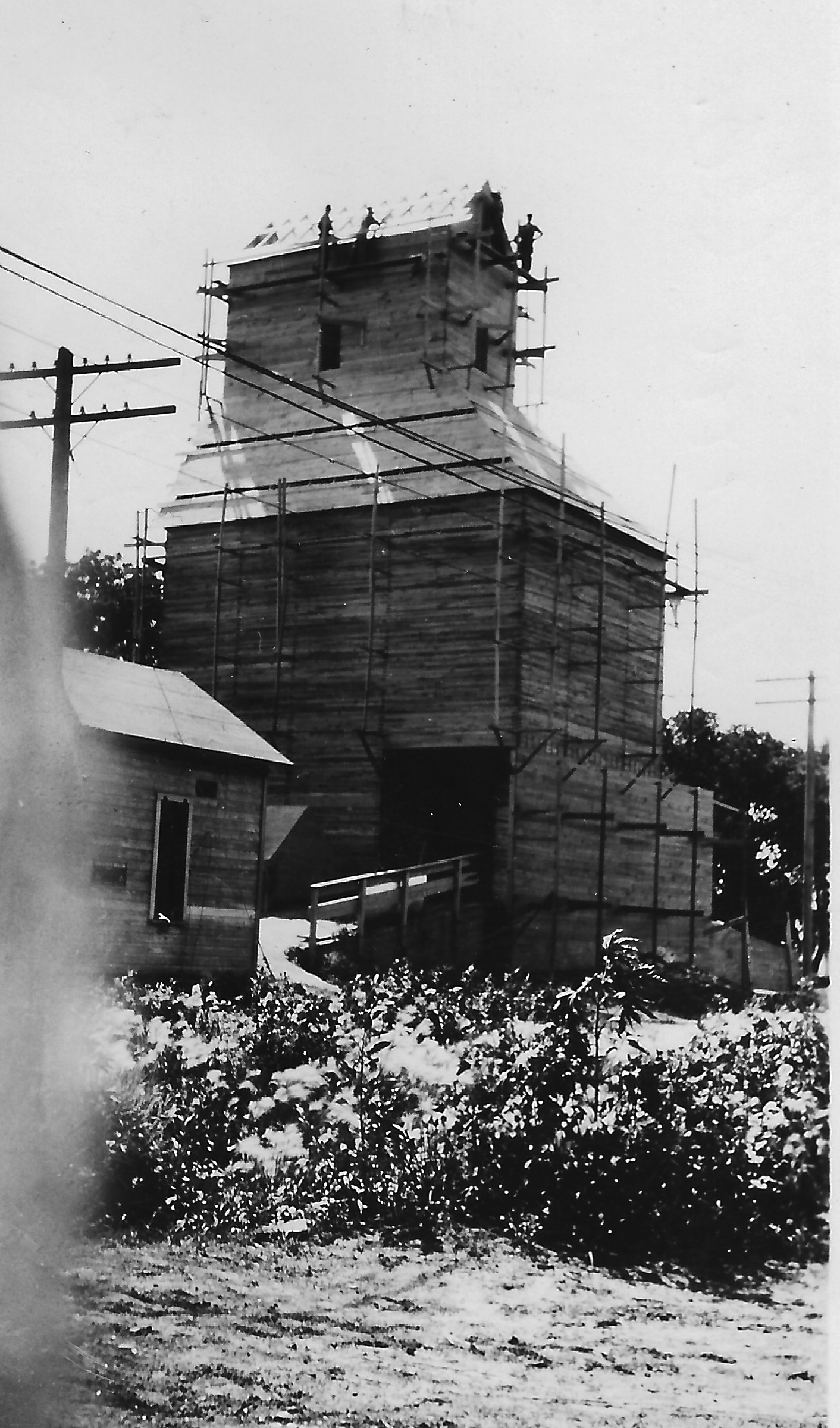
A hell of a blaze was going by the time the fire crew arrived on scene, and they couldn’t stop the destruction. The coup de grâce occurred when the roof fell in, and by dawn on that Saturday, April 29, 1933, the elevator had collapsed and was a smoldering ruin. Authorities indicated the fire had started under the cob bin. The elevator and its contents were insured for $8,000.
It would become a case of Van Ness Construction, from 95 miles away in Omaha, to the rescue.
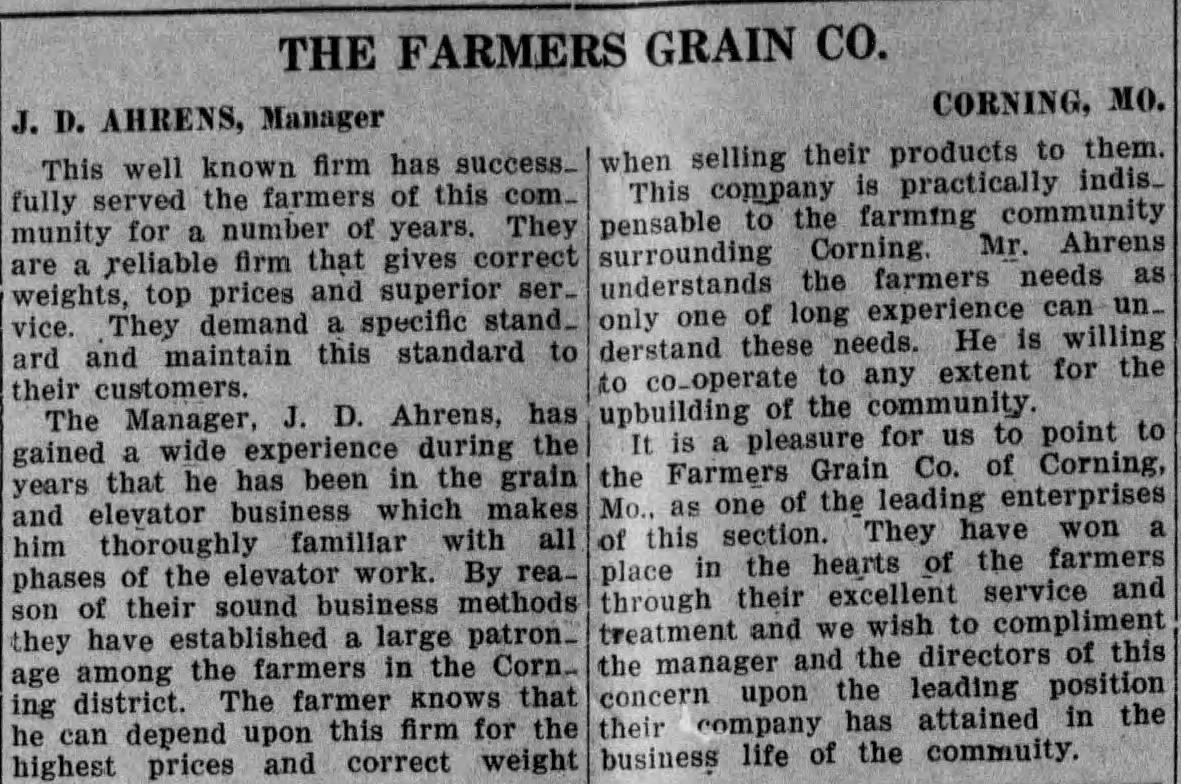
Oddly enough, on the very day before, a newspaper called The Holt County Democrat and The Craig Leader had run a substantial profile of the Farmers Grain Co. as part of a feature titled “Who’s Who in Neighboring Towns.”
Under the management of J.D. Ahrens (no relation to the present blogger), the “well known firm” was successful for years.
“They are a reliable firm that gives correct weights, top prices and superior service,” the profile declared. “They demand a specific standard and maintain this standard to their customers.”
The elevator was “practically indispensable to the farming community surrounding Corning” and had even “won a place in the hearts of the farmers through their excellent service and treatment.”
Obviously, quick replacement of the elevator would be a priority. Van Ness, which employed my great-grandfather Charles H. Tillotson and grandfather Reginald O. Tillotson, who was in his mid-twenties, came onto the scene.
So sure of a good outcome were the principals of Farmers Grain that, on June 23, The Holt County Democrat reported one V.A. Solleder had bought a Chevrolet truck for use at the elevator.
“Heretofore the elevator has been handicapped because of the inability to make delivery of coal, cobs and grain, also in hauling from the Farmers, their grain,” the news item said.
“The truck will be an important asset to the business.”
Meanwhile, the Omaha crew toiled on with help from some local men who joined in.
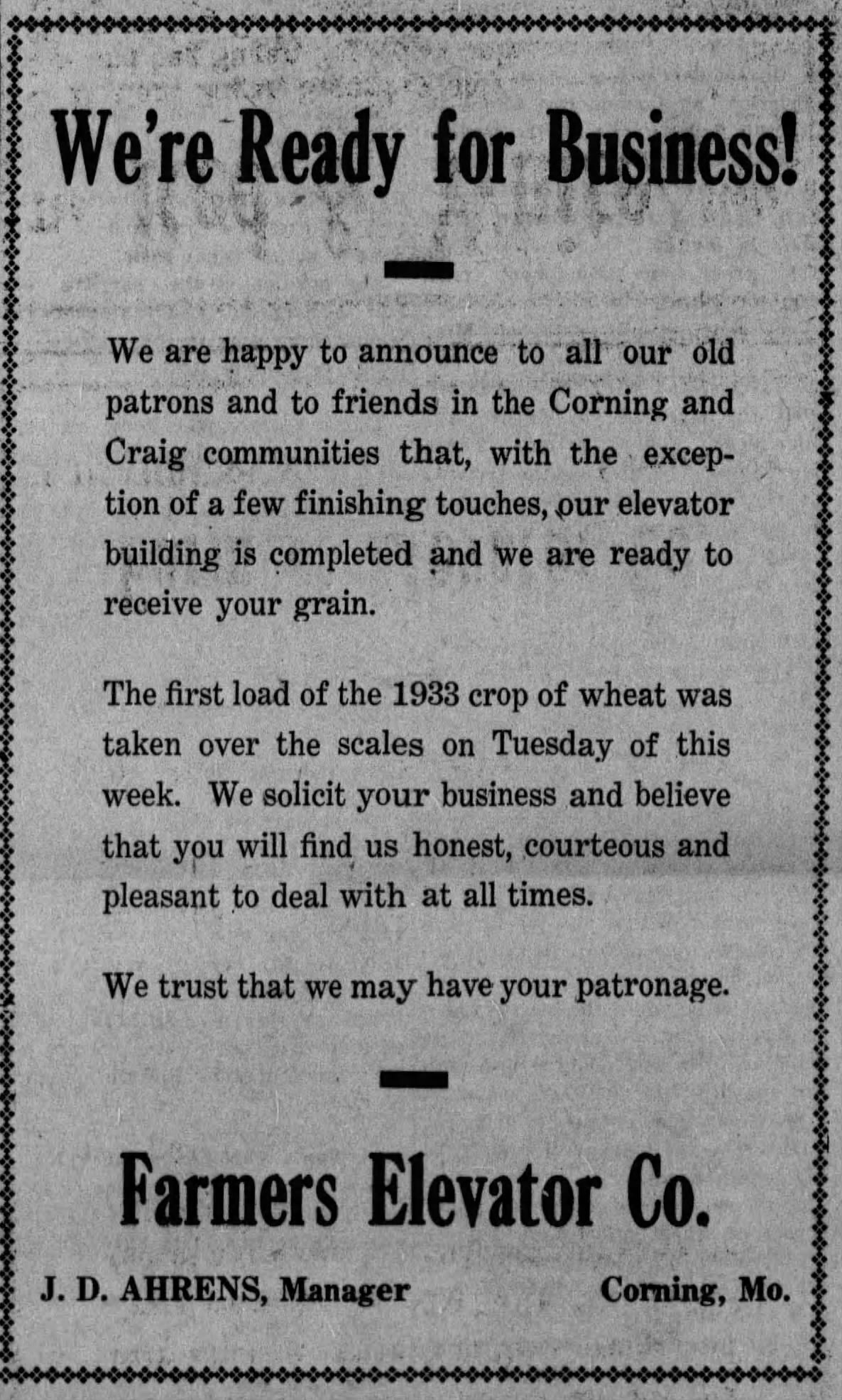
Only a few finishing touches remained to be completed when Farmers Elevator placed a July 14 ad in the Leader informing “all our old patrons and … friends in the Corning and Craig communities … we are ready to receive your grain.”
Van Ness performed its part with unprecedented skill and speed.
“It was exactly forty-eight days from the time the contractor began the work on the new building until it was ready for use,” a July 23 article reported. Farmer James Mavity arrived with the first load of wheat.
The new elevator that was bigger than the old by some 5,000 bushels, giving a total capacity of 18,000 bushels, and work was completed at the tidy price of $7,000, which ensured the cooperative’s solvency.
Near the end of that job, Reginald snapped the photo we see with this post, providing enduring evidence of the Tillotsons’ handiwork.
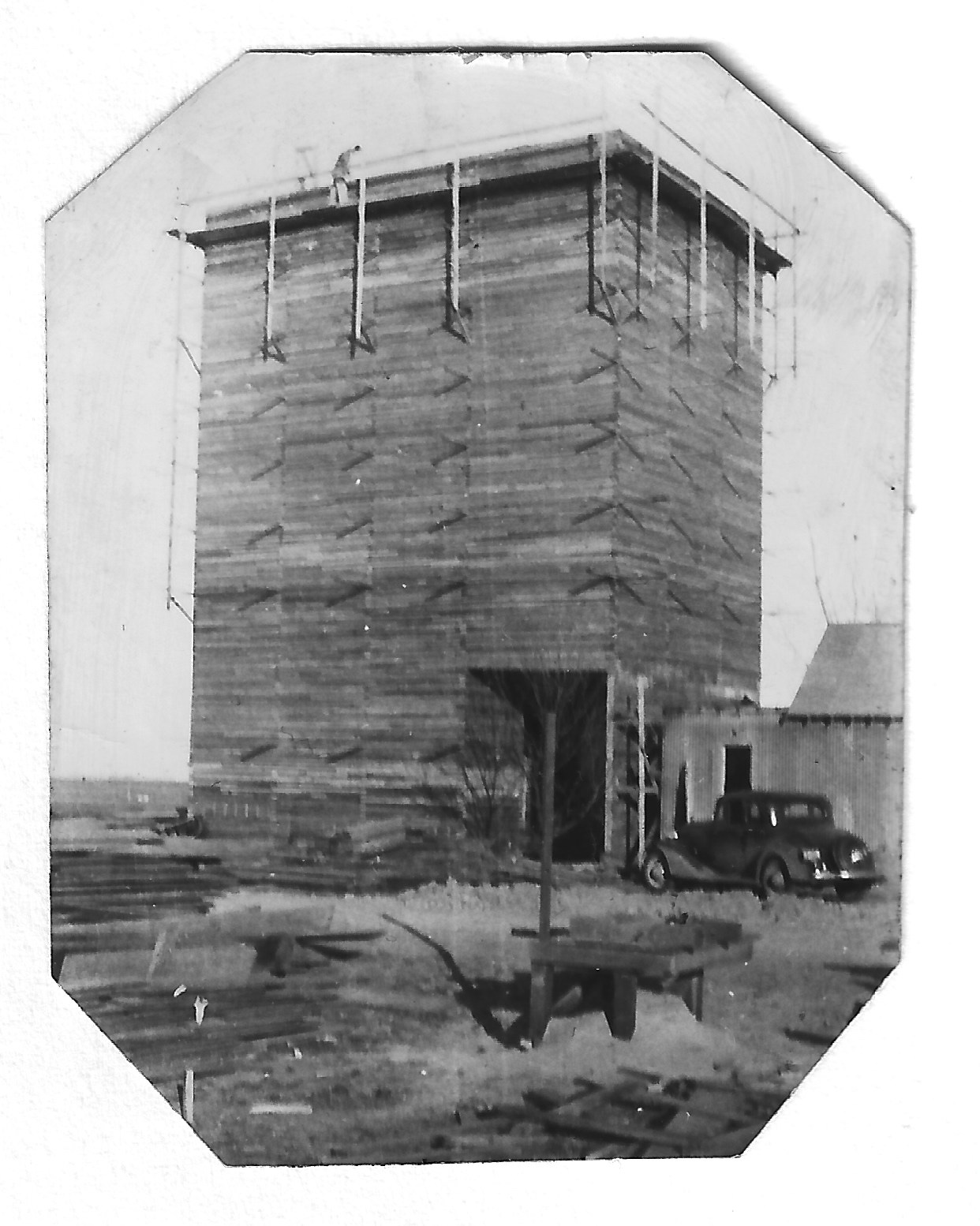
A lone worker adds finishing touches to an elevator in this photo dated Oct. 4, 1934 and inscribed “Shelby, Nebraska.” Shelby is today a town of 600 in Polk County, south of Columbus. The man balances on rudimentary scaffolding at the top of the structure, which we estimate to be about 55 feet high. A Ford coupe is parked on the ground below.
It is unknown whether this elevator was an all-new facility or the replacement for a damaged one. The nearest we can come to answering the question is a brief report in the Polk County News of the previous year.
“The Shelby elevators assumed a business activity on Monday (July 10, 1933) that reminded one of former days of prosperity, as we are informed that 213 loads of corn were delivered to the elevators that day, and the price paid was 47c per bushel.
“To show the difference in the price of farm products now and a little over four months ago, we reprint the markets as printed in the Sun on March 2, in comparison with the markets of today. We leave the reader to draw his own conclusions as to the cause of this improvement in the grain market. There’s a reason.”
Please see the news clip for price tables. Our interest is drawn to the phrase “Shelby elevators.” It’s impossible to say how many there were, or to account for this new elevator presumably built by Van Ness Construction, of Omaha, with Tillotson involvement.
We welcome comments from readers on wooden elevator construction methods. Another news item that came up in our search said a 20,000-bushel elevator in another Nebraska town was estimated to cost $7,000.
It would also be interesting to hear what “reason” the Polk editor had in mind about price improvements.
The Tillotson homestead north of Omaha was sold in 2025, and as a consequence Our Grandfathers’ Grain Elevators has received a few leaves from a photo album with snapshots of 1930s jobs. Together, these pictures comprise the earliest documentation we’ve ever seen of Van Ness Construction and Tillotson activities.
After the sudden passing of Charles H. Tillotson in 1938, his sons Reginald and Joseph built Tillotson Construction Company’s first concrete elevator, located in Goltry, Oklahoma. Prior to that, they worked for Ralston Van Ness out of Omaha. The photos we received appear to show jobs done for that company earlier in the 1930s.
Most of the photos are inscribed on the back with a name, location, and date.
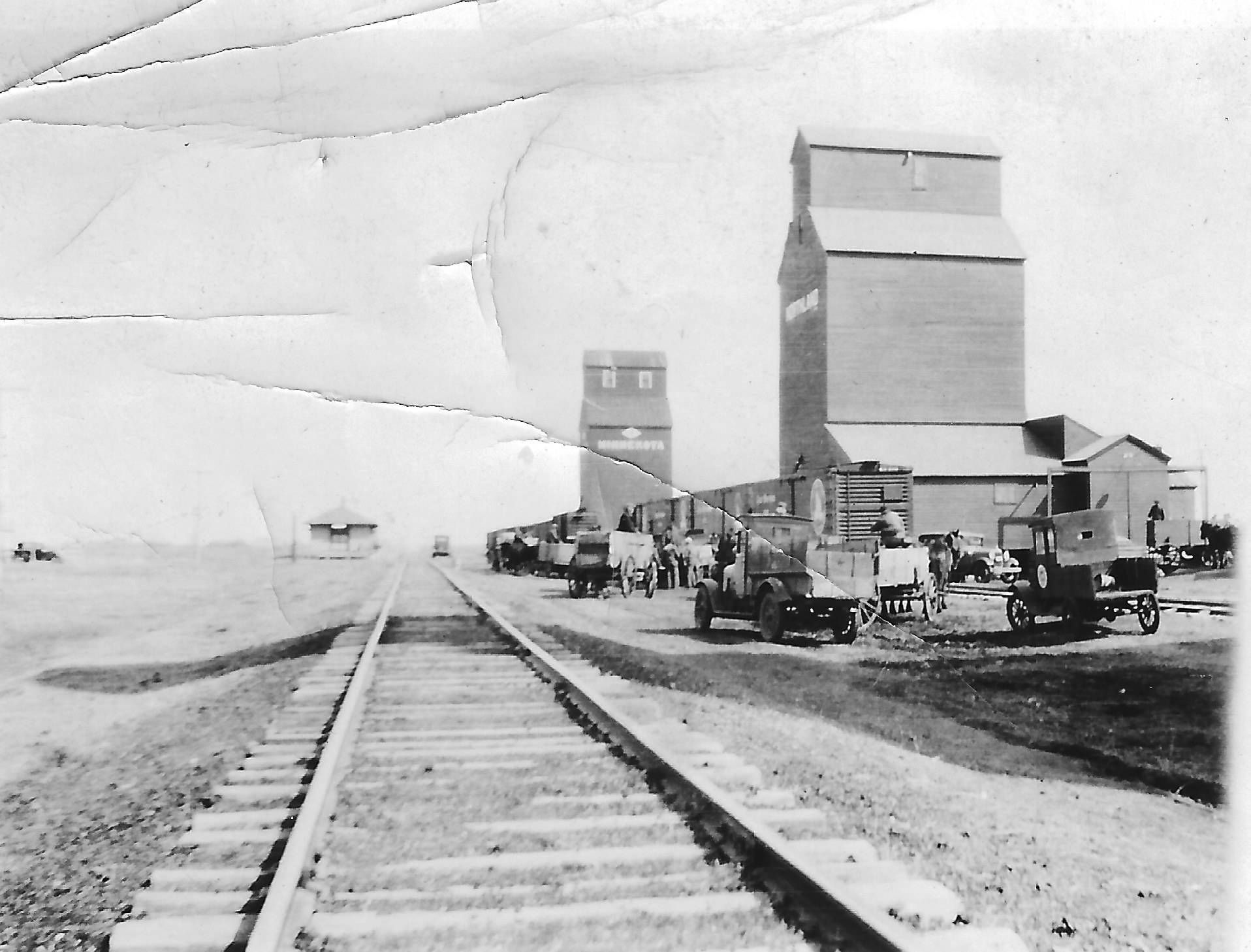
The above photo depicts a 1933 scene at a twin-elevator complex in Norma, North Dakota. Norma is a dot on the map in Renville County northwest of Minot and twenty or so miles south of the Canadian province of Saskatchewan. A note on the album page says “Rebuilt Fire Loss 1933.”
Searching through a newspaper archive turns up no more details, so we can only look at the image and suppose the relief felt by local farmers who had limited options for grain disposition. Especially at a country location like this, a damaged elevator was an unhappy circumstance that would have required hauling grain over an extended distance.
On a sunny day at Norma, a few motor vehicles converge at the complex with at least four horse-drawn farm wagons. It’s illuminating to see wagons still in use at that time. Their limitations surely gave farmers a sense of urgency about acquiring a motor truck.
An old pickup with wooden artillery-style wheels in the right foreground was likely a Ford. It has an emblem on the driver’s door, but we can’t determine anything more about it.
Under close examination of the photo, the elevator tower in the distance appears to be labeled “Minnekota.” The sign on the near tower can’t be read at all.
A number of men are going about their business, whether they’re still seated on wagon perches, standing inside a wagon, or on the ground. In the mix of trucks and cars, note the silhouette of an automobile way down the sidetrack.
Several boxcars await service. Norma is on a secondary road leading south from North Dakota Route 5, and it seems likely the rail line was a spur. This could have been part of Soo Line operations.
We lack additional information about the event that led to the reconstruction. Newspaper pages often had stories of grain elevator fires in 1932 and 1933, with casualties in Chicago at a 200,000-bushel elevator on the river there, and with lesser tolls at smaller elevators in prairie locations.
The Bismark Tribume reported on Aug. 24, 1933 that a 20,000-bushel Minnekota Grain Co. elevator had burned at Butte, North Dakota, to the southeast of Minot. It also claimed a 14,000-bushel carload of wheat. Butte was left with three elevators after the disaster.
We invite our readers to stay with us as we post the rest of the thirty photos in the newly obtained archive.
For a 2013 post, we visited the elevator at Bird City, Kan. to learn more about its provenance. Bird City (pop. 447) is in Cheyenne County, in the northwestern corner of Kansas. The county population is about 2,500.
“It has been demonstrated that the curved headhouse was a Tillotson signature,” we wrote after the site visit. “Did someone leave the Tillotson operation and branch out on his own, or were the plans sold to Vickroy-Mong?”
Later, we followed up with the story of a blowout that occurred there in 1950, not too long after the elevator was built by Vickroy-Mong Construction Co., of Salina, Kan.
Thanks to reader Steve Wilson, who grew up in St. Francis some 15 miles from Bird City, we have new views of the aftermath of that blowout, and these give a clue as to why the name Vickroy-Mong has otherwise disappeared from history.
The elevator was announced in January of 1950. The Omaha World-Herald reported as follows:
The Bird City Equity has voted to build a 250-thousand bushel storage elevator this spring. The government will assist in the finance to the extent of 80 per cent of the cost. It will also guarantee storage income for a three-year period. A drive to raise 50 thousand dollars in capital will be staged. Total cost of the elevator is estimated to be around 160 thousand dollars.
Photos courtesy of Steve Wilson
Soon after the tanks were loaded with grain, the blowout occurred. On Aug. 24, 1950, The Herndon (Kan.) Nonpareil reported:
Approximately 15,000 bushels of the 1950 Cheyenne County wheat crop spilled out on the ground about 6 a.m. Friday when a 30′ by 8′ section of the newly constructed Bird City Equity elevator caved in. The section of wall giving way was over the loading bins on the railroad. A train was in Bird City at the time and was sent to St Francis to be turned after wheat augers brought in from the surrounding countryside had cleared a path through the grain on the tracks. More than six boxcars of wheat were loaded with the augers after the engine returned, but between 6,000 and 7,000 bushels of wheat still remained on the ground the next day, A.A. Gillispie veteran St. Francis newspaperman reported. The elevator which has a capacity of 250,000 bushels was finished shortly before harvest this year.
Photos by Gary Rich
Chalmers & Borton received the contract for the repair work. In 1958, they also won the contract for an addition of 241,000 bushels.
W. Stephen “Steve” Wilson retired as professor of mathematics at Johns Hopkins University and lives in Baltimore. His father, Charles Wm. Wilson, M.D., served the people of Cheyenne County “doing everything from glasses to babies to surgery.” And Dr. Wilson was a photography buff. Steve Wilson provides this addendum regarding the blowout:
I was only 4, or almost 4, but it was a big deal. Lots of grain elevators in that part of the country, and they don’t usually fall apart. Worth the drive to see it!
In 2009, I took my kid out to see where I was from (the year before he graduated from high school). We went out to one of the elevators in St. Francis, the county seat. This was an elevator [where] they would take us kids up to the top, and we would throw model airplanes with cherry bombs in them.
However, when my son and I started walking towards the elevator, someone ran out of the office and told us we couldn’t get close to the elevator. Homeland security rules. What a waste of resources! If a terrorist wants to blow up a grain elevator in a town of 1,500 where you still have to drive 175 miles to get to a town of 25,000, that’s not a bright idea. Spending money to prevent it is even stupider.
David Herbert Hatch is senior pastor at Our Savior Lutheran Church in Green Bay, Wisc. He worked slip-form construction on elevators throughout Iowa in the early to mid-1970s.
I would like to tell you a story.
Word is that one fall, after a grain elevator had serviced the community harvest, a federal inspector came for a look at the facility.
Unable to find the elevator manager, he took the liberty to climb a ladder outside a tank, all the way to the top. He opened a manhole cover, stepped through with his flashlight, and walked over the grain.
Using a re-rod, he probed around, checking the grain. Its high level in the tank at this time of year was a surprise.
“It should have gone to market by now,” he thought.
When he returned to the bottom the manager had arrived.
“Why is it that you have so much grain in the elevator?” the inspector asked.
“There’s no grain in it whatsoever,” the manager said.
He opened a steel door.
The inspector peered into an empty tank.
They shone the flashlight beam to the top and, even to the manager’s shock, saw a frozen ring of grain.
If the inspector had fallen through, with his probe, it would have been the end of his life.
David Hatch was born and raised in Ames, Iowa. Prior to college studies, Pastor Dave worked construction and had hopes of serving in law enforcement until his partial color-blindness prevented that. He did not know what to do with his life. Through God’s Providence and a phone call from his sister, who was a kindergarten teacher in Milwaukee, he enrolled in a college where, unknown to him, many of his future classmates were studying to be pastors. He received his education at Concordia College in Milwaukee; Concordia Teacher’s College, River Forest, Ill.; and Concordia Theological Seminary, Fort Wayne, Ind. His pastoral career began in 1982, following seminary, when he served as an admissions counselor at Concordia College in Bronxville, N.Y. and parish pastor at Love Lutheran Church outside of Albany, N.Y.
David Herbert Hatch is senior pastor at Our Savior Lutheran Church in Green Bay, Wisc. He worked slip-form construction on elevators throughout Iowa in the early to mid-1970s.
Our operations back in the1970s had many vulnerabilities. That is, there were a lot of, “What ifs?”
The whole operation depended on a constant pour. If we had to shut down, we would have, what I remember them calling, a cold seam. That’s when the whole jacking system stopped. The concrete sat in the forms and dried, and everything had to be restarted again at a later time.
One absolutely ugly seam would be left around the perimeter of an otherwise beautiful structure. Not only that, but the drying concrete might hang up and attach itself to the forms, and they would not go up. So that’s what we tried to avoid.
Remember, I just ran a winch, and I only had hearsay. I was 18 or 19 and trying to gather information. I can only speak from what I know, and that’s not much.
What things could happen to cause such a shutdown?
What if an electrical storm lasted several hours and we had to get off the decks because we were a giant lightning rod?
What if the power went out in the city? There would be no electricity to run the jack pumps or the lights around the perimeter of the deck or to operate the electric-powered concrete vibrators!
What if only a bare-bones part of the crew showed up for work one day? Would there be enough manpower to lay the steel and push the concrete in ratio to how fast the forms had to be jacked?
What if the engine on the winch died? There was no back-up winch. (Setting the winch in place was no small matter. It had to be anchored into the ground just right, and angled perfectly so that the cable would wind properly on the spool. If the cable didn’t wrap right, it would rub against itself during wrapping and begin to fray, and then it would not be reliable.
Up on the deck was the jack house, where the jack pumps were kept. If I remember right, there were two of them, a primary and a back-up. The chance of going down, it seems, was low.
There were 1,000 other possible troubleshooting challenges. For example, concrete setting up too fast, hanging up in the form during normal operation and “pulling a hole” that would appear below as the forms began to rise. That would not stop the operation, but it sure would be a problem requiring later patching. If I remember right, the forms were oiled down prior to the start to help prevent this.
David Hatch was born and raised in Ames, Iowa. Prior to college studies, Pastor Dave worked construction and had hopes of serving in law enforcement until his partial color-blindness prevented that. He did not know what to do with his life. Through God’s Providence and a phone call from his sister, who was a kindergarten teacher in Milwaukee, he enrolled in a college where, unknown to him, many of his future classmates were studying to be pastors. He received his education at Concordia College in Milwaukee; Concordia Teacher’s College, River Forest, Ill.; and Concordia Theological Seminary, Fort Wayne, Ind. His pastoral career began in 1982, following seminary, when he served as an admissions counselor at Concordia College in Bronxville, N.Y. and parish pastor at Love Lutheran Church outside of Albany, N.Y.
During the slip operation, the ground was an exciting place to be. The viewing experience would be a little like watching Devil’s Tower rise out of the earth to its finished height in seven days–or the lights going on at the Field of Dreams. “If you build it they will come.” Especially at night, the farmers came. They stood, they watched. Without trying, we stepped out of their cornfields, and they beheld a sight they would never forget.
David Herbert Hatch is senior pastor at Our Savior Lutheran Church in Green Bay, Wisc. He worked slip-form construction on elevators throughout Iowa in the early to mid-1970s.
At night, the gatherers saw lights, heard a roaring winch engine, and saw concrete trucks lined up. They heard shouts from the deck to the ground: “More vertical rebar!” They could see concrete finishers go around and around the structure, lit with strings of incandescent bulbs. But silent to them were the jacks, lifting the whole unit several inches a minute.
Out in the flatlands, night travelers who were miles away could see a slip going up.
Ground support was by means of various components.
The Steel Pile–There was a steel pile on the ground. The guy running the steel gin pole called down for vertical or horizontal re-rod. He also called down for jack rods or a large drinking-water container with cups. Perhaps he sent up parts or hydraulic oil. Mostly, he sent up steel using a cable choker.
The Concrete Truck and Driver–Here is an important guy, the concrete-truck driver. He filled the concrete bucket as fast as he could, got out of the way, and watched it go up. As the gin pole operator pulled the bucket in for dumping, it went out of sight of the driver below. Then it reappeared in free fall to the ground and the cycle repeated.
I believe concrete-truck drivers had a dangerous job for many reasons. What if the winch operator did not stop the free fall in time? What if a pulley failed or snapped at its axle? What if someone dropped something from above, like the finisher’s bucket or brush? What if a Georgia buggy driver overfilled the form just above the concrete truck?
There were always one or two trucks lined up when the current one was out of mud. Sometimes we had to ask the driver to add more water to the mix as it was too thick. Sometimes we asked them for more calcium to have it set quicker, perhaps if the mud was too thin. Tricky business. They have come out with trucks that unload the concrete from the front. I believe that it is easier for the driver to control his parking and dumping. Those were not legal in Iowa back then as they were too heavy. No clue about the law today.
The Boom Truck–What a cool old truck! Resembling a tow truck, this cob-job lifter moved things around the job site. It was as fun to drive as it was deadly. Every driver was warned, “Don’t drive under low hanging power lines, you will snag them, and it will kill you!”
The Job Superintendent’s Office–This was often a large mobile home. There were blueprints everywhere and concrete dust all over. It couldn’t be helped. That is where you got your new hardhat if you needed one.
The Townspeople–Putting up an elevator in a small town made for a big gathering. This would be their elevator. Their grain would go into it. Their bread and butter depended on this concrete and steel. And so they came and watched. Seeing a slip-form operation working at night is better than visiting the midway at the state fair. The sights, the sounds, the whole event–wow!
The Winch–The winch that lifted the concrete bucket was powered by a Ford industrial engine. I had always thought it was a six-cylinder inline engine, but it may have been a four. The winch was anchored into the ground, several hundred feet away from the base of the elevator. I never studied the anchoring into the earth, but it must’ve been substantial.
The engine shroud was red. The operator stood up while running the winch. The throttle was a small wire with a piece of wood as the handle running through the shroud to the carburetor. There was a large foot-brake for the operator’s right foot. It had a hand clutch for the right arm. The hand clutch was tall, like a walking cane or taller, bent over to the right at the top. There were no gears, just single speed. There was no tachometer visible. It would’ve been fun to have a tachometer.
The winch operator had to be alert at all times. He had to have good eyesight for distance. The goal was to get the concrete bucket filled with mud and send it up to the gin-pole operator at the hopper. That gin pole operator would swing the bucket in, dump it as fast as he could into the hopper, and push it back out in the open air. Then the winch operator would begin to free fall the bucket to the ground. Obviously everything I just described cannot be done from at 10 feet off the ground. Once you hit 20 feet and up, things got exciting.
The winch operator had a lot of responsibility, because if he wasn’t being careful, he could run the bucket up into the top gin pole at full speed, knocking the hopper guy off. If he wasn’t careful, when free-falling the bucket to ground and braking late, he could injure folks on the ground–especially the concrete truck driver.
The winch operator had to keep an eye on the cable winding (spool wrap) so that it did not overlap and pinch itself, causing a frayed cable.
For myself, this job was so intense that when I was not working, I would sit up in bed and run the winch in my sleep. The guys working with me got the biggest kick out of that. We were all piled up in motel rooms as we moved from town to town.
In conclusion, it was a blast! I absolutely loved this job–especially the roar of that engine at full speed under load.
David Hatch was born and raised in Ames, Iowa. Prior to college studies, Pastor Dave worked construction and had hopes of serving in law enforcement until his partial color-blindness prevented that. He did not know what to do with his life. Through God’s Providence and a phone call from his sister, who was a kindergarten teacher in Milwaukee, he enrolled in a college where, unknown to him, many of his future classmates were studying to be pastors. He received his education at Concordia College in Milwaukee; Concordia Teacher’s College, River Forest, Ill.; and Concordia Theological Seminary, Fort Wayne, Ind. His pastoral career began in 1982, following seminary, when he served as an admissions counselor at Concordia College in Bronxville, N.Y. and parish pastor at Love Lutheran Church outside of Albany, N.Y.
David Herbert Hatch is senior pastor at Our Savior Lutheran Church in Green Bay, Wisc. He worked slip-form construction on elevators throughout Iowa in the early to mid-1970s.
It was 1973. Vietnam was still rolling along. Woodstock was four years in the rearview mirror, Watergate was only an investigation, and the Supreme Court had just decided Roe vs. Wade.
My friends and I graduated from high school that spring and signed on with Todd & Sargent out of Ames, Iowa, our hometown. For the next three summers we journeyed from slip to slip around Iowa.
In slip-form construction, we took–from the ground–a four-foot high honeycomb of wood to 120 feet in a mere seven days. It paid $4 an hour. Fast food was $1.60. I had just set down my mop at McDonald’s in order to learn a lot about slip-form construction.
In the beginning everyone got a little experience at each job. Perhaps it was like what the Navy does on a sub, training each man at each station just in case. I went from pushing a Georgia buggy, to running the concrete hopper, to settling into my saddle as the ground winch operator.
Rain or shine, cold or wet, once the pouring began it did not stop until you hit elevation or an emergency stop for lightning. The crew worked two 12-hour shifts, pouring 24 hours a day. On my first day I received a white hardhat and gloves. It sure beat the paper hat at the Golden Arches.
I clearly remember looking around and seeing something very complex: the work of a busy-bee carpenter who created an enormous, complex configuration of lumber. There were multiple, circular, honeycomb-like sections (tanks) with endless vertical wood slats (forms), and scores of steel (rebar and jackrods) rising six or eight feet like antennas. It was neat, clean, and super-intricate. There was sawdust everywhere!
On the deck with its several features and teams
The Deck–A plywood floor was attached to the forms. This is where the workers would live for the next seven days. It served like the floor on a regular elevator, but slower, in a business building and would go up with you on it. Or consider it like a stretched trampoline canvas with nothing beneath. Good thing we couldn’t look down.
The Pump Shack–On the deck the pump shack housed the hydraulic pumps. From here the hydraulic lines fed oil to the jacks. On many jobs, a father and son from Arkansas were the jacking experts. And experts they had to be. Lose the pump or blow a line, and the jacking could stall, hanging up a form or creating a cold ugly seam on the outside wall.
The ground winch operator.
The Steel Gin Pole and Winch–On the deck was a gin pole with its own electric winch. This brought up vertical and horizontal steel to be laid in the forms, spaced out and tied into place with wire ties. The gin-pole operator also brought up jackrods. These were threaded on the ends. They were about six feet long and perhaps a solid inch or more in diameter. The operator of the steel gin pole stood at an unprotected opening upon the sky. There had to be a gap for the steel to come through. He had a dangerous job. One of my friends ran this gin pole for awhile and recalled almost falling off when he lit his pipe.
The Concrete Hopper and Gin Pole–This gin pole and its operator received the loaded concrete bucket from the ground, dumped its contents into the hopper, and pushed the bucket into open air for free fall back to the ground and refilling. That pattern continued for seven straight days. The gin pole had a swing arm for the operator to bring in and return the bucket. Two pulleys were on the pole, one at top-center, one at the end of this upside down “L.”
The Steel Layers–Some guys were assigned to lay steel, both vertical and horizontal, inside the forms. The concrete was poured over the steel and all of it disappeared as the jacks lifted the deck, two inches a minute, as I recall. Then more steel would be laid, repeatedly and perpetually, until we hit elevation. Without the steel, the wall might succumb to a blowout.
The Jackrodders–These guys went around adding new jackrods where the existing ones were getting shorter and disappearing into the rising form. The jackrods were super-heavy. They had to be threaded onto the top of the other rod, above the jack. These jacks “bit” the rods, lifting and raising the deck in unison around the perimeter. With that, up went the whole structure!
The Concrete Pourer–This stalwart guided a Georgia buggy from the hopper through the narrow track in the formwork. If you pushed all day down Georgia Buggy Boulevard, you never had to join the YMCA.
The Concrete Vibrators–Carrying electric-powered vibrators, they rid the concrete of bubbles inside the forms. A man’s hands got numb, more so than from riding a Harley all day.
Safeway Scaffold Ladder–As the deck went up, new sections were added to the external Safeway ladder system. This was our way up and down. The more days that went by, the higher the ladder.
The Finishers–We never saw these guys from the deck. They stood on a suspended wooden scaffold that went around the perimeter below the deck. With a brush and a bucket of water, they finished the concrete and made it pretty. Around and around they went, never stopping until we hit elevation. Sometimes the blueprint called for a door or window to be dropped into the form at a certain elevation. The finishers would pretty-up the edging around that door or window as it came out of the form. If the door or window was uneven–no changing that.
Part Two tomorrow.
David Hatch was born and raised in Ames, Iowa. Prior to college studies, Pastor Dave worked construction and had hopes of serving in law enforcement until his partial color-blindness prevented that. He did not know what to do with his life. Through God’s Providence and a phone call from his sister, who was a kindergarten teacher in Milwaukee, he enrolled in a college where, unknown to him, many of his future classmates were studying to be pastors. He received his education at Concordia College in Milwaukee; Concordia Teacher’s College, River Forest, Ill.; and Concordia Theological Seminary, Fort Wayne, Ind. His pastoral career began in 1982, following seminary, when he served as an admissions counselor at Concordia College in Bronxville, N.Y. and parish pastor at Love Lutheran Church outside of Albany, N.Y.
We are pleased to introduce you this week to Rev. David Herbert Hatch. He leads a Lutheran congregation in Green Bay, Wisc. but cut his teeth in elevator construction during the 1970s when hydraulic jacking had replaced the mechanical means.
David Herbert Hatch is senior pastor at Our Savior Lutheran Church in Green Bay, Wisc. He worked slip-form construction on elevators throughout Iowa in the early to mid 1970s.
In this post and the coming series, Dave supplements his recollections with original drawings. These are especially noteworthy because of his colorblindness.
He writes: If I could leave this for your imagination …
An extremely heavy concrete bucket free-falling to the ground at an unknown speed for about 150 feet until the brake man on the winch brings it to a timed stop in front of a concrete truck driver on the ground below.
What if my foot had slipped off the brake?
Likewise, imagine an entirely full concrete bucket, running up the side of a grain elevator at full throttle and I got distracted just before it came to the pulley on the gin pole at the top … what would happen to the guy in the hopper or those below?
This was so intense for me, I would sit up in the middle of the night, operating the winch in my sleep.
I wonder why there’s a ringing in my ears. Hours and hours of running an industrial engine, a few feet away from me, at super-high RPM.
My brother-in-law worked steel. There was a bunch of us, my friends, who would camp–or crash in motels around the state–and go from slip to slip.
The experience gave me a hunger to be a crane operator, which never happened.
About getting concrete to the deck during active slip-form pouring:
Looking at the photographs of current construction, I can see concrete pumps and tower cranes. My company, Todd & Sargent, tried a concrete pump once and it plugged up! Yikes!
During my days, we used a winch that was anchored into the earth. That was our normal way of getting the mud to the top, one slip operation after another.
The winch was perhaps 200 to 300 feet away in the base of the tanks.
There were three pulleys involved. One at the base of the tank near where the concrete truck was and two up on the gin pole on the deck.
The Concrete Hopper
Above the deck was the concrete hopper.
Vertically next to the hopper was the gin pole. It had a handle so the bucket-dumper guy could swing the bucket in and out.
This hopper was directly above the concrete trucks below.
A guy stood on a platform next to the hopper. As soon as the bucket came up and stopped, and as fast as he could, he pulled the bucket in and dumped it into the hopper.
A light concrete splash went flying everywhere, everytime. Safety glasses for sure. That concrete spit often dropped down into your gloves, burning your skin.
And then, fast as he could, he threw and/or pushed the bucket out into open air to begin its freefall to earth for refilling. The winch operator controlled that.
Being hopper-guy was fun for many reasons: timing, repetitive actions, striving for efficiency and grace. Could it be graceful to pull in a bucket, dump it, and throw it to the wind as fast as you could? Yes! And you were working with some invisible guy on the ground you never saw or met: the winch operator. You were a team. You never communicated. It was like you were playing catch, back and forth as fast as you could, with bucket of mud. I kinda miss it!
David Hatch was born and raised in Ames, Iowa. Prior to college studies, Pastor Dave worked construction, and had hopes of serving in law enforcement until his partial color-blindness prevented that. He did not know what to do with his life. Through God’s Providence and a phone call from his sister, who was a kindergarten teacher in Milwaukee, he enrolled in a college where, unknown to him, many of his future classmates were studying to be pastors. He received his education at Concordia College in Milwaukee; Concordia Teacher’s College, River Forest, Ill.; and Concordia Theological Seminary, Fort Wayne, Ind. His pastoral career began in 1982, following seminary, when he served as an admissions counselor at Concordia College in Bronxville, N.Y. and parish pastor at Love Lutheran Church outside of Albany, N.Y.
R. Janet Walraven, M.Ed, retired 35-year teacher and international-award author of four books, resides near Albuquerque, N.M. She is the youngest of Bill and Sadina’s three daughters.
For our family, the nomadism of the grain-elevator construction business had its challenges. We moved 33 times in the 16 years from 1948 to 1964. My two older sisters changed schools 22 or 23 times; I changed 26 times. We were all good students. Since neither of our parents had the privilege of attending college, both set the standards high. With a lot of support and unconditional love, the expectation was always straight A’s, and we worked to accomplish that.
Because my eldest sister, Ramona Sue, had severe asthma and eczema, some of the high-humidity places were very difficult for her. She struggled with her health until ninth grade when doctors said she needed to be in a dry climate. Serendipitously, Daddy was assigned to the jobsite in Albuquerque, N.M., where Ramona enrolled in a private high school. Rita, second in line, and I continued moving with our parents.
Rita was very social; she was like a magnet collecting a group of friends wherever we moved. It became difficult to say goodbye, especially to boyfriends, when she reached high school. That’s when she decided she wanted to be in the private high school with Ramona, and I reluctantly joined them for two of the four years.
My parents made sure we visited attractions in various places. Paulding, Ohio was close enough to Canada to visit Niagara Falls. Moving to Florida brought adventures in learning to water ski, fishing for red snapper in the ocean with Daddy, and exploring the islands all the way to Key West. New Mexico was another adventure–learning about the Pueblo people, being fascinated with turquoise mines, and understanding the variety of Southwest cultures. We also learned to love sopapillas!
Left to right: Ramona Sue, Janet, and Rita
Most of Daddy’s crew quit following us around by the time their children reached junior high. Some of the men went back and forth from home to work on his jobs. Changing schools for the kids was difficult, and many of the wives got tired of moving. Mama did not.
When Daddy became vice president of Chalmers & Borton in 1964, Mama knew that was the end of the adventures. She had embraced all the different cultures, the historic sites, the people. They bought their very first home and settled down in Hutchinson, Kan.
Daddy enjoyed flying in the company plane to check on all the jobs around the country. Sitting in an office day after day was not his cup of tea. He imposed his strict standards on every superintendent in the company, but as his mentor Andy Milnar put it, no one ever lived up to Bill’s standards.
Note: Reno County Museum in Hutchinson, Kan. houses many of the archives of Chalmers & Borton, Inc.
Sadina’s list of moves from 1947 to 1964
1947 LaCrosse and Bison, Kan.
1948 Dighton and Bucklin, Kan.
1949 Hereford, Tex.
1950 Utica, Kan. and Aurora, Mo.
1951 Girard, Kan.
1952 Manter, Dighton, Bison, and Mullinville, Kan.
1953 Perry, Okla; McPherson and Kiowa, Kan.; Ponca City and Enid, Okla.
1954 Hereford, Tex.
1956 Sunray, Tex.; Paulding, Ohio
1957 Homestead, Fla; Hutchinson, Kan.
1958 Tampa, Fla; Ft. Worth, Tex; Albuquerque, N.M.



 Our Grandfathers' Grain Elevators