By Ronald Ahrens
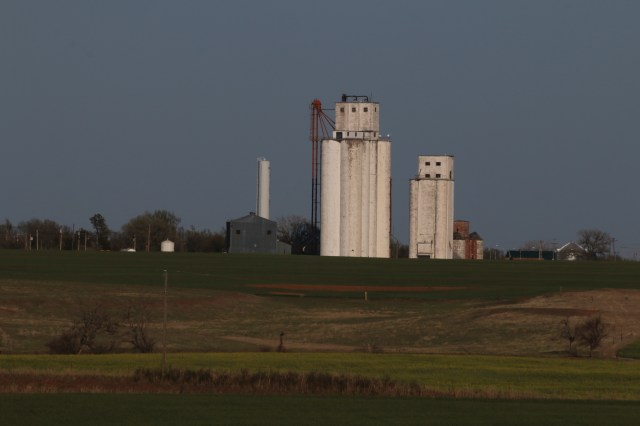
I reached Goltry by driving six miles east on Route 45 from Helena, where I had nearly been blown off my feet by the wind.
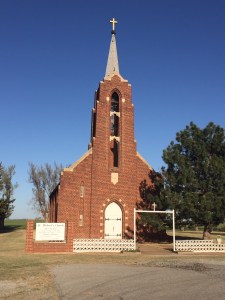
 Goltry is a curiosity. It had its largest population, some 346 people, in 1930. Today it’s more like 250 people. There used to be two Mennonite churches, but only one today. The Mennonites took their name from Menno Simons, who was also the namesake of the town of Meno, which I had visited earlier that day, April 18.
Goltry is also the birthplace of Wally Parks, who went to California and became co-founder of Hot Rod magazine. In 1951 Parks created the National Hot Rod Association, which still promotes drag racing today.

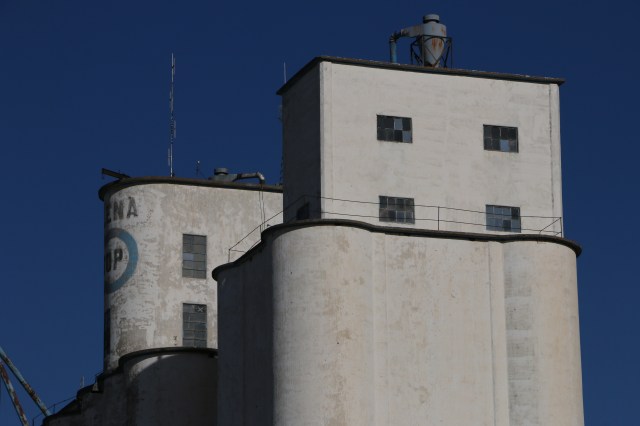
Not incidental to my journey, two grain elevators of reinforced concrete stand in Goltry. The smaller, a 60,000-bushel house, was the first such structure that Tillotson Construction Co., of Omaha, put up. It was a touchstone for me and, really, the beginning of our story. I wish I could have come here first, but instead it was one of the last.
Because I arrived after 7 p.m., everything was closed up.
I yearned to know how they got the job in 1939. Just the year before, great-grandfather Charles H. Tillotson had died, leaving the business to his sons Joe and (my grandfather) Reginald.
Until then, the Tillotsons had built wooden elevators. But Reginald and Joe saw the future was in concrete. Among other things, demand for storage was growing as crop production increased. Concrete enabled the company to build much bigger elevators for their clients.
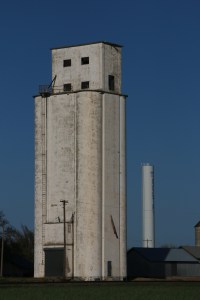 Nevertheless, even at 60,000 bushels, which is puny compared to later work, it took some nerve to proceed and manage this job. Would it come out straight and level?
Providing evidence that things worked out, they did an identical elevator the next year in Newkirk, Okla., a town about 80 miles to the northeast. Another on the Goltry plan went up in 1941 in Douglas, to the southeast of Enid.
The company completed five elevators in 1941. Grain elevator construction then ceased until Tillotson built one in 1944 and seven in 1945.
Company records from those early days include detailed information about costs. Here in Goltry, the total cost less commission was $21,522.97. Even at the rate of 30 cents per hour straight time, 60 cents overtime, the largest portion of that grand total was the $5,575.24 outlay for 14,000 hours of labor. Based on a 40-hour week, that’s 350 man-weeks of labor.
I wasn’t aware of this as I walked the site. Information about costs was a little too prosaic for the moment. My spirit was soaring as I took my photos, as if I’d reached a sacred place.
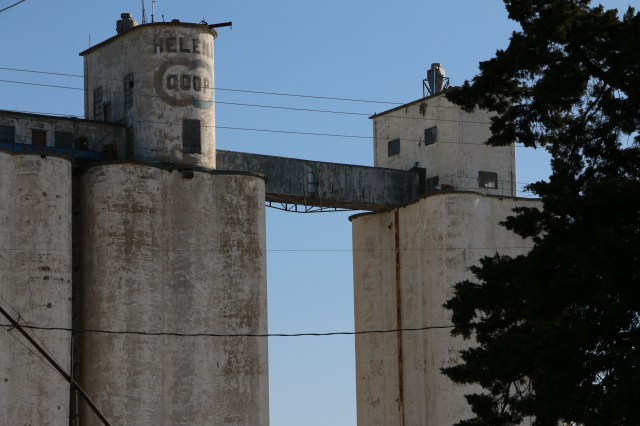
I didn’t know who built the second, larger elevator on the site, but it has a storage annex and a manhole cover with Tillotson’s name embossed. I guess they returned at some point.


The Goltry elevator looked in fair shape from the outside–no spalling or significant cracking–but was it still in use? While writing this post I phoned the Farmers Exchange of Goltry and spoke to Carol Jackson. “We haven’t used it in probably, if I say seven to eight years, it’s probably 10.” The bins leak, the leg, the man lift–everything needs repairs, she said.
It would have been better to find the first Tillotson elevator still in use, but at least it hasn’t been knocked down.
In the next post, I’ll share all the specs of the elevator that moved Tillotson Construction Co. into the modern era.




 A 7.5-hp Ehrsam motor operated the truck lift in the driveway, which raised a truck’s nose, causing the load of grain to stream into the pit.


 Additionally, the 13 x 17-foot driveway had benefited from some reinforcing.


 Our Grandfathers' Grain Elevators