The elevator at McAllaster, Kansas, proved to be a missed opportunity

McAllaster, Kan., photo by Gary Rich

Story by Kristen Cart

Sometimes our elevator quest ends in a dead end, without definitive answers. In the case of McAllaster, Kan., we had only an old photo belonging to my grandfather, William Osborn, to go on, and Gary Rich and I never got any independent confirmation of the builder. When I went to visit the elevator two months ago, nothing was left and there was no sign it had ever existed.

William Osborn photo

Gary Rich tried hard to get information about the builder, after he had gone to McAllaster to photograph the elevator. Both of us made calls to the cooperative. But all we were able to confirm was that it was slated for destruction sometime this year. It was shut up tight, of course, when Gary went to see it, and, no man-hole covers were visible from the outside. The only clue we could find was an old photo of one of grandpa’s projects, which was probably built for J. H. Tillotson, Contractor, of Denver, Colo., judging by the style. The caveat was that quite a few others similar to this one were also built, and some of them have long since disappeared.

Gary Rich photo

Elevators like those at Daykin, Fairbury, and Bradshaw, all in Nebraska, were built in a similar style, so the only clues to their builder are external to the main house: elements such as windows, driveways, office buildings, and loading chutes can be compared to details in my grandfather’s old photos. Of course, if we have independent verification, such as contemporary newspaper accounts or my dad’s memories, it makes our lives easier, since only one of grandpa’s photos has any caption. Daykin and Fairbury have both been verified in this way.

When the photo above is compared with the photos taken by Gary Rich of the McAllaster elevator, it shows just enough difference to dash our hopes for an identification. The building behind the driveway appears to be attached, and the windows don’t match our photos of McAllaster. So we are at a frustrating impasse. We still don’t know the identity of the elevator in grandpa’s photo, and we still don’t know the builder of the McAllaster elevator, though we suspect it was a J. H. Tillotson project. With no way to verify it, we are at the disappointing end of our quest.

McCook’s J. H. Tillotson-built elevator is still all original, down to the light fixtures

J. H. Tillotson built this attractive elevator at McCook, Neb. in 1948.

Story and photos by Kristen Cart

Kelly Clapp explains how levers and pulleys are used to distribute grain.

The straight-up elevator at McCook, Nebraska, was built for a private owner in 1948. J. H. Tillotson, Contractor, of Denver, Colorado, was tapped for the project, and it was completed just a year before the Mayer-Osborn Construction Company of Denver built the nearby Frenchman Valley Cooperative elevator. My grandfather, William Osborn, was a superintendent for Joe Tillotson at the time, just before going on to form the Mayer-Osborn Company with Gene Mayer, so both projects were his.

Kelly Clapp, a Frenchman Valley Co-op employee, opened up the elevator so I could look inside. A trapped pigeon stood  in the doorway when it opened, blinking in the unaccustomed light. It fluttered off when we went in. What I saw was state of the art for 1948.

The elevator leg, which lifts grain from the pit to the top of the bins.

The elevator stands by itself and is unique since no renovation has ever been done to it. The elevator is original, right down to the light bulbs, Kelly said. It operates as it always has. It only takes corn when the other McCook elevators are full. The elevator is cleaned right before harvest, so the manhole covers, stamped “J. H. Tillotson, Denver,” were off and the bins were open.

The elevator has basic electrical functions such as lighting, and the conveyors and the leg are motor-operated, but all of the controls for it are manual. Levers and pulleys operate in the driveway to direct grain chutes to load corn into a waiting truck, and a similar arrangement at the top of the man-lift directs grain into the proper bin while loading the elevator.

The interior of the driveway, with the leg to the right.

This elevator is a completely intact example of our agricultural past–as fascinating as a water-driven grist mill from the century before. Structures of concrete and steel, built for industrial purposes, don’t merit a historical marker or national designation, but they are just as significant as an ancient town hall or a dignified farm house. I think I prefer the plain functionality of the grain elevator.

The J. H. Tillotson-built farm elevator at Traer, Kan., is still standing, but idle

Grafel Farm elevator, built by J.H.Tillotson, Contractor, at Traer, Kan.

Story and photos by Kristen Cart

The road to Traer, Kan., was a bit obscure. The town is south of McCook, Neb., across the border, on unpaved secondary roads. It took some navigating to get close to the elevator, and then to find the right road, once the elevator peeked over the farm fields. We were rewarded with a handsome, squared-up, tall elevator on a lonely rail line in a winding creek valley surrounded by farmland. I hopped out of the van in a grassy parking area and started to take pictures. A truck was parked at the weighing house by the elevator. I knew this was a private farm, and it always had a privately owned elevator, from the time my grandfather built it. So I wanted to make my presence known.

The elevator leg and bins.

When we visited McCook’s elevator earlier in the day, worker Kelly Clapp told me the Traer elevator was still in operation. But his information was about two years out of date. Don Grafel, who greeted me when I entered the elevator office, chuckled when I asked if the elevator was working. “I wish a tornado would take it down,” he said.

Don had started working at the Traer elevator as a kid. His family now leases the farmland from a granddaughter of the Anderson family, who had the elevator built, and as part of the deal, the Grafel family had to buy the elevator. The Grafels operated it for a number of years.

The elevator was retired two seasons ago, Don said. The problem with the elevator was twofold. It had been built in a flood area with a high water table, and the measures taken during construction to account for the water had started to fail. It had leaking problems during wet years. But worse, the elevator was slow. Don said the elevator could take a semi-load at a time in the pit, which was good, but it would take an hour to load the bins. Fifteen years ago, the Grafel farm placed metal bins on high ground above the town. That handled the water risk, but Don said that even those bins were falling behind demand because of slow loading.

“J. H. Tillotson, Contractor, Denver” is stamped on the interior manhole covers.

Shirley Nichols, who also worked at the office, was keenly interested in the history of the elevator. I had a treat to offer her. Russell Anderson, who commissioned the elevator, wrote a letter of recommendation for my grandfather’s new company on May 6, 1949. The Traer elevator was an example of Grandpa’s work before he went out on his own after working for J.H. Tillotson, Contractor. I gave a copy of the letter to her along with a photo my grandfather took during the elevator construction. In return, she gave me another construction photo and some historical pictures of the town.

Finally, my hungry and thirsty children came into the office, and the visit was pretty well over. Don’s brother Greg came in after meeting my husband in the parking lot. He wondered who had dropped by. But it was time to get on the road again, before the complaints got too shrill.

The good people of the Grafel farm made us feel very welcome, and gave us a window into the Traer elevator’s past. I’m glad we were able to see it while it still stands.

Related Articles 

Faked out in American Falls, Idaho

Chalmers and Borton elevator at American Falls, Idaho.

During one of my recent road trips, I came upon a beautiful concrete construction elevator in American Falls, Idaho.  It looked much like the stand-alone elevators built by Tillotson Construction of Omaha, with an added annex.  It is in full operation.  I explored the elevator complex from about 7:30 am, and stayed on site as workers reported for their 8:00 am shift.  It was a very handsome elevator in the early morning light.  In its details it looked like a Tillotson elevator, except for the rectilinear head house, which is not unknown for a Tillotson or Mayer Osborn built elevator, but would be unusual.

As the shift started, I stopped at the elevator office to ask about the builder.  The worker smiled and pointed out the brass plaque by the door.  It was built by our grandfathers’ arch rival company, the ubiquitous Chalmers and Borton based in Hutchinson, Kansas.  Gary Rich pointed out one time that it seemed that wherever he found a J.H. Tillotson or Mayer Osborn elevator out in Kansas or Colorado, hard beside it would stand a Chalmers and Borton annex.  The companies played hard ball and competed for every contract.  Dad said, when I asked if Grandpa’s Mayer Osborn Construction of Denver, Colorado ever worked with Chalmers and Borton,  that “oh, no, they were his biggest competitor.”

Greenwood Nebraska’s straight-up elevator by Tillotson Construction of Omaha.

The elevator at Greenwood, Nebraska, built by Tillotson Construction of Omaha, is very reminiscent in its style to the elevator in American Falls.  I guess form followed function, and each company offered a product similar in its details–often the deciding factor was the bid price.  This Chalmers and Borton elevator certainly faked me out.  But it stands as a beautiful example and deserves notice.

Searching for Mayer-Osborn’s office in Denver produces a good possibility

Story and illustration by Kristen Osborn Cart

Looking for the original offices my grandfather used while putting up elevators for a living, I checked maps for the buildings that stood at the old Mayer-Osborn Company addresses. Google gives a bird’s-eye view. The newer address at 5100 York, in Denver, has no building and seems to be a parking lot full of junker cars and abandoned trailers. There is a small white cinderblock-looking building next door that might be that old, but it is nothing to speak of. I am sure the old building where William Osborn and his partner Gene Mayer located their business is long gone.

The address at 1717 E. Colfax has a handsome, two-toned, tan-and-brown brick building, three stories high, with a glass-brick corner feature on each floor and a style very like some of the better buildings from the Forties and Fifties. It has white-framed windows. It looks like it could have been newly built, if it was their office back then. A mural painted on the side looks like old Nebraska historical scenes, and a canvas awning shades the entry.

If I were any good at all at remembering architectural terminology from my college art history class, you would have a pretty good idea what it looks like just from my description.

Alas, there’s no way of knowing from a photo exactly when it was built, and whether Mayer-Osborn set up there in the old office of Holmen and Mayer, but I suspect so. The building would have made a very presentable impression on clients who came in looking for a reputable, established elevator construction company.


Musings about an Absent Father

By Kristen Osborn Cart

My dad has been writing a memoir about his life growing up in Nebraska, as the son of Bill Osborn, builder of the Mayer Osborn elevators.  It struck me that after about 1939, Dad scarcely mentions him, other than to note his absence.  Grandpa was gone all of the time. Over the years the Osborn cousins have assembled photos from those times, and it is very striking that the photos of the Osborn home became scarce from about then. The few pictures we have from later on were from visits, and from the various projects he worked on. Bill Osborn was the photographer in the family.

William Osborn, 1952.

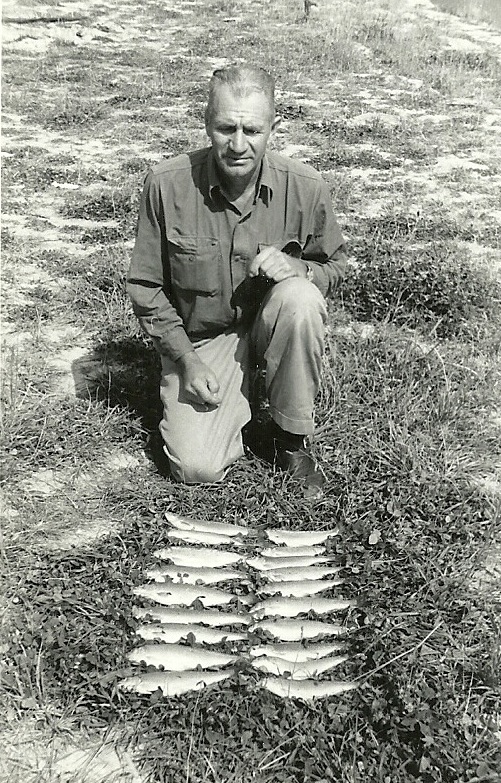
By the time I knew him, he had long since retired from that occupation, and he was home, taking care of his tropical fish business. He would find time to take his little granddaughters fishing (my cousin Diane and me), after night crawler hunting by flashlight, of course.  He was an affectionate grandfather, and he loved my mom.  He read the morning paper over breakfast, and ate his eggs sunny-side-up, mopping up the last of them with his toast. And he didn’t talk much. The elevator phase of his life, in my mind, consisted of a framed photo of an elevator (McCook Equity Exchange), and Dad’s assurance that it was grandpa’s first elevator he built on his own.

My cousin, Diane, brought out a cache of photographs of grain elevators one day, not too long ago.  Most were not marked, though the one from Kanorado, Kansas, had it’s location and capacity written on the back.  We have identified almost all of them, but a few are still mysterious, so now that it has been thirty-five years since Grandpa died, we have something to ask him.

This summer we are planning to go find some of the grain elevators he built some sixty to seventy years ago, many of which are still in use.  The buildings can’t tell us about his jovial smile, his mischief, or his aggravation at workers who left after their first paycheck.  But I can imagine him there, just as I suppose my father had to.  At least Dad could visit sometimes.

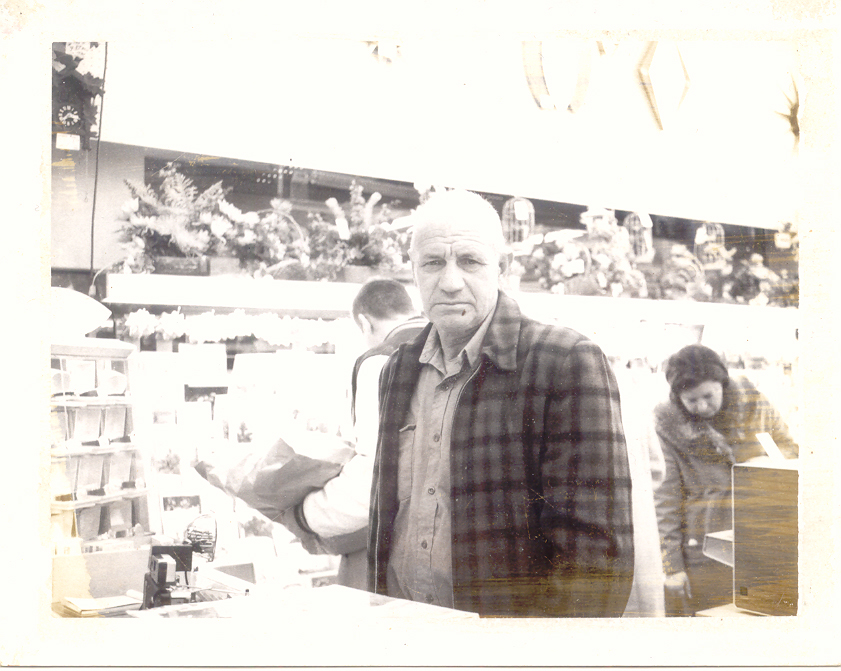
William Arthur Osborn, 1965

Osborn letterhead reveals new dimensions to the elevator story

Story and drawings by Kristen Osborn Cart

Note: Kristen recently visited Nebraska and located a batch of family papers. 

William Osborn retired from building elevators in 1955, but he continued maintaining them.

It was not until sometime in the Sixties that he switched careers and started a tropical fish business, breeding fancy beta fighting fish and guppies in tanks he welded himself. The fish shop was in his basement. It made a fascinating place for a young granddaughter to explore.

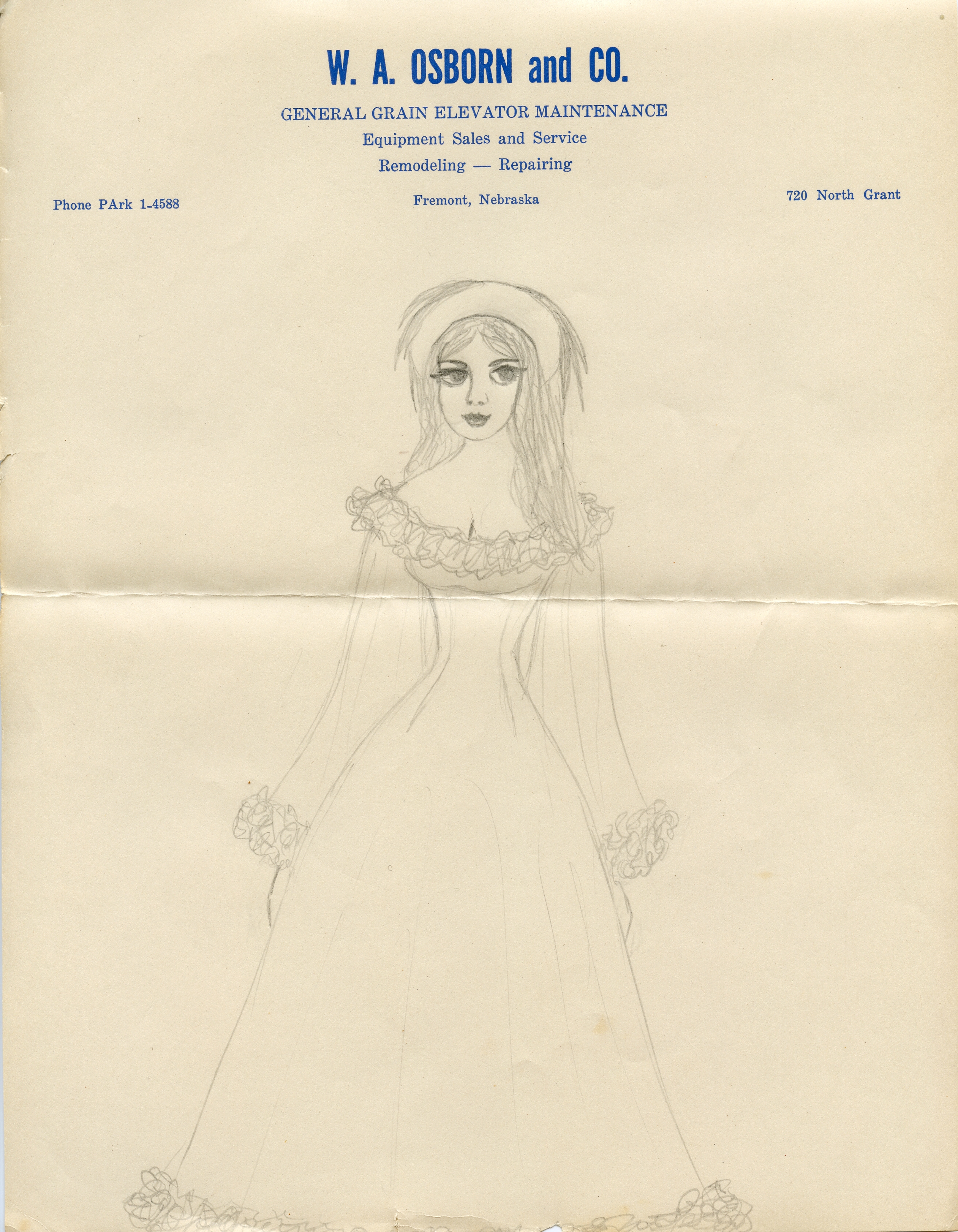
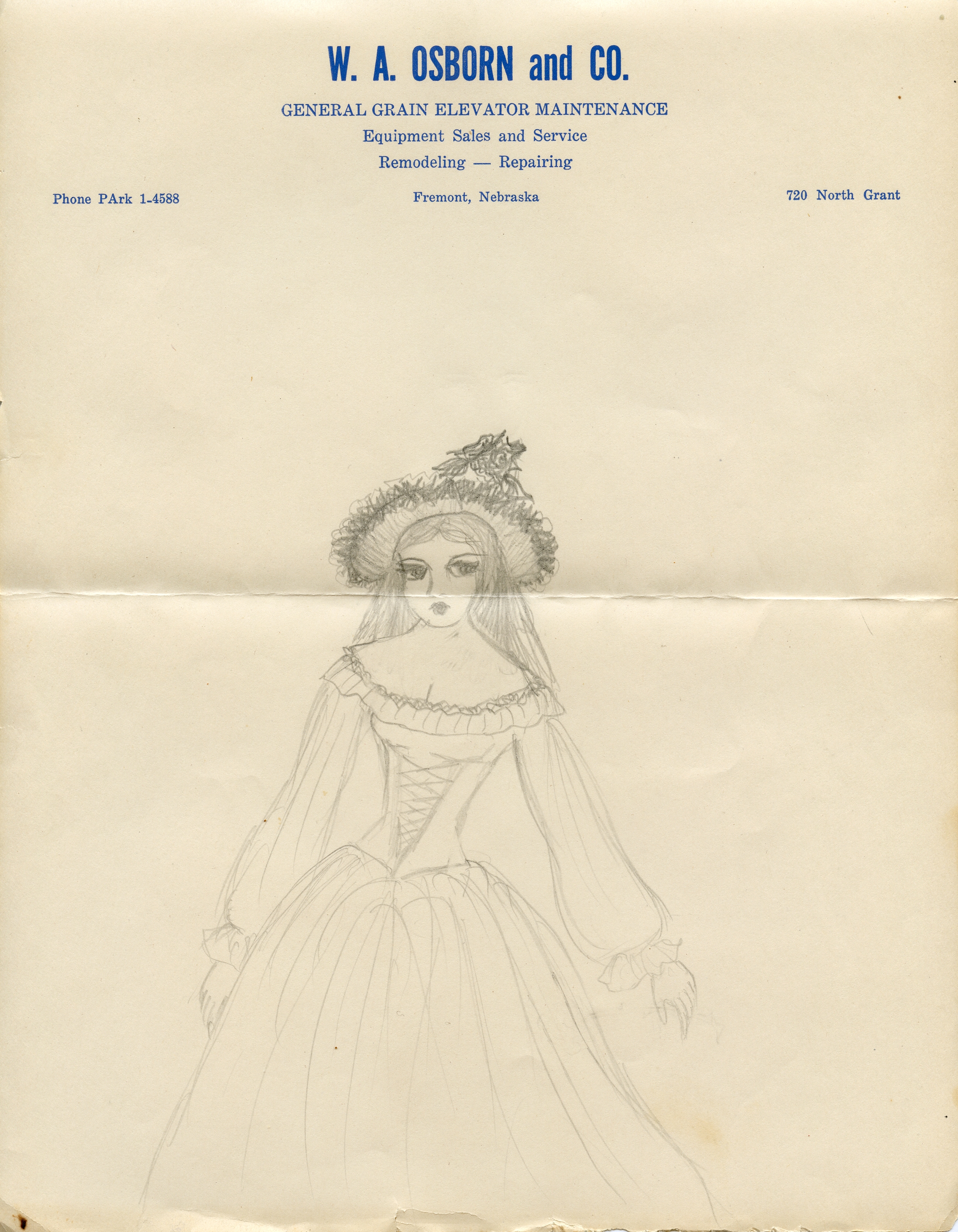
Apparently, he still had some elevator repair company letterhead paper lying around, because I found it and used it for some of my drawings. How they survived all of these years is a mystery to me.

All I ever drew were girls and horses. 

Engaged in sales, William Osborn spent serious time on the road

Gerald Osborn makes this point in an email to Kristen Osborn Cart:

Just for the record, your grandfather [William Osborn, of Mayer-Osborn Company] spent a lot of time on the road selling elevators. I remember waiting in the car during one stop he made; I believe it was at Le Mars, Iowa. I don’t believe it is correct to attribute all the sales to Gene Mayer.

In fact, my understanding was that Gene spent most of his time in the office in Denver and likely was involved with drawing up the contracts, doing the cost analysis, and issuing the bid package. There was also the financial side of things that I don’t think my dad was very involved with:  payroll, purchasing, accounting, et cetera.

Wauneta registers as an important architectural landmark and literary archive

Story by Kristen Osborn Cart

Photo by Gary Rich

The elevator operators at Wauneta, Nebr., have done a remarkable job of retaining the blueprints and correspondence accumulated during the time the elevator complex was designed and built.

In virtually every other case we’ve investigated, blueprints were lost or unavailable, and the histories of the elevators were unknown. At Wauneta, we can track the history of their endeavor very easily.

We know from a newspaper item that the first, straight-up elevator at Wauneta was built by William Osborn, during his years with J. H. Tillotson, Contractor, of Denver, in 1945.

My dad knew that Grandpa built an elevator at Wauneta, so the story has been verified. A few years later, Wauneta obtained designs for an annex to be built by a winning bidder.

Map of Nebraska highlighting Chase County

Among these designs were two blueprints, dated 1948 and 1949, which were done by Holmen and Mayer, and Mayer-Osborn, respectively. Apparently the first set of plans was not built and a second set was ordered, this time from the newly formed Mayer-Osborn Company.

Other builders also submitted plans. Instead of an annex, however, Wauneta eventually built a second elevator, likely as a money-saving move.

A third elevator was also built.

The first two elevators had access to a rail line, and when the third elevator was built by Mel Jarvis Construction of Salina, Kan., it had no rail access, so runs were built connecting it to the other elevators.

After his recent visit, Gary Rich confirms that Mayer-Osborn built the Co-Op office building, formerly a John Deere dealership, and also a boiler room just west of the dealership. The blueprints are still kept at the Co-Op.

According to Gary, who interviewed a member of the Co-Op board, “The Co-Op provided everything for the farmers. They had the elevator, the John Deere dealership, a grocery store, and a lumber yard. Plus, they had a fertilizer plant and gasoline dealership.” 


Note: Follow the embedded link for William Osborn’s explanation of construction techniques used by Mayer-Osborn in nearby McCook, Nebr.

Memories of William Osborn’s automotive fleet from A to Olds

By Kristen Osborn Cart

Long before my grandpa William A. Osborn started working in the elevator business, his father Arthur K. Osborn lost his Nebraska farm when the loan he co-signed for a son-in-law went bad. This occurred around the start of the Great Depression. Being the eldest son, Grandpa had to find another way besides farming to make a living. He was in the National Guard for a time when he was very young, and afterward he worked as an auto mechanic and in construction.

His first car was a Model A Ford. Around 1939, he bought a used 1936 Chevy. By 1945, after he had worked for Tillotson Construction Company, of Omaha, and had moved from a farm where they rented into town, he bought a 1941 Chevy. That was the last used car he owned.

Alice and Bill Osborn, in back, with their brood, from left: Dick, Audrey, Jerry--and the '36 Chevy.

In 1948 Grandpa bought a 1948 Chevrolet sedan. Two years later, he bought a 1950 Buick Special, brand new, and also purchased two new 1950 Chevy sedans. My Dad’s brother Dick likely paid for one of them, which he drove. Grandpa and Grandma went to Oklahoma to pick up the other one for Grandma and drive it back.

These purchases came after Mayer-Osborn Company was established and their first project, the elevator in McCook, Nebraska, was finished.

In 1951 Grandpa bought a new 1951 Buick Roadmaster. Two years later he bought a 1953 Packard, but soon the engine block cracked, so the next year he bought a new 1954 Cadillac and another new Chevrolet for my grandmother. After Grandpa moved to Denver, Dad lived alone with Grandma for a number of years, and he had the use of her car when he worked his first teaching job at Luther College in Wahoo, Nebraska, in the fall of 1955. After 1956, Dad purchased her ’54 Chevy for $1000 and had it when he moved with Mom to Denver. He paid it off by 1961.

Kristen's dad, Jerry, with the 1950 Buick Special.

Grandpa retired from Mayer-Osborn in 1955. He drove his Cadillac until the early ’60s when he bought a new Oldsmobile that he drove for a number of years, finally trading for his last car, a 1968 Olds, which is presently in Dad’s barn. I remember that car and sitting on its burning hot seat in the middle of summer, the inside smelling like softened plastic. I remember when it was new, with seats as wide as a park bench and a big round steering wheel.

Dick Osborn with 1950 Chevy Deluxe

Grandpa did pretty well in his business. There was still a good nest egg after he died in 1977. He had to have a good reliable vehicle because he certainly put on the miles.