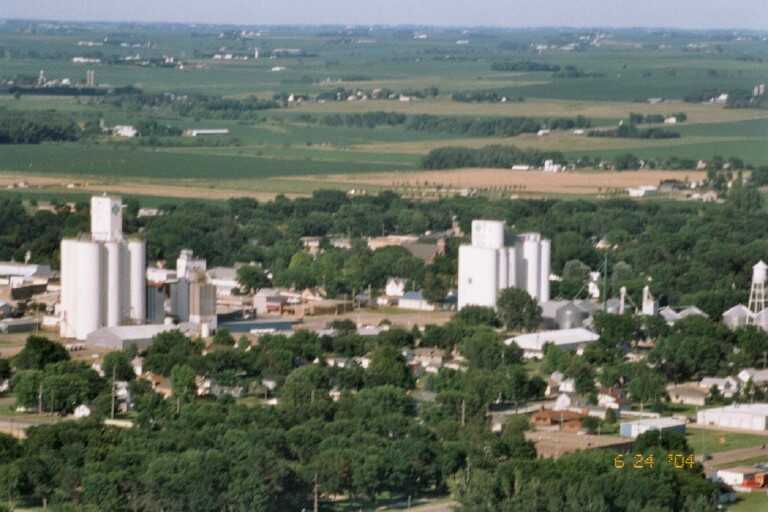
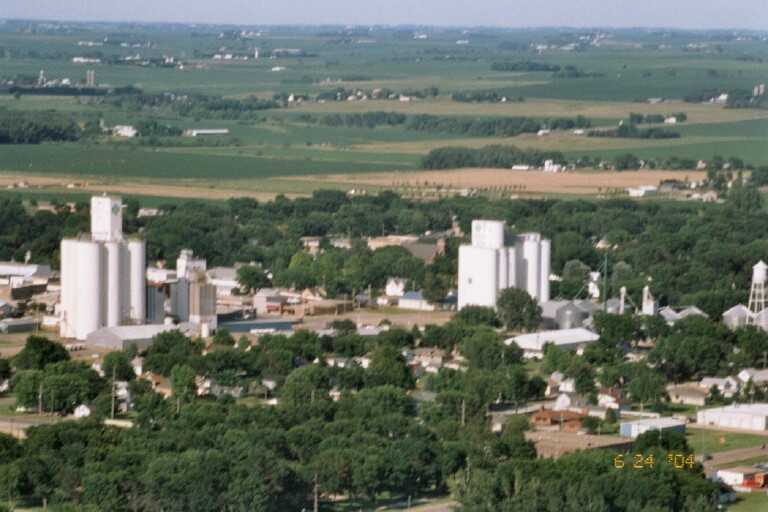
Open house to welcome Tillotson Construction’s large elevator at Rock Valley


Photo by Rock Valley city administrator Tom Van Maanen

Rock Valley, Iowa–In June 1950, Farmers’ Elevator Guide reported a 270,000-bushel, $125,000 concrete grain storage elevator was being put up by Farmers Elevator Company.

In November the same publication reported an October 7 open house at the facility. Final cost and capacity were $150,000 and 310,000 bushels. This was “said to be the second largest in the northwest section of Iowa.”

Other key dimensions:

  • A footprint of 65 by 85 feet
  • Height: 160 feet
  • 34 bins ranging from 300 bushels to 28,000 in capacity

Features included a “cleaner room” and a grain dryer adjacent to the elevator.

Tillotson Construction Company, of Omaha, contracted the work.

Men wanted in Paullina, Iowa, by Tillotson Construction in 1949

Back Alley, Paullina, Iowa, by Jim Hamann

MEN WANTED for construction work on Concrete Grain Elevator, 90¢ per hour, 10 hours a day, 6 and 7 days a week. Time and ½ over 40 hours.

Tillotson Const Co. at Paullina, Ia.

The Alton, Iowa Democrat, Thursday, May 5, 1949

Editor’s note: In 2008, an explosion and fire injured a customer at the new elevator in Alton.

This map shows the incorporated and unincorpor...

Image via Wikipedia

Page City structure exemplifies functional and aesthetic aspects of elevator design

Page City elevator as seen January 26, 2012

Story and photos by Gary Rich

The elevators without a headhouse were called straight-up elevators. J. H. Tillotson, Contractor and Mayer-Osborn Company produced these in the latter 1940s and early 1950s. Their elevators had a smaller diameter pipe that came out about three-quarters up the rail side. Loading a boxcar was time-consuming.

About 1958, there were improvements added for quicker loading of boxcars. These images show the Page City, Kan., elevator. Notice the rail loading chutes are much larger and there are two chutes, so the grain could be loaded equally. These chutes were on all concrete elevators raised during the late 1950s and 1960s. Most boxcars could be loaded within fifteen minutes, whereas on the old wooden elevators it could take up forty-five minutes.

The Page City elevator was built by Johnson-Sampson Construction Company, of Salina, Kan.  It was built about 1958 or 1959. Did Gene Mayer draw up the blueprints for this elevator? We don’t know where he went after the Mayer-Osborn era, which ended after 1955.

Another improvement is the area around the driveway. You can see the three reinforcing columns above the driveway and door. I would think this would add greater strength. The Kanorado, Kan., elevator has a smaller version built out. It is established that Gene Mayer produced the plans for that elevator.

Tillotson Construction wins Rock Valley contract, loses $870 judgment for employee’s injuries

Photo by Rock Valley city administrator Tom Van Maanen

East Elevator To Be Sold At Public Auction Saturday

Directors of the Farmers Elevator company decided last week to sell the red (east) elevator structure to make way for the new concrete storage elevator. Included also will be a feed shed and the driveway office structure.

Various and sundry pieces of equipment are being offered for sale, either before or during the public auction, scheduled to be held this Saturday, starting at 2:00 p.m.

The elevator building to be sold has a 15,000 bushel capacity and Manager Owen Manning has pointed out that the driveway and office would make a good machine shed. The feed shed measures 30 by 48 feet. See the advertisement on another page for the list of machinery and equipment up for sale.

Manager Manning said that the contract for the new concrete storage building had been awarded to the Tillotson Construction company of Omaha and that work on the structure will begin on or about June 1. The building is due to be completed about September 15 and work may be far enough advanced to permit acceptance of grain for storage about September 1.

Rock Valley Bee, Thursday, April 27, 1950 

♦ ♦ ♦

Sioux County Courthouse News 

In the case of Winfield Kenneth Bagley vs Tillotson Construction Company & American Mu. Liability, the court approved the compromise settlement between the parties in which the defendants are to pays $870.00 to plaintiff for injuries he received to his foot, while employed at Rock Valley, Iowa by the Tillotson Construction Co.

Sioux Center News, Thursday, August 16, 1951 


Tillotson Construction’s Ralston, Iowa, project ‘progressing nicely’ in 1939

Ralston, Iowa–The work on the new annex at the Farmers Elevator is progressing nicely. The Tillotson Construction Company of Omaha will soon have it ready to store grain.

Carroll (Iowa) Daily Herald, Wednesday, September 13, 1939

Note: The New York Times visited Ralston in 2006 for a story about inadequate storage capacity in the face of madly expanding corn production.

How does a grain elevator work?

By Gary Rich

First of all, let me explain how an elevator actually works. The grain is dumped from a truck through the grates. The area below the grate is called the pit. The leg runs from the pit to the head house. On the leg is a thick rubber belt with buckets or cups. When the leg is started, the belt will move through the pit. The cups will fill up the grain and take it to the head house. As the leg reaches the top, it will arch, the cups will be up side down. When the cups turn to go back down towards the pit, they empty the grain on a conveyor belt. The cups will be facing downward, until the cups reach the pit and the will right themselves, filling up with more grain.

The run is the conveyor belt between the elevator and a storage annex. The run will have walls on the side of conveyor. They could be completely covered, too. Workers will set up the run, to a certain bin. There are openings at each bin. There is generally a door that they can open, so the grain will fall into the bin. They will put another piece of metal on the run, which acts like a chute. Thus, when the grain gets to the proper bin, and the grain hits the chute, the grain will move toward the opening of the run, and the grain will empty into the bin.

Sometimes, there will be a short conveyor belt that can be put under the main conveyor belt from the elevator. It is the same method. The grain will hit the chute, then through the opening, onto the second conveyor belt, which has a rise to it, and it will dump the grain into the bin.

Kristen mentioned that the bins are sloped. Most bins are built this way. You can think of it as self cleaning, as all the grain will come out the bottom of the bin. Now, if they built the bin flat, most of the grain can be removed. However there will still be about three feet of grain that is away from the bottom opening. Then some one has to climb through the manhole into the bin and they must shove the grain through the opening at the bottom. This is the only way that you can empty a flat bin.

The storage annex always has a basement. There is a conveyor belt that runs from a bin, back to the elevator, then up into a hopper. Most elevators have two separate hoppers. One will load a rail car and the other one can load a truck. If you did not have this conveyor belt, you could not unload a bin.

The area where the run is located is enclosed. If you look at a photo of a grain elevator with a storage annex, you will see an enclosed area above the storage annex. Outside this area, the bins are covered with concrete. Inside the run, either part of each bin will be open, or they could have metal slabs that cover the bins.
William Osborn’s photo of the Kanorado, Kansas, elevator

By Kristen Osborn Cart

This is an image that was in my grandfather’s papers when he died. It was his photo, since he was the only photographer in the family. This was the only elevator image he identified on the back. The caption was “Kanorado, KA, 125,000 bu.” I know Grandpa worked on it because he photographed it. We know it was built before March of 1947, which was the month Joe Tillotson died.

Grandpa was working for Tillotson Construction of Omaha as late as the fall of 1944 through the spring of 1945, when Giddings, Texas, was built. Dad visited Grandpa on the Giddings job, so he was able to date it–they visited in early 1945, the spring, when Dad turned eleven years old. That means the Kanorado elevator was built circa 1945 to 1947.

It may be hard to find information on Joe Tillotson’s business because he was independent for such a short time–even though there were quite a few elevators to his name.

¶ Ronald’s note: While posting this, I gave Kan-o-RAY-do a call and was told that original records pertaining to the elevator’s construction burned in an office fire.


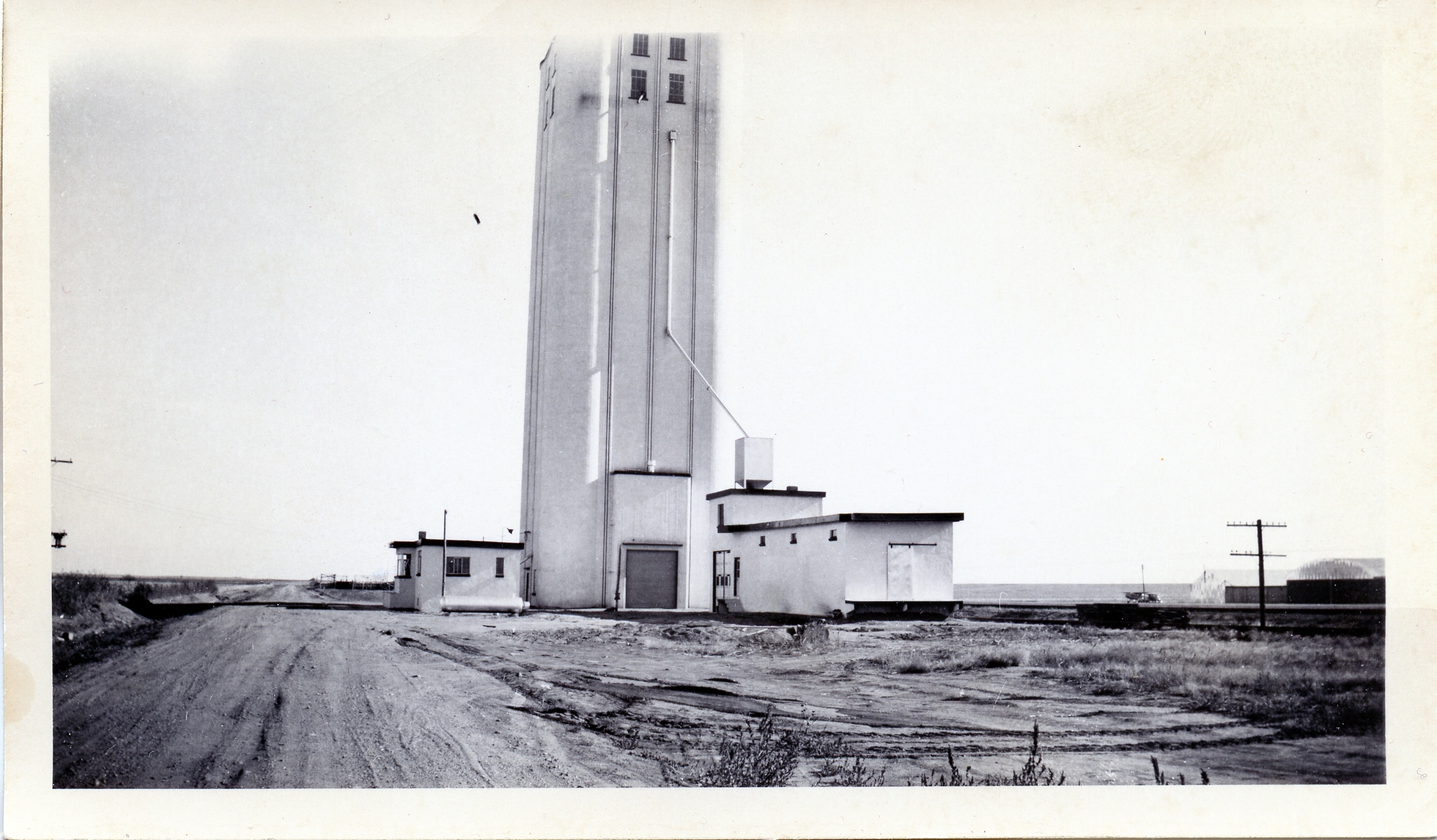
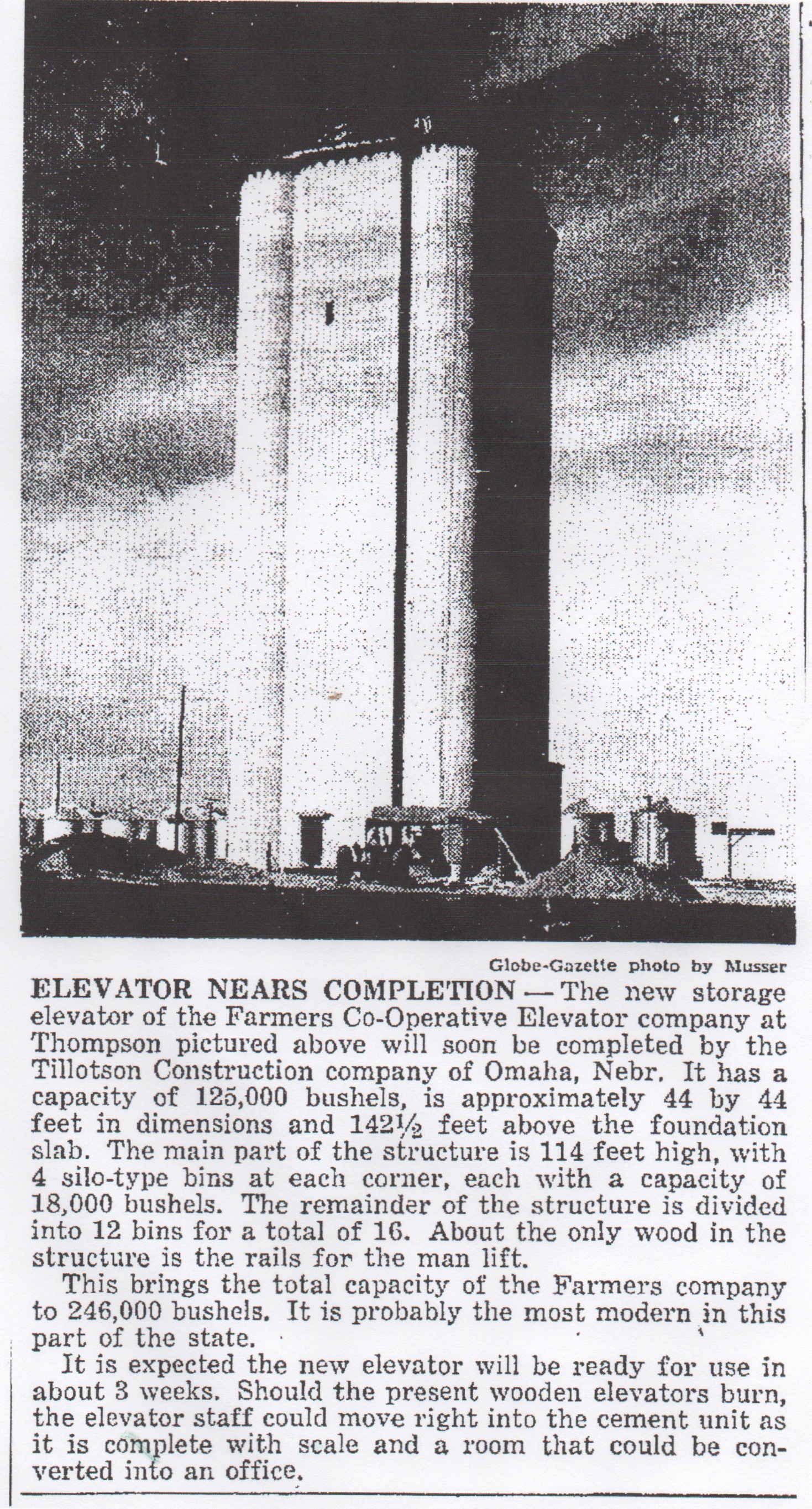
Thompson, Iowa, elevator completed in 1950, torn down in early 1980s

Work Underway on Storage Elevator

Thompson – Work has been started on a 125,000 bushel storage elevator for the local co-operative elevator company by the Tillotson Construction company of Omaha, Nebr.

Mason City (Iowa) Globe-Gazette, June 20, 1950

Mason City Globe-Gazette, September 2, 1950

♦ ♦ ♦

Our call to the Farmers Cooperative elevator in Thompson, Iowa, while preparing this post resulted in a conversation with location manager Lyle Wirtjes, who said he started working at the elevator in 1969. By then, Mr. Wirtjes said, one silo had already “busted out.” After another such incident, a new elevator was constructed across the road and the Tillotson elevator was torn down sometime in the early 1980s.

♦ ♦ ♦

Kristen’s analysis:

This Thompson elevator should not have failed—look at Greenwood, still here after all these years. I would guess there were some corrupt people in the building trades pulling off a scam, and since so many projects were going at once, a few poorly done elevators slipped through. They all looked like carbon copies of one another, so unless soil, water table problems, or fire caused the break, crooked subcontractors could have caused it. Not an uncommon problem when the federal cash spigot is turned on full blast—everyone shows up to the party, whether good or not.  My speculation here.  Nineteen years is not much of a lifetime for an elevator, barring a fire.


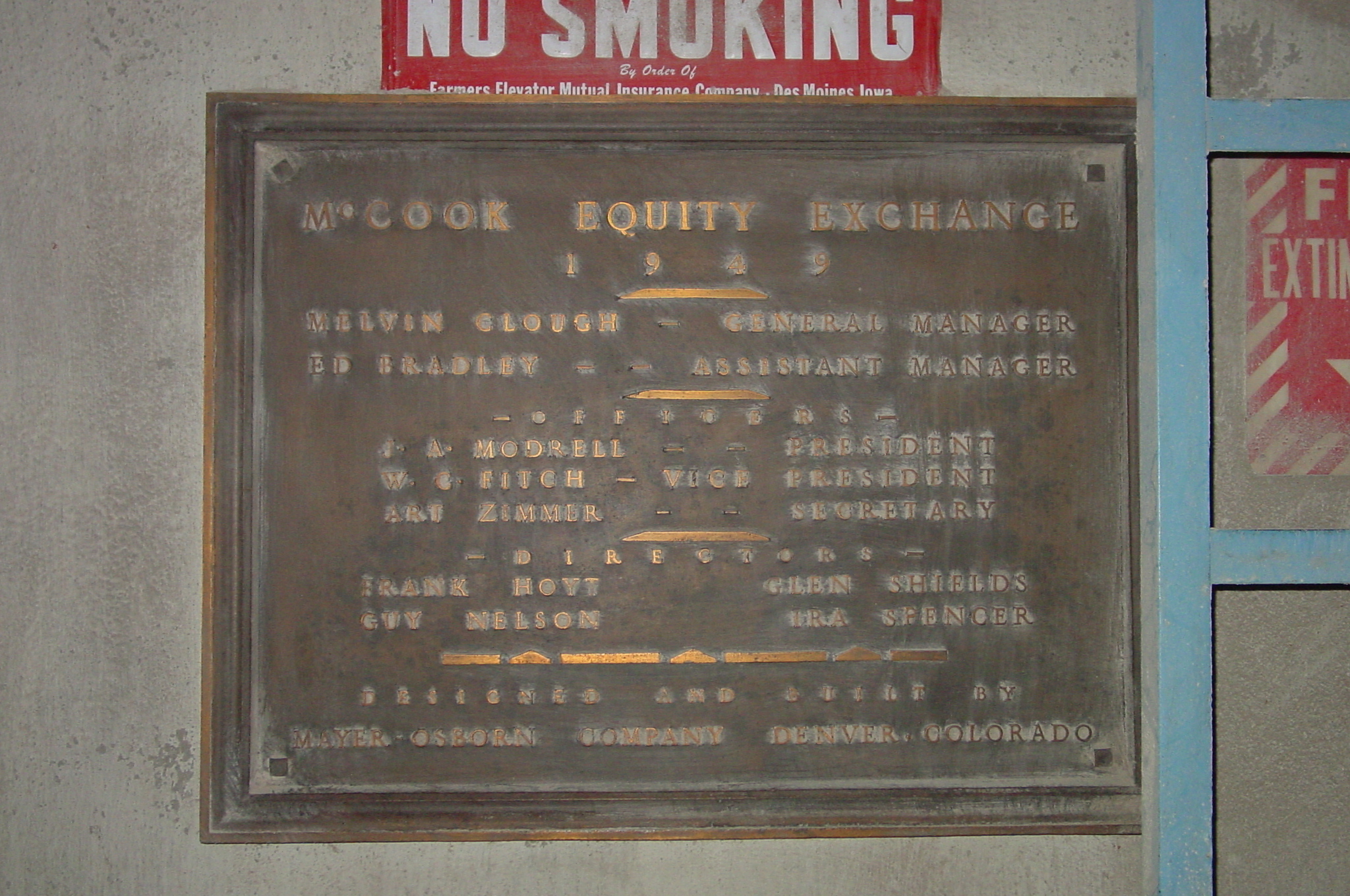
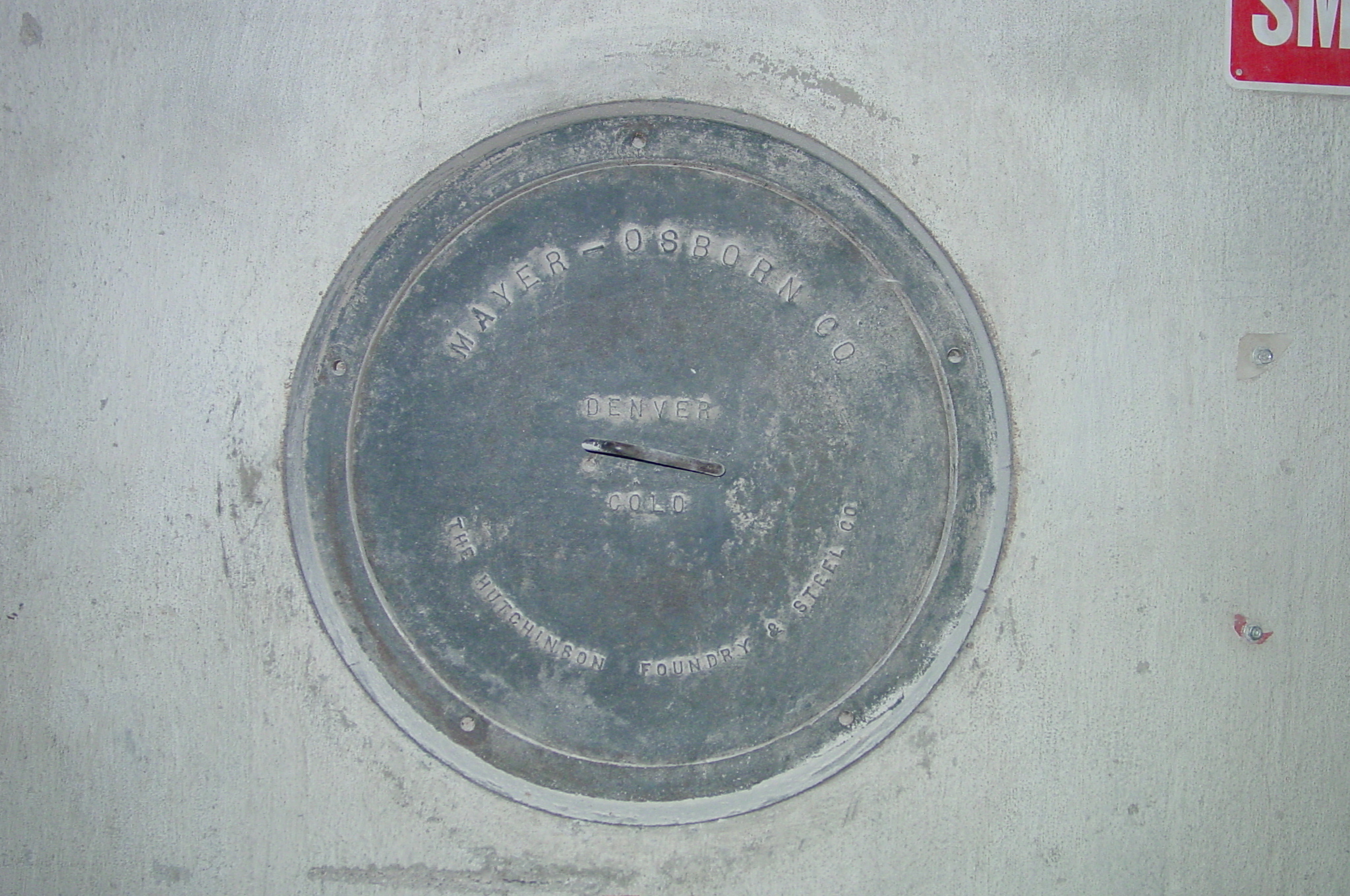
Ports and plaques provide clues about an elevator’s builder

A good quick way to identify the builder of a grain elevator is to check the grain ports. At their first project, in McCook, Nebraska, Mayer-Osborn used these forged steel ports from the Hutchinson foundry. A nice touch was the bronze plaque inside the elevator. It identifies the people responsible for its construction.