An inside look at the J. H. Tillotson elevator at Hanover, Kansas

The J. H. Tillotson straight-up elevator in Hanover, Kan. just after a rain

The J. H. Tillotson straight-up elevator in Hanover, Kan. just after a rain. 

Story and photos by Kristen Cart

One of the loveliest elevators J. H. Tillotson, Contractor ever built is still in use at Hanover, Kansas. Last October, during a visit to this small Washington County town just seven miles south of the Nebraska border, I photographed the elevator under moody skies and marveled at its clean, graceful lines. Then it was time to get to the business of finding out about it.

DSC_0681

Ryan Riekenberg takes a moment to show me around the elevator.

Fortunately, Ryan Rieckenberg, a twenty-year employee of the Farmers Cooperative Association, was on hand to show me inside. He had previously worked for the grain department and currently worked as a crop sprayer. He said before the Hanover location joined the Worchester-based Farmers Cooperative, it operated its own association called the Farmers Union of Hanover. He said the elevator was currently used for milo.
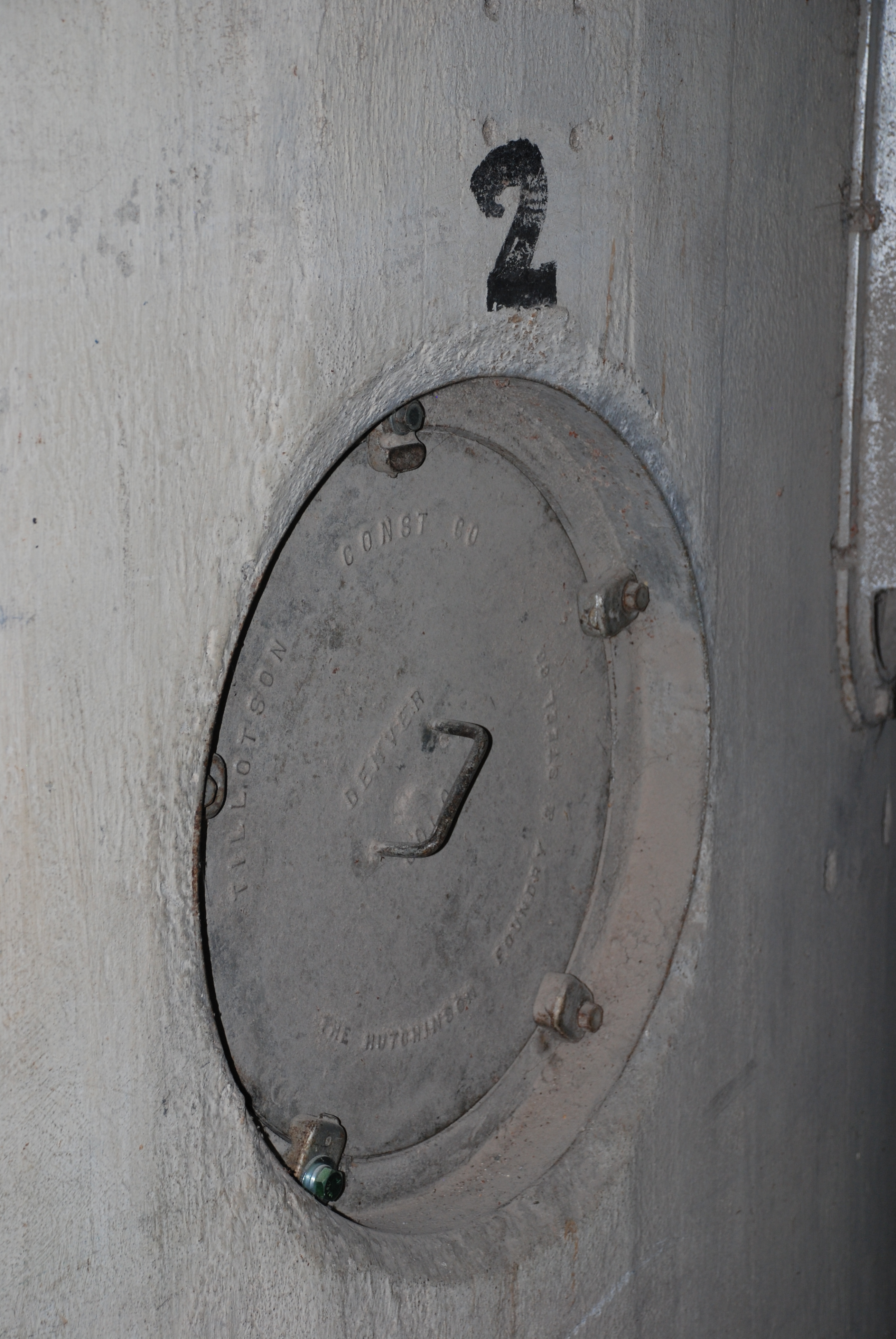
The manhole cover identified the builder

Manhole cover

He pulled up in his truck, fished out his keys, and took me into the elevator to look at its interior, including the manhole covers that positively identified the elevator as a J. H. Tillotson project.

As he unlocked the door, Ryan supplied some historical details. The elevator had been built beside an old wooden elevator, which was used as a feed mill until it was demolished about eight years ago. We entered the doorway a couple of steps up from the gravel drive where the old wooden edifice used to stand.

DSC_0673

The elevator leg

Once inside, we could see the leg in the center of the elevator. A grate covered the pit, and Ryan opened the grate to display the sloped bottom where the grain would funnel toward the base of the leg, to be scooped up and carried to the top of the elevator for distribution to the bins. The leg extended all the way to the bottom of the pit. A ladder went into the pit from another opening, providing access for cleaning and maintenance.

Nearby, a cage-enclosed man-lift gave access to the integral head-house at the top of the elevator. The cage was almost certainly a later modification, since the old man lifts didn’t have them.
DSC_0670

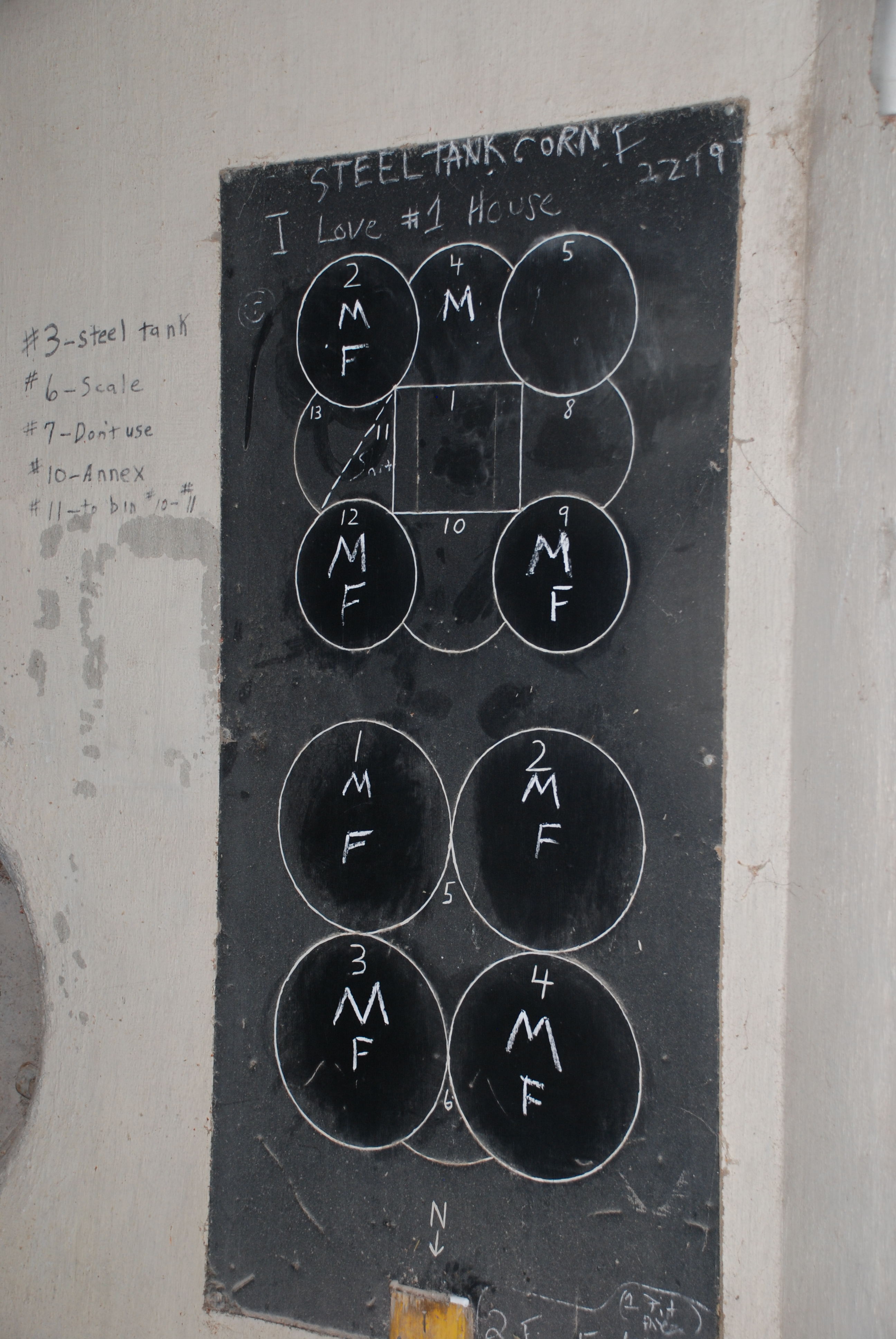
The distribution diagram

Prominently displayed on one of the bins was a diagram of the elevator and its annex. Here the storage assignments for each of the bins were noted, including the neighboring steel bin, which was served by the same integral head-house with a chute from the top of the elevator. Presumably, “M” stood for milo, and a note indicated that the steel bin held corn. Perhaps “F’ indicated feed, but that is just a guess.

I’m not sure why someone wrote “I love #1 house,” but if they meant this lovely elevator that my grandfather, William Osborn, built for Joe Tillotson’s company in 1947, I must share the sentiment. It was a dandy, and it appeared to have a long, useful life ahead of it.

DSC_0689

A view from the west side where the feed mill used to stand. 

Photo tour reveals the Goodland, Kan., elevator’s symmetries and history

Story and photos by Kristen Cart

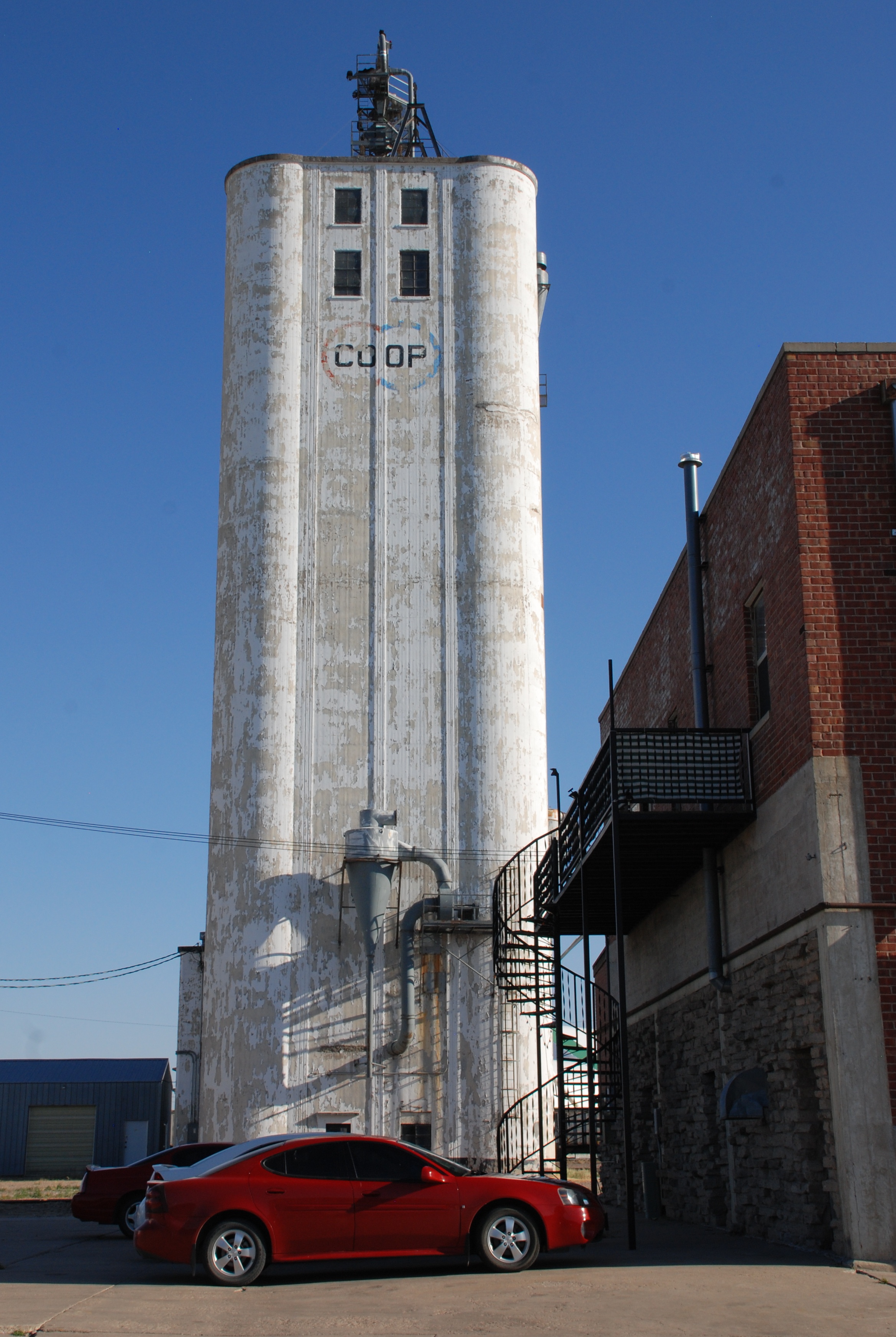
My dad, Jerry Osborn, always knew Grandpa built this elevator, and I remember pictures of it from long ago. It still rises gracefully above the Kansas plain, tucked in among its neighboring elevators, listing slightly in its old age. It has always held a place of pride since its construction in the town of Goodland, Kan.

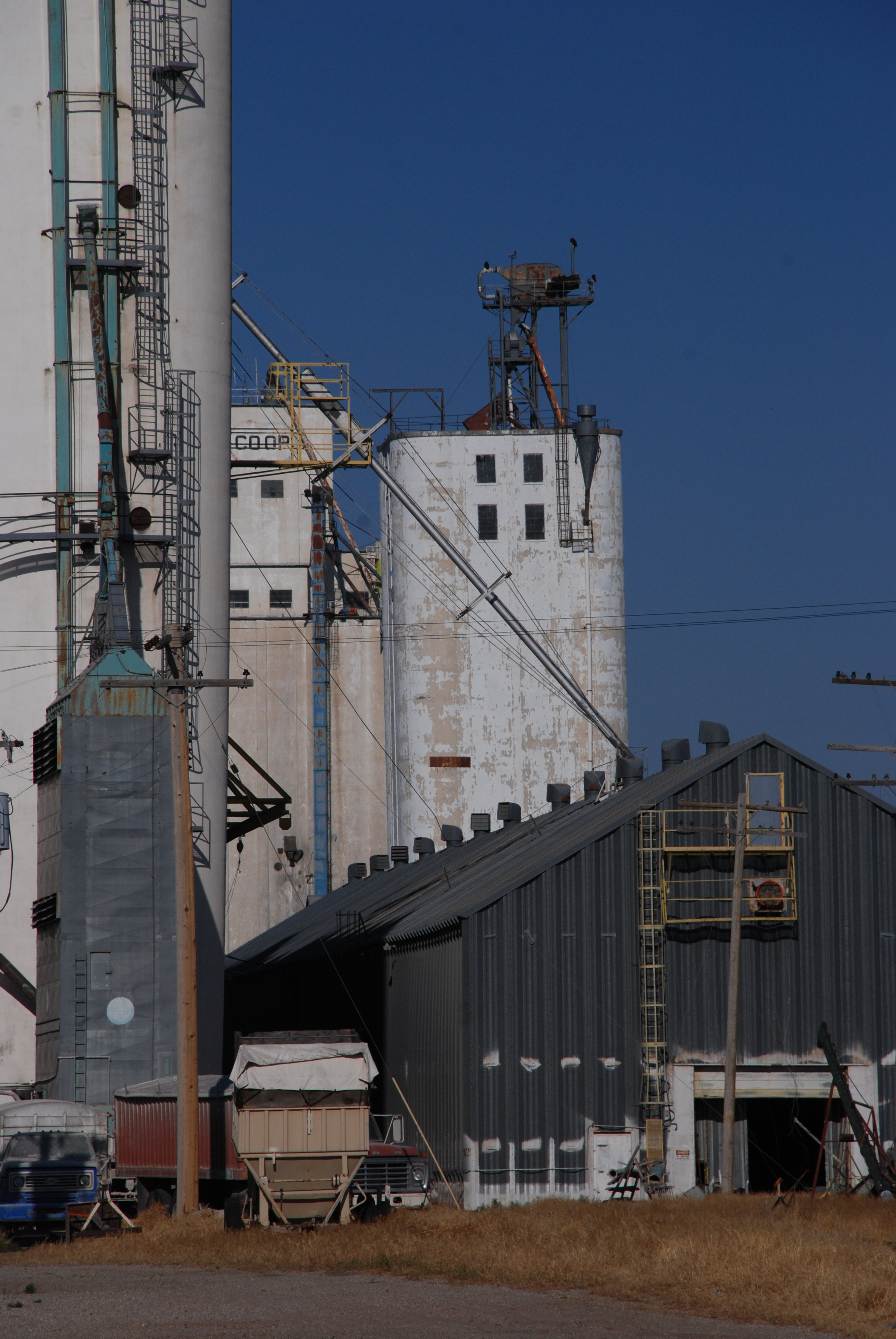
Contributor Gary Rich discovered, when he visited the site, that this elevator, built by J. H. Tillotson, Contractor, is now used for sunflower seed. When I saw it, it was all buttoned up, presumably awaiting its summer crop. The slight tilt is obvious from some angles, but the elevator appears sound.

William Osborn photo of the Goodland, Kan. elevator, found among his papers.

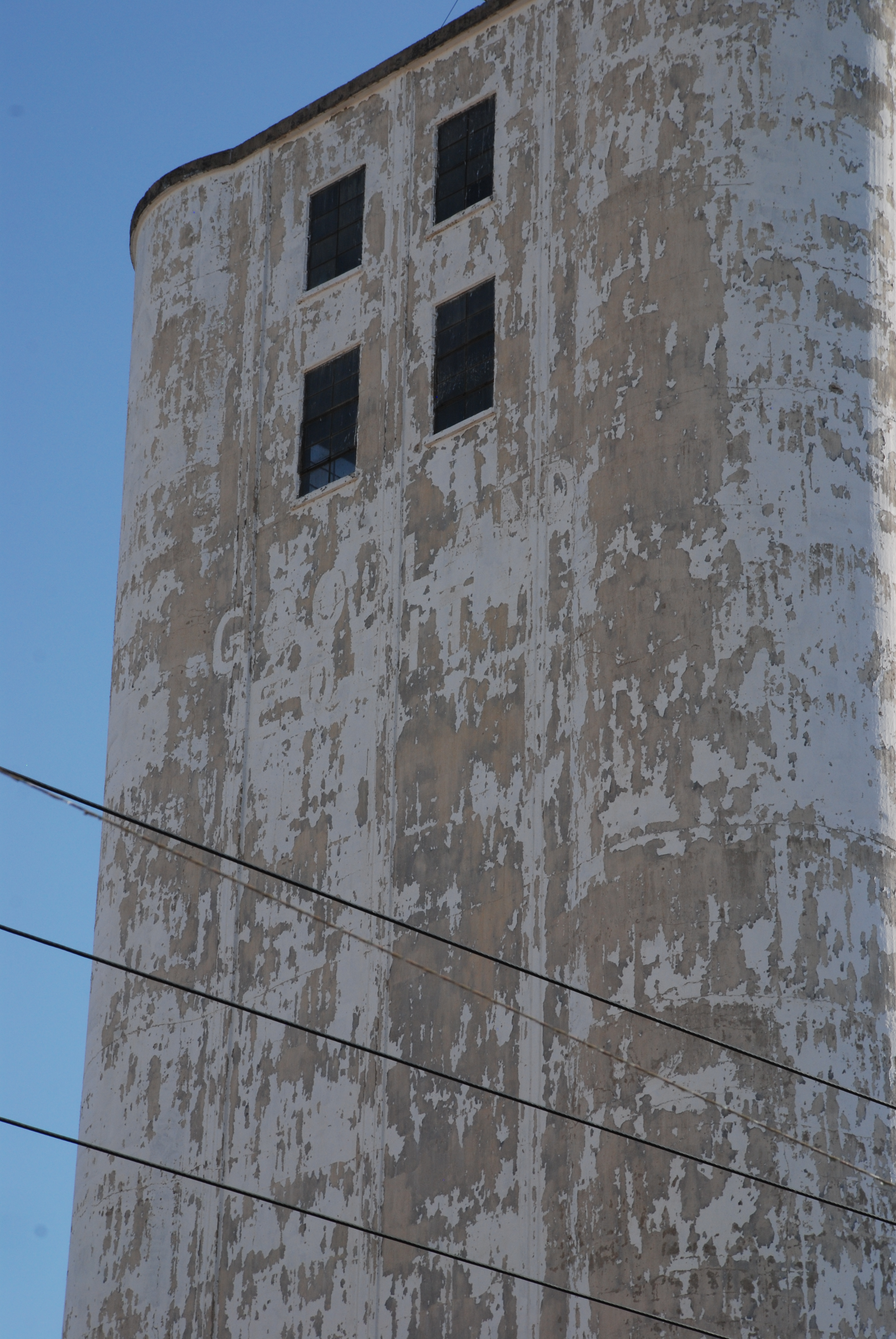
The words “Goodland Equity” can be faintly discerned under the white paint.

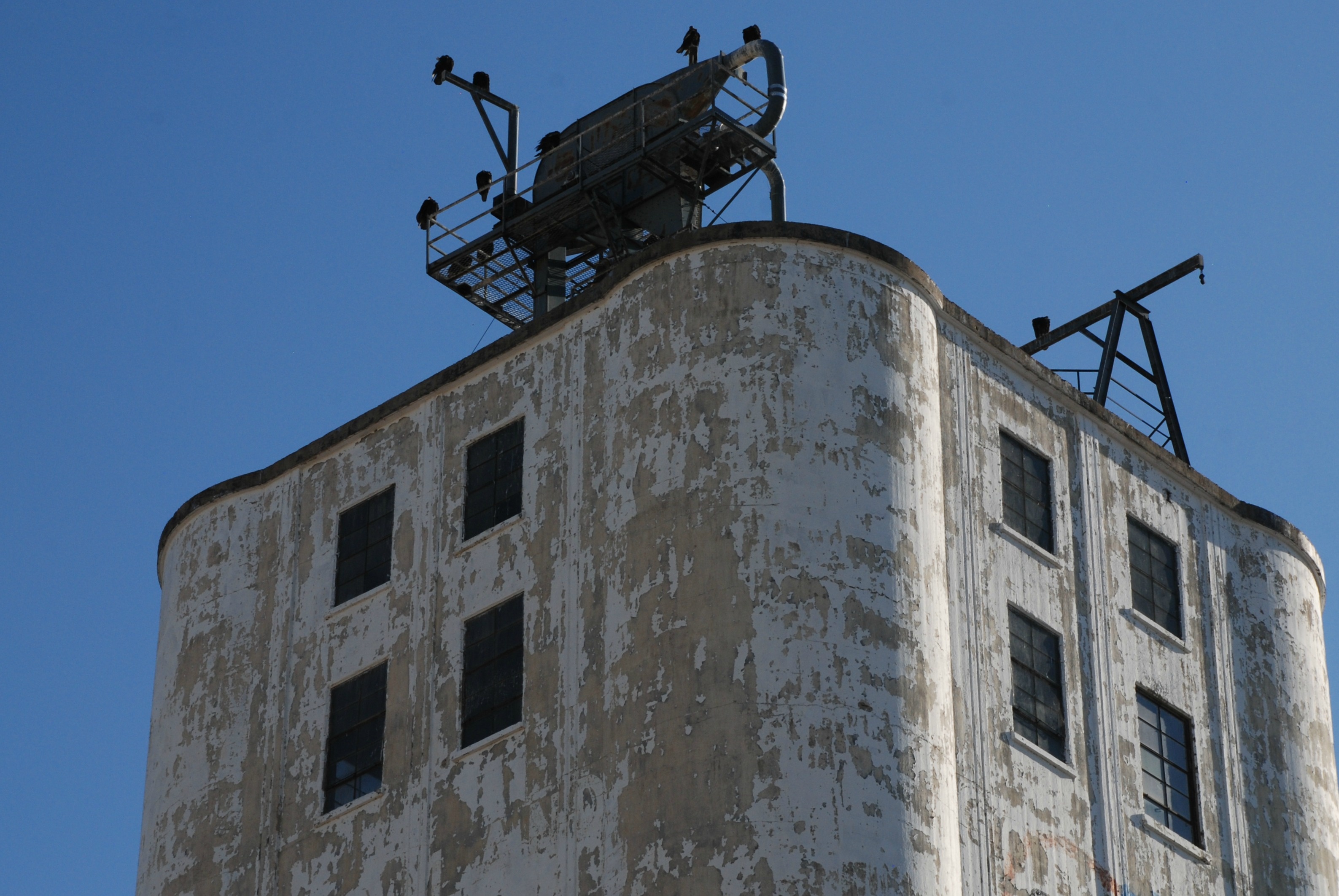
You can still see, faintly outlined in white letters, the name Goodland Equity, long since painted over. At one time  the elevator sported a neon sign proclaiming “Goodland Equity” to the night sky. That sign has disappeared and now vultures adorn the top of the leg in a lofty roost.

This beautiful elevator will continue to attract photographers as long as it stands. Aside from building useful, well-engineered, long-lasting structures, my grandpa, Bill Osborn, built beauty into the flat Kansas landscape.

For that, I am grateful.

A convenient roost for vultures.

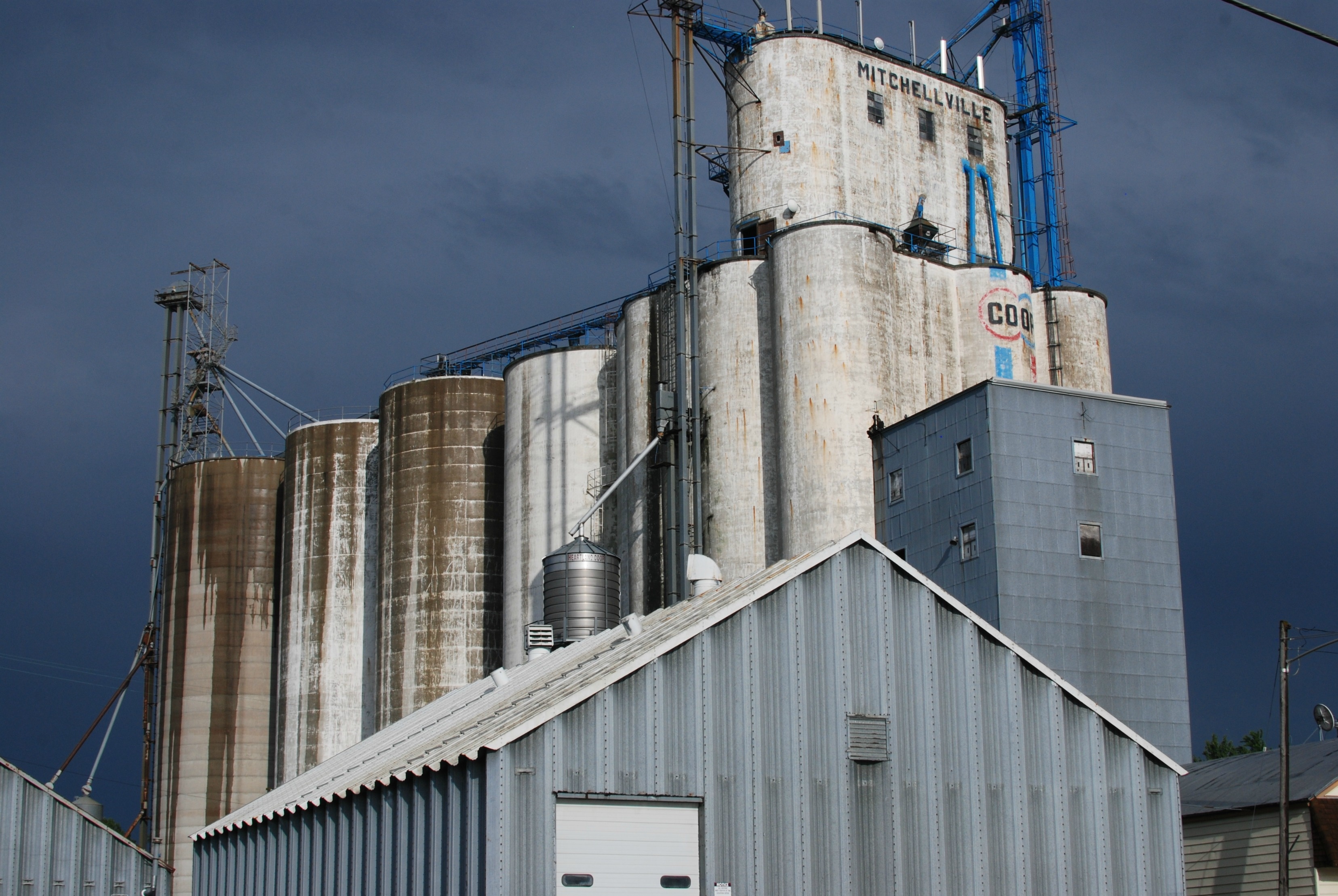
Tillotson Construction’s Mitchellville elevator is a key part of Heartland’s grain operation

The Heartland Cooperative elevator complex at Mitchellville, Iowa.

Story and photos by Kristen Cart

The Mitchellville elevator is visible from Interstate 80, and the rounded head house drew my attention as we headed through Iowa on our way home from our recent trip out West. “Just one more stop, OK, kids?” I said, and they answered with groans. I think I promised ice cream to quell the protest.

The main elevator built by Tillotson Contruction Company of Omaha, with grain drier.

I parked the van, air conditioner running, in a shady spot and hopped out with my camera. Thunderheads threatened nearby, but the storm seemed to be moving off, and the sun peeked out and illuminated the scene. I took advantage of the beautiful light to photograph the elevator.  As I finished up, I saw a truck rounding the corner from an alley into the gravel lot beside the elevator, so I flagged the driver down to ask if he knew anything about it. We were in luck.

The driver introduced himself as Ed Baldwin, a grain truck driver for Webb Farms. He was more than happy to talk about the elevator, having trucked “at least two million bushels” in and out of Michellville. Bill and Stan Webb own the farm, and Ed purchased his truck from their father who used to truck his own grain. Ed gave me a quick outside tour of the elevator property.

The Younglove annex viewed from the driveway.

Ed explained the Heartland Cooperative operation at Mitchellville. He did not know the builder of the “head house,” as he termed the main elevator, but he knew the adjacent annex was built by Younglove in 1972.  The bins had numbers and he pointed out the function of each one. All the way to the left was a new bin with its own leg that was built in the 1980s and used for damaged corn. Immediately to the right of it, on one end of the Younglove annex, was a bin dedicated to soybeans. The rest of the annex held corn, with the main house taking all the wet corn since it gave access to the grain drier.

The Younglove annex is placarded with the date of construction.

During harvest, the employees kept a grueling schedule filling the bins, especially during a wet year. Jim Dietrich, grain manager for Heartland Co-op at Mitchellville, would pull a twenty-four hour shift to accept the grain into the main elevator and dry it. The drier had a capacity of seven thousand bushels per hour, which would limit the amount of grain that could be taken in. Ed said the main house would take seven semi loads per hour of grain that needed to be dried. Shipments from the elevator were by rail, unless capacity was reached and grain needed to be trucked.  Trucking would be the exception for Mitchellville’s operation.