A last farewell to a wooden elevator at Ryegate, Montana

DSC_5220

Story and photos by Kristen Cart

The search for our grandfathers’ elevators has led us to many small towns and many grain operations. Among our discoveries have been ancient wooden elevators, now quaint relics among their larger concrete cousins. In some towns, wooden elevators still have jobs to do, but their time is short.

Charles H. Tillotson built wooden elevators long before his children took up the slip-formed concrete building technique, and at one time, every Midwestern town with a rail line had a row of them serving the local farmers. Now it is increasingly rare to find a town with more than one wooden elevator in service, or for that matter, still standing.

DSC_5225

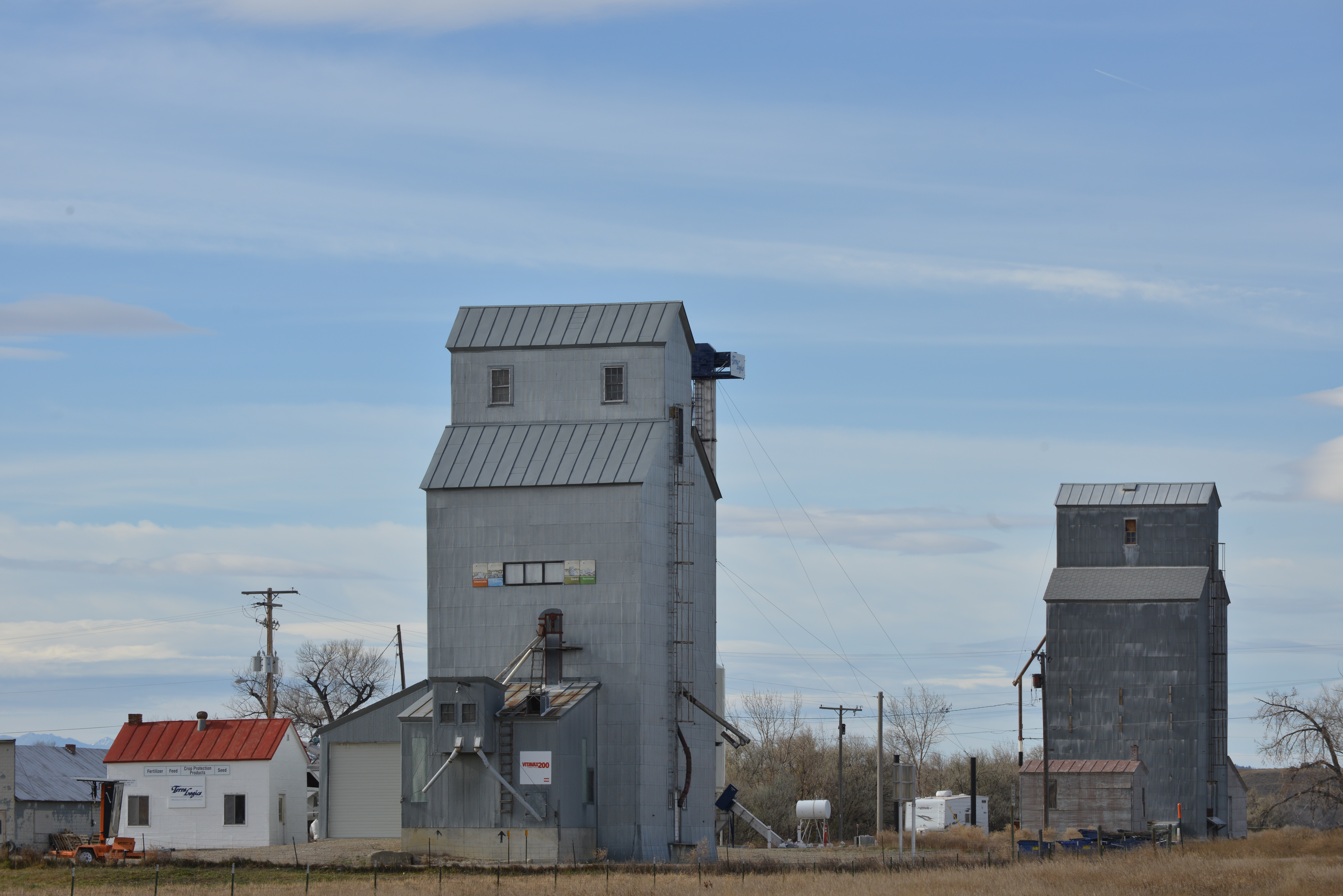
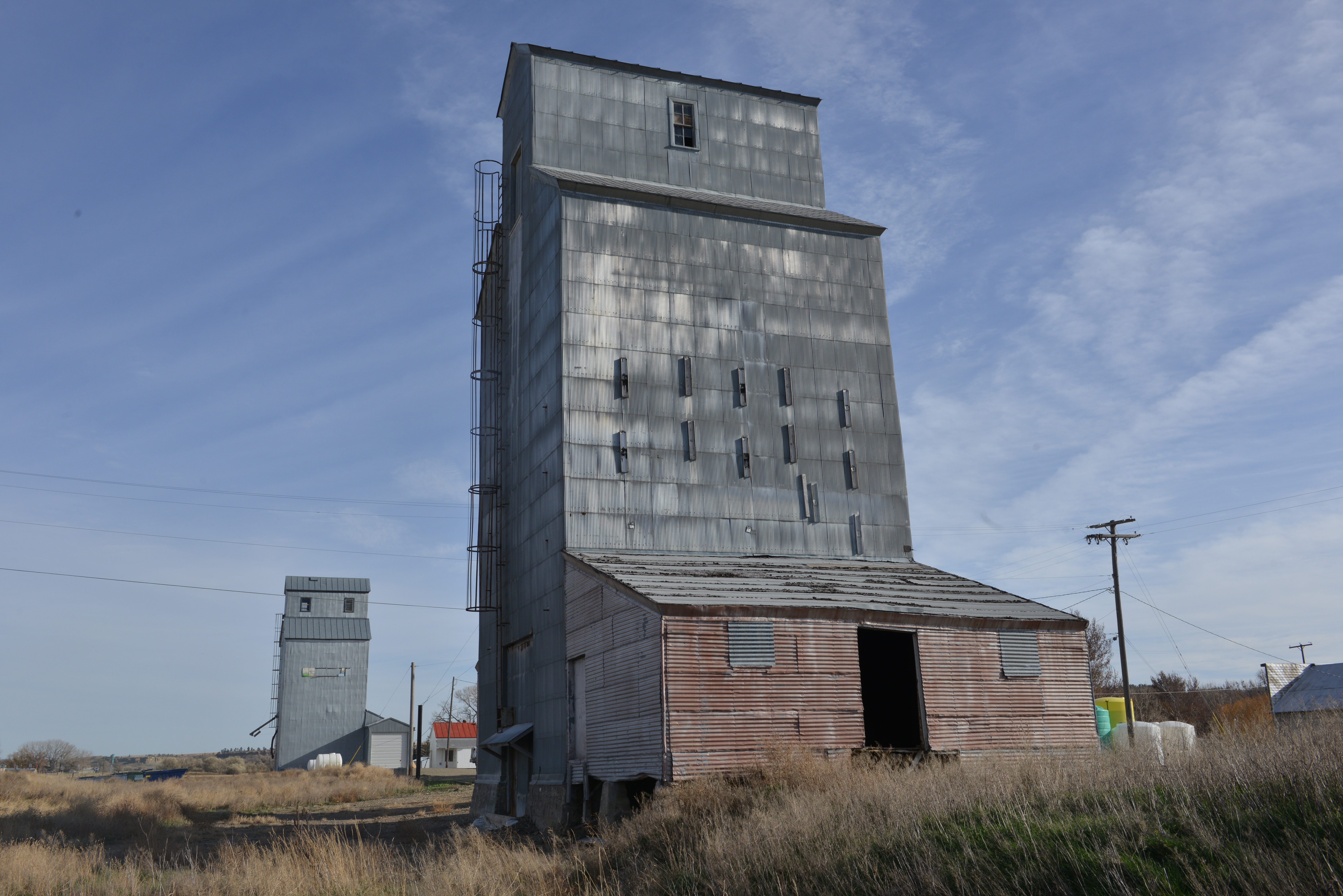
The Ryegate, Mont., elevator is flanked by its replacement fertilizer plant.

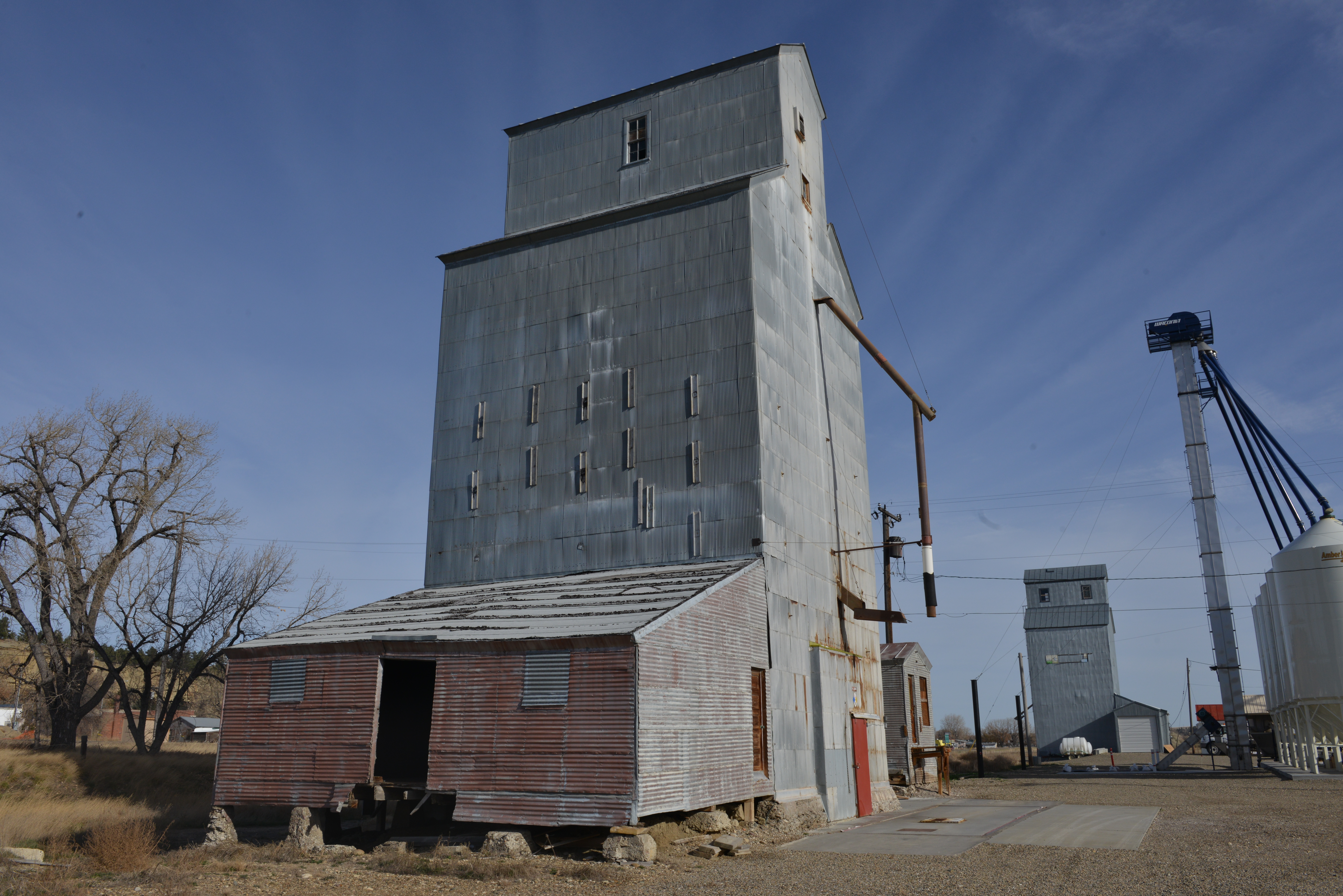
In the last year or two, in several towns, locals have told me that their wooden elevators were no longer used and would shortly be destroyed. I made an extra effort to document those elevators. This week, I almost missed one. In Ryegate, Mont., a new fertilizer plant was put into operation last year, and the elevator that had served the purpose was now slated for destruction.

When I stopped to photograph the pair of wooden elevators at Ryegate, a town on U.S. 12 in east-central Montana, I went into the local cafe for a burger. A fellow at the bar introduced himself as Ken. He wondered where my hometown was, and the purpose of my visit. When I told him I was a bit of an elevator tourist, he told me about the Ryegate elevators. DSC_5156

Ken worked at the Ryegate facility. He said that over the years, he had been employed as a grain hauler and in almost every other aspect of elevator work.

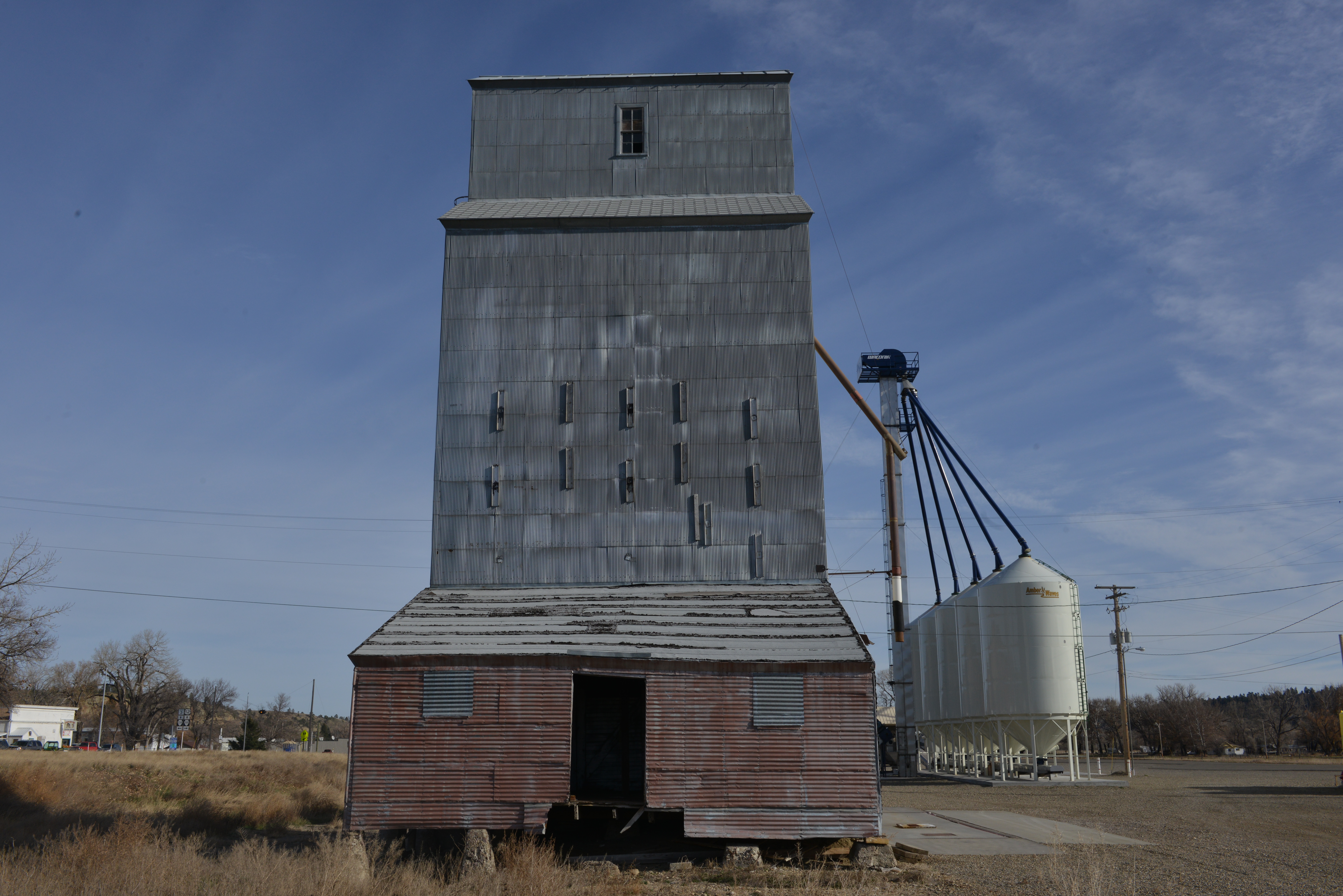
The smaller elevator was built in 1917. Ken said grain dropped 70 feet from the top of the grain spout to a truck below while loading. The elevator had been in use as recently as two years ago, then the new fertilizer plant was built nearby to replace it.

The larger elevator, built in 1914, was still used for storage—it had fresh siding and looked neat and clean on an immaculate lot. But the smaller elevator, equally handsome, would be razed next week. He hoped I would get out and take more pictures before it was gone.

Our discussion ranged from elevators to the military. Ken served in the U.S. Army, had great admiration for the old C-130 aircraft, and expounded with enthusiasm about the M-1 Abrams tank and the Tow missile. He got a kick out of talking with another veteran who shared his interest. He also spoke with reverence about serving under President Ronald Reagan.

DSC_5253

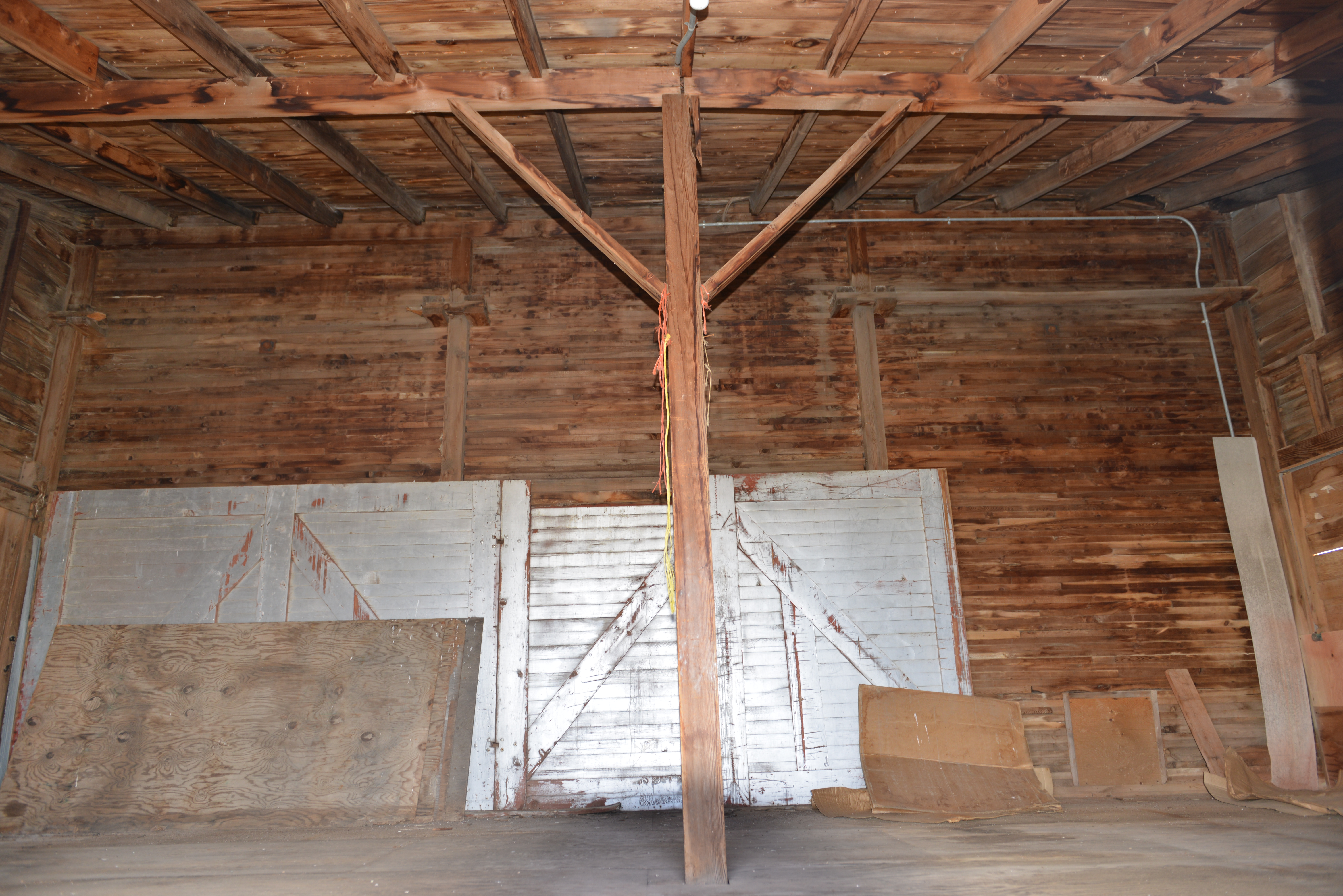
The interior of the shed addition.

Our conversation was interrupted as a young lady burst into the cafe, exclaiming,

“I just got a deer!”

As two men moved to follow her out the door to see her trophy, she said,

“Come see. I got my mulie.”

Her announcement passed without any comment at the bar. Apparently, during deer season, such declarations are expected.

Before I departed to take a closer look at the doomed elevator, Ken introduced himself more formally as Sgt. Ken Davis, and shook my hand. It was an honor to meet this veteran who served back when we had a 600-ship Navy (in the good old days, about three wars ago).

As I took another circuit around the old elevator to shoot a few last pictures, the sun played on the high clouds, projecting light like a halo radiating about the old structure. I thought it a fitting farewell.

In honor of Veterans Day, I salute Sgt. Davis and his life’s work. I hope he enjoys the pictures. DSC_5231

A recent trip west reveals mystery elevators

dsc_0976

Story and photos by Kristen Cart

After our annual trip west to tease the elk (hunting them is perhaps too strong of a term, since our freezer has admitted no elk meat for several years), we took a small detour to look at elevators. I headed the car east onto Hwy 34 in Neb. after stopping to photograph the Grand Island, Neb. elevator, a Johnson Construction project.

This time my dad, Jerry Osborn, went with us, and he humored me, though he was eager to get home. The kids just rolled their eyes and said, “Not another elevator!”

Like pearls on a string, grain elevators line up on Hwy 34 as it stretches from town to town west of Lincoln, Neb. From the look of the rounded headhouses on each elevator,  Tillotson Construction Company of Omaha had free reign there during the construction years, having butted out potential competition as it changed the landscape on the old road.

Only the York and Aurora elevators are recorded in the company construction record pages we have. I will present them more fully in a later post.

dsc_1531

The Murphy sign stenciled on the elevator does not seem to be a town name

The Murphy and Hampton elevators present a bit of a mystery. Since I had a full load of family cramped together in a rental car that was barely an SUV, more suited to a terrier dog and a bicycle than the five passengers it claimed to hold, I did not stop to investigate the mystery elevators. I had to be content with a few pictures taken on the fly.

Here they are. I wonder if any of our readers remember these elevators, or can identify the builders? They will get another visit, hopefully soon, but for now, enjoy the photos.

dsc_1536

Hampton’s elevator also has a rounded headhouse

Summer 1950: All finished with the main house in Alta, Iowa

scan0016

Commentary by Neil A. Lieb and photo from his archive

From a telephone interview on July 22, 2014

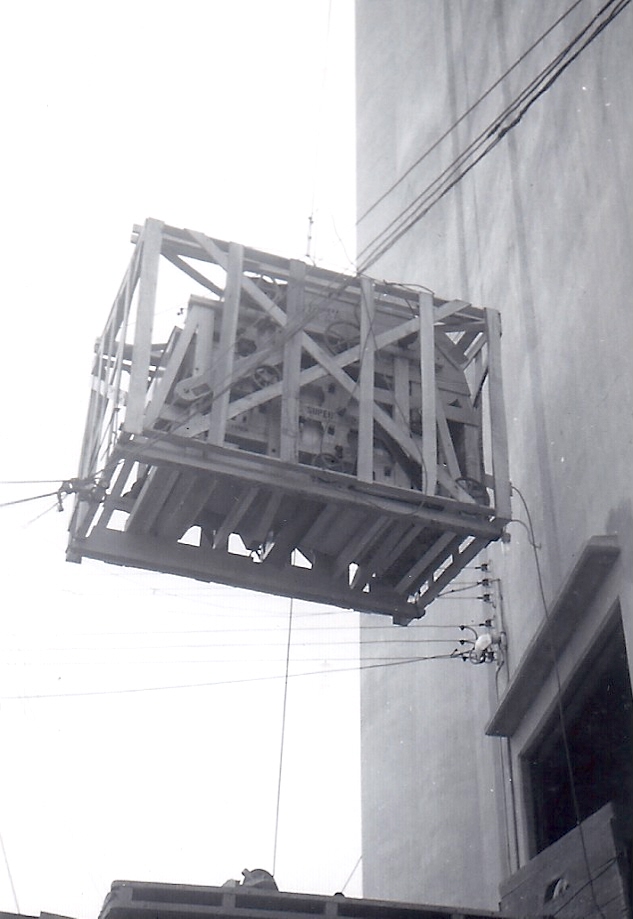
It’s all done. It looks like they’re putting scaffolding up for painting. The main hoist is on the left. That’s a Georgia buggy hanging on the hoist. The guy that’s standing there is going to push it as soon as it hits the deck. They might be just starting on the headhouse. I can’t figure that scaffolding out. It’s a rigid scaffolding.

Memories of cranes and pushing the Georgia buggy in Alta, Iowa

The formwork is clearly seen at the Alta elevator rises. The catwalk around the bottom was for the concrete finisher, who smoothed and patched the freshly formed surface. Photo from the Neil A. Lieb Archive.

Commentary by Neil A. Lieb, photo from his archive.

From a telephone interview on July 22, 2014

On the upper left-hand corner, there’s a crane. That crane we used to haul the steel up to the top, the rebar, the jackrods. That’s all we used it for. You didn’t tie up the other hoist, you used that one. I think it’s called a jack crane. It was an electrically operated crane. The railroad tracks are on the bottom, that’s the end of a box car in the lower right. That doorway—that’s used when you’re loading grain after the thing was all over with.

When I first started, I pushed the Georgia buggy.  It’s probably the worst job in the world because it’s very physical. They weighed 1000 pounds. At Alta, I progressed to laying steel. All the new hires always got to push the concrete because that was the hardest work. There was a big turnover when you started out because pushing Georgia buggies wasn’t very much fun.

The Tillotson elevator in Boxholm, Iowa, afforded unique photographic possibilities

DSC_0535Story and photos by Kristen Cart

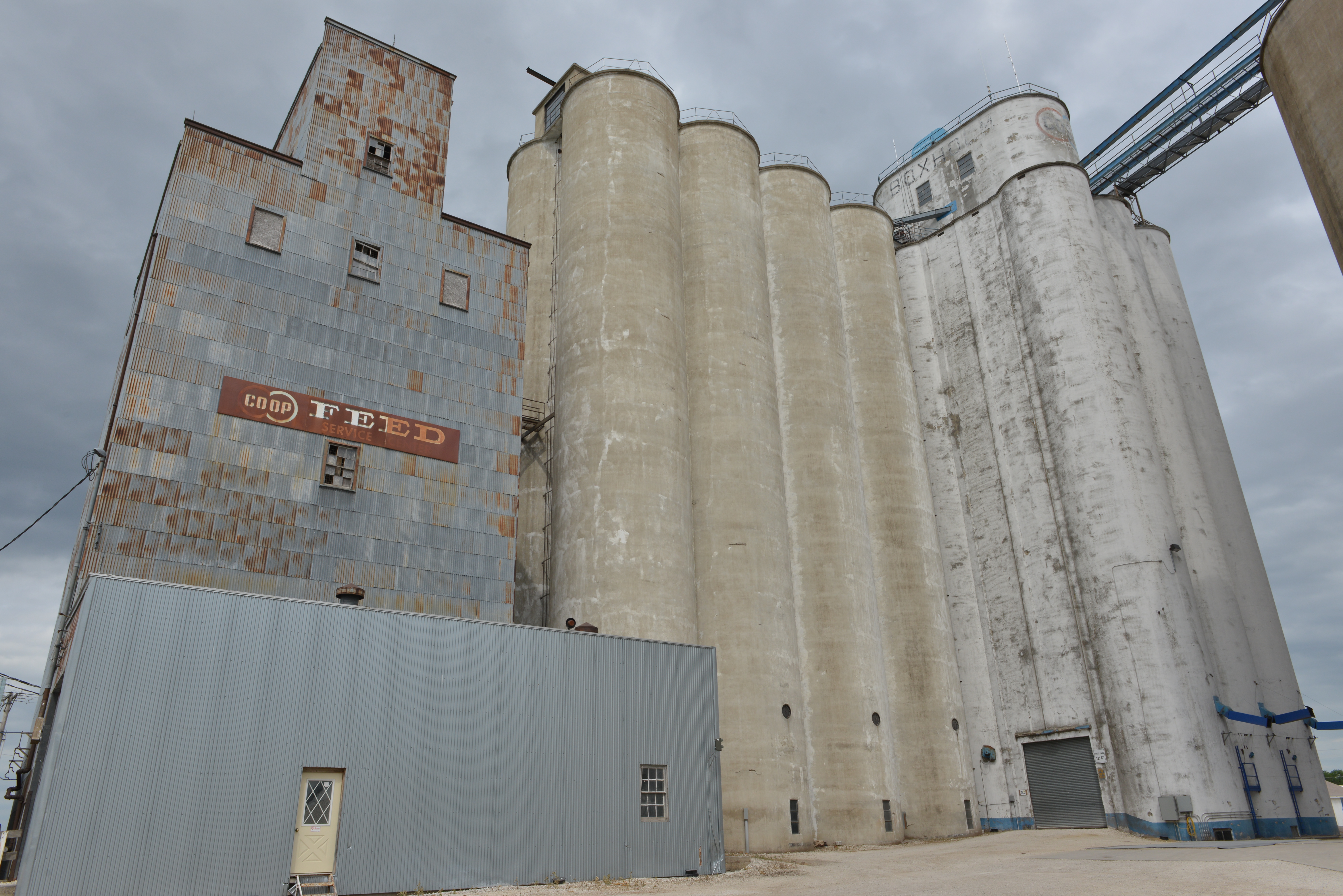
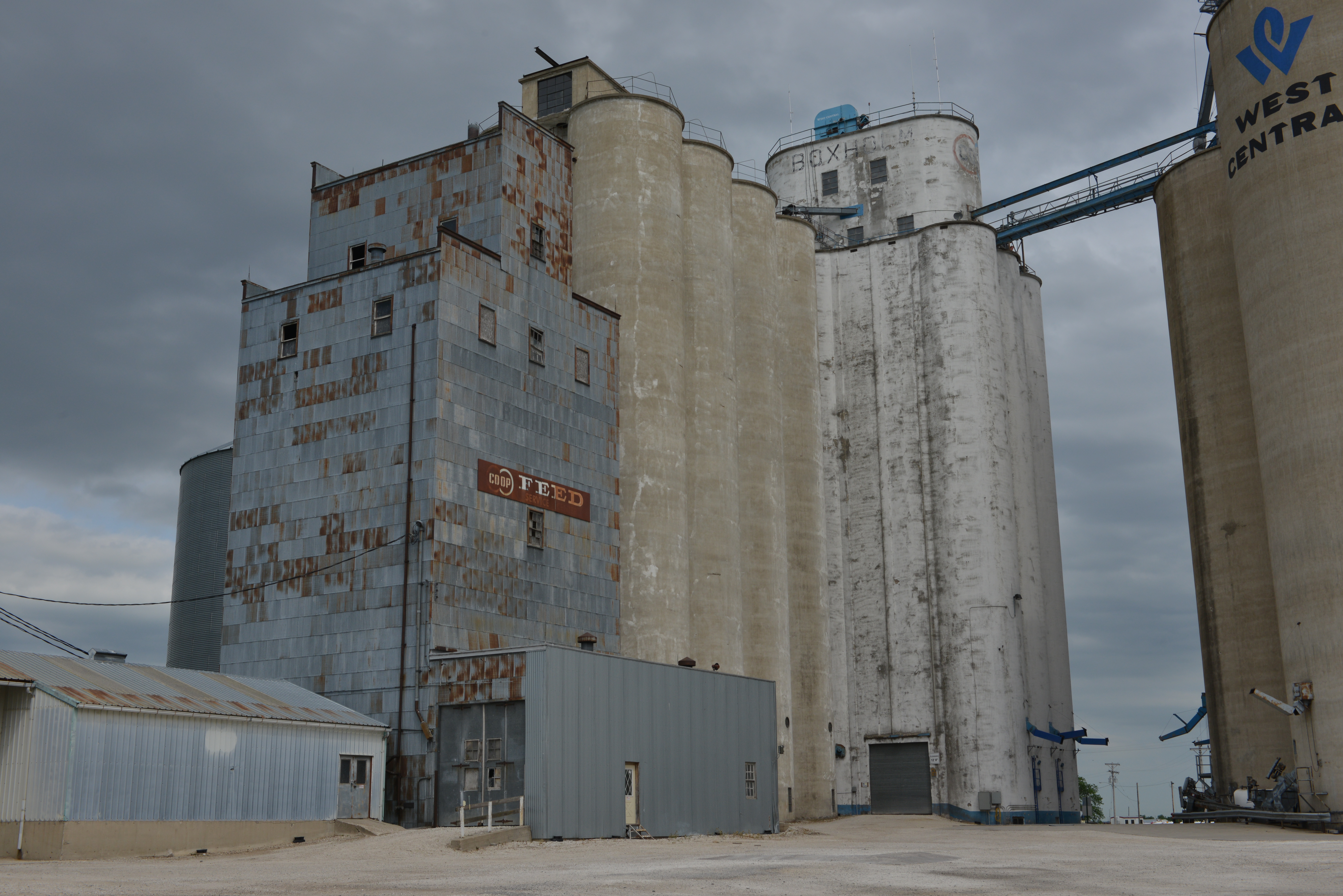
The Boxholm elevator located in central Iowa was an intriguing destination, particularly since I had knowingly passed it by, missing it by a few miles on more than one trip. It became imperative to make the detour to see it. I was glad I did, since the elevator made beautiful pictures on that early summer day. I used a wide-angle lens that added pronounced distortion to the scene, causing the buildings on the edges to lean in dramatically. But the leaning lines pointed to the beautifully clouded sky.

You can use a wide-angle lens to include more of the scene from close quarters than would be possible with another lens, but you forfeit realism. This is not a problem for certain artistic photos, but it is not ideal for documentary shots. When photographing buildings where you want to preserve parallel lines, you must stand farther away and use a longer focal-length lens. At Boxholm, I did not have that option.

DSC_0547

Wide-angle lens distortion is maximized in this view.

At extremely close quarters, the wide-angle lens exaggerates height and adds drama. But the distortion becomes more pronounced.

The Tillotson Construction Company of Omaha, Neb., built the elevator in 1955. An annex stands beside it, and an old wooden feed mill is beside that. A much newer elevator with the West Central logo was built later, after it became customary to leave the concrete plain, without the white finish.

DSC_0563

A more conventional view of the elevator complex.

The specifications for the Boxholm elevator are among the Tillotson Company construction records. We learned some details about the elevator from a few stray sources before my visit; for instance, the elevator has exactly 96 light bulbs installed. Its construction followed the Drummond plan. Other projects using the same architectural plan were the elevators at Waverly, Neb., and Lahoma and Drummond, Okla.

Specifications

Capacity per plans (with Dock): 199,400 bushels

Capacity per foot of height: 2,002 bushels

Reinforced concrete per plans (total): 1,797 cubic yards

Plain concrete (3″ hoppers): 33 cubic yards

Reinforcing steel per plans (includes jack rods): 85.71 tons

Average steel per cubic yard reinforced concrete: 95.4 pounds

Steel and reinforced concrete itemized per plans:

Below main slab: 6,861 pounds steel, 59.2 cubic yards concrete

Main slab: 25,603 pounds steel, 202 cubic yards concrete

Drawform walls: 103,192 pounds steel, 1,295 cubic yards concrete

Driveway and Work floor : 3,820 pounds steel, 23.8 cubic yards concrete

Deep bin bottoms (including columns): 7,271 pounds steel, 39.3 cubic yards concrete

Overhead Bin bottoms: 6,040 pounds steel, 27.6 cubic yards concrete

Bin roof and Extension Roofs: 7,210 pounds steel, 41.7 cubic yards concrete

Scale floor (or garner complete): 160 pounds steel, 2.5 cubic yards concrete

Cupola walls (including leg & head): 7,257 pounds steel, 76 cubic yards concrete

Distributor floor: 1,560 pound steel, 9.4 cubic yards concrete

Cupola roof: 2,147 pounds steel, 15.6 cubic yards concrete

Misc. (track sink, steps, etc.): 173 pounds steel, 3.5 cubic yards concrete

Attached driveway: none

Bridge and/or Tunnel: none

Pit Liner–plain: 16 cubic yards concrete

Drier Bin Bottom: 134 pounds steel, 1.3 cubic yards concrete

Coffer Dam, Cleaner Floor: Wood

Remarks: 10 Bin Hot spot; 8 Bin Aeration tubes; Dryer bin

DSC_0541

The rounded headhouse is a reliable indicator of a Tillotson elevator

Construction details

Like Waverly: construction details were identical to Waverly and not listed separately in the records.

Main slab dimensions (drive length first dimension): 56 1/2′ x 70′

Main slab area (actual outside on ground): 3,850 square feet

Weight reinforced (total) concrete (4000 pounds per cubic yard plus steel): 3,747 tons

Weight plain concrete (hoppers; 4000 pounds per cubic yard): 98 tons

Weight hopper fill sand (3000 pounds per cubic yard): 732 tons

Weight of grain (at 60 pounds per bushel): 5,982 tons

Weight of structural steel and machinery: 20 tons

Gross weight loaded: 10,579 tons

Bearing pressure: 2.75 tons per square foot

Main slab thickness: 24″ with 3″ pile cap

Main slab steel: straight #9 at 7″ spacing

Tank steel and bottom (round tanks): #4 at 12″ spacing

Lineal feet of drawform walls & extension: 606′

Height of drawform walls: 120′

Pit depth below main slab: 15’3″

Cupola dimensions (outside width x length x height): 22 1/4′ x 48 1/2′ x 35′

Pulley centers: 160.75′

Number of legs: 1

Distributor floor: yes

Track sink: yes

Full basement: yes

Electrical room: yes

Driveway width clear: 13′

Dump grate size: 2 at 9′ x 5′ and 9′ x 15′

Column under tanks size: 16″ square

Boot legs and head: concrete

DSC_0531Machinery details

Boot pulley: 72″ x 14″ x 4 15/16″

Head pulley: 72″ x 14″ x 2 7/16″

R.P.M. Head pulley: 42

Belt: 335′, 14″ 6 ply Calumet

Cups: 12″ x 6″ at 8″ spacing

Head drive: Howell 40 horsepower [4 circled here]

Theoretical leg capacity (cup manufacturers rating): 8,440 bushels per hour

Actual leg capacity (80% of theoretical rating): 6,750 bushels per hour

Horsepower required for leg (based on actual capacity): 32 horsepower

Man lift: 1 1/2 horsepower Ehr.

Load out scale: 25 Bushel

Load out spout: 10″ diameter

Truck lift: 7 1/2 horsepower Ehr.

Dust collector system: Fan to bin

Cupola spouting: 10″ diameter

Driveway doors: 2 overhead rolling

Conveyor: provision

Remarks

see page 10 (above)
Night and day in 1950, Tillotson’s grain elevator rose in Alta, Iowa

scan0011

Commentary by Neil A. Lieb, photos from his archive

From a telephone interview on July 22, 2014:

It was commercial power for the lamps. The only thing that was noisy was the mixer and the hoist. Once you got about 40 feet off the ground, all that anybody heard was people talking to each other. That’s the top of the driveway (seen in the photo), about 16 feet, so they’re about 25 or 30 feet off the ground. On a construction site, there’s lumber all over everywhere. Today they keep track of it very carefully because people steal it. But when we were building these, nobody stole lumber. People in Iowa and the Midwest, they didn’t steal lumber from a construction site like they do out here (California.) See the scaffolding below the forms? A cement finisher finished the concrete as it came out of the forms. That’s all he did, all night long.

scan0012

Those cars…I didn’t have a car at Alta. Those shacks were probably, lower right, the office, and the other was where we kept the tools. We built a lot of those things and then we tore them down. Slip-form construction was a major engineering feat. They built concrete grain elevators before slip-forms. They had steel forms they’d fill with concrete.


Building a grain elevator required a whole boxcar of lumber

scan0009

Commentary by Neil A. Lieb, photos from his archive

From a telephone interview on July 22, 2014:

Decks for the formwork are stacked at upper-right corner of the foundation. Piles of sand and gravel are for concrete. It took one complete boxcar-load of lumber to build most elevators. Everything came by rail in those days.

One thing you did, you re-used all that lumber many, many times. The inside walls of forms were all taken down, taken apart, and the lumber was all reused. We always had a crew of two or three guys cleaning lumber, taking the nails out and cleaning the concrete off of it. Slip-form lumber was seldom reused. By the time you stripped the forms out at the top, that lumber fell 120 feet to a concrete slab and by the time it got there, it was moving. So when it hit, it pretty well disintegrated.

scan0010
This is probably the third or fourth day. They went about six inches an hour. The boxes were put in the forms to leave holes where they wanted a hole. On the inside, they’d want a hole to put a spout or something. They’re all pre-made and numbered. The shift foreman’s responsibility is to make sure they’re put in where they’re supposed to be. They have a given height and given location.

You always knew how high you were because in the elevator’s water shaft there was a continuous measuring stick so you knew exactly how high off the ground you were. It was important that these boxes be put in at a certain height.

You also had a continuous ladder. We used to race up and down.

You see the jacks are on the outside. The guys looking over the rails, this is the back side. Way on the other side is where the cement is coming up. You can’t see a hoist.


Stabbing jack rods one-handed and borrowing smokes in Alta, Iowa

scan0007Commentary by Neil A. Lieb, photo from his archive

In a telephone interview July 22, 2014, Neil describes this dramatic scene:

Everything is in place, I can tell you that. This is all ready to go. The big long ones are jack rods. if you follow them down you can see the jack. One-third into the picture from right, you can see the jack heads. You turn those a quarter turn at a time.

An interesting thing about jack rods, to impress the new hires, the old timers… They were eight-foot-long, one-inch cold-rolled steel weighing about 65 pounds. The trick was that you pick up the rod and put it in the jack with one hand. it was something you just did. Just to demonstrate ability, I guess. Everybody on the crew could stab a jack rod one-handed.

Around the outside wall, the thin rods are vertical rebar. If you look in the middle, you can see the hold that the concrete goes in.

Bracing for the hoist is what cuts across the roofline of the house.

Wayne Baker, foreman, is probably the one striding through the middle. Baker never bought cigarettes. When I worked in construction, everybody smoked. I don’t ever remember seeing him pull out a pack of cigarettes.

A Tillotson skyscraper dominates corn country in Randall, Iowa

DSC_0638

Story and photos by Kristen Cart

During every elevator scouting trip, there comes a fork in the road where we choose which elevator to see, and which to save for another time. On the way home from Nebraska this summer we came to such a place at the junction of Iowa Route 175 and US 69 in central Iowa. To the north I could see the silhouette of an elevator at Jewell, and just east from Jewell, across the South Skunk River, the town of Ellsworth beckoned. But as I checked my map, to the south I saw Randall, which was a familiar name. I elected to turn south onto US 69.

The name should have been familiar, because it is found in several places in the Tillotson Construction Company records. The elevator in the central Iowa town of Randall was built in 1949 using the “Dike Plan.”

DSC_0662

The elevator commands the Randall skyline

In the company records for subsequent projects at West Bend and Pocahontas, Iowa, both built using the Dike plan, the quantities of concrete and steel and the machinery details were summarized with the shorthand, “Like Randall,” for each project. The Dike plan was widely used for Tillotson’s quarter-million-bushel elevators.

The Randall elevator and its annexes overlooked a silent street of empty storefronts on that quiet Sunday. The co-op office looked new and efficient. The town was a perfect snapshot of the principle of economy-of-scale: the small business, like the small farm operation, must grow, combine forces, or die.

We have the construction records for Randall’s elevator and its siblings in West Bend and Pocahontas, which vary in minor details. Randall’s specifications follow.

DSC_0644

The Randall Lumber Co. appears to be a survivor of the economic slump.


Specifications

Capacity per plans (with Dock): 252,000 bushels

Capacity per foot of height: 2,520 bushels

Reinforced concrete per plans (total): 2,066 cubic yards

Plain concrete (hoppers): 40 cubic yards

Reinforcing steel per plans (including jack rods): 109.37 tons

Average steel per cubic yard reinforced concrete: 106 pounds

Steel and reinforced concrete itemized per plans:

Below main slab: 4,637 pounds steel, 40 cubic yards concrete

Main slab: 39,291 pounds steel, 266 cubic yards concrete

Drawform walls: 129,000 pounds steel, 1,430 cubic yards concrete

Work and Driveway floor (including columns): 3,700 pounds steel, 24 cubic yards concrete

Deep bin bottoms: 11,832 pounds steel, 58 cubic yards concrete

Overhead Bin bottoms: 4,876 pounds concrete, 30 cubic yards concrete

Bin roof (or garner): 8,791 pounds steel, 56 cubic yards concrete

Scale floor (complete): none

Cupola walls: 8,404 pounds steel, 92 cubic yards concrete

Distributor floor: 1,848 pound steel, 11 cubic yards concrete

Cupola roof: 2,360 pounds steel, 18 cubic yards concrete

Misc. (boot, leg, head, track sink, steps, etc.): 3,000 pounds steel, 30 cubic yards concrete

Attached driveway: 1000 pounds steel, 11 cubic yards concrete (driveway extension, walls and roof)

DSC_0664Construction details

Main slab dimensions (drive length first dimension): 60′ x 72 1/2′

Main slab area (actual outside on ground): 4,200 square feet

Weight reinforced (total) concrete (4000 pounds per cubic yard plus steel): 4,241 tons

Weight plain concrete (hoppers 4000 pounds per cubic yard): 74 tons

Weight hopper fill sand (3000 pounds per cubic yard): 985 tons

Weight of grain (at 60 pounds per bushel): 7,560 tons

Weight of structural steel and machinery: 20 tons

Gross weight loaded: 12,880 tons

Bearing pressure: 3.06 tons per square foot

Main slab thickness: 21″

Main slab steel: bent 1″ square at 7″ o. c. spacing

Tank steel and bottom (round tanks): 1/2″ diameter at 9″ o. c. spacing

Lineal feet of drawform walls: 655 excluding extension

Height of drawform walls: 120′

Pit depth below main slab: 14’9″

Cupola dimensions (outside width x length x height): 24 1/2′ x 50 1/4′ x 40′

Pulley centers: 165.25′

Number of legs: 1

Distributor floor: yes

Track sink: yes

Full basement: yes

Electrical room: yes

Driveway width clear: 12′

Dump grate size: 2 at 9′ x 6′ and 9′ x 14′

Column under tanks size: 20″ square

Boot legs and head: concrete

DSC_0635Machinery details

Boot pulley: 72″ x 14″ x 2 3/16″

Head pulley: 72″ x 14″ x 3 15/16″

R.P.M. Head pulley: 42

Belt: 355′, 14″ 6 ply Calumet

Cups: 12″ x 6″ at 8 1/2″ o. c. spacing

Head drive: Howell 40 horsepower [3 circled here]

Theoretical leg capacity (cup manufacturers rating): 7,920 bushels per hour

Actual leg capacity (80% of theoretical rating): 6,340 bushels per hour

Horsepower required for leg (based on above actual capacity plus 15% for motor): 32 horsepower

Man lift: 2 horsepower Ehr.

Load out scale: 10 Bu. Rich.

Load out spout: 10″ w.c.

Cupola spouting: 10″ diameter 14 gauge

Truck lift: 7 1/2 horsepower Ehr.

Dust collector system: Fan to bin

Driveway doors: 2 overhead rolling

Conveyor: provision

Remarks

3 bin distributor under scale

Provision for hopper scale


The Alta, Iowa, grain elevator’s unique layout was ‘a different kind of job’

scan0009

Commentary by Neil A. Lieb and photos from the Neil A. Lieb Archive

This post’s two photos show early stages of work on Tillotson Construction Company’s grain elevator at Alta, Iowa, in the spring of 1950. In a July 22 phone conversation, Neil Lieb, who worked on this elevator as a Tillotson employee (1949 to 1951) described details:

Three tanks on right, two on left, a square tank on left … The little tanks were a lot more trouble to make. Alta was not designed by Tillotson. It was designed by some outfit out of Kansas City. So it was a different kind of a job, and it was specifically designed—they had some kind of a grain-drying system that was relatively new. When these [elevators] were built, they didn’t dry the grain. It had to be dry before you put it in. Alta had some kind of a drying system. These bins were all designed—the whole idea was you could have smaller quantities of grain stored that was wet, and you’d run it out of these bins and through the dryer into the bins below. Half full of wet grain, the other half full of dry. The dry was taken back and dumped in the major silos.

scan0008


The co-ops in Iowa were very large in those days, with hundreds of members signed up. They would take a sample out of the load and do a moisture content test. So they would test each load and put it in one of these tanks based on how much moisture it had. When they went to dry it, it would take out the required amount of moisture. I know we had a lot of extra electrical work.

The plans for the elevator are inscribed on the elevator [slab], so you could set the forms where they belonged. The scribing was done a couple of days after the slab was poured. So when you build forms and moved them in, you knew exactly where to put them. It looked like it was all hit and miss, but it wasn’t.

Sixteenpenny nails were used in nailing together the forms. When you’re doing this, the foreman will count heads. You make all these interior pieces before you do anything else. When you make these, the foreman counts out heads, and he opens that many kegs of sixteenpenny nails, and they’re all supposed to be empty when you go home at night. Fifty-pound kegs and twenty-ounce hammer, and you start the nail and drive it with three strokes. The nail is a little over seven inches long. When you do that all day long for several days, you develop a real good right arm.