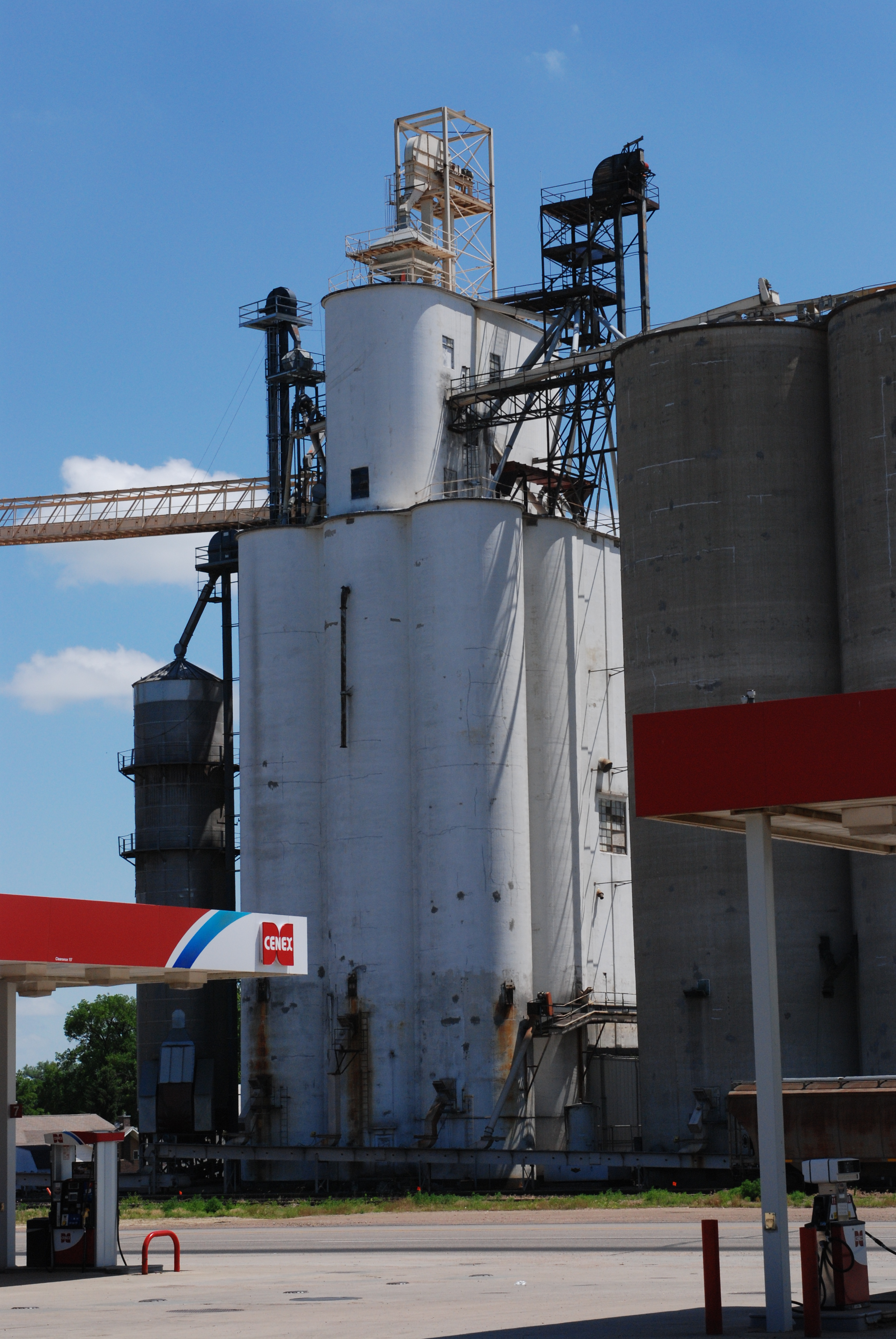
The Tillotson elevator in Hinton, Iowa, is fully upgraded to fulfill today’s mission

DSC_0444

Story and photos by Kristen Cart

The Hinton, Iowa, grain elevator, anchoring the eastern verge of town along U.S. 75 in western Iowa, looks very little like it did when it first rose in a continuous pour over the flat surrounding farmland. Conveyors and legs and platforms stick out at odd angles from the headhouse–distribution central for the sprawling complex of elevator, drier, and annexes. The long row of grain storage bins and equipment deeply overshadows the eastern side of the highway, which zips past the center of town without a nod to the businesses along the main streets to its west.

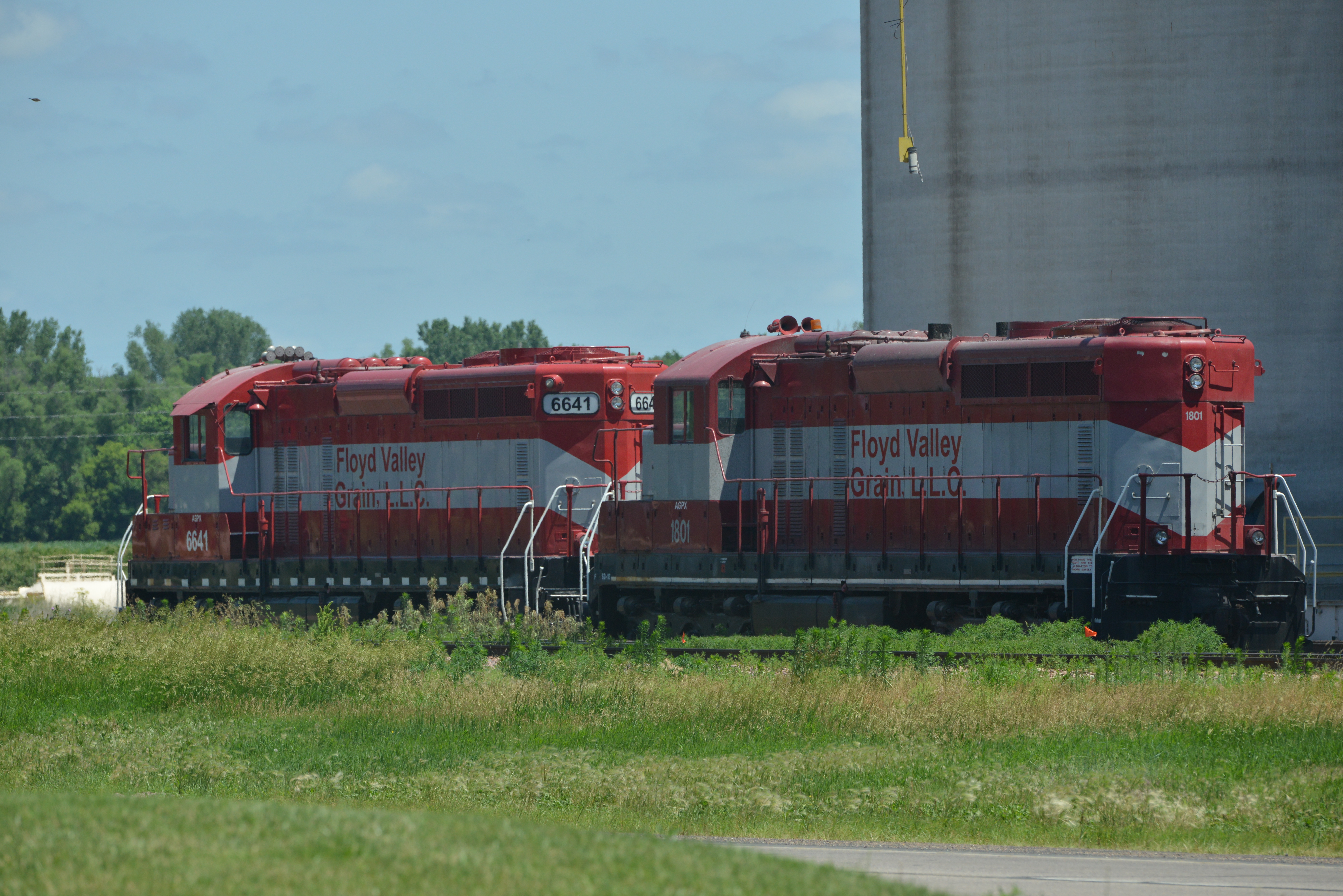
An elevated conveyor crows in red lettering, “Floyd Valley Grain, L.L.C.,” where it may be easily read from the road. To drive the point home, two dedicated locomotives parked upon the nearby rails are painted bright red in the company colors and sport the company name. This cooperative, the advertising seems to say, is the true center of town.
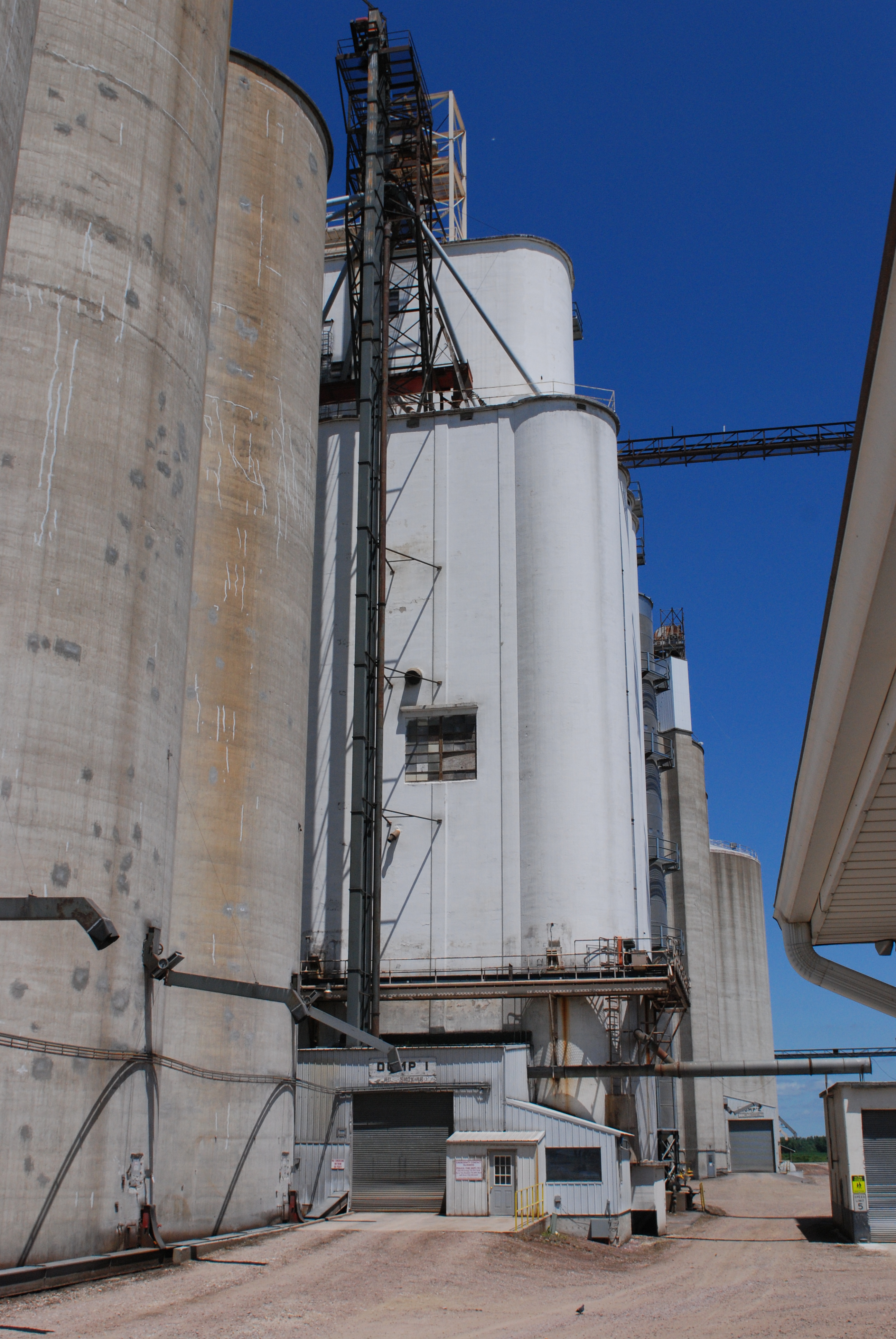
DSC_6412Innovation and modernization bristle from every side of the old Tillotson elevator. The externally installed legs (the parts of an elevator that lift the grain during the loading process) are a later modification taken to prevent grain dust fires: the moving parts that may heat up, such as bearings and motors, are no longer confined in an enclosed space with combustible grain dust. The various conveyors connect to newer annexes that were built when the storage demand outgrew the original elevator. The entire complex has become a far greater enterprise than our grandfathers, builders of the original structures, ever envisioned.

I paged through the Tillotson Construction Company records, preserved in handwritten and carefully photocopied pages, looking for the building specifications for the original Hinton elevator. Unfortunately they were not preserved with the rest. But we know it is a Tillotson elevator from a news item about an accident at the construction site where a man fell to his death in 1954. Perhaps records pertaining to the subject of a potential lawsuit were not with the rest of the file.

The elevator follows a well-tested design, and like the majority of the later Tillotson elevators we have studied, it still serves. It is a fitting testament to the engineering pioneer that was Tillotson Construction Company.
DSC_0455

Making sense of a chimney near a wooden elevator in Alta, Iowa

scan0018

Commentary by Tim Tillotson, photo from the Neil A. Lieb archive

Note: What follows is from a phone interview on May 14. Uncle Tim is speculating about the reason why some Tillotson Construction Company employees stayed behind for this small job after completing the concrete elevator at Alta, Iowa, in the summer of 1950.

That chimney is probably about 30 inches in diameter. They’ve got a mortar mixer down there for masonry, a hand line going up, and the framework is scaffolding. The building in front is eight-inch block. Every three blocks is two feet. The building is 12 foot to the eaves.

There’s a reason for that damn stack, and it’s got to have something to do with fire down below. [Brother] Charles [Tillotson] said it could’ve been an iron-working shop.

Why does that car have chock blocks front and rear? Is it some kind of an anchor? It’s a 1935 or 1936, possibly DeSoto.

If you were burning coal, you wouldn’t get sparks. Maybe they were baking bread, cornbread. They’re carrying that stack high enough to get above the wooden elevator. What the hell it could be made of to be that thin and not be braced?

I don’t understand what’s with the masonry mixer down there. If that stack, for example, was a heavy metal tube, I don’t know that you could plaster it.

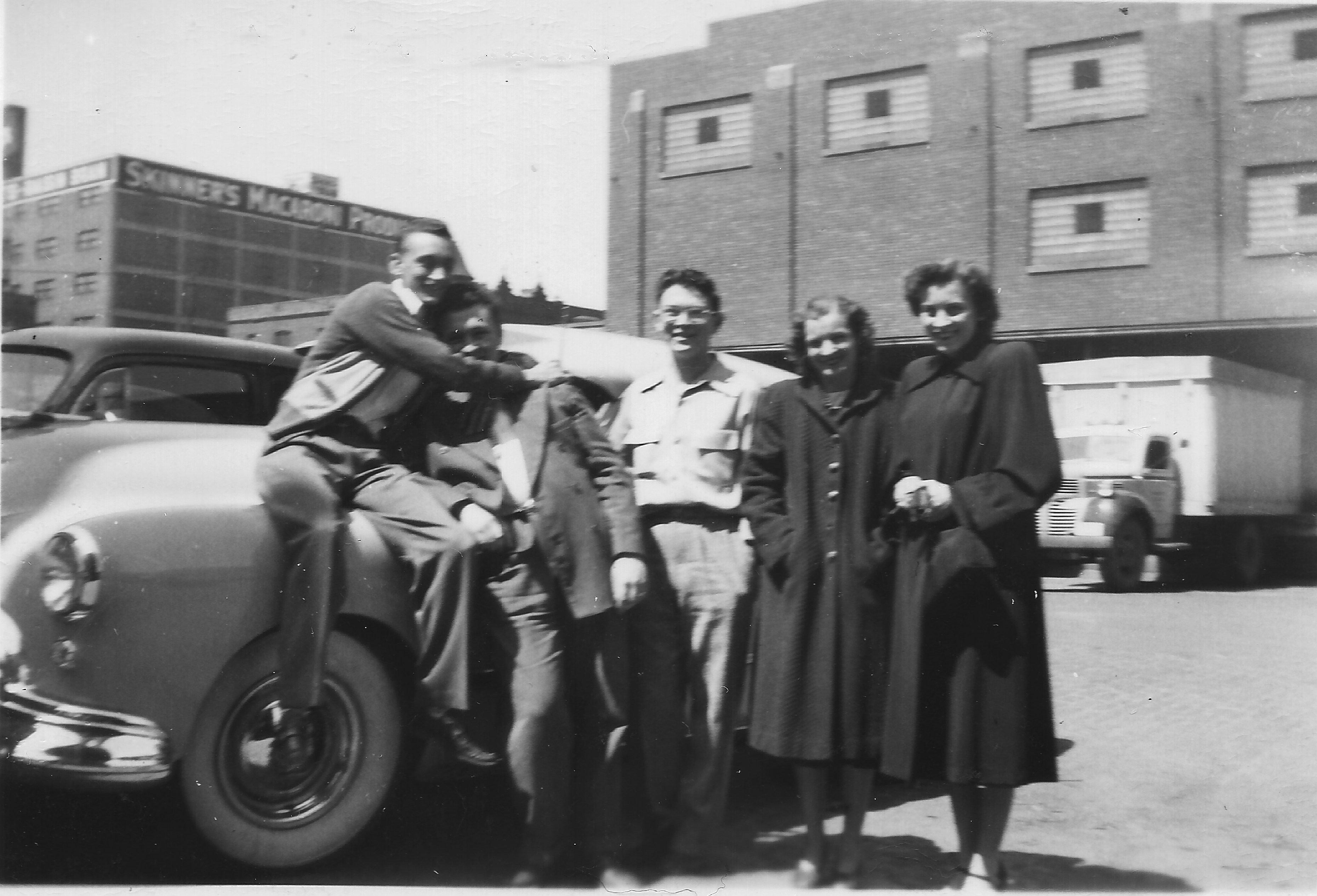
Tillotson Construction employees share playful moments outside the company’s Omaha office

Virginia Slusher 03

Story by Tim Tillotson, photos from the Virginia Slusher archive

Editor’s note: The story is from a May 14 phone interview.

On the top pic, second from left, Ted Morris? It don’t look like him at all to me. Wayne Skinner, I believe that’s his Olds they’re leaning against.

In the background is Fairmont Ice Cream. They brought refrigerated rail cars in there. One of them, Dad rammed the ass-end of his ’56 imperial into, backing out of the front of the office and I don’t know where he was going in such a hurry. Second day he had it. A four-door Southhampton, pink and white, Mother drove it most of the time. The air conditioning system—they were coming into the picture then—the condenser unit was in the front of the trunk in a big metal box.

When he slammed into the tongue of that rail car, you know how high those tongues stick out, it got into the trunk and the back window. He had them working 24 hours a day to fix that thing, the trunk, back window, and roof.

After he had it fixed, you could always hear some broken glass shifting around in the box of that unit.

Wayne was the so-called engineer, he set over there in that drafting room in the other side of the office, did all the structural calculations.

It was a ’49 or ’50 Olds. Wayne is in the middle pic with Bob Rodgers. He was like the bookkeeper.

Top and bottom picture? There’s Virginia (second from right) and I don’t know who that woman is.

Johnny (Hassman) had to be office help. He didn’t really have anything to do with the drawings or plans. I don’t even remember that he even worked on a job. And I don’t remember why he was there. He got his college work done, I think, in Missoula.

Uncle Ralph, Johnny’s dad, helped later in sales. I remember Ralph talking about him almost living in the car, and he ate a lot of pork and beans out of the can to pay for his way through college. I can’t remember his academic agenda.

Ted was the pilot. He worked int the office with Wayne, doing the drawing and getting the specs together. He flew Dad when Dad would go out to the jobs. Ted used to take me flying out to the job. He was a fun guy, good-natured. He tried going into business himself after Dad passed.

In Hampton, Neb., the grain elevator could be from the Tillotson Construction lineage

Brad Perry Hampton Nebr.

Story and photos by Brad Perry

Bradshaw, Neb.

Bradshaw, Neb.

I was a loan officer in Nebraska and financed many of the elevators built from 1975 to 1980. The dominant Nebraska builder was probably Mid-States, out of Omaha, along with Jarvis. Borton wasn’t very active in Nebraska at that time, but Farmland Industries brought more players in. Venturi and Jordan were two of them. Farmland served as the general contractor on the majority of elevators built by co-ops in the 1970s and 1980s. The players in Iowa were Younglove and Todd & Sargent, but the lowest-priced builder was always Quad-States out of Des Moines. It’s easy to tell their elevators—they only had one design! This photo above is from Hampton, Neb. Looks like a Tillotson, but I think it was Sampson. There was a twin to it at Bradshaw, 10 miles east, that was hit by lightning and had to be torn down.

Tillotson’s employee ‘Tiny’ could sucker the locals in any barroom


Photo from the Neil A. Lieb Archive.

Story by Ronald Ahrens, photo from the Neil A. Lieb Archive

He was called Tiny, and he could always put one over on the locals.

Neil Lieb couldn’t recall Tiny’s full name during our telephone conversation on April 29, when we sought to identify people shown in photos from Tillotson Construction Company’s job at Alta, Iowa.

As a young man just out of high school, Neil was part of the crew, and even sixty-five years later he still marvels at the older, wiser Tiny.

Members of the crew would go into the beer parlor after hours. scan0017

“Tiny would bet you he could drink a bottle of beer in 10 seconds,” Neil said. “It takes eight seconds for the bottle to run dry by itself. He would bet five or ten dollars, and he would find some sucker.”

Tiny was 6 feet 2 inches tall, Neil recalled.

Neil couldn’t identify the man at the rear of the photo, nor could he express details of the job they were undertaking because he had moved on after the Alta Cooperative’s new concrete elevator was finished.

Photos document the construction of a chimney that rose from a small building next to the old wooden elevator. We don’t know this stack’s purpose, but Neil (and my Uncle Tim Tillotson) don’t suspect it had to do with grain drying.


From their ever-rising perch, elevator men saw the workaday world of Alta, Iowa

scan0013

Story by Ronald Ahrens, photo from the Neil A. Lieb archive

Reader Frank Nine recently expressed fond memories of his job with Tillotson Construction Company, writing, “I can’t believe it has been 61 years ago that I started working for Tillotson. It seems like yesterday and was some of the best times of my life.”

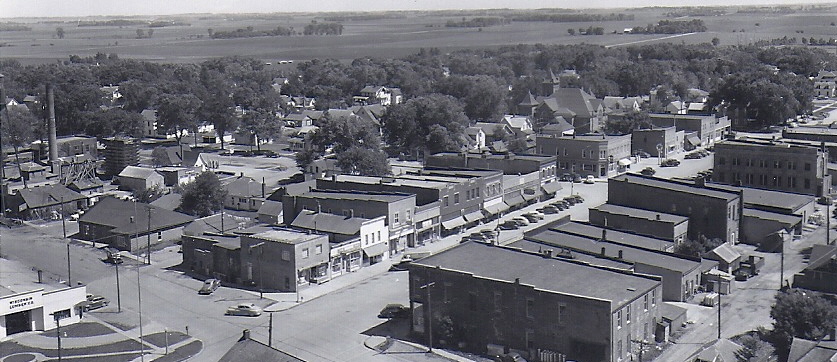
This view of downtown Alta, Iowa, from Tillotson’s new grain elevator for the Alta Cooperative makes his statement easy to understand. Aside from the challenge of the work itself, part of the appeal of building a reinforced-concrete elevator was the high-profile nature of the job, in every aspect.

In a town like Alta, with 1350 inhabitants in 1950, the construction crew had to feel the eyes of everybody in town. Wherever they went, whether the cafe or saloon, they were known and perhaps treated differently.

And from their lofty perspective, the workers could be forgiven for harboring a sense of superiority over the townsmen, some of whom may not have been inside a building taller than three stories. Building an elevator made you part of an elite team, rather like a visiting circus troupe.

In the photo we look to the south-southeast and see a lumber company, the downtown businesses, and an important church. Assistance would be welcome in identifying buildings around the smokestack, as well as other establishments.

From the neighborhood, the Alta grain elevator loomed ever larger

scan0010

Story by Ronald Ahrens, photo from the Neil A. Lieb archive

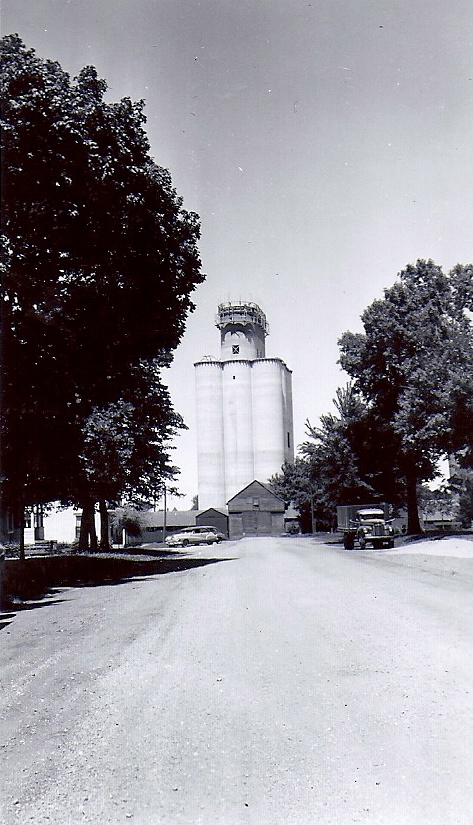
As the Alta Cooperative’s new elevator rose in the early summer of 1950, life went on at its not too vigorous pace in the namesake town.

Here, we see the elevator as the headhouse nears completion. The view, as far as I can determine from satellite imagery on Google Maps, is looking north on Cherokee Street–which, as we see, was unpaved.

Pressed for a guess, I’d say the truck is an International and the light-colored car is a Pontiac.

Note the cross-bracing in the headhouse window.

On the extreme right, through the opening under the tree, you see the outline of the old wooden elevator building.

The crew had only a few more feet, or maybe it was inches, to go before topping out the new reinforced-concrete elevator. After dismantling the formwork, they would install the equipment inside the main house and headhouse.

Then the painters would sway on a flying scaffold and apply whitewash, making the elevator gleam.

How an Iowa grain business flourished without a concrete elevator and silos

Story and photos by Kristen Cart

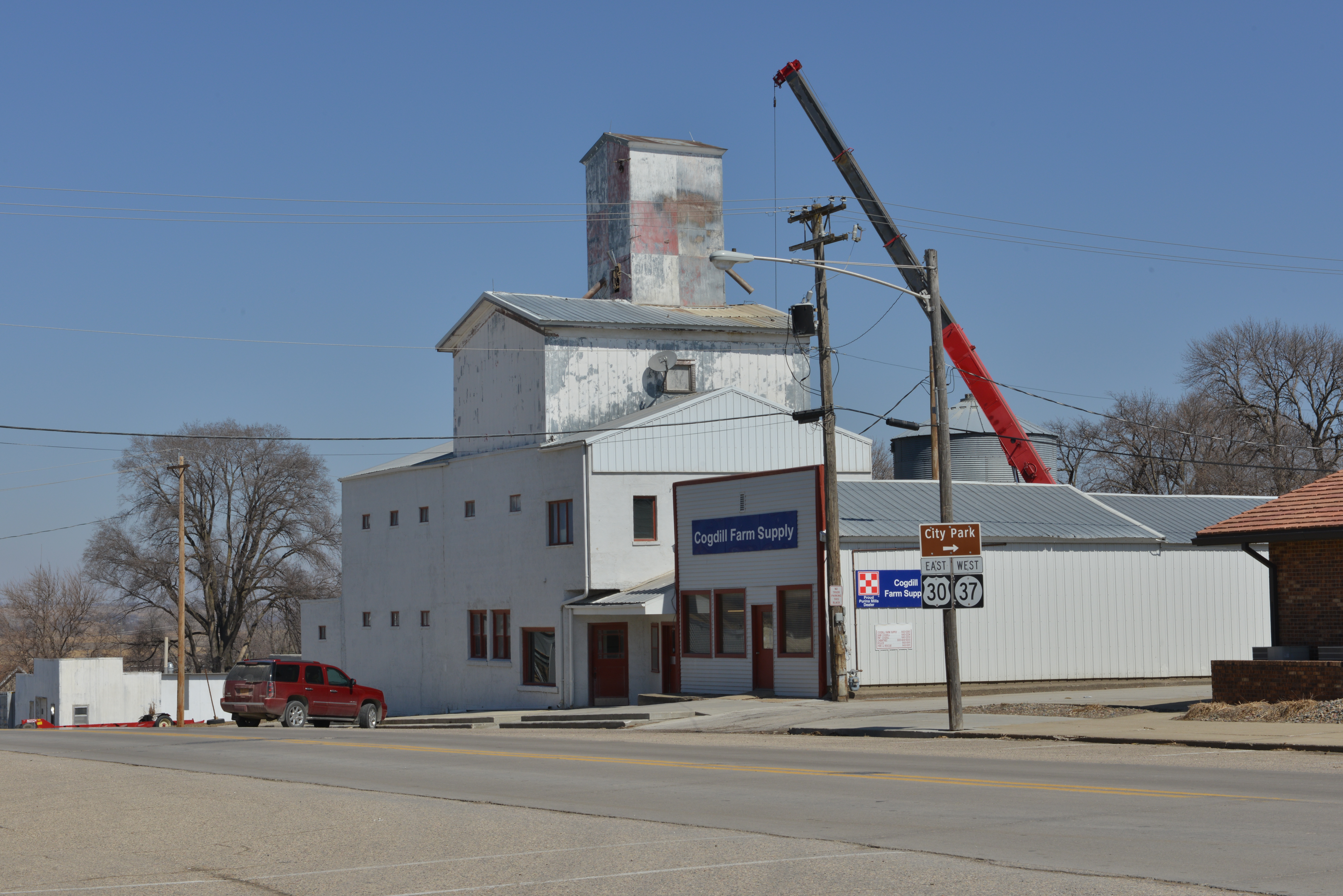
Cogdill Farm Supply Inc. is a family business, founded in 1979. It flourished as the grain business underwent big changes. Gone were the days of government-subsidized concrete grain elevators, but this operation, one step at a time, went from a small feed and grain business, operating a terminal-style wooden elevator, to a full-service farm supply company sprawling across several towns in western Iowa. The business skipped the concrete-elevator stage as it grew without price supports, relying instead on good business practices and a growing economy.

DSC_5821

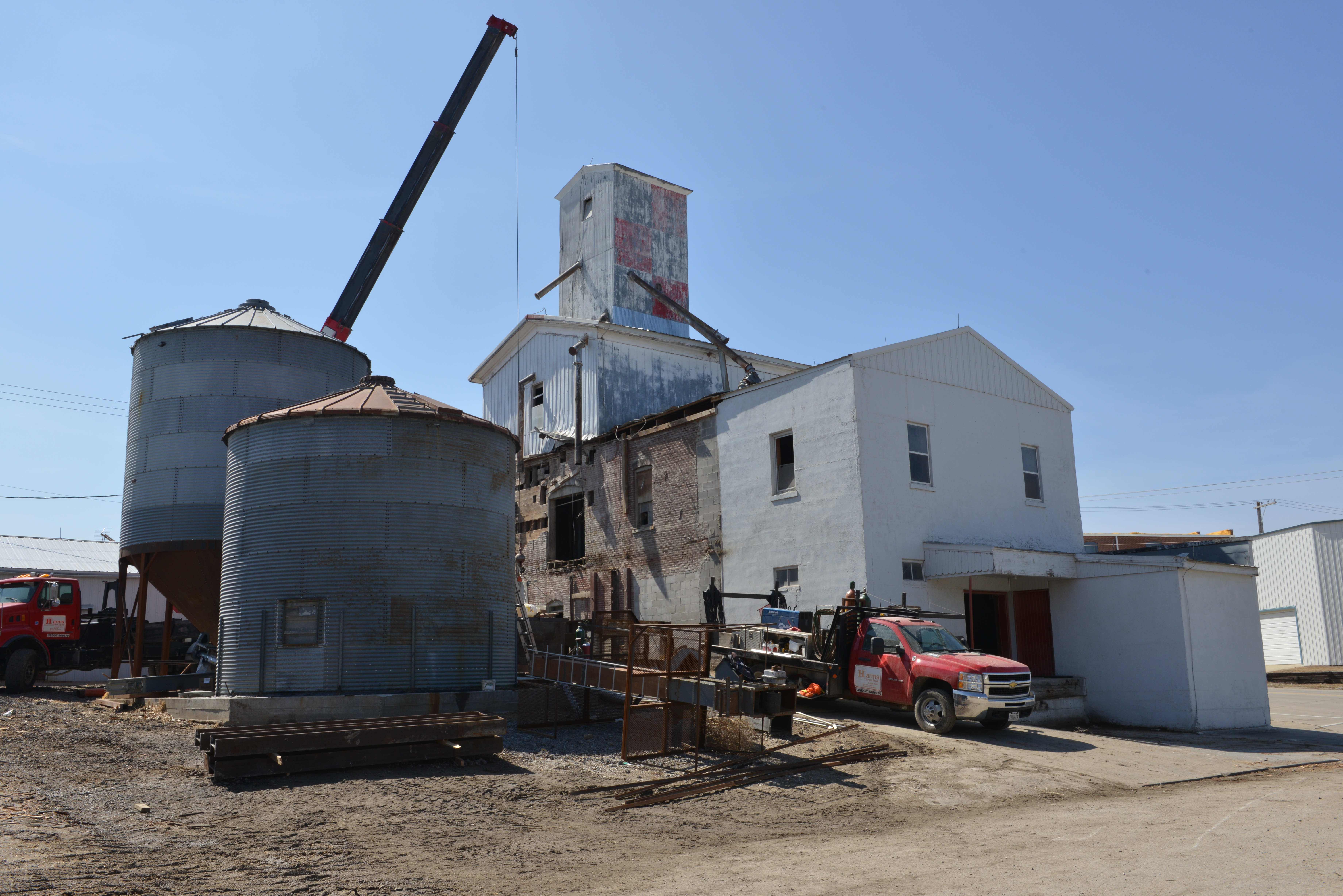
Brand new shiny bins (not shown) stood by to replace the old wooden ones at the mill in Dunlap. The shed roof was gone, exposing the wall for the first time in generations.

The company showed no signs of slowing down as it modernized. When I visited over a year ago, new bins were going in at the Dunlap feed mill.

As I photographed the mill, Rob Cogdill came down and greeted me. He said that temporary feed facilities were set up as the old shed roof came down (animals don’t quit eating for a day while the mill is down for repairs). Steel bins stood by across the street, waiting for installation. He told me that the side of the mill, now bared, had not seen daylight for a hundred years.

DSC_5736

Cogdill feed mill in Logan, Iowa.

The Cogdill feed mill facility in Logan, Iowa, another town along U.S. 30, was idle and slated to come down, according to Rob Cogdill. It was another step to be taken to streamline and modernize the business.

DSC_5811

Old Cogdill elevator in Dunlap, Iowa.

Rob also told me about his plans to replace the older wooden elevators as they became obsolete. He pointed out the elevator in Dunlap and said he hated to operate the thing any more—it had become difficult to keep in working condition. He had spent his youth in that elevator, and he said it was close to time for it to go.

It is easy to appreciate the aesthetic beauty of these old buildings, but when their service life ends, they cannot be saved and must be replaced. However, it is not only the beauty that makes them hard to destroy—sometimes, their history keeps them in service well beyond their heyday. “The crookedest elevator in Iowa,” in Dow City was one such case. That elevator represented the beginnings of Cogdill Farm Supply Inc. I went on down the road to see it, and while there, I met the founder of the company.

DSC_5830

“The crookedest elevator in Iowa” still had its Purina logo, visible from the rail line, in Dow City, Iowa.

Pat Cogdill, Rob’s father, gave me the run of the site to take pictures. Afterward, he gave each of my kids a soda and told me about the old elevator. Clearly, there was a sentimental attachment.

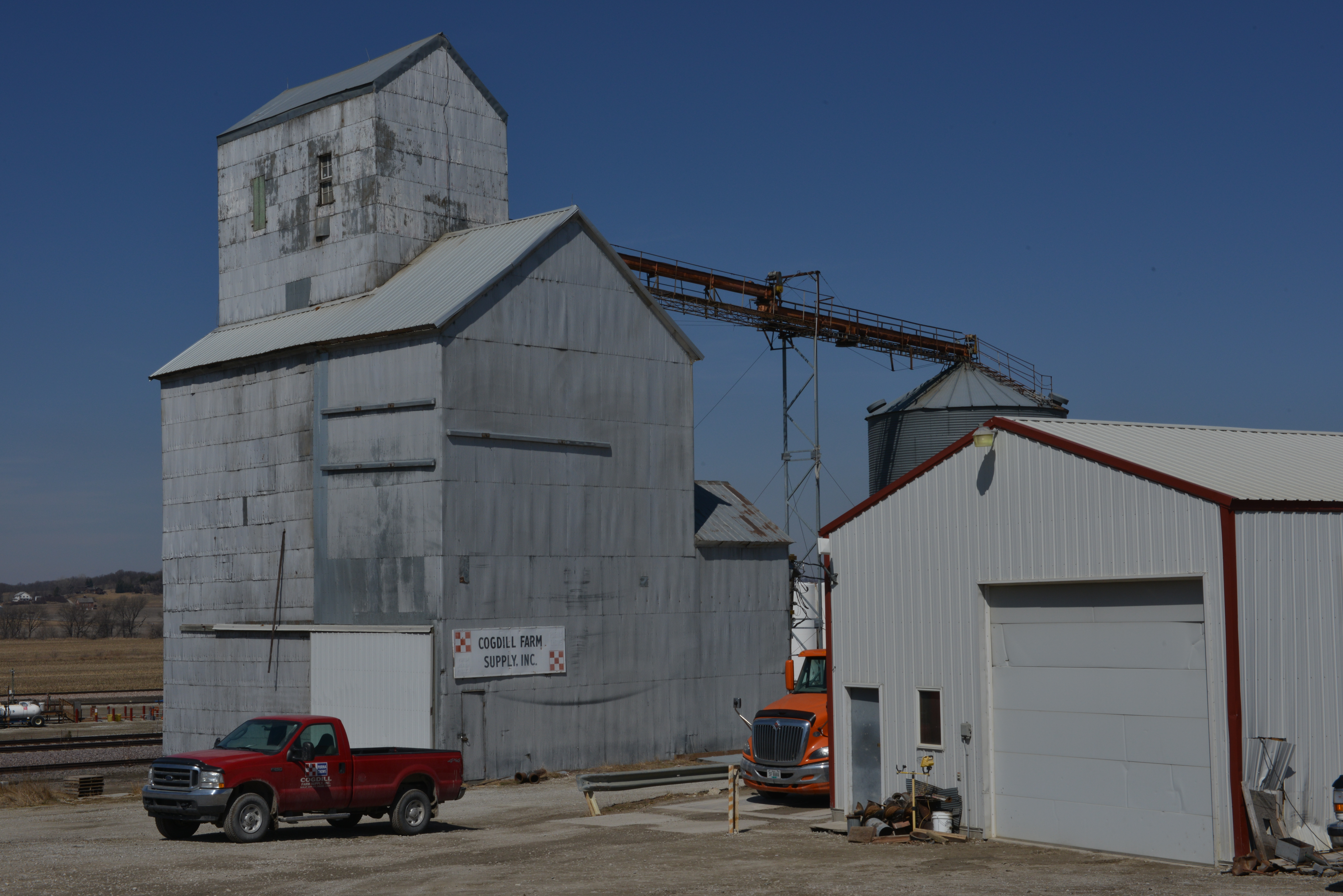
The Cogdill operation took over the old wooden elevators in Dow City, which were built in 1946 and 1953. The larger one had two rows of bins. Conveyors were installed above and below—an arrangement which allowed a custom mix of grain for each individual customer. Pat said it was a “terminal elevator. It can mix anything.”

He said, “It’s the crookedest elevator in Iowa,” describing how the marshy soil allowed one corner to sink during construction.

When I asked if it would be replaced any time soon, Pat said, “This elevator paid for all of this,” indicating the whole operation with a wave of his arm. “It will provide the boards for my coffin.”

dsc_5949

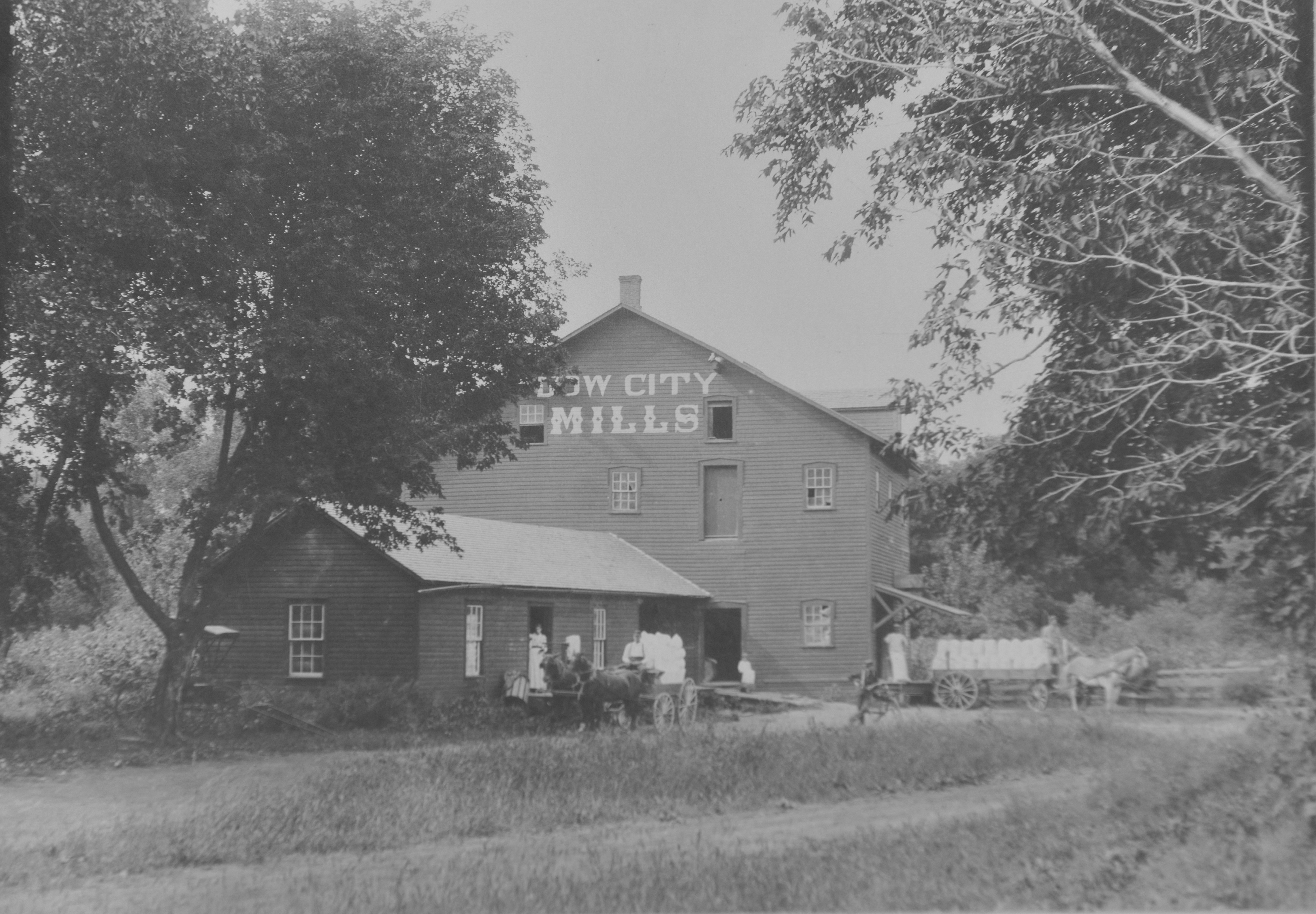
Dow City Mills from an early day, courtesy Pat Cogdill.


How ‘the crookedest elevator in Iowa’ was built

DSC_0416Story and photos by Kristen Cart

It was a terminal elevator, a family operation, capable of supplying a custom mix of feed fine-tuned to the individual farmer’s requirements. It sat along a rail line that ran through Dow City, Iowa, along U.S. 30 in the western part of the state. And it had been crooked as long as it existed.

There were two different explanations offered for its seemingly casual slouch. The first was intended for credulous tourists, and the last was a more scientific tale. But I liked the first story better.

You see, when the wooden elevator was built, the crew employed for nailing the boards was instructed to rotate around the structure as they built it. That way, the fellows who hammered harder would work their way around the elevator, keeping it even. That precaution had been neglected. The slackers on one side of the elevator, by not pounding as hard, left the rising wall noticeably taller on their side than did the guys who could swing a hammer. Thus, the finished elevator gained a noticeable tilt.

dsc_5941I bought every word of it. I imagined the men smacking the boards tightly on one side, and their chagrin when they discovered what they had done. But alas, the truth was far less romantic.

According to the owner, the builders set the foundation in soggy ground left from years of servicing steam locomotives, and the elevator sagged into the bog as soon as it was built.

Humbug.

dsc_5929In the next post, I will explain how this pay-as-you-go family operation skipped the concrete elevator stage of business. The present effort to modernize must do so without the subsidies that characterized the concrete elevator boom.


Near Chelsea, Mich., an elevator introduces us to ‘blisters’

IMG_5902

IMG_5894Story and photos by Ronald Ahrens

In Michigan for some meetings and library research, I drove along the back road in Lima Township between the towns of Chelsea and Dexter and came upon an elevator.

IMG_5896Seeing me taking pictures, an employee asked if he could help me with anything. Identifying myself as a grain elevator buff, I received an invitation to come into the office. So I climbed up a steel ladder, entered a dock area, and passed through two doors leading into a warm office.

Photos on the wall showed the elevator when it must have been new in the mid-1950s. I’d noticed a “B” on the manhole cover, but the name of the builder was unknown. However, I was told that laborers from the state prison in Jackson worked on the construction.

Chelsea Grain LLC has operated the elevator a relatively short time. (It made news in 2013 after the local fire department responded to an incident involving a grain dryer.)

IMG_5899My other question concerned the apparent oval shape of the silos.

The answer: “Blisters.”

“Blisters?”

I dashed back to the car to fetch a business card. By the time I returned, a drawing had been prepared by way of answering.

Yet, this term begs for elaboration, which perhaps our readers can provide.

Meantime, thanks to Chelsea Grain for the hospitality.