The demise of Mayer-Osborn Construction remains an enduring puzzle

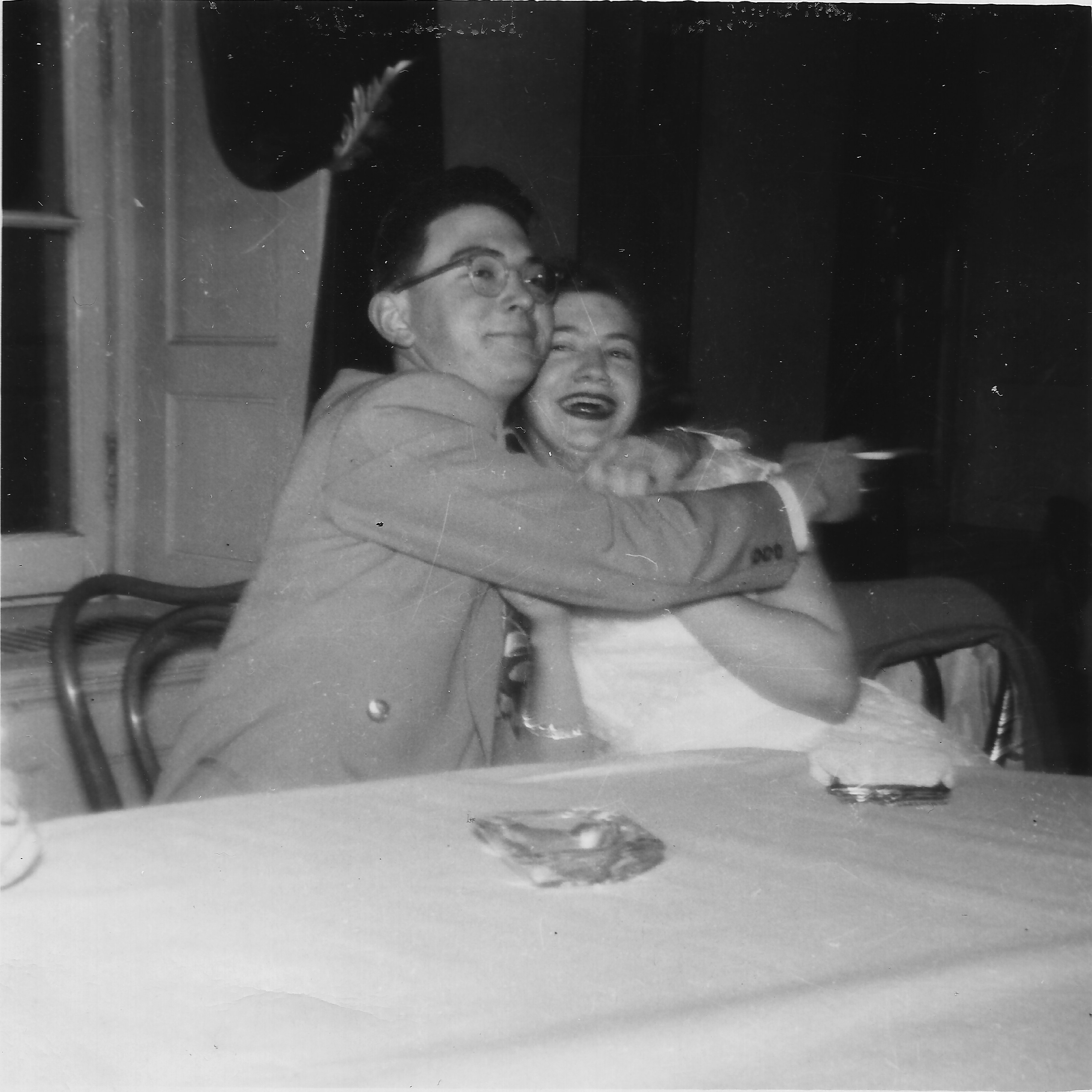
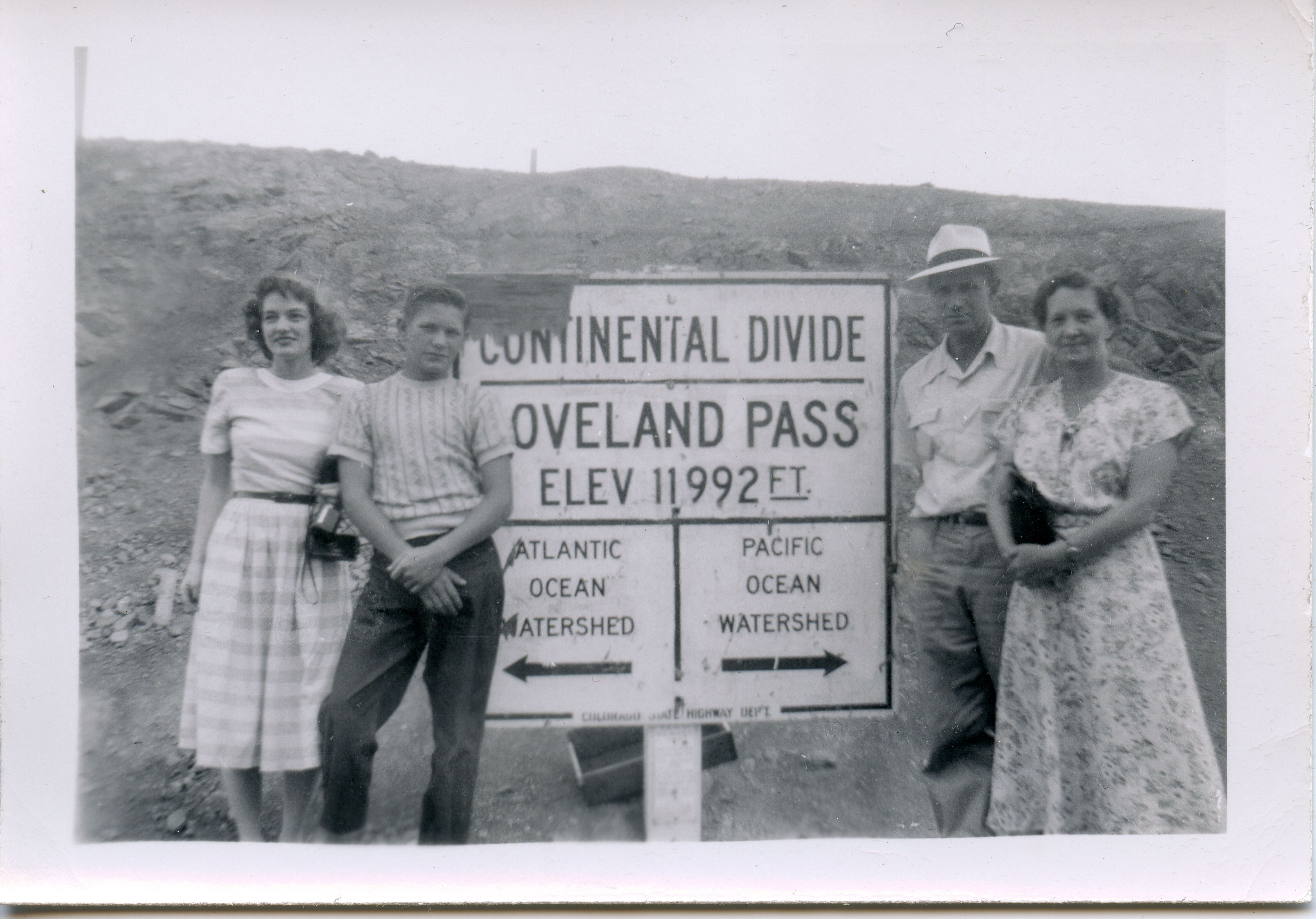
Audrey, Gerald, William and Alice Osborn, ca. 1950

Audrey, Gerald, William and Alice Osborn, circa 1950.

Story by Kristen Cart

Some mysteries are not meant to be solved. Perhaps it is a natural outgrowth of my grandmother’s tight-lipped discretion where evil tidings were concerned. I can remember the disapproving purse of her lips if I broached the wrong topic–it was wise to move on.

Albert Skoog as a boy

Albert Skoog as a boy

Alice Christoffersen married William Osborn in the 1920s. All anyone in our family could know about those times was conveyed in the pleasant images of a young couple goofing around by the lake and fishing. In later pictures you could see the pained expression of a long-suffering middle-aged woman, but her concerns were private, at least when they brought bad memories to mind.

My dad, Jerry Osborn, was quite amazed to find he had a deceased great-uncle, whose name had never been spoken in front of him. Alice Christoffersen’s maternal uncle, Albert Skoog, died young from injuries sustained in a horrific automobile crash when she was a young woman. The story was relegated to the darkest recesses, never to be mentioned again.

“Albert Skoog Dies from Effects of an Auto Accident

Had Lived Nearly Ten Months with a Broken Back

After living nearly ten months with a broken back, during which time he suffered untold agony, Albert Skoog, 42, formerly and employee of the Fremont Stock Yards, died at the home of his sister, Mrs. James L. Christoffersen, south of Fremont. Death was due to injuries sustained in a automobile accident on the Lincoln Highway about a mile east of Fremont last October….”

The article went on to describe the accident and his medical treatment. He died in the family home of Alice’s parents.
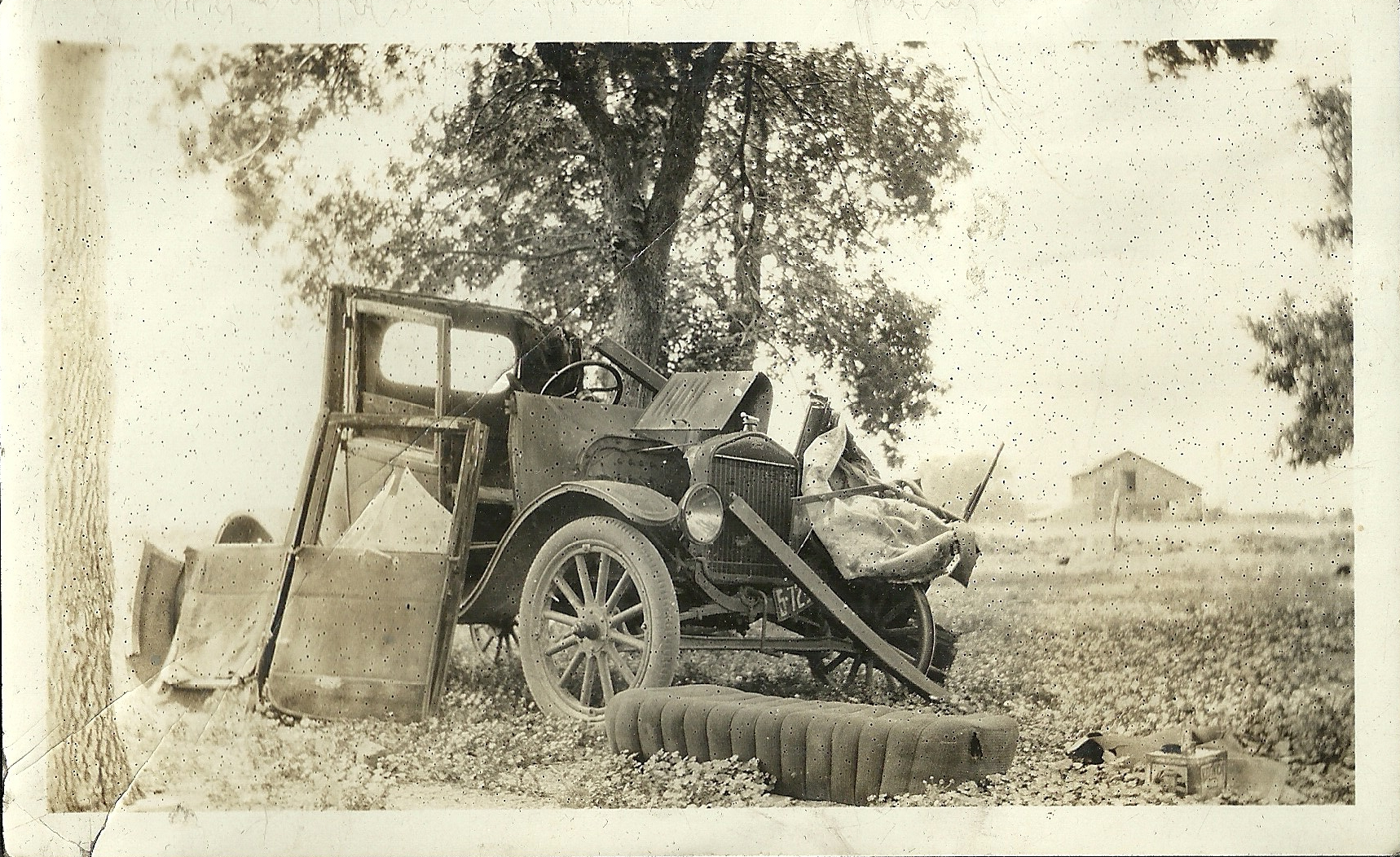
This image was found among Grandma's pictures. It was the car her uncle wrecked in an ultimately fatal accident.

The wreck fatally injured Albert Skoog, who died months later from a broken back. Grandma had this photo of the car in an album that once belonged to her mother.

No stone marks his grave. It took many years to locate pictures of him, preserved by a different branch of the Christoffersen clan. Images of the wrecked car also survived, tucked away in Grandma’s photo album. But such things were not discussed in my grandmother’s world.

Another side of Grandma’s personality was not so discrete–she would tell stories that put others in a bad light when she thought she could gain favor for herself. This habit got worse as she aged, and by the time she passed on at age 98, family members believed awful stories about each other because of things she said.

We have tried, without success, to verify Grandma’s story of why my grandpa, William Osborn, got out of the elevator business. Perhaps she invented it. We have no way to tell.

Mayer-Osborn elevator at McCook, Neb. during a family visit, ca 1950. This elevator was the first of its type, a model for the later Blencoe elevator.

Mayer-Osborn elevator at McCook, Neb. during a family visit, circa 1950. This elevator was a prototype for the Blencoe elevator.

Dad never had an inkling about why his dad quit (except that he heard in whispers not intended for him) until Mom started poking around. Grandma told her the story, apparently in a fit of pique. Details were fuzzy, and by now, not well remembered. There’s hardly more to it than speculation. But that one glimpse was the only information we ever got. Otherwise, it “wasn’t discussed,” as Dad put it.

Mom says an elevator was built, and very shortly thereafter, failed. She variously used the terms “collapse,” “explosion,” and “fire.” But the two things she was pretty consistent about were the facts that the concrete mix was wrong because the crew had shorted the materials (possibly for financial gain), and that the collapse occurred as soon as the elevator was filled with grain for the first time. That is all she remembers from what Grandma told her.

Dad says his father was out of the business by 1955. Dad remembers that his dad had come home to Fremont, Neb., from Denver, Colo., the home base of his business, that summer when he should have been on the job. He thinks that his dad was blamed for the failure–Bill’s partner, Gene Mayer, apparently went on without him. But that is all we have.

We don’t know where it happened and haven’t found a newspaper story. We know a large terminal elevator collapsed that year in Fargo, N.D., but we discovered the identity of that builder and it wasn’t Mayer-Osborn. There were whispers about an elevator that had a bad headhouse around Linn, Kan., or Bradshaw, Neb., which might have been his, but that story hasn’t been verified or dated.

The Blencoe, Iowa elevator built by Mayer-Osborn

The Blencoe, Iowa elevator built by Mayer-Osborn

The only story I can verify is the tear-down and restart of the Mayer-Osborn elevator in Blencoe, Iowa. The concrete mix was wrong there, and it cost a few days and quite a lot of money to correct. Could that relatively mundane event in 1954 have created a rift between the partners, Bill Osborn and Gene Mayer? Was the tale of a more dramatic accident simply angry gossip from my grandmother?

Until we know more, it is a skeleton yet to be found, buried in a very deep closet.


A mystery unfolds at the Tillotson elevator of Blencoe, Iowa

This elevator is attributed to the Tillotson Construction Company of Omaha, but evidence points elsewhere

This elevator is attributed to the Tillotson Construction Company, but evidence points elsewhere.

Story and photos by Kristen Cart

In an earlier post, we showed that the elevator built by the Tillostson Construction Company in the northwest Iowa town of Blencoe had a structural failure prior to completion. A photo provided by Tim Tillotson showed that the concrete slumped over the driveway after the slip-form pour had progressed considerably past the point of failure. Construction would have halted there. The question of how the elevator was completed was never answered.

In the company records we have, the specifications log ended by 1956, while the company continued to build elevators beyond that date. So later records are lost to us. Tim Tillotson estimated that this mishap occurred in about 1955. I discovered, on review, that Blencoe was not in the specifications at all. Why?

A photo of the manhole cover on the rail side of the elevator could provide the answer. It is not typical for Tillotson elevators to have exterior manhole covers on elevators of this type, so the existence of these was a little surprising. More shocking was the identity of the company that placed them.

"Grain Storage Const. Co, 1959, Council Bluffs, Iowa" is embossed on the manhole cover

“Grain Storage Const. Co, 1959, Council Bluffs, Iowa” is embossed on the manhole cover.

The Grain Storage Construction Company of Council Bluffs, Iowa, is not familiar to us. It may be the company called in to repair the damage when the failure occurred.

We don’t know if Tillotson Construction was fired on the spot. But it is also possible that Tillotson was given a second chance–the design of the elevator clearly follows the trademark Tillotson design, whether copied by some one or built by the original contractor.

I wonder if the original repair destroyed the structural integrity of the elevator, and Grain Storage Construction was brought in to replace two of the bins. We know it was a later job because of the 1959 date on the manhole covers. Unfortunately, I made my visit on a Saturday, and the co-op was closed, so there was no one there to ask.

It is a beautiful, functional elevator today. It stands beside the older Mayer-Osborn elevator, which is also clearly in use sixty years after it was built. Both elevators had problems during construction, but the capacity was urgently needed, so both projects were finished. How the Tillotson elevator ultimately became a Grain Construction Company branded elevator is a mystery we will try to solve in a future post.

DSC_0427

Could the previously unidentified Tillotson employee be Mary Melia?

Virginia Slusher 01

Photo from the Virginia Slusher archive

We believe the woman on the far right is Mary Melia. Her husband Marvin also worked for Tillotson Construction Company and served as a pilot. Virginia Slusher is second from right.

Mary Melia died six months ago. Here’s an obitiuary:

Melia, Mary Clare (Burns) Aug 31, 1922 – Dec 29, 2014

Preceded in death by husband, Marvin G. Melia. Survived by children, Marvin G. Melia II of Pleasant Valley, Mo., Mary Lou (Timothy) Brennan, Steven M. (Janet) Melia of Cheyenne, Wyo., and Donald L. Melia; brother, Jack (Carol) Burns of Twenty Nine Palms, Calif.; 10 grandchildren; 10 great grandchildren and many nieces and nephews.

VISITATION Thursday, January 1, 2015 from 4-7 pm with a Rosary at 7 pm at Roeder Mortuary 108th Street Chapel.

FUNERAL SERVICE Friday, January 2, 2015 at 10am at St. Philip Neri Church 8200 N. 30th Street.

Interment Holy Sepulchre Cemetery.

A low-wing airplane sped up business for Tillotson Construction Company

Navion

Commentary by Tim Tillotson

Note: What follows is from a phone interview on May 14. Here, Uncle Tim recalls flying with Tillotson Construction Company’s pilot Ted Morris.

I remember taking a few trips in that Navion with him. It was one of the last planes Dad bought, the only one with a low wing. That Navion was fast, too, a faster plane. I remember being with him somewhere–where the hell were we?–trying to find a spot to land and picked a spot that looked absolutely wonderful from up there. We didn’t realize till we were almost on the ground that the spot had three-foot-tall grass. We went plowing through that grass and also an electric fence that was in the middle. We had to plow our way out.  

Dad [Reginald “Mike” Tillotson] could never get a license because he had double hernia and all that. Ted was our pilot and we also had Marvin Melia, he flew dad, too. Marvin was giving me flyin’ instructions. We’d go out there to the airport, North Omaha. Marvin’s the one that flew Dad around. They didn’t fly every day, or every week necessarily. He’d been flying Dad two years before. 

Ted came back from KS one time in that Navion, and he said something about, “Let’s go home fast.”

So he’s flying like 200 feet off the ground, really a lot of fun. He radioed in to get clearance for landing, and the communication that came back said, “Where the hell are you? We cant pick you up on the radar!”

Ted said, “I guess we better get up off the deck so they can see it.” 

Virginia Slusher remembers her years as Tillotson Contruction’s office girl

Virginia Slusher 05

Story by Virginia Slusher, photos from her collection

Editor’s note: Virginia Slusher, who lives near Kansas City, contacted us to share these recollections and photos. We have previously written about The Office, part of the old Anheuser-Bush brewery on Jones Street, which served as Tillotson Construction’s headquarters in the 1950s. 

Beginning in the fall of 1951, I worked for Mike (Reginald) and Mary Tillotson for seven years. I was the “office girl”–some bookkeeping, receptionist, et cetera.

I went to Commercial Extension School of Commerce, and Johnny Hassman was my date for our graduation party. He was in the office quite often. I think Johnny helped with sales. IMG_1390

One morning I arrived first, and the safe was hanging open. Because of the burglary, I immediately ran down to the gas station on the corner. The thief took the petty cash they kept in the safe. I don’t think he bothered anything else. The police came to investigate.

I loved working there; they were so good to me.

The three guys and I would sit up on the balcony and play cards sometimes when Mary was gone. It was a raised area where Wayne and Ted, the two engineers, sat. Bob the bookkeeper sat just below.

I loved the guys. They took me out for my first legal drink when I turned 21 years old. They teased me unmercifully but were so good to me.

I remember typing about 2000 W-4s at the end of the year. Men would work for one or two days and quit. I also sent all the “give us your business” cards to the small towns in multiple states. Virginia Slusher 01

The other woman–I can’t remember her name–was working there when I started.

They had a huge NCR bookkeeping machine that she taught me how to operate. Shortly after I started there, the company sold it to, I think, China.

Mary was different to say the least. She had an ugly Boxer that came to work with her sometimes. He would slobber on me; therefore, I did not like him!

She used to tape a St. Christopher medal on her desk. We joked that we wondered if the desk would take her somewhere.

Johnny Hassman and Virginia Slusher celebrate her business school graduation. Photo from the Virginia Slusher archive.

Johnny Hassman and Virginia Slusher celebrate her business school graduation.

She was very good to me, gave me nice bonuses at the end of the year, not quite as big as the three guys. But very good for the ’50s. I received $1000 to $15oo. The men usually around $10,000. Very large amount for the times.

Mike (Reginald) was funny, not in the office much. I had to write the checks to pay the family bills.

I was still Virginia Engel but married William Slusher while working there, 60 years now, and they were very nice to us.

When the company closed, Mary found a new job for me at Power District credit union.

Bill Russell delivered the first load of grain in Alta’s new concrete elevator

First load of grain being dumped in the elevator. Man on left is probably an elevator employee, Bill Russell, right.

An Alta Cooperative employee, left, and Tillotson’s superintendent Bill Russell dump the first load of grain in 1950. Photo from the Neil A. Lieb archive.

By Ronald Ahrens

We’ve laid out the story of Tillotson Construction Company’s concrete elevator at Alta, Iowa.

Now for the completion.

The photo shows the ceremonial first load of grain being dumped after the elevator was wrapped up in 1950. The job had started in early spring.

Bill Russell superintended from start to finish. As his son Dennis has told us, Bill was born in 1900 and built ammunition depots during World War Two before coming to work for Tillotson.

He was father of eight sons. One of them, Jim, a promising law school student, died in a fall on Tillotson’s elevator at Murphy, Neb.

After a long run with Tillotson, Bill started Mid-States Construction, which became known as Mid-States Equipment, with Gordon Erickson.

During the key postwar period of elevator expansion, few men contributed more than Bill Russell, and we are proud to remember and honor him.

Tillotson’s employee ‘Tiny’ could sucker the locals in any barroom


Photo from the Neil A. Lieb Archive.

Story by Ronald Ahrens, photo from the Neil A. Lieb Archive

He was called Tiny, and he could always put one over on the locals.

Neil Lieb couldn’t recall Tiny’s full name during our telephone conversation on April 29, when we sought to identify people shown in photos from Tillotson Construction Company’s job at Alta, Iowa.

As a young man just out of high school, Neil was part of the crew, and even sixty-five years later he still marvels at the older, wiser Tiny.

Members of the crew would go into the beer parlor after hours. scan0017

“Tiny would bet you he could drink a bottle of beer in 10 seconds,” Neil said. “It takes eight seconds for the bottle to run dry by itself. He would bet five or ten dollars, and he would find some sucker.”

Tiny was 6 feet 2 inches tall, Neil recalled.

Neil couldn’t identify the man at the rear of the photo, nor could he express details of the job they were undertaking because he had moved on after the Alta Cooperative’s new concrete elevator was finished.

Photos document the construction of a chimney that rose from a small building next to the old wooden elevator. We don’t know this stack’s purpose, but Neil (and my Uncle Tim Tillotson) don’t suspect it had to do with grain drying.


Elevator operators once implicated labor activists in mysterious explosions

Evevator test003

A 1920 Department of Agriculture experiment showing that accumulations of grain dust would ignite under the right conditions

Story by Kristen Cart

Elevator fires have been a great concern since the days when Charles H. Tillotson first built wooden elevators with his army of carpenters at the beginning of what would become the family business.

When elevators started to randomly ignite and explode in the early twentieth century, suspicions ran rampant.

Shortly after 1900, labor violence was on the rise, and businesses had reason to be worried.

In the Midwest, elevator owners suspected the labor unionist Industrial Workers of the World (IWW), or Wobblies, had committed acts of sabotage, torching the structures to make their anarchistic point.

Evevator test004

Then, cooler heads prevailed as engineers found a scientific explanation.

Using a scale model in the manner of a college lab experiment, the United States Department of Agriculture demonstrated that grain dust would ignite and explode under the right conditions, leaving destruction and injury in its wake.

The Wobblies were off the hook.

From the neighborhood, the Alta grain elevator loomed ever larger

scan0010

Story by Ronald Ahrens, photo from the Neil A. Lieb archive

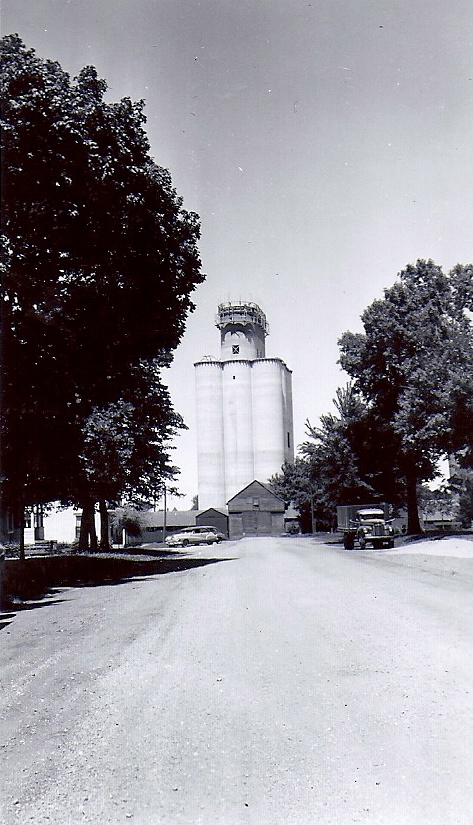
As the Alta Cooperative’s new elevator rose in the early summer of 1950, life went on at its not too vigorous pace in the namesake town.

Here, we see the elevator as the headhouse nears completion. The view, as far as I can determine from satellite imagery on Google Maps, is looking north on Cherokee Street–which, as we see, was unpaved.

Pressed for a guess, I’d say the truck is an International and the light-colored car is a Pontiac.

Note the cross-bracing in the headhouse window.

On the extreme right, through the opening under the tree, you see the outline of the old wooden elevator building.

The crew had only a few more feet, or maybe it was inches, to go before topping out the new reinforced-concrete elevator. After dismantling the formwork, they would install the equipment inside the main house and headhouse.

Then the painters would sway on a flying scaffold and apply whitewash, making the elevator gleam.

Welcome to Alta. Please slow-down and see our new grain elevator!

scan0009

Story by Ronald Ahrens, photo from the Neil A. Lieb archive

Why would we not be blamed for thinking the sign in the photo was actually about the new elevator that Tillotson Construction Company had just completed in Alta, Iowa? Or do we read too much into it?

Just think what was required to build the elevator in 1950. Men started in the mud and gloom of early spring. All they had were piles of sand and lumber and steel bars, relatively few, simple tools, and an ingenious way of keeping the formwork level. They were about to perform an amazing feat.

By midsummer, the job was done, the lettering affixed to the headhouse, and farmers could more efficiently store and ship their corn.

The men who built the elevator moved on to another job, maybe in Iowa, maybe in Texas.

What they left behind towered over the countryside of Buena Vista County. Some folks had probably never seen a monument this grand.

Shucks, by scrooching up your eyes, you might even have been able to see it all the way from Storm Lake, three miles down Route 7.