Wauneta registers as an important architectural landmark and literary archive

Story by Kristen Osborn Cart

Photo by Gary Rich

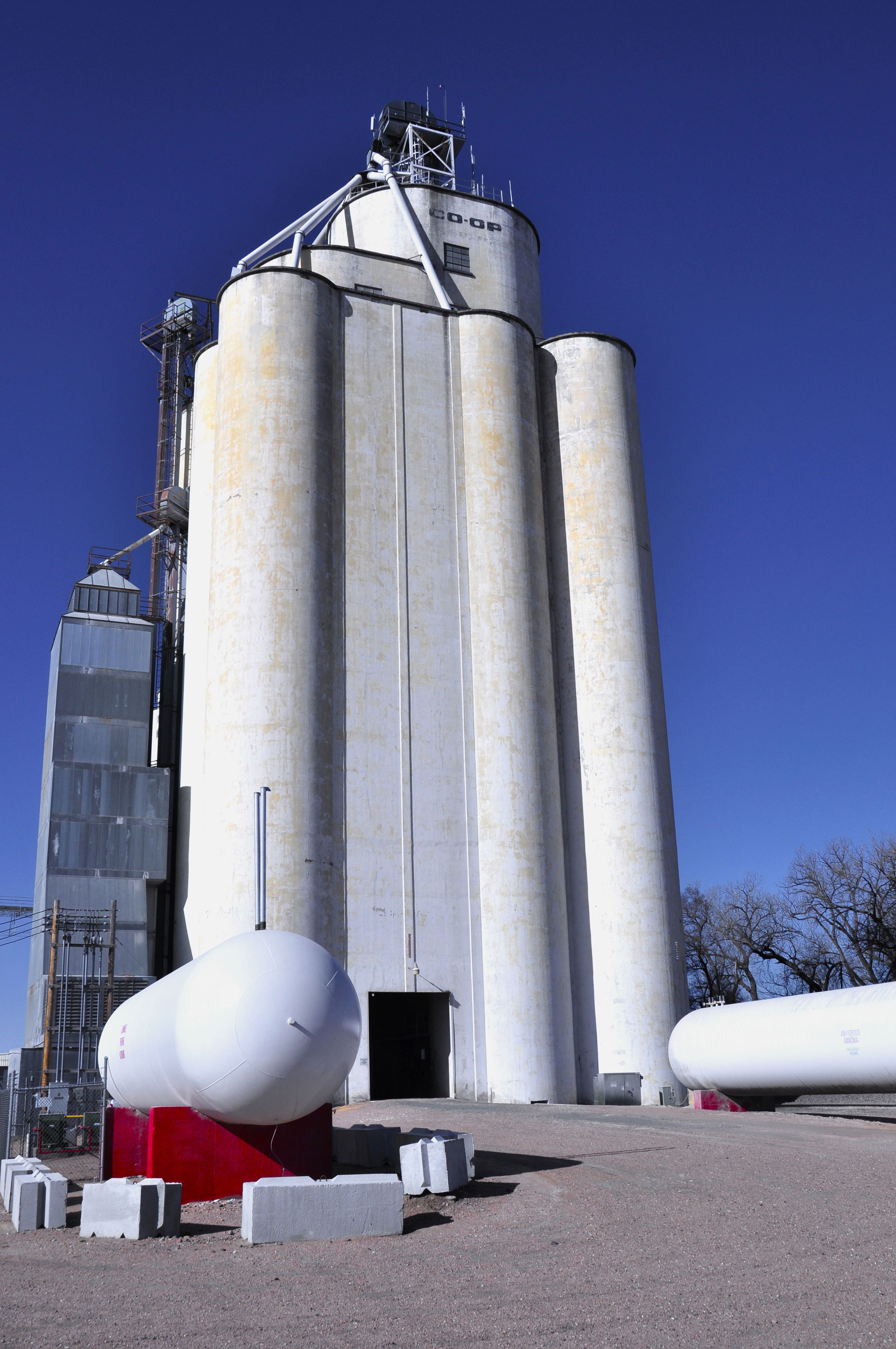
The elevator operators at Wauneta, Nebr., have done a remarkable job of retaining the blueprints and correspondence accumulated during the time the elevator complex was designed and built.

In virtually every other case we’ve investigated, blueprints were lost or unavailable, and the histories of the elevators were unknown. At Wauneta, we can track the history of their endeavor very easily.

We know from a newspaper item that the first, straight-up elevator at Wauneta was built by William Osborn, during his years with J. H. Tillotson, Contractor, of Denver, in 1945.

My dad knew that Grandpa built an elevator at Wauneta, so the story has been verified. A few years later, Wauneta obtained designs for an annex to be built by a winning bidder.

Map of Nebraska highlighting Chase County

Among these designs were two blueprints, dated 1948 and 1949, which were done by Holmen and Mayer, and Mayer-Osborn, respectively. Apparently the first set of plans was not built and a second set was ordered, this time from the newly formed Mayer-Osborn Company.

Other builders also submitted plans. Instead of an annex, however, Wauneta eventually built a second elevator, likely as a money-saving move.

A third elevator was also built.

The first two elevators had access to a rail line, and when the third elevator was built by Mel Jarvis Construction of Salina, Kan., it had no rail access, so runs were built connecting it to the other elevators.

After his recent visit, Gary Rich confirms that Mayer-Osborn built the Co-Op office building, formerly a John Deere dealership, and also a boiler room just west of the dealership. The blueprints are still kept at the Co-Op.

According to Gary, who interviewed a member of the Co-Op board, “The Co-Op provided everything for the farmers. They had the elevator, the John Deere dealership, a grocery store, and a lumber yard. Plus, they had a fertilizer plant and gasoline dealership.” 


Note: Follow the embedded link for William Osborn’s explanation of construction techniques used by Mayer-Osborn in nearby McCook, Nebr.

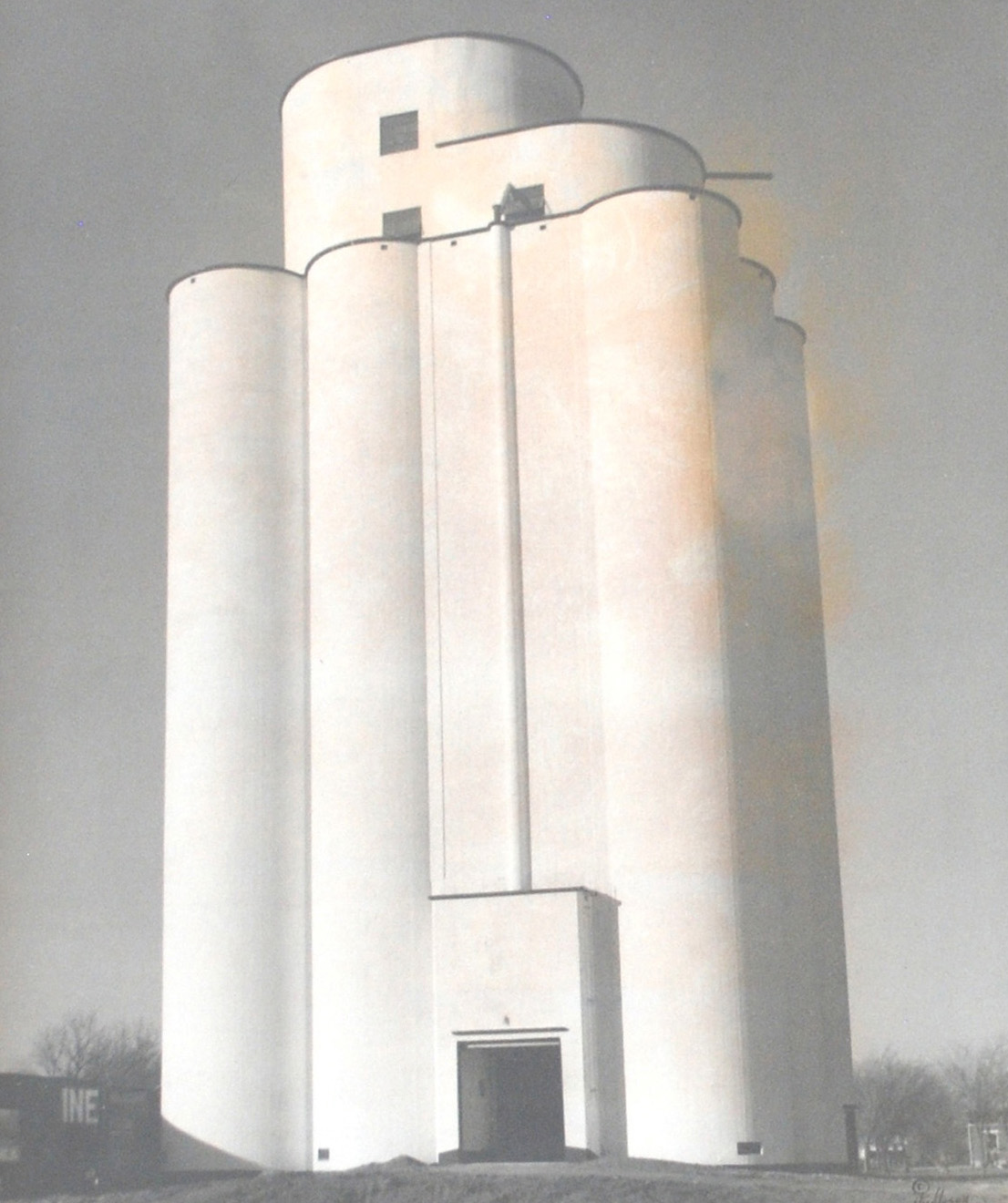
A contemporary view of Mayer-Osborn’s Blencoe elevator

Last holiday season, when she visited the Mayer-Osborn elevator at Blencoe, Iowa, Kristen Osborn Cart snapped this photo of a framed photo hanging in the office. It shows an early view of the elevator, which was finished in 1954. Her own father helped with the construction. The gleaming coat of white paint gave the structure an ultramodern look.

McCook: A different view of Mayer-Osborn’s first elevator

Kristen Osborn Cart provides this view of Mayer-Osborn’s first elevator, in McCook, Nebr., seen from a different angle. McCook is a town of about 7500 people in southwestern Nebraska’s Red Willow County, along the Republican River. The original elevator stands in the middle, between later annexes that added more storage.

Pritchett: Three elevators in southeastern Colorado


Gary Rich captured this striking view of the elevators at Pritchett, a small town in Colorado’s southeasternmost county, Baca. The elevators are along U.S. 160–called Railroad Street in the town–on the northern edge of the Comanche National Grassland. While we don’t know the builders of these elevators, some Mayer-Osborn characteristics are to be seen, notably, the step-up headhouse design and ground-level drive-through access of the first building.

Tracking down the builders of some Kansas and Colorado elevators

Photos by Gary Rich

We’re trying to track down the builders of elevators that stand in various places throughout Kansas and Colorado.

They could be Mayer-Osborn Company elevators.

Here are photos of elevators in Pritchett, Colo., above; Limon, Colo., center; and Coldwater, Kan., below.

Brandon, Colo., also has an elevator whose builder we haven’t identified. 

In Kansas, we have looked at elevators of unknown provenance in Bridgeport, Carlton, Coldwater, Lucas, and Peabody. Of these elevators, Bridgeport, Carlton, and Peabody are of the straight-up type.

From Salina, Bridgeport is due south while Carlton is to the southeast. Peabody is on U.S 50 northeast of Newton.

It seems likely that the elevators in these towns were built by Johnson-Sampson Construction Company, or companies that derived from it, because these towns are fairly close to Salina, where Johnson-Sampson was located.

There are elevators in a few places that were certainly built by Johnson-Sampson. These in Atlanta, Galatia, and Fowler are of the step-up type.

Although circumstances around the dissolution of Mayer-Osborn in 1955 aren’t precisely known, we think that after William Osborn left the business, Eugene Mayer, his partner, carried on under another name, and the signature Mayer-Osborn design scheme was used by Johnson-Sampson and perhaps others.

It’s official: Mayer-Osborn built Big Springs’ original concrete elevator

Story and Photos by Gary Rich

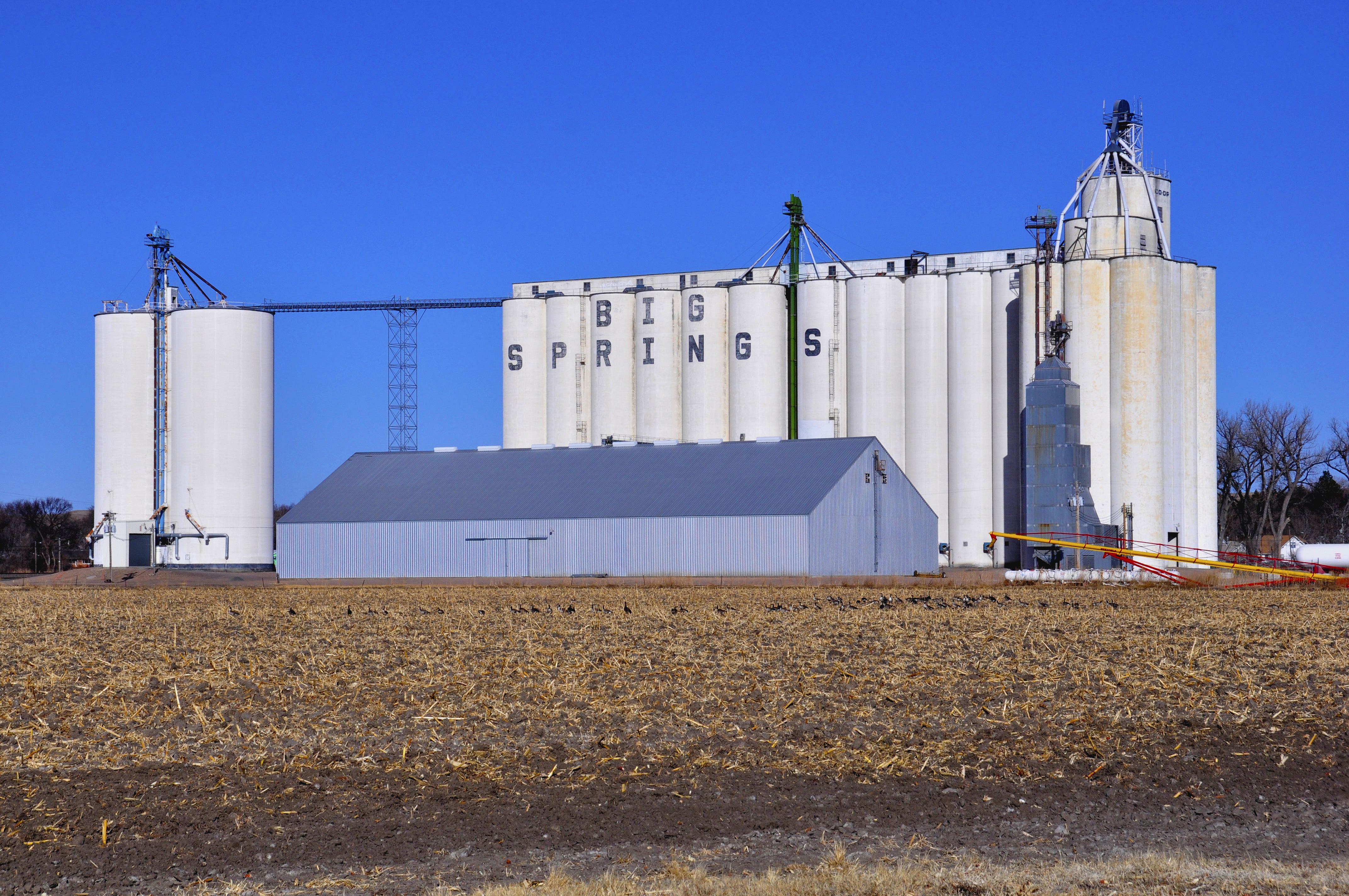
Who built the Big Springs elevator? The winner is Mayer-Osborn Company. The manhole covers have Mayer-Osborn on them. It was built in 1951.This structure is today called Elevator 1. A six-bin annex was added afterwards. I do not know who built it. There were no manhole covers.

Another annex was built by Mid States. They call this Elevator 2. It has its own leg. This annex has about sixteen bins.

Mid States also built the third annex, which has its own leg, too. There are two huge bins. 

I asked manager Larry McCroden about the primary crops raised around the area. The two biggest crops are corn and wheat. Secondary crops were sunflower seeds, for making sunflower oil, and millet. Some oats were grown, but there hasn’t been any oats tendered to the Co-Op for the past four years. Most years, corn was the number-one crop with wheat coming in second. I would say that there was about twenty percent more corn than wheat. One year was an exception. I believe it was 2008. Farmers delivered more wheat than corn that year.

The Big Springs Co-Op is independent–no other elevators in any towns. It says a lot that an independent Co-op can survive during without merging or being taken over.

Mayer-Osborn joins bidders on AEC sewage plant near Pocatello

Tolboe and Woolton Construction company, Provo, Utah, is apparent low bidder on a contract for the construction of two sanitary sewage disposal plants, the U.S. Atomic energy commission, Idaho operations office, announced thursday.

The company’s bid of $75,803 was apparently the lowest of 17 opened February 14 by the Idaho operations office’s contract board. J.O. Young and Son, Nampa, was second lowest bidder with a proposal of $77,908, followed by United Engineers, Inc., Ogden, Utah, at $83,798.

Other bidders were Brennan and Cahoon, Inc., Pocatello; Olson Construction company, Salt Lake City, Utah; Gibbons and Reed company, contractors, Salt Lake City; J.H. Wise and Son, Inc., Boise; Mayer-Osborn company, Denver; Haggerty-Messmer company, Bozeman, Mont.; Arrington Construction company, Inc., Idaho Falls; M.J. Brock and Sons, Los Angeles; Joe Lundberg Construction company, Seattle; Lee Hoffman, Portland, Ore.; Lovedahl and Sorenson, Idaho Falls; W.T. Grayson, contractor, Pocatello; Young and Smith Construction company, Salt Lake City; and C.H. Elle Construction company, Pocatello.

Work covered by the contract will include construction of Imhoff tanks, trickling filters, settling tanks, sludge drying bed, chlorination equipment and chambers, and necessary mechanical and electrical work. The plants will be installed at AEC’s reactor testing station near here.

Bids are now being analyzed, and the contract award is expected to be made within a few days.

Idaho State Journal, Feb. 15, 1951

In Chase County, we meet Gary State, an elevator construction veteran

By Gary Rich

Editor’s note: Gary is recently returned from a fact-finding foray in Nebraska.

I stopped at the Chase County courthouse in Imperial, Neb., looking for the dates when the elevators were built in Imperial, Enders, and Wauneta. They did not have much information about the build dates. The only info they have in their records is that the old office building for Frenchman Valley Co-op was done in 1946. The FVC built a new office across the street from the old one.

The ladies on the courthouse staff told me to stop in at the FVC office and talk with Gary State, who might have the dates. Mr. State went to work for Mid States building grain elevators and feed plants. I do not know if it was just Mid States or Mid States Construction. He was living in Imperial when he started working for them.

Map of Nebraska highlighting Chase County

I explained about Tillotson Construction Company, of Omaha, J.H. Tillotson, Contractor, of Denver, and Mayer-Osborn Company. He gave me some leads. He told me that Hugh O’Grady is still alive and lives in Omaha. Mid States was started by a man name Erickson. He had seven sons. Six of the sons ended up working for Mid States. One son died at a construction site. He said Jack Russell was a superintendent. He thought that he was living in Seward, Neb.

Mr. State built the second annex, or elevator number two, at Big Springs, and then elevator number three.

He told me that he built the Woolstock, and Goldfield, Iowa, elevators; the feed plant at Fruita, Colo.; and elevators at Garrison and nearby David City, Neb. At the other end of the Cornhusker State, he built the west elevator in Imperial. After the west elevator was finished, he left Mid States and he went to work for the Co-op. This is the reason that he is working for FVC.

♦ ♦ ♦

Okay, here is another thing. I thought that when a construction company built an elevator that they did everything. This is not true. Mr. State told me about a company based at York, Neb. This company did all the belts inside the elevators, all around Nebraska, no matter who the builder was. So we know the belts were installed by a separate company. Now I am wondering if a separate company was onsite to install the leg as they built the elevator up. Or did the general contractor install the leg?