Nebraska Firms get Government Contracts

Give projects to Nebraska firms

Washington (AP).  The War Department has awarded the following government contracts (Army engineers office in charge in parentheses):

Less than $50,000.

C.C. Larsen and Sons, Council Bluffs, IA., temporary buildings, Thayer County, Neb. (Omaha).

Olsen, Assenmacher, and Rokahr, Lincoln, Neb., temporary frame building, Lancaster County, Neb. (Omaha).

Tillotson Construction, Co., Omaha, temporary building, Fillmore County, Neb. (Omaha).

Owen Mann, Rapid City, S.D., storage facilities, Box Butte County, Neb. (Omaha).

A. Borchman Sons, Omaha, temporary building, Dodge County, Neb. (Omaha).

Lincoln Nebraska State Journal, Lincoln, Nebraska, Friday, June 11, 1943.

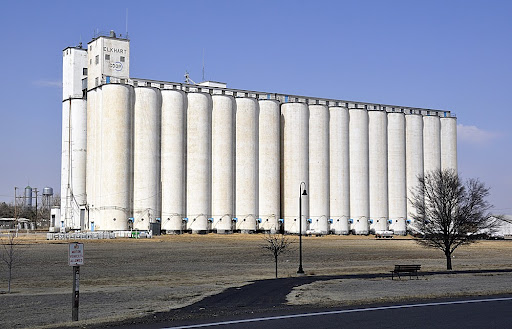
Tillotson Construction adds six feet a day on Elkhart elevator

Elkhart–Construction is starting on the new 225,000 bushel elevator for the Equity Grain Co. here.
The Tillotson Construction Co. of Omaha has the contract.Hutchinson (Kan.) News-Herald, December 24, 1945

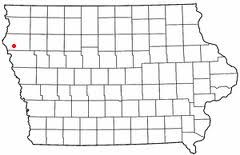
From the city of Elkhart’s website. Note elevator silos in upper left.

Work Day and Night on Elkhart Elevator 

Elkhart–Work is proceeding day and night on the construction of the new Equity elevator here.
Floodlights are rigged up to illuminate the scene for the night workers.The concrete storage tanks are going up at the rate of six feet a day. They will stand 140 feet high when completed. The elevator will have a storage of 250,000 bushels of grain.The Tillotson Construction Co. of Omaha, have the contract. It is expected the bins will be finished in three weeks.

Hutchinson (Kan.) News-Herald, March 21, 1946

Elkhart farmers ‘raise sights,’ hire Tillotson Construction on new elevator

Photo taken March 19, 2011, by Kate Flint.

Stockholders of the Cooperative Equity Exchange here have raised their sights. Instead of the 100,000 bushel elevator first planned, the stockholders have voted in favor of erecting a modern elevator of 225,000 bushels capacity.

The contract has been let to the Tillotson Construction Co. of Omaha. It will be built on a “cost plus” basis, but Gale Cochran, manager of the Equity said it was estimated it would cost around $85,000.

There will be eight overhead bins, six interstice bins and eight grain tanks. The elevator head will stand 120 feet high. The plant will be built at the site of the old Elkhart mill, purchased from J.E. Heintz. The present elevator buildings will be sold.

Construction will be started in about two weeks, and the new plant is to be completed before harvest next summer.

Hutchinson (Kan.) News-Herald, November 20, 1945

♦ ♦ ♦

Note: Here’s the link to the BNSF railroad’s grain elevator index page on Elkhart.

Additional note: University of Southern California professor Kate Flint chased grain elevators in March 2011 and even stayed in one overnight.

Marvin Richards falls 105 feet from Hinton elevator

Iowan Killed in Fall from Grain Elevator

Sioux City (AP) — Marvin Richards, 28, of Hinton died in a hospital here Friday shortly after he had fallen 105 feet from the top of a grain elevator at Hinton.

Richards was employed by the Tillotson Construction Company of Omaha. He was working on a scaffold atop the nearly completed elevator of the Farmers Elevator Company.

He apparently lost his balance and fell 105 feet to the concrete top of a hopper.

Cedar Rapids Gazette, October 1, 1954

♦ ♦ ♦

Special note: The obituary of Mr. Richards’s sister Deloris E. Holtz.

News of recent developments in Hinton are found on Younglove’s site, including a picture of the original elevator.

By 1930, the Tillotsons are prospering — with a radio set!

By Ronald Ahrens

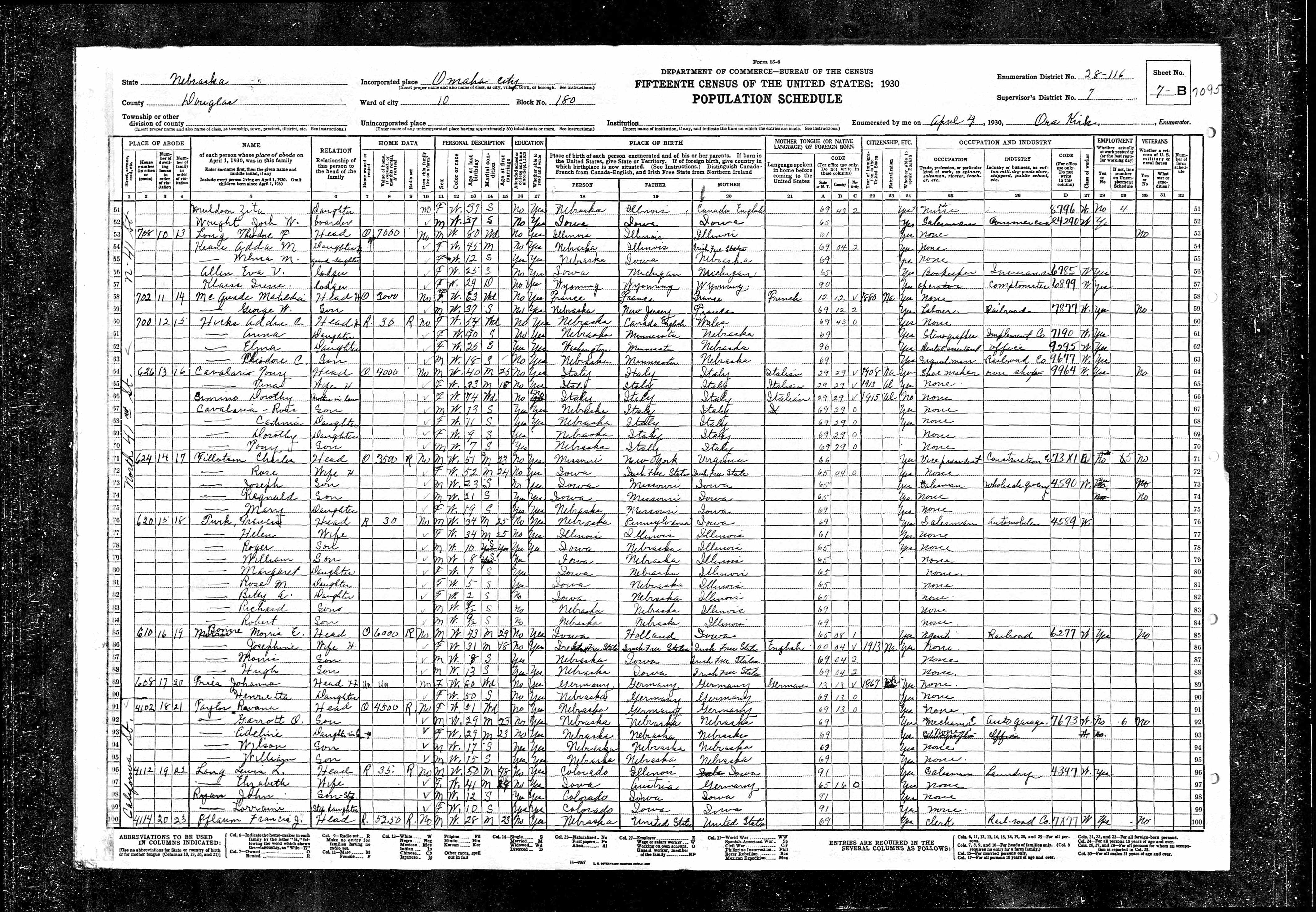
On April 4, 1930, the census-taker knocked at the Tillotsons’ door at 624 N. 41 St., in Omaha, and found them prospering.

Charles H. Tillotson, 51, was head of household and gave his occupation as superintendent in construction. Census code 73X1 supports this. It appears he was an employee.

Rose Tillotson, 52, was home. The age given here corroborates my belief that Rose’s age, given as 38 in 1920, was incorrect.

Charles was 23 and Rose 24 when they were wed.

Son Joseph, 23, was employed as a salesman in the wholesale grocery business, as census code 4590 supports. Son Reginald, 21, as well as daughter Mary, 19, also lived in the home.

The Tillotsons owned their home, which was valued at $3500. And they cooperated in supplying an extra bit of data: they had a radio set.

By 1935, Reginald would be the father of Charles J. Tillotson, the first of six children with Margaret Irene McDunn Tillotson. The grandson would barely know his grandfather: Charles H. would die in June 1938 at Concordia, Kansas.

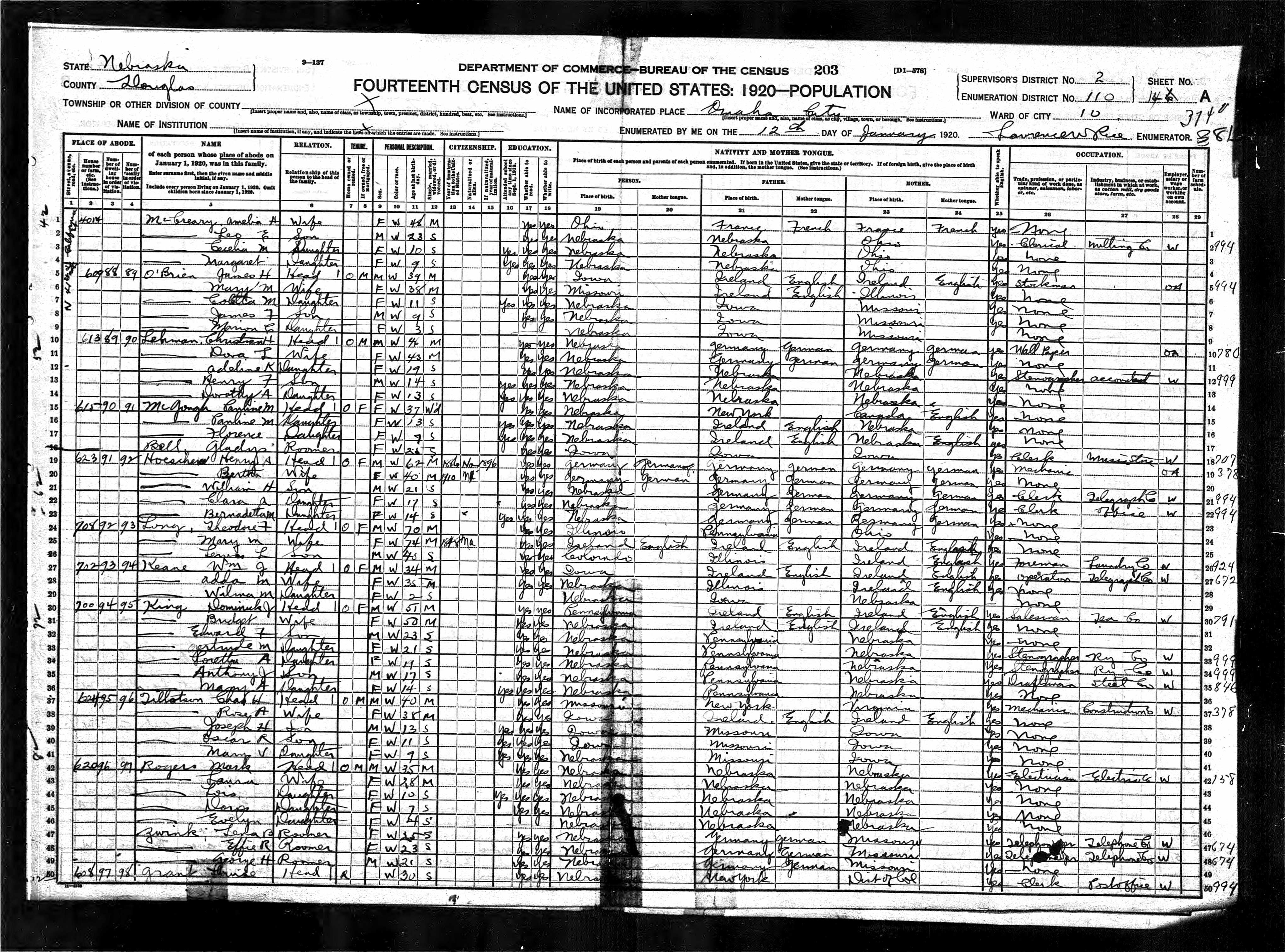
1920 census finds the Tillotsons settled in Omaha

By Ronald Ahrens

After their sojourn on Alda Street in Elba, Nebraska, where they were living at the time of the 1910 census, the family of Charles H. and Rose A. Tillotson found their way to Omaha.

When the census-taker came to the door in 1920, my great-grandfather gave his occupation as a “mechanic” in construction. This tells me several things. One is that just fifteen years earlier, the term “mechanician” was frequently used in the press. So it might be said that the language was in a sense settling.

Another thing is that mechanic was rather loosely defined. During the 1930s, Bill Knudsen, who became president of General Motors in 1937, gave speeches and interviews in which he insisted that every boy should learn the mechanic’s trade. This didn’t necessarily mean auto mechanics. It was more a case of learning the manual arts: sheet-metal work, electrical, maybe even plumbing or pipefitting.

But in the case of “Chas. H,” as he’s here listed (he was Charlie in 1910), I suspect it has something to do with assembling the legs and other internals of grain elevators.

Note that, whereas he was evidently an employer in 1910, he’s now a worker. The family was living at 624 N. 41 St, where they would be found again in 1930.

My grandfather’s name is entered incorrectly as “Oscar R.” instead of Reginald Oscar.

Joseph H. was 13, Reginald was 11, and Mary V. was 9. (Although that numeral may at first glance look like a 7, inspection by magnifying glass of a printed copy shows that it’s in fact a 9 with the loop nearly closed.)

Meanwhile, it’s certainly unusual that my great-grandmother Rose was thirty-five years old in 1910 but here is thirty-eight. Hers had to be the most effective anti-aging strategy ever!

Census data, genealogical work establish Tillotsons from 17th-century onward

In the following passage, Kristen, an experienced genealogist, destroys the myth that my grandmother, Margaret Irene McDunn Tillotson, always perpetuated about the Tillotsons being an Irish family:

I seem to have had a run of very good luck. Your [Tillotson] tree is verified back to 1816 with the census and before that, other researchers have the family back to the 1750s in Connecticut. It was an early family. Lots of families moved west around the time of the Civil War, and some of these very earliest families seem to have gravitated toward Nebraska. It does not surprise me at all to find a New England root for your family.

Charles [father of Reginald] was the son of John W. Tillotson, and his father was John W. Tillotson. They came from Cazenovia, Madison County, New York. The younger John moved to Missouri, then Iowa, then Nebraska. The online researcher has an Ephraim as father of the older John, and an Abraham before that. (I have evidence that Abraham Tillotson served in the Revolutionary War, and got a pension.) The researcher said they came from Hebron, Connecticut. I have not chased down wives. The elder John had a good amount of land—220 acres—in 1860, improved and worth quite a bit of money.

One webpage has data as far back as the 17th century.

The 1910 census reveals important information. Charlie and Rose Tillotson were 30 and 35 years old, respectively, were able to read and write, and lived on Alda Street in Elba, Howard County, Nebraska. (The seat of this east-central county is St. Paul.) They had already had brought Joseph, age four, and Reginald, age two, and an as yet unnamed baby daughter into the world. Both boys were born in Iowa, but the girl, undoubtedly Mary, had been born in Nebraska, so the Tillotson family had come there within the last two years. Charlie’s occupation is given as carpenter, his place of occupation was an elevator, he evidently had employees, and the family rented a house.

1940 Omaha directory shows new home addresses for Tillotsons

The Omaha city directory for 1940 shows new information for the Tillotsons as compared to the year before.A change within the business organization was that Rose Tillotson had relinquished her duties as treasurer to daughter Mary V. Tillotson. But Rose continued to serve as company secretary.

All the home addresses were different for 1940.

Joe and Sylvia Tillotson were living at 2205 Jones, apartment 213.

Rose and Mary Tillotson, mother and daughter, shared a place at 3100 Chicago St.

And Reginald’s address is given as RD 2, Florence. RD could be the abbreviation for rural delivery. His family lived in the hills north of Florence, which was the village at the far north of Omaha.

1939 Omaha directory locates Tillotson Construction in Grain Exchange Building

The Omaha city directory for 1939, found by Kristen on Ancestry.com, verifies the status of the Tillotsons. From these pages it emerges that Tillotson Contruction Company kept offices at 720 Grain Exchange Building. Joseph H. Tillotson was president, Reginald O. Tillotson was vice-president, and their mother Rose A. (Brennan) Tillotson was secretary-treasurer in this  year.“Grain elev,” as seen in the listing, would refer to the company’s specialty.

Company president Joe Tillotson appears to have lived at 345 N. 41 St. with his wife Sylvia.

For the other Tillotsons, what could be a residential address of 1804 Dodge St. is given, although the directory’s abbreviations aren’t clear. Included here are Mrs. C.H. (Rose) Tillotson, who was by then the widow of Charles H. Tillotson, and Mary Tillotson, Reginald’s sister.

It seems unlikely that Reginald lived with his mother and sister at 1804 Dodge St. because by 1939 he and his wife Margaret already had at least four children of their own.

All this is in keeping with the announcement the previous autumn of Tillotson Construction Company’s establishment.

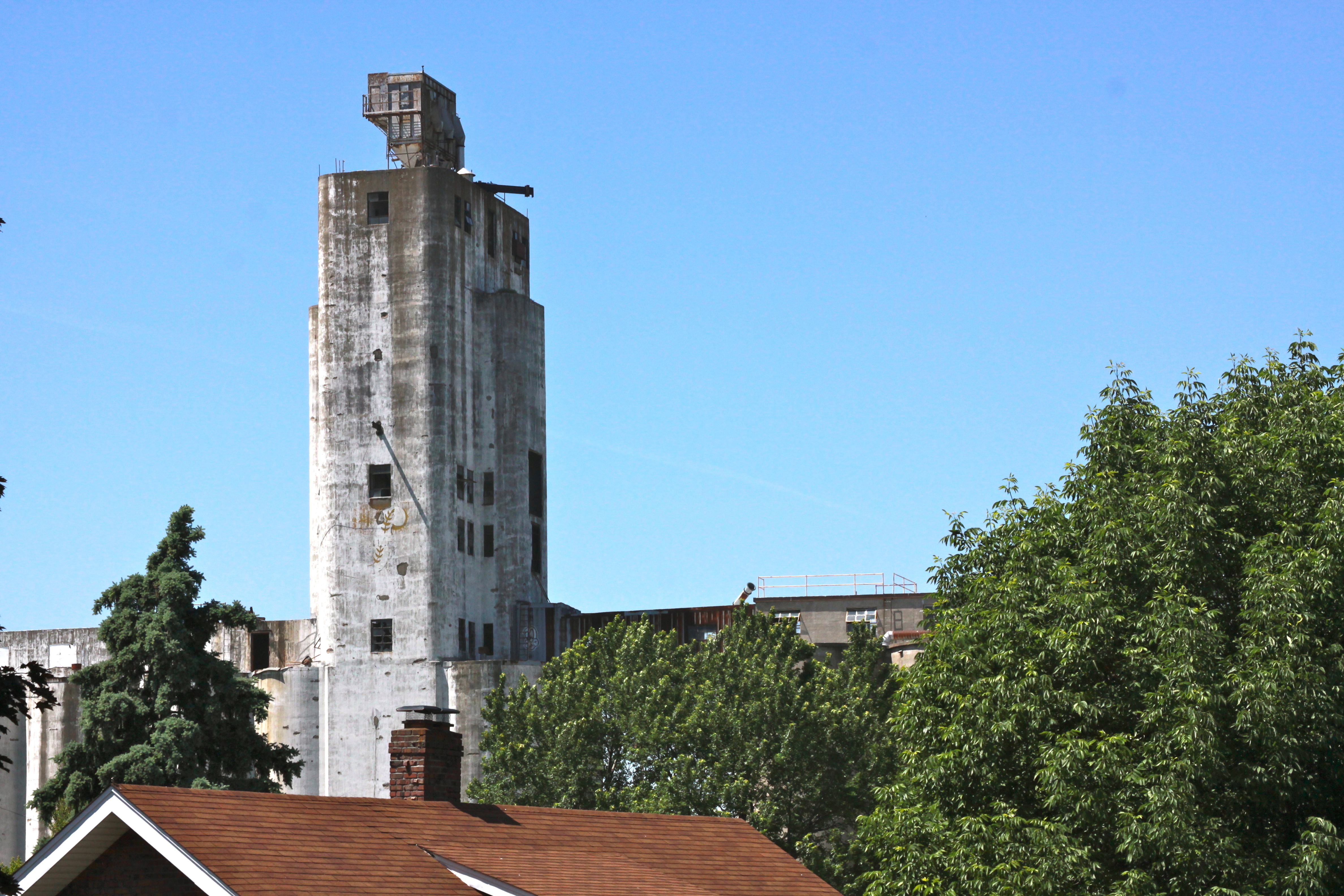
‘Stored Potential’ will expand art themes at Tillotson’s Vinton Street elevator

Illustration from Emerging Terrain, a Nonprofit Research & Design Collaborative

The Vinton Street elevator represents a bellwether for Tillotson Construction Co. Not only was it high and mighty but also close at hand for the company with headquarters in Omaha. Family and friends who never went to the small grain-belt towns where Tillotson put up elevators could see this one for themselves. In fact, they couldn’t miss it. And this was particularly true after Interstate 80 was completed: the superhighway went right past the complex that had risen and then expanded and finally fallen into abandonment.When I worked for a time at Omaha’s very first Federal Express office, a part-time job during my freshman year of college, I reguarly drove past the complex while on my way to the airport, having no idea my grandfather’s company had built the key elevator. And in the many times I’ve gone by since then on my return visits to Omaha, I still had no idea.The other day, speaking with my Uncle Tim Tillotson, he mentioned Vinton Street and said that Uncle Charles, the oldest son of Reginald and Margaret Tillotson, worked the night shift during the construction phase.

He also told me about the public art project.

Photo from Emerging Terrain

The abandoned elevator and silos are “bombproof,” as he put it, not readily lending themselves to any scheme for demolition. Even though my own grandfather and uncle had a hand in putting up this structure, I will admit it became rather tedious.

But I object to the invective of the blogger who used the term “visual pollution” and casually denigrated the elevators. Tillotson Construction took pains to erect symmetrical buildings with graceful cupolas.

In language more suitable for a grant proposal than a black eye, Anne Trumble, a thoughtful woman, describes the Vinton Street elevators as a blank canvas for “a large-scale installation re-purposing a prominent grain elevator no longer used for its original purpose.”

In September of 2010, her nonprofit, Emerging Terrain, weighed in with “Stored Potential: Re-Purposing the Mid-Century Grain Elevator” exercise, which allowed artists to work on a large canvas, draping thirteen banners, each of twenty-by-eighty-feet, on the silos.

The theme was land use, and the result was stunning.

Good news: next month, thirteen new banners will be added, this time addressing transport–the physical kind, not the ecstasy some will experience when seeing the finished result.

Related articles