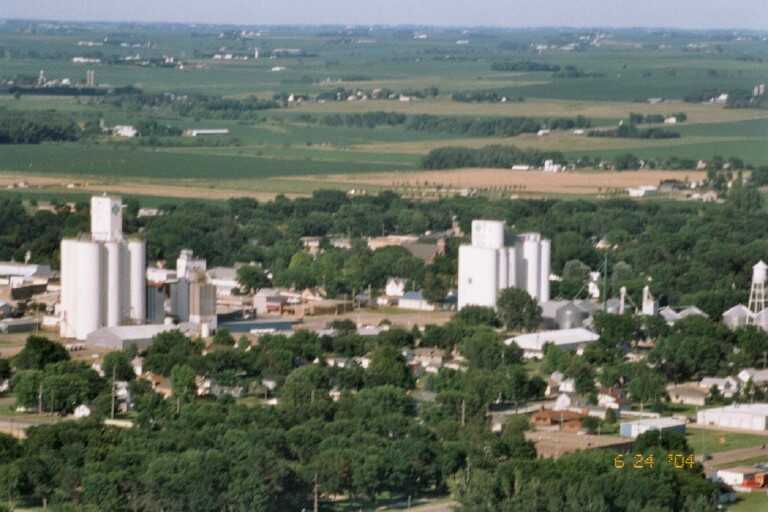
J.H. Tillotson’s Fairbury elevator, slowed by rain during construction, will miss 1947 harvest


These clippings were among William Osborn’s papers. They come from the Fairbury (Nebr.) Daily News, a long-defunct paper, and appear to have run in the summer of 1947. The article “Rain Hampers Work At New Elevator Site” gives a good summary of the construction methods used on the Farmers Union elevator. The name J.T. Tillotson Contractors, as it appears in the article, should be J.H. Tillotson, according to other records.


Open house to welcome Tillotson Construction’s large elevator at Rock Valley


Photo by Rock Valley city administrator Tom Van Maanen

Rock Valley, Iowa–In June 1950, Farmers’ Elevator Guide reported a 270,000-bushel, $125,000 concrete grain storage elevator was being put up by Farmers Elevator Company.

In November the same publication reported an October 7 open house at the facility. Final cost and capacity were $150,000 and 310,000 bushels. This was “said to be the second largest in the northwest section of Iowa.”

Other key dimensions:

  • A footprint of 65 by 85 feet
  • Height: 160 feet
  • 34 bins ranging from 300 bushels to 28,000 in capacity

Features included a “cleaner room” and a grain dryer adjacent to the elevator.

Tillotson Construction Company, of Omaha, contracted the work.

Men wanted in Paullina, Iowa, by Tillotson Construction in 1949

Back Alley, Paullina, Iowa, by Jim Hamann

MEN WANTED for construction work on Concrete Grain Elevator, 90¢ per hour, 10 hours a day, 6 and 7 days a week. Time and ½ over 40 hours.

Tillotson Const Co. at Paullina, Ia.

The Alton, Iowa Democrat, Thursday, May 5, 1949

Editor’s note: In 2008, an explosion and fire injured a customer at the new elevator in Alton.

This map shows the incorporated and unincorpor...

Image via Wikipedia

Page City structure exemplifies functional and aesthetic aspects of elevator design

Page City elevator as seen January 26, 2012

Story and photos by Gary Rich

The elevators without a headhouse were called straight-up elevators. J. H. Tillotson, Contractor and Mayer-Osborn Company produced these in the latter 1940s and early 1950s. Their elevators had a smaller diameter pipe that came out about three-quarters up the rail side. Loading a boxcar was time-consuming.

About 1958, there were improvements added for quicker loading of boxcars. These images show the Page City, Kan., elevator. Notice the rail loading chutes are much larger and there are two chutes, so the grain could be loaded equally. These chutes were on all concrete elevators raised during the late 1950s and 1960s. Most boxcars could be loaded within fifteen minutes, whereas on the old wooden elevators it could take up forty-five minutes.

The Page City elevator was built by Johnson-Sampson Construction Company, of Salina, Kan.  It was built about 1958 or 1959. Did Gene Mayer draw up the blueprints for this elevator? We don’t know where he went after the Mayer-Osborn era, which ended after 1955.

Another improvement is the area around the driveway. You can see the three reinforcing columns above the driveway and door. I would think this would add greater strength. The Kanorado, Kan., elevator has a smaller version built out. It is established that Gene Mayer produced the plans for that elevator.

Government loans, subsidies led to elevator construction boom in 1940s and 1950s

The following observations come after Kristen’s recent foray in the University of Wisconsin library:

English: Chicago Board of Trade at night, phot...

The trip to check out the Farmers’ Elevator Guide was interesting. There is no index, so I have just scratched the surface. But this is an interesting twist on things: through the Forties and Fifties, the farmers’ cooperatives were a way of doing business along the lines of a union. There are articles about Washington’s involvement (that went so far as to prohibit all commercial building in the nation at one point, excepting elevators!) that makes today’s meddling seem mild by comparison.

Some of these articles, when I get back to Madison, are a must for the politics of the times that made this boom happen. Both the bumper crops that were bolstered by price supports, and various government loan programs and grain storage subsidies, made the business quite a going thing until it didn’t quite work any more. The Chicago Board of Trade complained we were on the road to Socialism. (And we were.) Much of the debate and business news made its way into the Farmers Elevator Guide.


Tillotson Construction wins Rock Valley contract, loses $870 judgment for employee’s injuries

Photo by Rock Valley city administrator Tom Van Maanen

East Elevator To Be Sold At Public Auction Saturday

Directors of the Farmers Elevator company decided last week to sell the red (east) elevator structure to make way for the new concrete storage elevator. Included also will be a feed shed and the driveway office structure.

Various and sundry pieces of equipment are being offered for sale, either before or during the public auction, scheduled to be held this Saturday, starting at 2:00 p.m.

The elevator building to be sold has a 15,000 bushel capacity and Manager Owen Manning has pointed out that the driveway and office would make a good machine shed. The feed shed measures 30 by 48 feet. See the advertisement on another page for the list of machinery and equipment up for sale.

Manager Manning said that the contract for the new concrete storage building had been awarded to the Tillotson Construction company of Omaha and that work on the structure will begin on or about June 1. The building is due to be completed about September 15 and work may be far enough advanced to permit acceptance of grain for storage about September 1.

Rock Valley Bee, Thursday, April 27, 1950 

♦ ♦ ♦

Sioux County Courthouse News 

In the case of Winfield Kenneth Bagley vs Tillotson Construction Company & American Mu. Liability, the court approved the compromise settlement between the parties in which the defendants are to pays $870.00 to plaintiff for injuries he received to his foot, while employed at Rock Valley, Iowa by the Tillotson Construction Co.

Sioux Center News, Thursday, August 16, 1951 


Tillotson Construction’s Ralston, Iowa, project ‘progressing nicely’ in 1939

Ralston, Iowa–The work on the new annex at the Farmers Elevator is progressing nicely. The Tillotson Construction Company of Omaha will soon have it ready to store grain.

Carroll (Iowa) Daily Herald, Wednesday, September 13, 1939

Note: The New York Times visited Ralston in 2006 for a story about inadequate storage capacity in the face of madly expanding corn production.

Tillotson Construction builds new elevator in Glidden, Iowa

Glidden—The Tillotson construction company, Omaha, started work Saturday on a new reinforced concrete elevator for the Farmers Co-Operative elevator at Glidden.

Carroll (Iowa) Daily Times Herald, Monday, April 11, 1949

Glidden—As part of an expansion program at the Glidden Farmers Co-operative company, work begun April 13 on a reinforced concrete elevator with a 100,000 bushel capacity is progressing rapidly toward completion.

About 20 feet higher than the present buildings, the new elevator will be situated east of them. With the additional storage space the company, for several years the largest co-operative elevator owned and operated in Iowa, will be able to take care of a large amount of corn and beans grown extensively in the Glidden area.

The 100-ft.-high main storage part of the new elevator is up, and bin bottoms are being covered with concrete and hopper fill.

Approximately 35 men are working 10 hours a day on construction of the new elevator, which is under the direction of the Tillotson Construction company of Omaha.

It is expected to be completed by July or August.

Carroll (Iowa) Daily Times Herald, Wednesday, June 22, 1949 


Mysteries surround the origin of Mayer-Osborn Company and its first elevator

By Gary Rich

Let me explain about Wauneta, Neb. I got into a lot of trouble there last week. It was my wife that gave me the trouble. I went into the office trying to gain some information. The lady working inside went into the back room. She had all kinds of blueprints. I wasn’t about to pass up a chance looking at them. It took me over them minutes to look at everything. Needless to say, somebody was over the boiling point when I got back out to the car.

Let me give some other information that we thought about J.H. Tillotson, Contractor. Kristen and I thought Mayer-Osborn took over when Joe passed away. Now, I have proof that this wasn’t the case at all.

I found blue prints that pointed to Denver, but more towards Mayer-Osborn. One set of prints was not for an elevator. It was like footing foundations for a building. One set had the date in the body of blueprint, then there was a box in the lower right hand corner that had the company and another date. The first one had Orrie J. Holmen, Designer, Denver, Colo., but no company name was written there. The body of the blueprint had 1948, but the lower right corner showed 1949.

I found another set that had in the lower right-hand corner the following information; Holmen & Mayer, Designers & Engineers, Denver, Colo. So once Joe Tillotson passed away, I believe Orrie J. Holmen took over the company. We know that Gene Mayer worked for Tillotson–both Tillotson Construction, of Omaha, and J.H. Tillotson, of Denver–as well as Bill Osborn. But I could not find any dates for these blueprints.

Yet another set of blueprints had Holmen & Mayer, 1717 East Colfax, Denver, Colo. This is the exact address that is on the Mayer-Osborn brochure. I found even another set of blueprints, which are not blue. They are on clear paper or yellow paper. It shows the old elevator, which is the one without the headhouse. In the lower right-hand corner, it has the following information; Mayer-Osborn, 5100 York Street, Denver, Colo. But there is no date in the lower right corner box.

Kristen found a small article in the Farmers’ Elevator Guide which was a monthly magazine. It told about Mayer-Osborn moving to the address at 5100 York St. It stated that it gave them more room at this location.

This is my guess and my guess only that this is the way company names happened:

  1. J.H. Tillotson, Contractor
  2. Orrie J. Holmen or Holmen Construction
  3. Holmen & Mayer Construction
  4. Mayer-Osborn Co.

Kristen originally told me that Mayer-Osborn started in 1946. I still think the company name was Tillotson. She mentions that Mayer-Osborn built the McCook, Nebr., elevator, which was their first; however, the plaque inside the elevator shows 1949.

I am planning another trip to Wauneta in a few weeks. I will try to get permission to get into the elevator, so I can see whose name is on the manhole covers. This will tell us for sure, if it Tillotson or Mayer-Osborn who built the original elevator. I am thinking the original elevator was built either 1947 or 1948.

I want to get to the elevators in McCook, too. The one that Mayer-Osborn built there was another elevator standing a ways from the newer elevator. It is one that has no head house, too. I am hoping that they will let me inside this elevator, so I can find out who built this elevator. Some elevator managers are willing to let me inside the elevators, while others say that I can not go inside due to insurance. I am trying to get inside as many elevators as I can before it comes down that no one will be allowed inside.

♦ ♦ ♦

Kristen Cart explains:

Some of the mystery can be explained by the sequence of events leading to the establishment of the Mayer-Osborn Company.  J. H. Tillotson, Contractor was owned by Joe Tillotson. My father told me that Mr. Morris, Joe Tillotson’s construction superintendent, died in a roadside accident while changing a tire early in 1947. Within a month, Joe Tillotson died in a car accident, which we know was in March 1947. The only one left in the company who had contractor experience and construction expertise was William Osborn. It seems apparent to Dad that Gene Mayer had an independent architecture and engineering firm, which worked on projects with J. H. Tillotson, Contractor. For a period of time Gene Mayer was partnered with Orrie Holmen. My Dad says his father started an independent company called Osborn Construction, but it became very immediately apparent that he needed a partner.

This differs from Gary’s interpretation, but since Gary was at the site, talking to the people there, his thinking about it carries some weight. So we need to find more documentation.

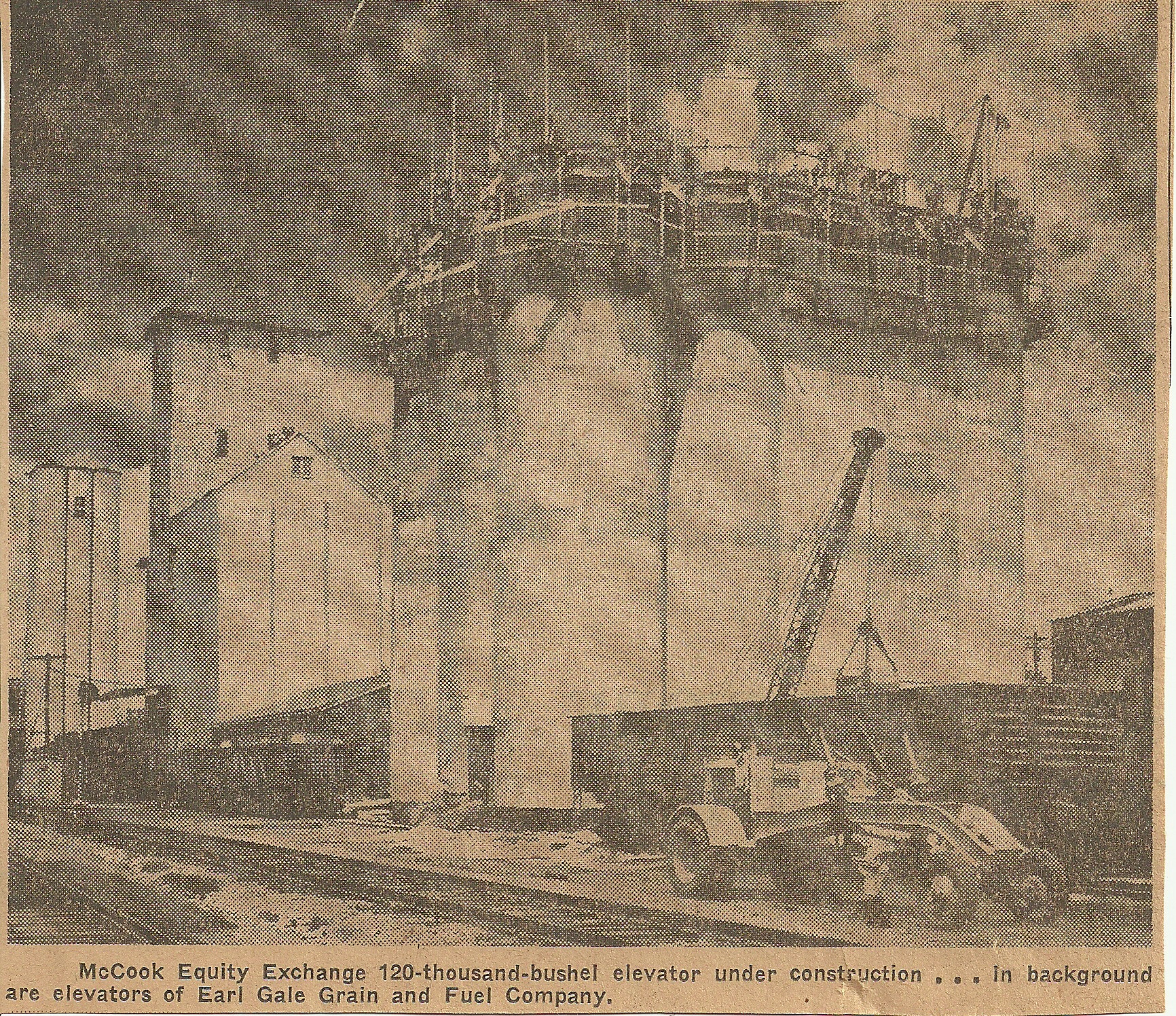
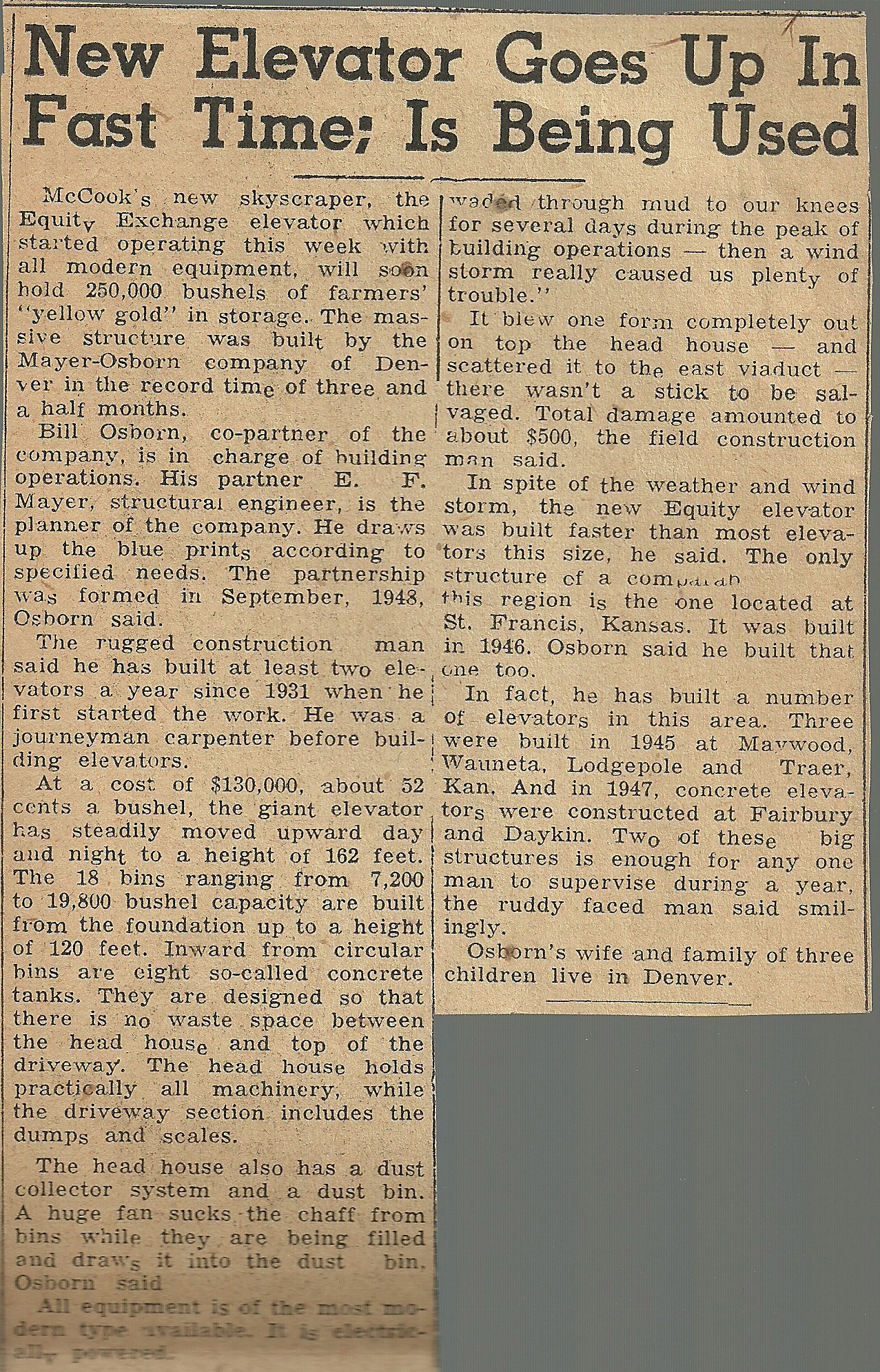
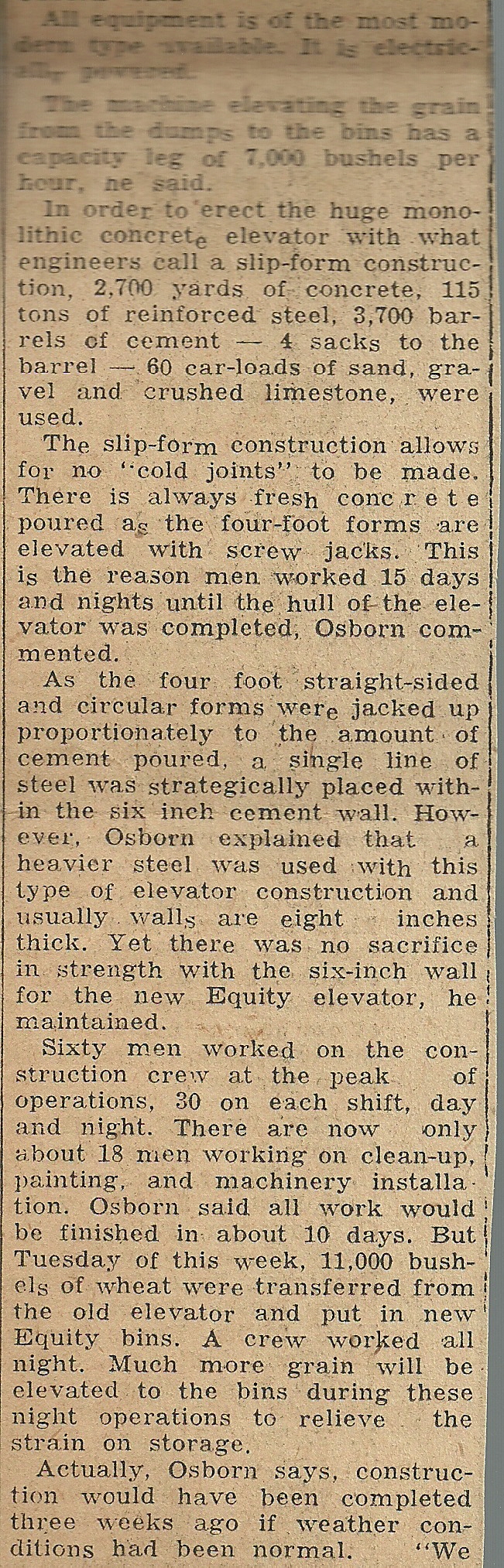
In a newspaper story about the building of the McCook elevator in 1949, Bill Osborn was interviewed. He said Mayer-Osborn was incorporated  in September 1948. We do not have any documentation of William Osborn’s interim business other than two elevators that he said he built in 1947, according to the same newspaper account, in Fairbury and Daykin, Nebraska. They probably fulfilled contracts already won by J. H. Tillotson, Contractor.

In the same newspaper article, the author said the Wauneta elevator was built in 1945, which makes us wonder about the purpose of the later dated blueprints that were found there. The yellow blueprint that Gary found at Wauneta could only have been produced after May, 1953, which is when the Farmers’ Elevator Guide announced Mayer-Osborn’s move, from 1717 East Colfax Avenue in Denver, to 5100 York Street in Denver.

The sequence of events Gary describes above accurately tracks Gene Mayer’s business of engineering and architecture that built these elevators.  The business relationship that existed with my grandfather is something we will continue to explore.