
In this 1950 photo from Neil Lieb’s archive, our contributor explains what we see in this view from atop the newly completed elevator in Alta, Iowa. “Those were storage bins for the excess before the elevator was built,” he says.
In this 1950 photo from Neil Lieb’s archive, our contributor explains what we see in this view from atop the newly completed elevator in Alta, Iowa. “Those were storage bins for the excess before the elevator was built,” he says.

That pipe is used to run the grain down to the railroad cars when they’re shipping it. Inside of that tank, there’s a hole that connects to that pipe. The system works [this way], you open a tank at the bottom, and run the grain into the pit. You use a belt to take it to the top and into this pipe. Commentary by Neil Lieb, photo from his archive.

The Tillotson elevator and annex alongside the railroad tracks in Greenwood, Neb.
Along U.S. 6 between Omaha and Lincoln, Neb., stands an early testament to the ingenuity of the Tillotson Construction Company of Omaha. This early elevator, which rises alongside the highway next to its attached annex in the town of Greenwood, still holds grain. The original elevator was built with a capacity of 129,000 bushels. On the side facing the highway, stenciled in black, is a sign that says “Built by Tillotson Construction Co. Omaha Nebraska.” The lettering is partially obscured by paint and concrete patches.
Highway 6 is a very familiar stretch of road. I have driven it innumerable times between Ashland and Lincoln while visiting my family–on every run to Lincoln, the old Tillotson elevator and its annex come up on the right side of the road about a third of the way there. As a little girl, when traveling across Nebraska, I would see a white edifice on the horizon, and it meant a new town was coming up and we were closer to our destination. Now, living far away, I rarely see the elevators that have become so familiar. But last summer, I revisited this one.

A Burlington Northern train slows to pass through town on an early morning run.
The Greenwood elevator was built in 1951. Its annex was added in 1954, and although we do not have the construction record of the annex among our Tillotson company papers, the embossed manhole covers identify its provenance.
The pairing of a Tillotson elevator with a Tillotson annex is fairly unusual in the company records–usually another company would come along and build an annex. During the elevator boom, it seems very likely that the Tillotson company was too busy to meet the demand for annexes that were springing up everywhere, and it is very doubtful that they competed and lost the contract at each site. The company was too good at what they did, and it is almost certain that they had more work than they could accept.
 We have the building specifications for the original elevator in the Tillotson Construction Company records.
Greenwood’s elevator was built following the Churdan Plan, with four 14 1/2-foot-diameter tanks, 120 feet high, and a 13 x 17-foot driveway. The spread was 13 feet, and eight bins were built over the driveway. The plan called for 17 total storage bins and a dust bin, with bin number 8 split to accommodate a dryer. The total capacity was 129,000 bushels.
Grain capacity per foot of height was 1318 bushels. For the project the company poured 1255 cubic feet of reinforced concrete, and 25 cubic feet of plain concrete for the hoppers. 60.23 tons of steel were used for construction (including jack rods). The average weight of steel per cubic yard of concrete was 96 pounds. The plans broke out the concrete and steel to be used for each line item:
Below main slab: 3,200 pounds of steel; 30 cubic yards of concrete;
Main slab: 15,870 pounds of steel; 118 cubic yards of concrete
Draw-form walls: 82,377 pounds of steel; 934 cubic yards of concrete
Driveway and work floor (including columns): 3,370 pounds of steel; 26 cubic yards of concrete
Deep bin bottoms: 3,491 pounds of steel; 19 cubic yards of concrete
Overhead bin bottoms: 3,752 pounds of steel; 23 cubic yards of concrete
Bin root: 3,060 pounds of steel; 30 cubic yards of concrete
Scale floor (or garner), complete: 186 pounds of steel; 3 cubic yards of concrete
Cupola walls: 2,789 pounds of steel; 35 cubic yards of concrete
Distributor floor: 886 pounds of steel; 7 cubic yards of concrete
Cupola roof: 1,129 pounds of steel; 9 cubic yards of concrete
Misc (boot, leg, head, track sink, steps, etc.): 360 pounds of steel; 20 cubic yards of concrete
Attached driveway: driveway extension included above

Concrete repairs are evident around the annex manhole cover.
Construction Details
The dimensions of the main slab were 49 x 49 feet, with a main slab area (actual outside on the ground) of 2,377 square feet. The total weight of reinforced concrete, at 4000 pounds per cubic yard plus steel, was 2,570 tons. Also computed at 4000 pounds per cubic yard, the total plain concrete weight for the hoppers was 50 tons. The fill sand for the hoppers, at 3000 pounds per cubic yard, was 360 tons. The planned weight of grain was 60 pounds per bushel, and when filled, the elevator could hold 3,870 tons of grain. Fifteen tons of structural steel and machinery were added to complete the planned gross weight, loaded, of 6,865 tons. The elevator was designed to withstand 2.89 tons per square foot of bearing pressure.
 The dimensions of the elevator were planned as follows:
Main slab thickness: 18 inches
Main slab steel: 1 1/4-inch square at 10-inch o. c. spacing
Tank steel and bottom for the round tanks: 1/2-inch diameter at 12-inch spacing
Lineal feet of drawform walls: 1,006 feet
Height of drawform walls: 120 feet
Pit depth below main slab: 12 feet 0 inches
Cupola dimensions (outside width x length x height): 17 x 34 x 22 feet
Pulley Centers: 145.67 feet
The elevator was designed to operate with one leg. A distributor floor, track sink, full basement, and electrical room were included in the plans. Two dump grates, 5 1/2 x 9 and 15 x 9 feet, were built. The columns under the tanks were 16 x 16 inches square, and the boot-leg and head were built of concrete.
Machinery details
Boot pulley: 60 x 14 x 2 2/16 inches
Head pulley: 60 x 14 x 3 15/16 inches
R.P.M. Head pulley: 42 rpm
Belt: 310 feet of 14-inch 6-ply Calumet
Cups: 12 x 6 inches at 9-inch spacing
Head drive: Howell 30 hp.
Theoretical leg capacity (cup manufacturer rating): 6,250 bushels per hour
Actual leg capacity (80% of theoretical): 5,000 bushels per hour
Horsepower required for leg (based on above actual capacity plus 15 percent for motor): 22 hp.
Man lift: 1 1/2 horsepower electric
Load out scale: 10 Bu. Rich.
Load out spout: 8 inch w.c.
Truck lift: 7 1/2 Ehr.
Dust collector system: fan to dust bin
Cupola spouting: 10-inch diameter
Driveway doors: 2 overhead rolling
Conveyor: none
Also built
Inside steps
Dryer provided (split bin)


A portrait of Tillotson Construction Company’s Aurora South elevator, as seen Nov. 2, 2014, by Collin Quiring.
“It’s funny that you drove through Hampton,” he wrote.
“I’ve been following this blog for a while now and started looking at all the manhole covers on elevators that I haul to, and sure enough there were a lot of Chalmers-Borton, Tillotson, and Mayer-Osborn elevators around.
Hampton has the manhole covers on the outside of the silos and they’re 10 feet or so off the ground, so I’ve been wondering who made it for a while now!
It looks like you just saw the one downtown elevator in Aurora though?
The other elevator is called Aurora South and is on the southwest edge of town. It used to be a Cargill elevator, but Aurora Coop purchased it.
I’m pretty sure that’s a Tillotson elevator, too.”

Collin’s view from the scale house.
“We’ve been alternating where we were taking corn, and I was planning to get back there for a few more pics.
But harvest will be over in an hour.
So I won’t be getting back there anytime soon.
Here’s what I did get while trying not to hold up the line.
End of this week or beginning of next I will be hauling to Hampton and will send you some from over there.”

The concrete work is finished. You see those windows up there? The end of the headhouse is round because it’s hard to lay steel on a square corner. When you’re laying rebar, you have long straight sticks. Corners are hard to do. The is a Tillotson unique feature, as far as I know. It looks good because it matches the contours of the rest of the building. It was functional because the steel of the tank comes in about four pieces, and you lay them and they overlap. It was pretty exacting. You worked on your knees all night, up and down. You got the steel off the rack and you had to get down under neath and run it under all that stuff. And you did that over and over. The day that we were going to put the glass in the windows, those were steel-frame windows. There’s a little metal clip that holds the glass. You put the putty on the outside and you’re all done. The day we were doing that, the wind was blowing so hard, it was breaking the glass as we were put it in. We had to quit because of the danger of flying glass. They bought some different glass that was stronger, double-strength glass. It was just one of those things. All of a sudden, boom, this flying glass comes across the room at you.
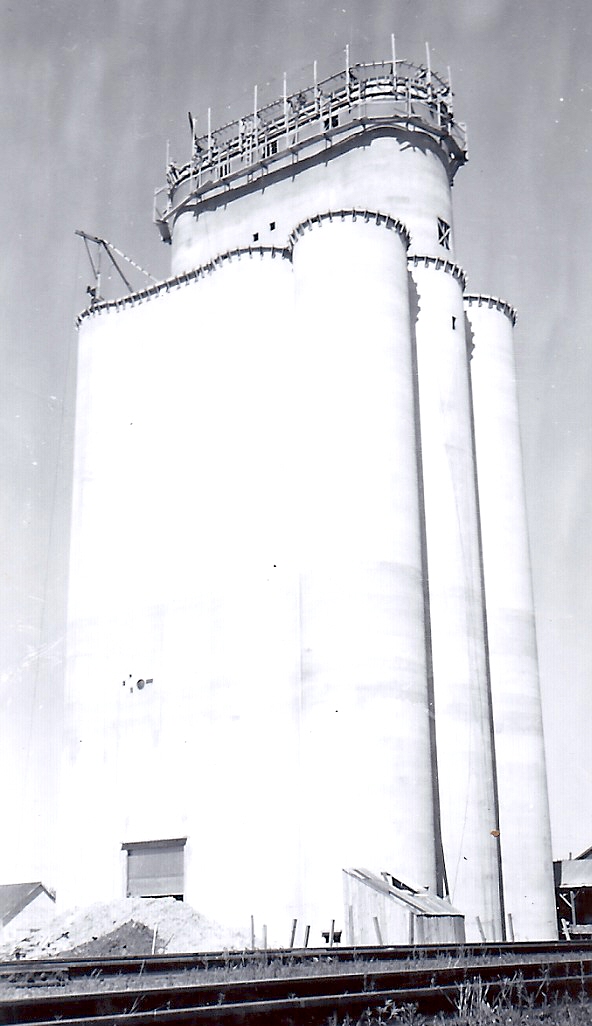
See the little cornice atop the tank? Those are forms for the cornice, the overhang. They call them eaves on a house.
The roof was poured before the headhouse went up.
That crane is a concrete-hoisting crane.
The headhouse is quite an operation because you had to hoist the concrete up to the top of the tank. And then they had a deck crane, and you had to hoist it [the concrete] to the top.
Every job I worked on, they used a nail keg that had been filled with concrete as a counterbalance weight. When you went up and down on the cable to go to work, that’s what you stood on—two guys, one foot each. That’s all there was room for.
It didn’t take that long, about fifteen or twenty seconds.
The motor and cable were down on the ground.
The operator had a shed to keep him out of the rain and sun.

It’s all done. It looks like they’re putting scaffolding up for painting. The main hoist is on the left. That’s a Georgia buggy hanging on the hoist. The guy that’s standing there is going to push it as soon as it hits the deck. They might be just starting on the headhouse. I can’t figure that scaffolding out. It’s a rigid scaffolding.

On the upper left-hand corner, there’s a crane. That crane we used to haul the steel up to the top, the rebar, the jackrods. That’s all we used it for. You didn’t tie up the other hoist, you used that one. I think it’s called a jack crane. It was an electrically operated crane. The railroad tracks are on the bottom, that’s the end of a box car in the lower right. That doorway—that’s used when you’re loading grain after the thing was all over with.
When I first started, I pushed the Georgia buggy. It’s probably the worst job in the world because it’s very physical. They weighed 1000 pounds. At Alta, I progressed to laying steel. All the new hires always got to push the concrete because that was the hardest work. There was a big turnover when you started out because pushing Georgia buggies wasn’t very much fun.
 Story and photos by Kristen Cart
The Boxholm elevator located in central Iowa was an intriguing destination, particularly since I had knowingly passed it by, missing it by a few miles on more than one trip. It became imperative to make the detour to see it. I was glad I did, since the elevator made beautiful pictures on that early summer day. I used a wide-angle lens that added pronounced distortion to the scene, causing the buildings on the edges to lean in dramatically. But the leaning lines pointed to the beautifully clouded sky.
You can use a wide-angle lens to include more of the scene from close quarters than would be possible with another lens, but you forfeit realism. This is not a problem for certain artistic photos, but it is not ideal for documentary shots. When photographing buildings where you want to preserve parallel lines, you must stand farther away and use a longer focal-length lens. At Boxholm, I did not have that option.
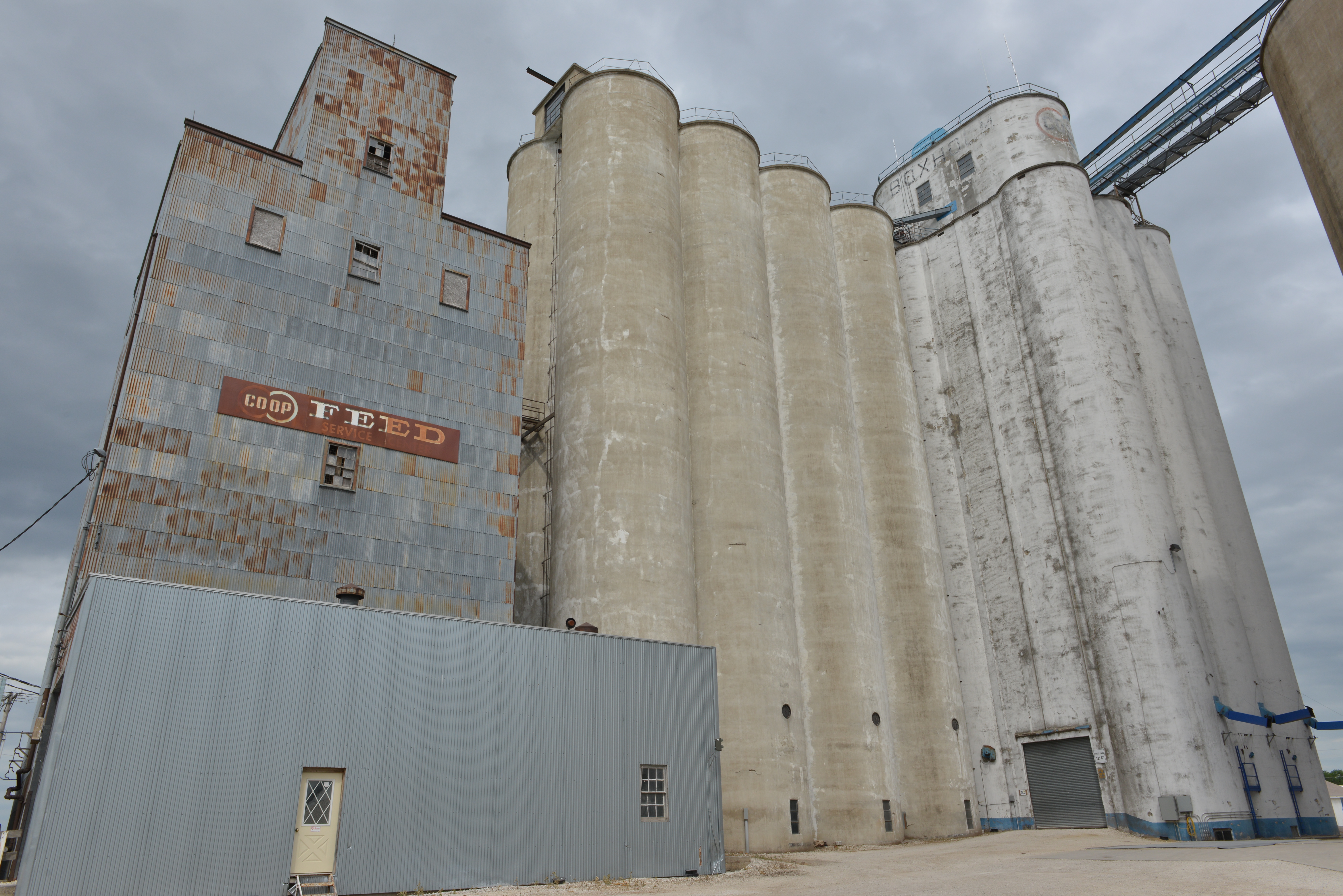
Wide-angle lens distortion is maximized in this view.
At extremely close quarters, the wide-angle lens exaggerates height and adds drama. But the distortion becomes more pronounced.
The Tillotson Construction Company of Omaha, Neb., built the elevator in 1955. An annex stands beside it, and an old wooden feed mill is beside that. A much newer elevator with the West Central logo was built later, after it became customary to leave the concrete plain, without the white finish.

A more conventional view of the elevator complex.
The specifications for the Boxholm elevator are among the Tillotson Company construction records. We learned some details about the elevator from a few stray sources before my visit; for instance, the elevator has exactly 96 light bulbs installed. Its construction followed the Drummond plan. Other projects using the same architectural plan were the elevators at Waverly, Neb., and Lahoma and Drummond, Okla.
Specifications
Capacity per plans (with Dock): 199,400 bushels
Capacity per foot of height: 2,002 bushels
Reinforced concrete per plans (total): 1,797 cubic yards
Plain concrete (3″ hoppers): 33 cubic yards
Reinforcing steel per plans (includes jack rods): 85.71 tons
Average steel per cubic yard reinforced concrete: 95.4 pounds
Steel and reinforced concrete itemized per plans:
Below main slab: 6,861 pounds steel, 59.2 cubic yards concrete
Main slab: 25,603 pounds steel, 202 cubic yards concrete
Drawform walls: 103,192 pounds steel, 1,295 cubic yards concrete
Driveway and Work floor : 3,820 pounds steel, 23.8 cubic yards concrete
Deep bin bottoms (including columns): 7,271 pounds steel, 39.3 cubic yards concrete
Overhead Bin bottoms: 6,040 pounds steel, 27.6 cubic yards concrete
Bin roof and Extension Roofs: 7,210 pounds steel, 41.7 cubic yards concrete
Scale floor (or garner complete): 160 pounds steel, 2.5 cubic yards concrete
Cupola walls (including leg & head): 7,257 pounds steel, 76 cubic yards concrete
Distributor floor: 1,560 pound steel, 9.4 cubic yards concrete
Cupola roof: 2,147 pounds steel, 15.6 cubic yards concrete
Misc. (track sink, steps, etc.): 173 pounds steel, 3.5 cubic yards concrete
Attached driveway: none
Bridge and/or Tunnel: none
Pit Liner–plain: 16 cubic yards concrete
Drier Bin Bottom: 134 pounds steel, 1.3 cubic yards concrete
Coffer Dam, Cleaner Floor: Wood
Remarks: 10 Bin Hot spot; 8 Bin Aeration tubes; Dryer bin
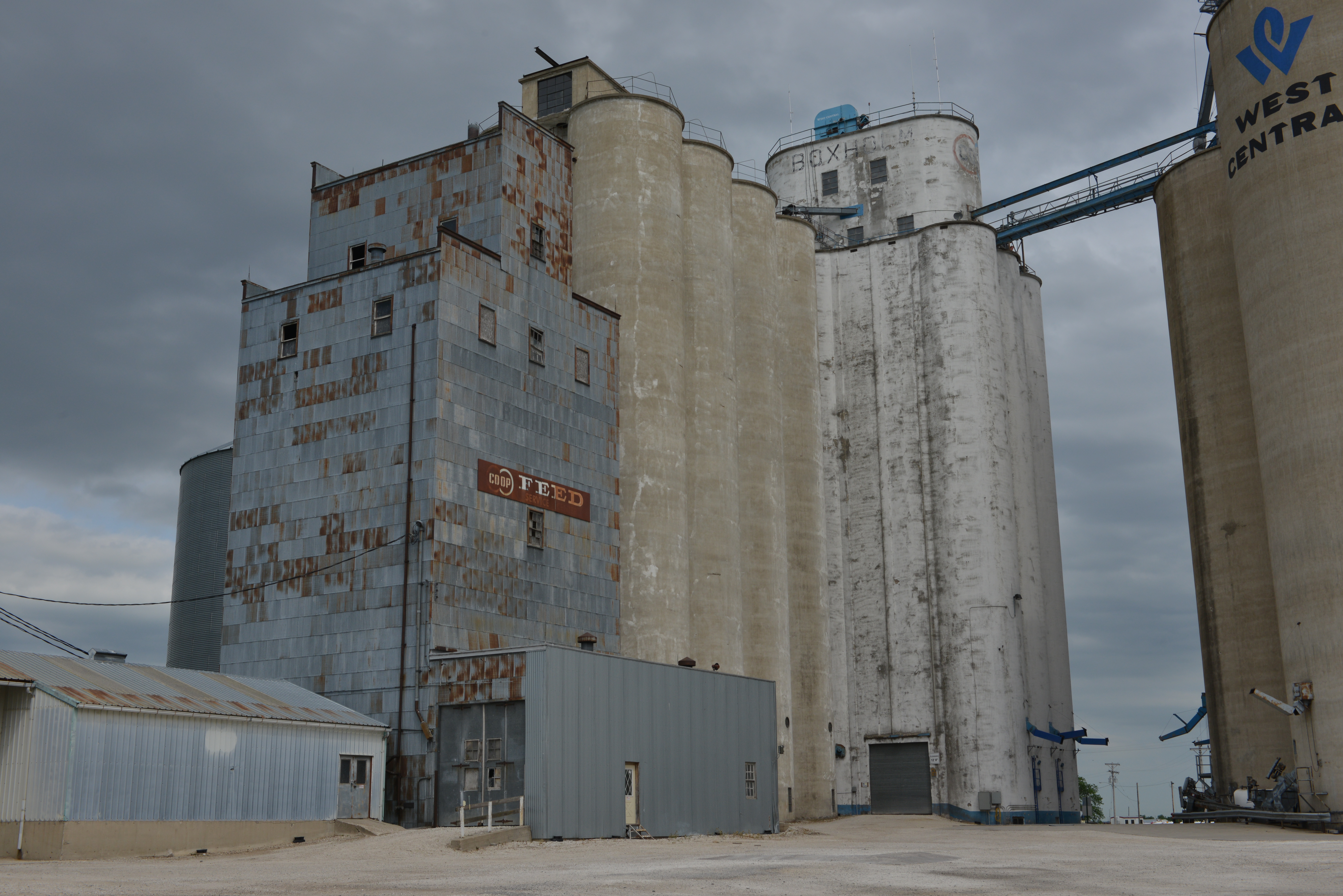
The rounded headhouse is a reliable indicator of a Tillotson elevator
Construction details
Like Waverly: construction details were identical to Waverly and not listed separately in the records.
Main slab dimensions (drive length first dimension): 56 1/2′ x 70′
Main slab area (actual outside on ground): 3,850 square feet
Weight reinforced (total) concrete (4000 pounds per cubic yard plus steel): 3,747 tons
Weight plain concrete (hoppers; 4000 pounds per cubic yard): 98 tons
Weight hopper fill sand (3000 pounds per cubic yard): 732 tons
Weight of grain (at 60 pounds per bushel): 5,982 tons
Weight of structural steel and machinery: 20 tons
Gross weight loaded: 10,579 tons
Bearing pressure: 2.75 tons per square foot
Main slab thickness: 24″ with 3″ pile cap
Main slab steel: straight #9 at 7″ spacing
Tank steel and bottom (round tanks): #4 at 12″ spacing
Lineal feet of drawform walls & extension: 606′
Height of drawform walls: 120′
Pit depth below main slab: 15’3″
Cupola dimensions (outside width x length x height): 22 1/4′ x 48 1/2′ x 35′
Pulley centers: 160.75′
Number of legs: 1
Distributor floor: yes
Track sink: yes
Full basement: yes
Electrical room: yes
Driveway width clear: 13′
Dump grate size: 2 at 9′ x 5′ and 9′ x 15′
Column under tanks size: 16″ square
Boot legs and head: concrete
 Machinery details
Boot pulley: 72″ x 14″ x 4 15/16″
Head pulley: 72″ x 14″ x 2 7/16″
R.P.M. Head pulley: 42
Belt: 335′, 14″ 6 ply Calumet
Cups: 12″ x 6″ at 8″ spacing
Head drive: Howell 40 horsepower [4 circled here]
Theoretical leg capacity (cup manufacturers rating): 8,440 bushels per hour
Actual leg capacity (80% of theoretical rating): 6,750 bushels per hour
Horsepower required for leg (based on actual capacity): 32 horsepower
Man lift: 1 1/2 horsepower Ehr.
Load out scale: 25 Bushel
Load out spout: 10″ diameter
Truck lift: 7 1/2 horsepower Ehr.
Dust collector system: Fan to bin
Cupola spouting: 10″ diameter
Driveway doors: 2 overhead rolling
Conveyor: provision
Remarks
see page 10 (above)

It was commercial power for the lamps. The only thing that was noisy was the mixer and the hoist. Once you got about 40 feet off the ground, all that anybody heard was people talking to each other. That’s the top of the driveway (seen in the photo), about 16 feet, so they’re about 25 or 30 feet off the ground. On a construction site, there’s lumber all over everywhere. Today they keep track of it very carefully because people steal it. But when we were building these, nobody stole lumber. People in Iowa and the Midwest, they didn’t steal lumber from a construction site like they do out here (California.) See the scaffolding below the forms? A cement finisher finished the concrete as it came out of the forms. That’s all he did, all night long.

Those cars…I didn’t have a car at Alta. Those shacks were probably, lower right, the office, and the other was where we kept the tools. We built a lot of those things and then we tore them down. Slip-form construction was a major engineering feat. They built concrete grain elevators before slip-forms. They had steel forms they’d fill with concrete.
 Our Grandfathers' Grain Elevators