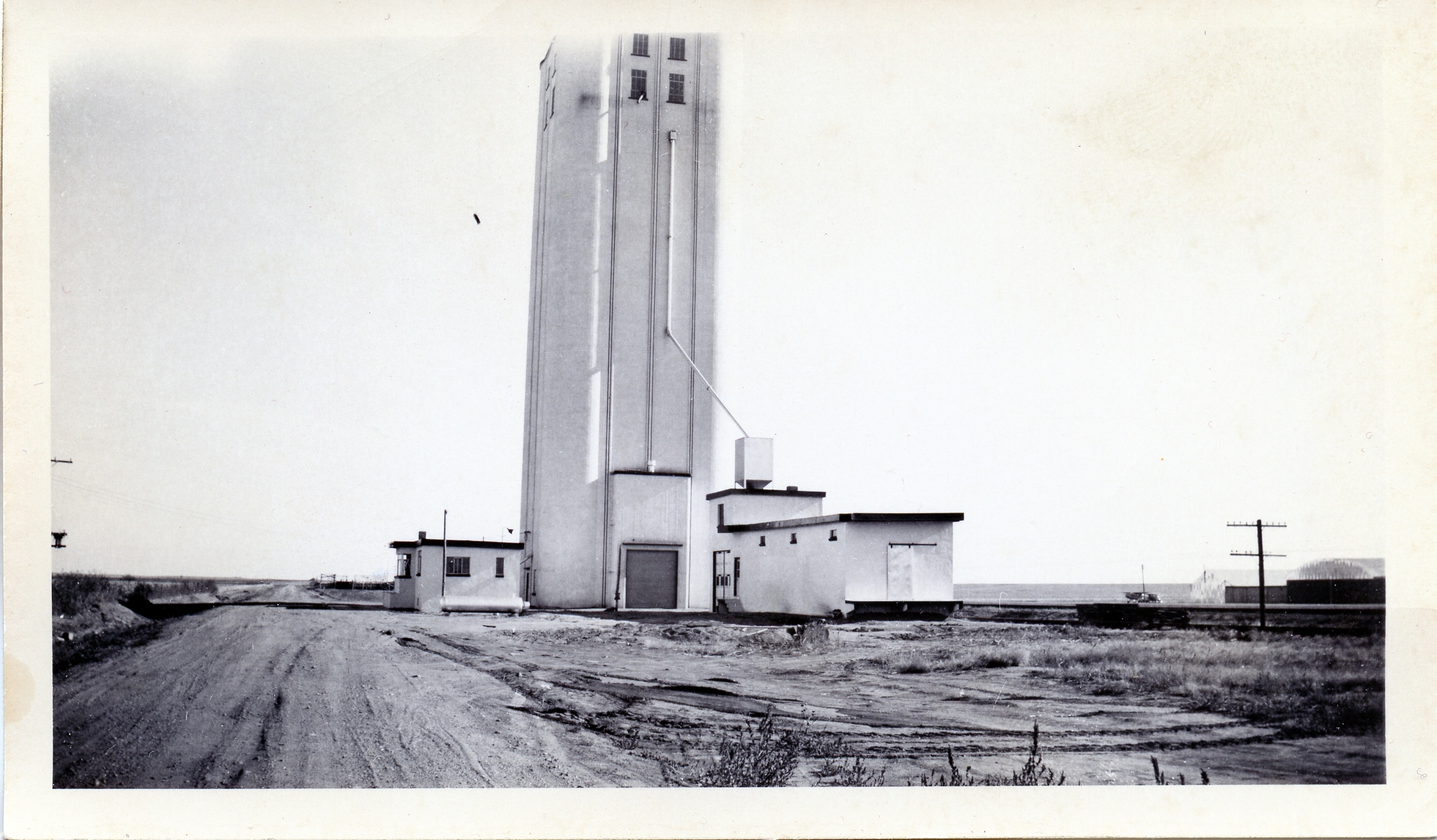
Mayer-Osborn’s new elevator will tower over the Burlington tracks at Roggen

Photos by Gary Rich

Excavation will start Monday morning on a strictly modern 250,000 bushel grain storage plant at Roggen to be constructed for the Farmers Grain & Bean association, a farmers cooperative. The association stores and markets at Roggen the grain grown by hundreds of southeastern Weld county wheat growers.

The new building will tower 160 feet in the air and architects’ drawings show that its beauty will equal its great utility. Mayer Osborn company of Denver has the general contract for the elevator.
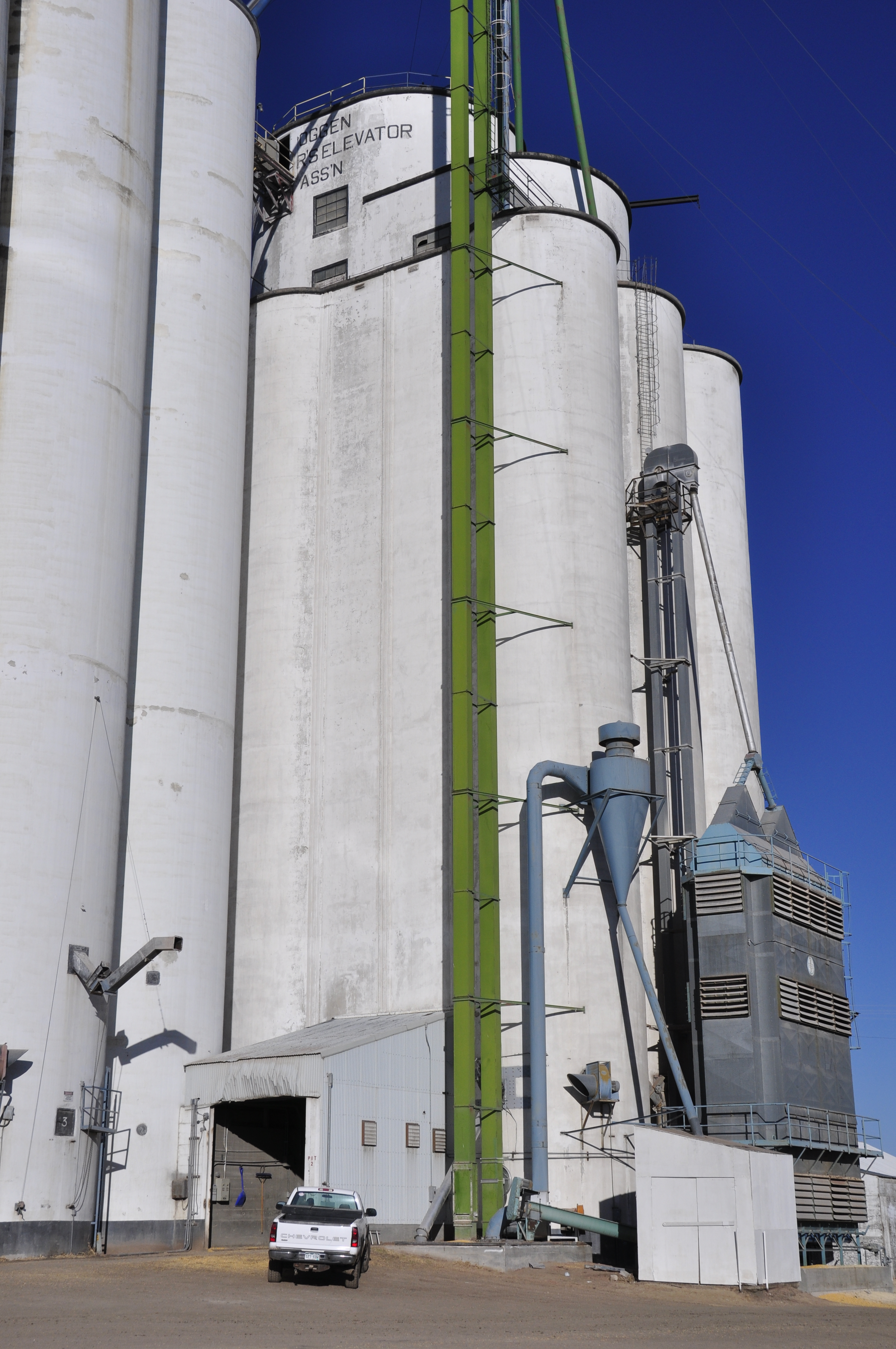
Site is 50 feet east of the present 80,000 bushel elevator of the association. Both elevators are served by the main line of the Burlington railroad.

Construction will be of concrete and steel of multiple slip design. Capacity can be enlarged indefinitely from year to year as need arises.

Marvin Jones, manager of the Farmers Grain & Bean association, said Friday night that the company is also building a similar but smaller structure at Byers on the Denver Kansas City line of the Union Pacific east of Denver. Byers elevator will hold 150,000 bushels.

Jones said that the new elevator will be ready for use by the time the 1950 harvest starts. He said the wheat crop in the Roggen, Kiowa and Prospect districts is looking fine. He said there had been very little damage from wind and that this was confined to the sandier soils of the district.

Present elevator of the association at Roggen will be kept in use giving the association 880,000 bushel storage at Roggen. Allowing 1500 bushels to a carload this is the equivalent of 220 carloads capacity.

The Greeley (Colo.) Daily Tribune, April 6, 1950

Memories of William Osborn’s automotive fleet from A to Olds

By Kristen Osborn Cart

Long before my grandpa William A. Osborn started working in the elevator business, his father Arthur K. Osborn lost his Nebraska farm when the loan he co-signed for a son-in-law went bad. This occurred around the start of the Great Depression. Being the eldest son, Grandpa had to find another way besides farming to make a living. He was in the National Guard for a time when he was very young, and afterward he worked as an auto mechanic and in construction.

His first car was a Model A Ford. Around 1939, he bought a used 1936 Chevy. By 1945, after he had worked for Tillotson Construction Company, of Omaha, and had moved from a farm where they rented into town, he bought a 1941 Chevy. That was the last used car he owned.

Alice and Bill Osborn, in back, with their brood, from left: Dick, Audrey, Jerry--and the '36 Chevy.

In 1948 Grandpa bought a 1948 Chevrolet sedan. Two years later, he bought a 1950 Buick Special, brand new, and also purchased two new 1950 Chevy sedans. My Dad’s brother Dick likely paid for one of them, which he drove. Grandpa and Grandma went to Oklahoma to pick up the other one for Grandma and drive it back.

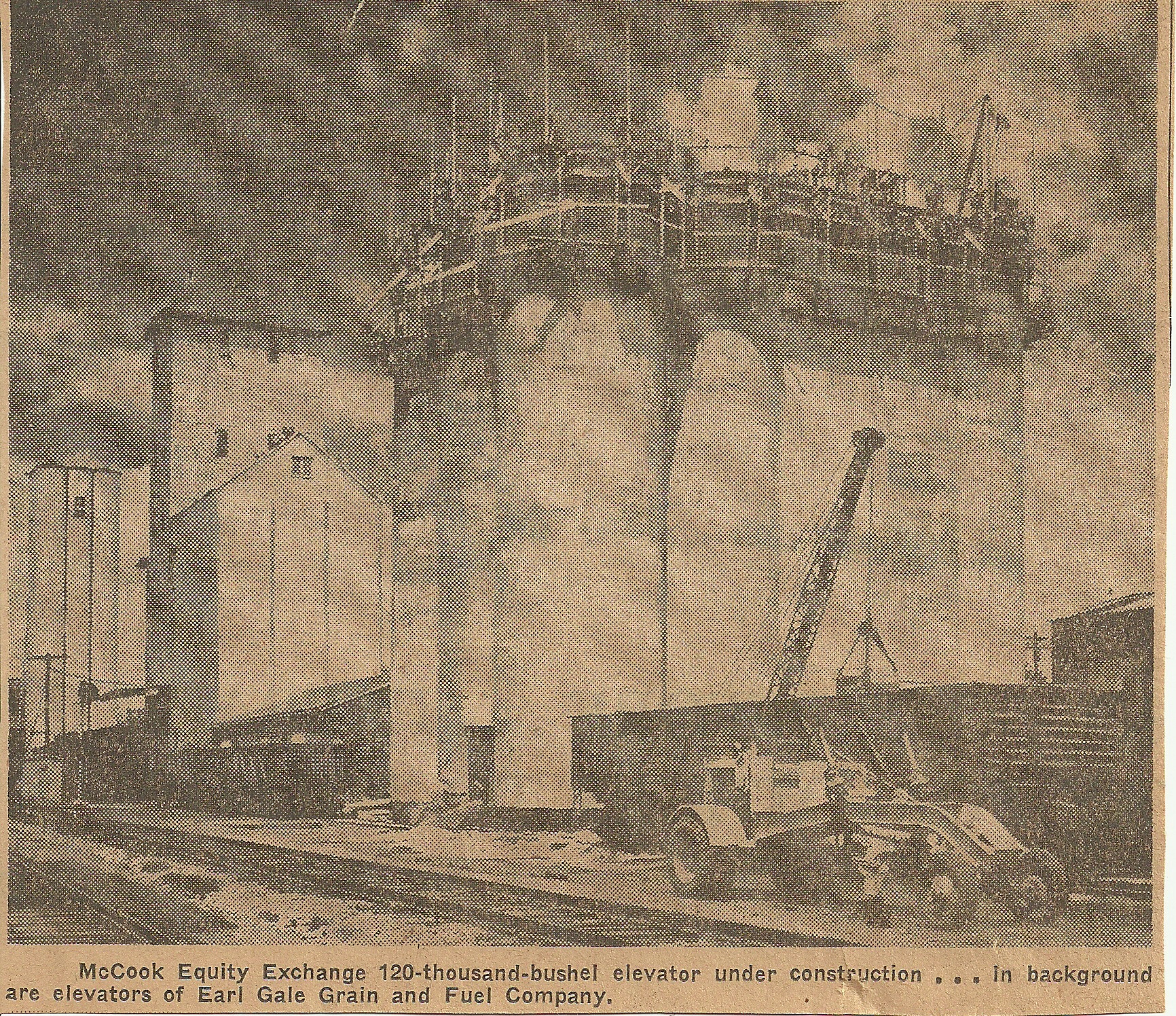
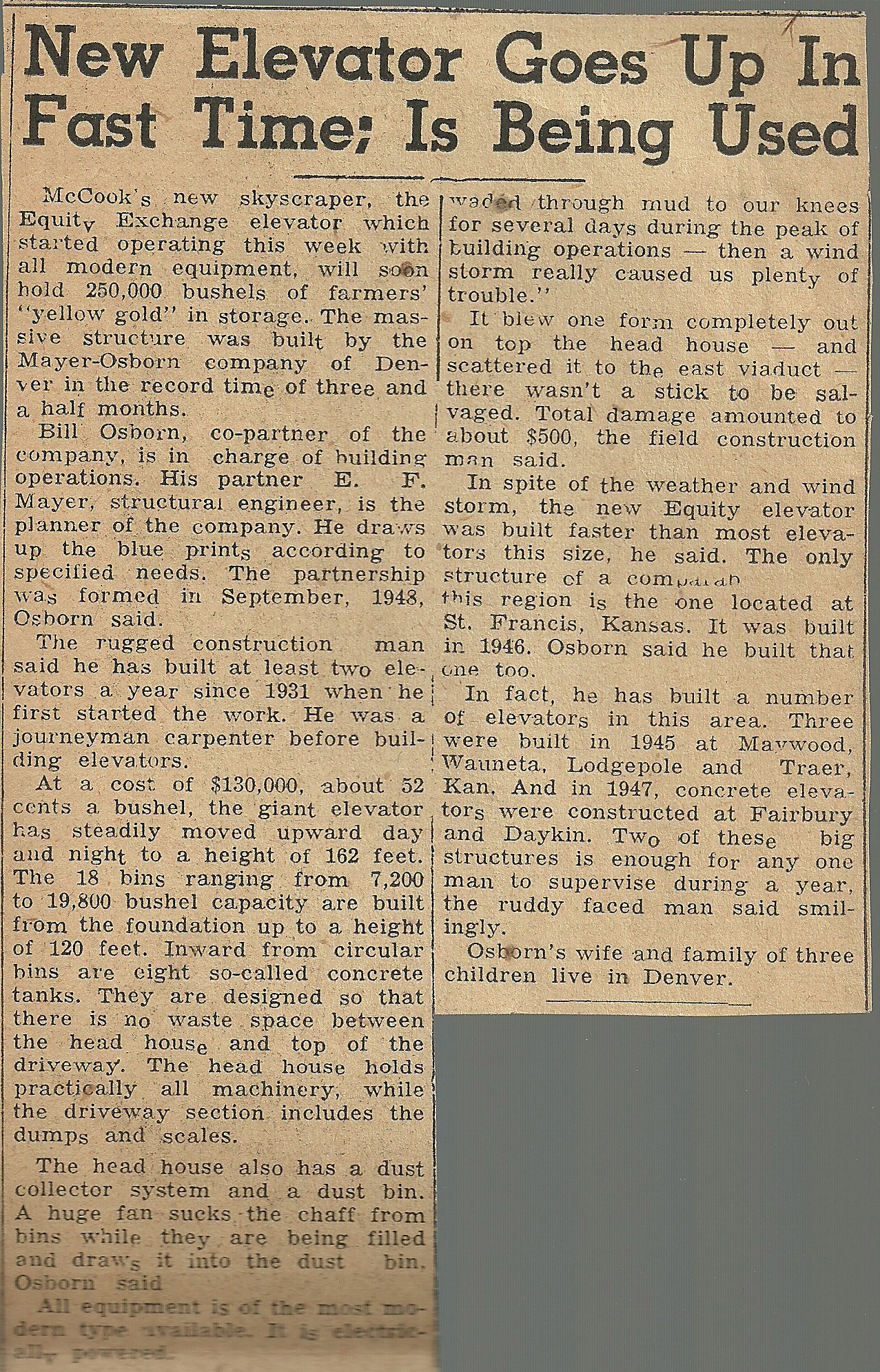
These purchases came after Mayer-Osborn Company was established and their first project, the elevator in McCook, Nebraska, was finished.

In 1951 Grandpa bought a new 1951 Buick Roadmaster. Two years later he bought a 1953 Packard, but soon the engine block cracked, so the next year he bought a new 1954 Cadillac and another new Chevrolet for my grandmother. After Grandpa moved to Denver, Dad lived alone with Grandma for a number of years, and he had the use of her car when he worked his first teaching job at Luther College in Wahoo, Nebraska, in the fall of 1955. After 1956, Dad purchased her ’54 Chevy for $1000 and had it when he moved with Mom to Denver. He paid it off by 1961.

Kristen's dad, Jerry, with the 1950 Buick Special.

Grandpa retired from Mayer-Osborn in 1955. He drove his Cadillac until the early ’60s when he bought a new Oldsmobile that he drove for a number of years, finally trading for his last car, a 1968 Olds, which is presently in Dad’s barn. I remember that car and sitting on its burning hot seat in the middle of summer, the inside smelling like softened plastic. I remember when it was new, with seats as wide as a park bench and a big round steering wheel.

Dick Osborn with 1950 Chevy Deluxe

Grandpa did pretty well in his business. There was still a good nest egg after he died in 1977. He had to have a good reliable vehicle because he certainly put on the miles.

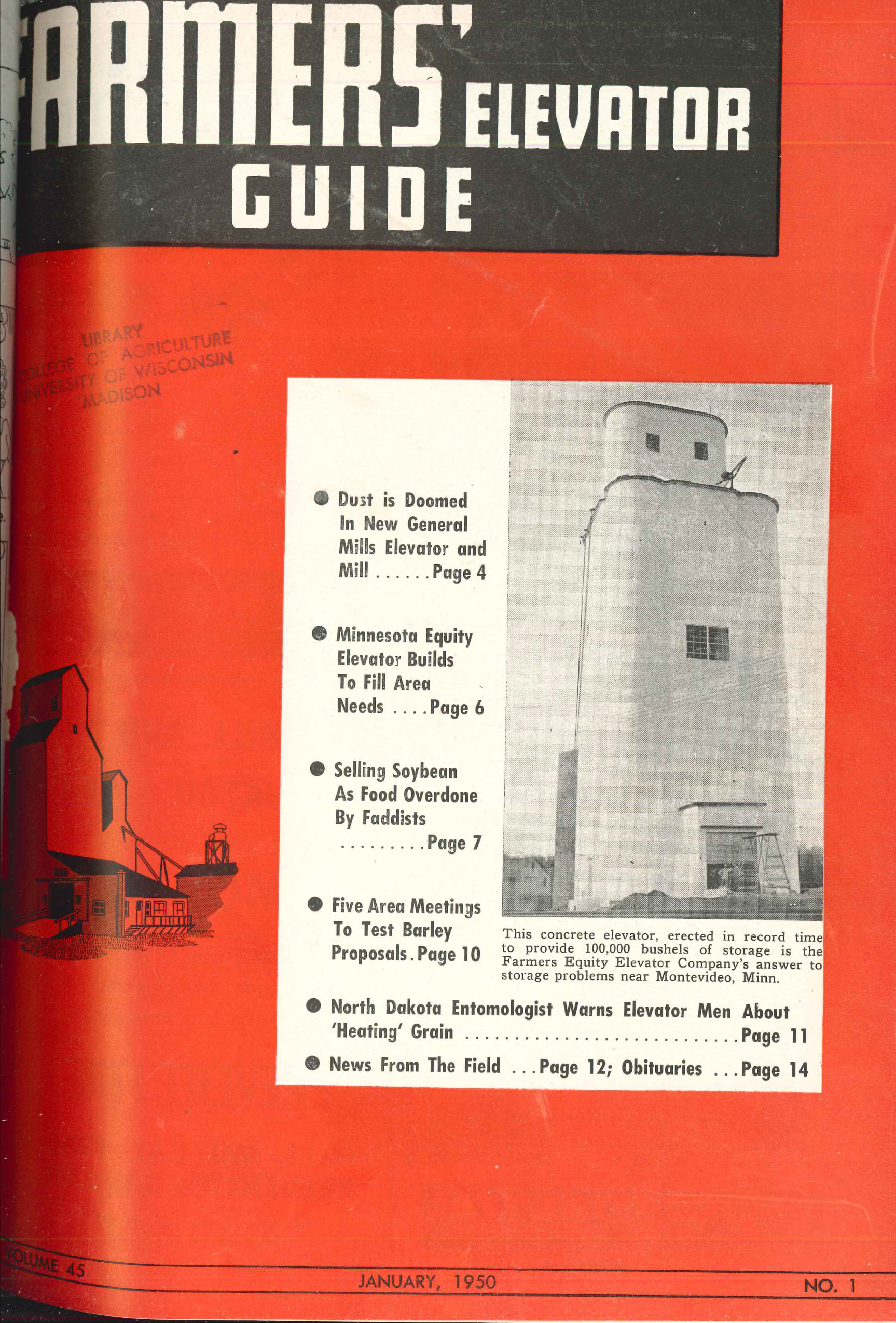
Farmers’ Elevator Guide reports Tillotson Construction’s record Montevideo project

The following story and photos are reproduced from library copies of the January 1950 edition of Farmers’ Elevator Guide:

Complete Service: Minnesota Equity Elevator Builds to Fill Area Needs

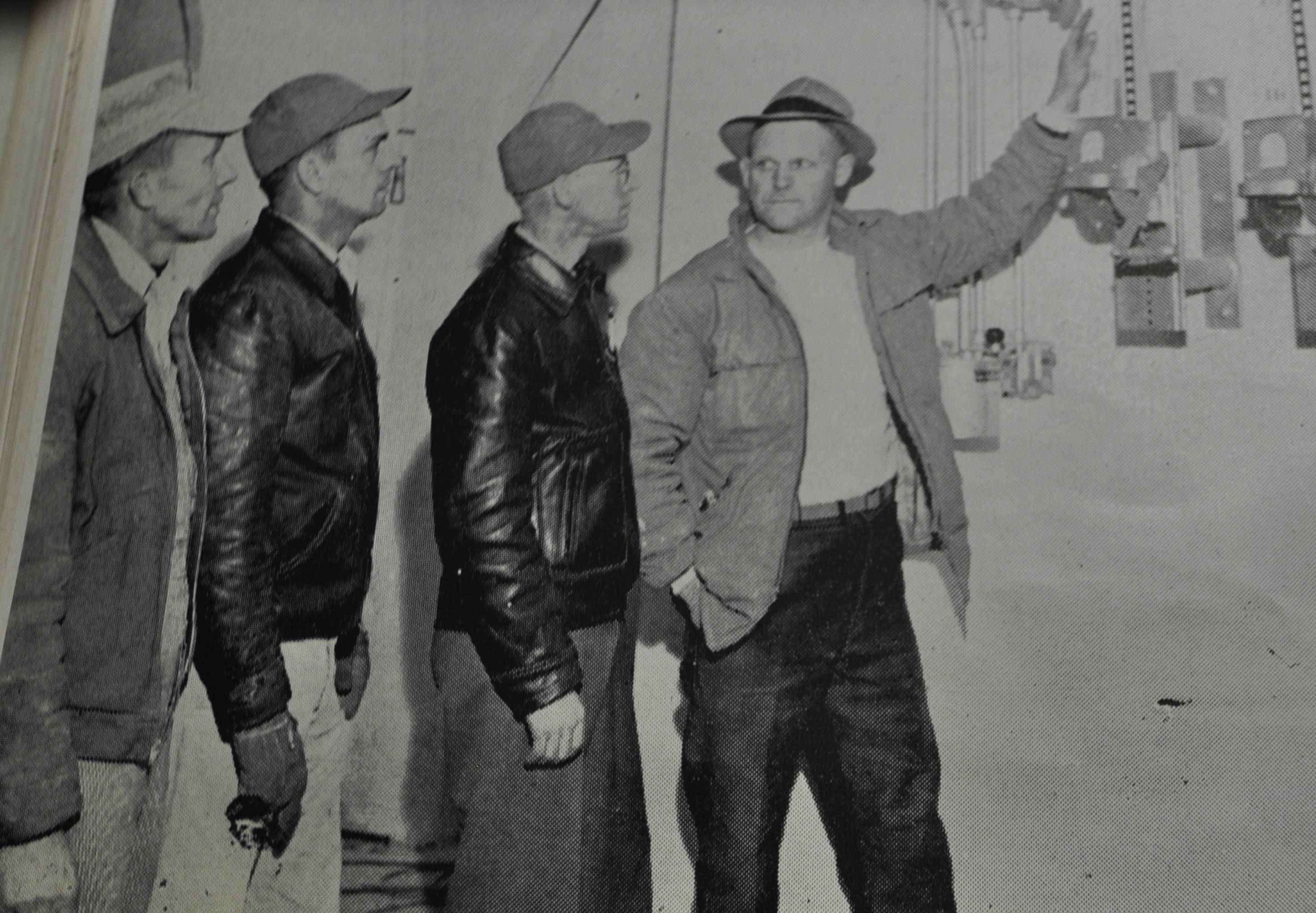
Tillotson Construction's Bill Russell, far right, instructs (from left) Stanley Kittleson, Adrian Dahl, and Merlynn Nelson on operation of the elevator's distributor controls.

Moving quickly to establish itself as the principal district elevator for grain handling, the Farmers Equity Elevator Co. of Montivideo, Minn., has a new 100,000-bushel capacity concrete elevator in full operation after a whirlwind effort to get it built to meet needs of the fall harvest.

When it became apparent that existing facilities in the area left room for a vast expansion to handle grain crops, the Farmers Equity Elevator Company decided to expand its plant which had only 25,000 bushels of capacity.

The project, begun late in August, was rushed to completion by Tillotson Construction Co. of Omaha, Neb, in record time. Concrete pouring by round-the-clock crews was completed in nine days and four hours. This bettered by 18 hours any previous accomplishment for an elevator of this size.

The structure is 102 feet high and has a cupola 29 feet high. It has 17 bins.

Installed during erection was a $15,000 corn drying plant and, on the midway level, a $10,000 grain cleaning installation. This included a large Crippin sieve machine, a large Superior cleaner, a Slurry grain treater and other equipment.

The new building houses a weighing and sampling room but the offices of the company are in the old quarters.

Sliding tubular forms were used to permit the rapid construction.

The plant cost $120,000 including $10,000 for piling costs, but other equipment raised the total to $134,000. Features include a 50-ton, 50-foot long scale with lighted dial and printomatic type registering beam. It has two concrete elevating legs each with 30 h.p. head drive and elevating capacity of 5,000 bushels per hour dumping into a Gerber distributing system. Its dump pit has two sections each built under the driveway and extending 12 feet below ground. All bins are hoppered to discharge into pit.

Two large cleaners installed are a Superior cylinder subterminal size machine for coarse grains and a Crippin screen cleaner for flax. All grains will be commercially cleaned before loading out to add profit to operations. The mills can be adjusted for farm seed cleaning in spring months. Gravity is used to feed mills from above and to distribute grain into bins below before loading to cars.

A 400-bushels-per-hour new type Campbell corn dryer was installed at a cost of $15,000. Some 50,000 bushels of the government loan 1949 corn crop were taken in and dried.

The new elevator was dedicated Dec. 29 with President J.W. Evans, also president of the American Soybean Association, presiding.

A Galveston seaside respite for the Osborns and Salroths in 1945

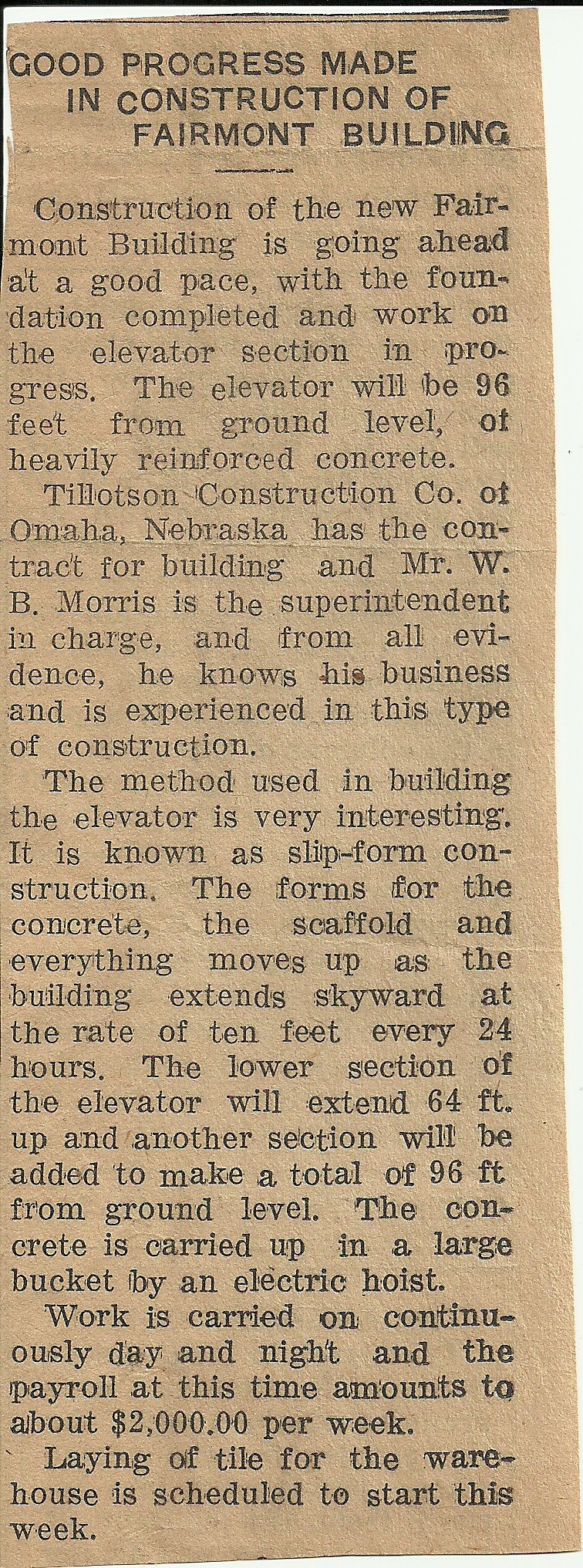
Kristen muses: Now Mr. and Mrs. Salroth were on this trip, and Mr. Salroth must have worked with my grandfather on the Tillotson Construction Company’s elevator job, the Fairmont Building, in Giddings, Texas.

The first image shows, from left to right, my grandmother Alice Christofferson Osborn, my dad Gerald Osborn, and Emma Salroth.

The second image shows, also from left to right, an unknown man, my dad Gerald Osborn, my grandfather William Osborn, and Iver Salroth.

Finally, there’s the portrait of Gerald by himself.

♦ ♦ ♦

In an email to Kristen, Gerald Osborn recalls:

Emma Salroth was your grandma’s first cousin. Emma and Iver had been pretty close to my parents. They occasionally spent an evening playing pinochle together.

Iver was a carpenter and was in Texas with dad working on the project. Along with your grandma, Emma and I took the train to Giddings for a visit.

When we arrived they had locked Iver in the elevator’s headhouse as a prank so he wouldn’t be there to meet us.

Iver was a scrawny little guy with a heavy Swedish accent and a good sense of humor. He was fourteen years older than my dad. I don’t know of any other job they worked on together.

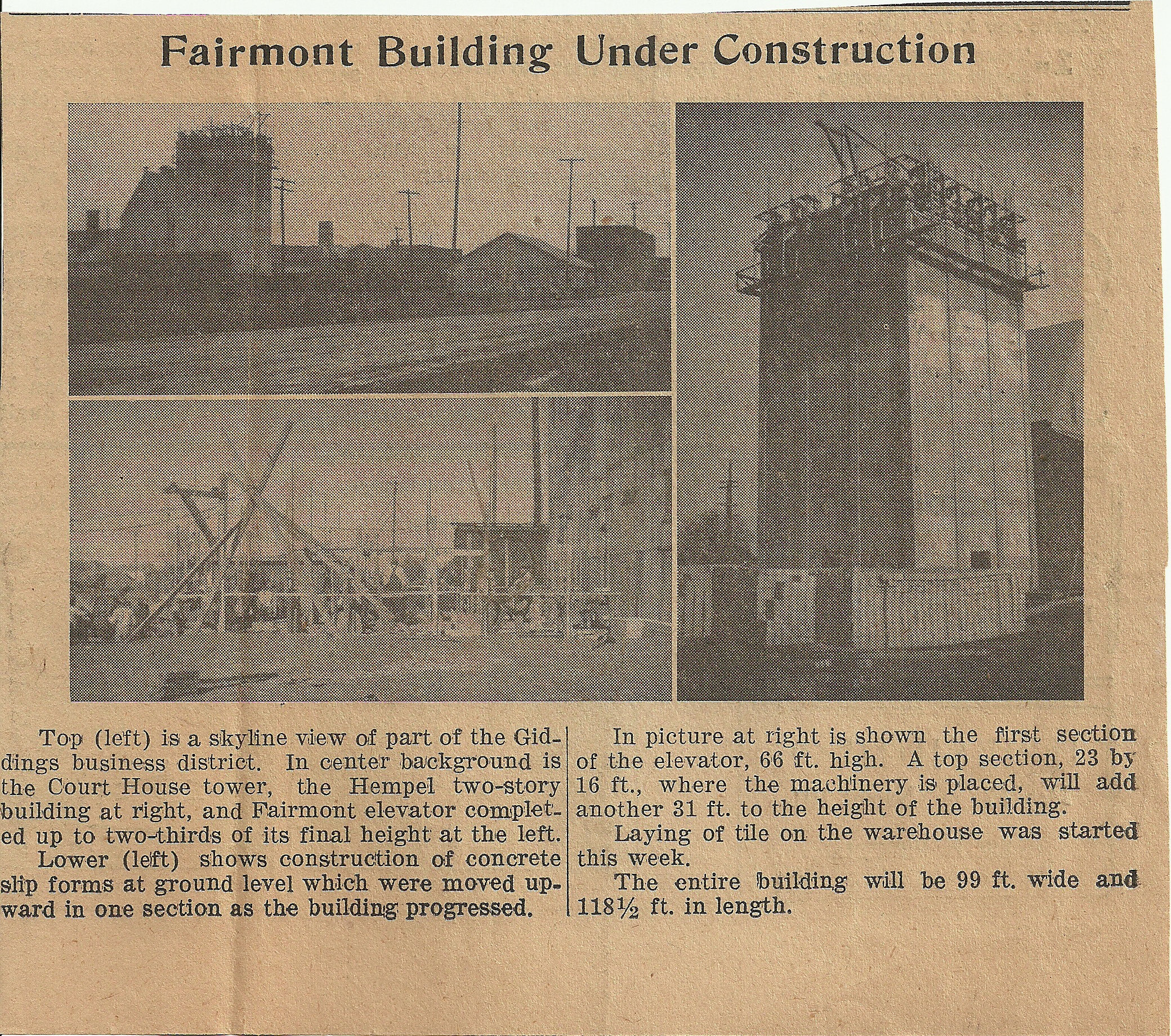
In 1945, William Osborn worked on Tillotson Construction’s elevator in Giddings, Texas

Map of Texas highlighting Lee CountyThis elevator at Giddings, Texas, called the Fairmont Building, is the only one I have pictures for that my grandfather built when he worked for Tillotson Construction Company of Omaha. It would have been built in 1944 and 1945, when my dad turned eleven years old. Dad went to visit my grandpa William Osborn at Galveston in the spring of 1945 during this project. — Kristen

Note: Nutrena bought Fairmont Foods’ plant in Giddings in 1955.

J.H. Tillotson’s Fairbury elevator, slowed by rain during construction, will miss 1947 harvest


These clippings were among William Osborn’s papers. They come from the Fairbury (Nebr.) Daily News, a long-defunct paper, and appear to have run in the summer of 1947. The article “Rain Hampers Work At New Elevator Site” gives a good summary of the construction methods used on the Farmers Union elevator. The name J.T. Tillotson Contractors, as it appears in the article, should be J.H. Tillotson, according to other records.


Page City structure exemplifies functional and aesthetic aspects of elevator design

Page City elevator as seen January 26, 2012

Story and photos by Gary Rich

The elevators without a headhouse were called straight-up elevators. J. H. Tillotson, Contractor and Mayer-Osborn Company produced these in the latter 1940s and early 1950s. Their elevators had a smaller diameter pipe that came out about three-quarters up the rail side. Loading a boxcar was time-consuming.

About 1958, there were improvements added for quicker loading of boxcars. These images show the Page City, Kan., elevator. Notice the rail loading chutes are much larger and there are two chutes, so the grain could be loaded equally. These chutes were on all concrete elevators raised during the late 1950s and 1960s. Most boxcars could be loaded within fifteen minutes, whereas on the old wooden elevators it could take up forty-five minutes.

The Page City elevator was built by Johnson-Sampson Construction Company, of Salina, Kan.  It was built about 1958 or 1959. Did Gene Mayer draw up the blueprints for this elevator? We don’t know where he went after the Mayer-Osborn era, which ended after 1955.

Another improvement is the area around the driveway. You can see the three reinforcing columns above the driveway and door. I would think this would add greater strength. The Kanorado, Kan., elevator has a smaller version built out. It is established that Gene Mayer produced the plans for that elevator.

William Osborn’s photo of the Kanorado, Kansas, elevator

By Kristen Osborn Cart

This is an image that was in my grandfather’s papers when he died. It was his photo, since he was the only photographer in the family. This was the only elevator image he identified on the back. The caption was “Kanorado, KA, 125,000 bu.” I know Grandpa worked on it because he photographed it. We know it was built before March of 1947, which was the month Joe Tillotson died.

Grandpa was working for Tillotson Construction of Omaha as late as the fall of 1944 through the spring of 1945, when Giddings, Texas, was built. Dad visited Grandpa on the Giddings job, so he was able to date it–they visited in early 1945, the spring, when Dad turned eleven years old. That means the Kanorado elevator was built circa 1945 to 1947.

It may be hard to find information on Joe Tillotson’s business because he was independent for such a short time–even though there were quite a few elevators to his name.

¶ Ronald’s note: While posting this, I gave Kan-o-RAY-do a call and was told that original records pertaining to the elevator’s construction burned in an office fire.