Faked out in American Falls, Idaho

Chalmers and Borton elevator at American Falls, Idaho.

During one of my recent road trips, I came upon a beautiful concrete construction elevator in American Falls, Idaho.  It looked much like the stand-alone elevators built by Tillotson Construction of Omaha, with an added annex.  It is in full operation.  I explored the elevator complex from about 7:30 am, and stayed on site as workers reported for their 8:00 am shift.  It was a very handsome elevator in the early morning light.  In its details it looked like a Tillotson elevator, except for the rectilinear head house, which is not unknown for a Tillotson or Mayer Osborn built elevator, but would be unusual.

As the shift started, I stopped at the elevator office to ask about the builder.  The worker smiled and pointed out the brass plaque by the door.  It was built by our grandfathers’ arch rival company, the ubiquitous Chalmers and Borton based in Hutchinson, Kansas.  Gary Rich pointed out one time that it seemed that wherever he found a J.H. Tillotson or Mayer Osborn elevator out in Kansas or Colorado, hard beside it would stand a Chalmers and Borton annex.  The companies played hard ball and competed for every contract.  Dad said, when I asked if Grandpa’s Mayer Osborn Construction of Denver, Colorado ever worked with Chalmers and Borton,  that “oh, no, they were his biggest competitor.”

Greenwood Nebraska’s straight-up elevator by Tillotson Construction of Omaha.

The elevator at Greenwood, Nebraska, built by Tillotson Construction of Omaha, is very reminiscent in its style to the elevator in American Falls.  I guess form followed function, and each company offered a product similar in its details–often the deciding factor was the bid price.  This Chalmers and Borton elevator certainly faked me out.  But it stands as a beautiful example and deserves notice.
Musings about an Absent Father

By Kristen Osborn Cart

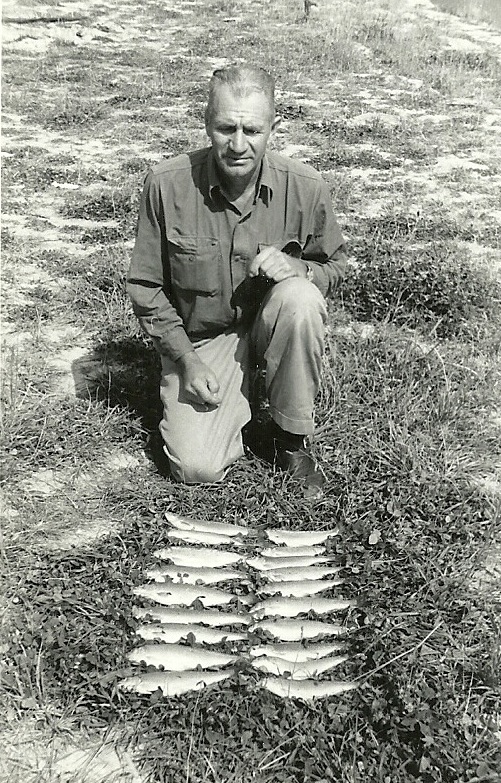
My dad has been writing a memoir about his life growing up in Nebraska, as the son of Bill Osborn, builder of the Mayer Osborn elevators.  It struck me that after about 1939, Dad scarcely mentions him, other than to note his absence.  Grandpa was gone all of the time. Over the years the Osborn cousins have assembled photos from those times, and it is very striking that the photos of the Osborn home became scarce from about then. The few pictures we have from later on were from visits, and from the various projects he worked on. Bill Osborn was the photographer in the family.

William Osborn, 1952.

By the time I knew him, he had long since retired from that occupation, and he was home, taking care of his tropical fish business. He would find time to take his little granddaughters fishing (my cousin Diane and me), after night crawler hunting by flashlight, of course.  He was an affectionate grandfather, and he loved my mom.  He read the morning paper over breakfast, and ate his eggs sunny-side-up, mopping up the last of them with his toast. And he didn’t talk much. The elevator phase of his life, in my mind, consisted of a framed photo of an elevator (McCook Equity Exchange), and Dad’s assurance that it was grandpa’s first elevator he built on his own.

My cousin, Diane, brought out a cache of photographs of grain elevators one day, not too long ago.  Most were not marked, though the one from Kanorado, Kansas, had it’s location and capacity written on the back.  We have identified almost all of them, but a few are still mysterious, so now that it has been thirty-five years since Grandpa died, we have something to ask him.

This summer we are planning to go find some of the grain elevators he built some sixty to seventy years ago, many of which are still in use.  The buildings can’t tell us about his jovial smile, his mischief, or his aggravation at workers who left after their first paycheck.  But I can imagine him there, just as I suppose my father had to.  At least Dad could visit sometimes.

William Arthur Osborn, 1965

Seed money: Roggen safecrackers use welding torch, net $34 for the trouble

Roggen Elevator Safe Robbery Investigated

Sheriff’s officers Thursday investigated a safe robbery at the Farmers Grain and Bean Association elevator at Roggen. The safecrackers got $34 in cash.

Photo by Gary Rich

A similar safe job, but unsuccessful, was done in Denver Thursday night, Sheriff William C. Tegtman was informed.

Deputies Harry Mills and Robert Patterson reported that the Roggen building had been entered by breaking a south window. The office window was then broken, and welding equipment moved to the safe to cut it open.

Greeley (Colo.) Tribune, Feb. 18, 1955

Tracking down the builders of some Kansas and Colorado elevators

Photos by Gary Rich

We’re trying to track down the builders of elevators that stand in various places throughout Kansas and Colorado.

They could be Mayer-Osborn Company elevators.

Here are photos of elevators in Pritchett, Colo., above; Limon, Colo., center; and Coldwater, Kan., below.

Brandon, Colo., also has an elevator whose builder we haven’t identified. 

In Kansas, we have looked at elevators of unknown provenance in Bridgeport, Carlton, Coldwater, Lucas, and Peabody. Of these elevators, Bridgeport, Carlton, and Peabody are of the straight-up type.

From Salina, Bridgeport is due south while Carlton is to the southeast. Peabody is on U.S 50 northeast of Newton.

It seems likely that the elevators in these towns were built by Johnson-Sampson Construction Company, or companies that derived from it, because these towns are fairly close to Salina, where Johnson-Sampson was located.

There are elevators in a few places that were certainly built by Johnson-Sampson. These in Atlanta, Galatia, and Fowler are of the step-up type.

Although circumstances around the dissolution of Mayer-Osborn in 1955 aren’t precisely known, we think that after William Osborn left the business, Eugene Mayer, his partner, carried on under another name, and the signature Mayer-Osborn design scheme was used by Johnson-Sampson and perhaps others.

In Hutchinson, foundries create cast of thousands of manhole covers

Castings Plants Held Not Needed

Hutchinson’s industrial development is apparently not wanting in respect to foundries and the manufacture of metal castings.

Interviews with managers of two local firms bear this out. Frank Hulet of M.W. Hartmann Manufacturing Co., 120 North Adams, and Joe O’Sullivan, Sr., of Hutchinson Foundry and Steel Co., Washington and D, both report the Hutchinson market does not near utilize their capacities for production.

“We have more capacity available than is being utilized by local firms,” said Hulet. His company produces gray iron, alloy iron, brass, bronze and aluminum castings. In 1957 they produced 600 tons of gray iron and alloy castings. They did business in Oklahoma, Colorado, Texas, Nebraska and Missouri.

Hulet pointed out that at the present time they are capable of producing over twice that amount. The company has a second plant at 400 West 2nd in Hutchinson.

M.W. Hartmann Manufacturing Co. makes castings for such industries as hydraulic, agricultural, farm equipment, oil field and municipal. “We furnish our own castings, too,” Hulet said.

O’Sullivan said the work of the Hutchinson Foundry and Steel Co. deals principally with municipal and farm implement castings. They also make iron water well screen.

“The local demand is not over 20 per cent of our production for this area,” said O’Sullivan. He felt that production in their field was more than adequate for Hutchinson needs.

Hutchinson Foundry and Steel Co. is equipped for the heavier type casting work. They meet municipal, highway and agricultural needs and do more outlying area business than local business.

Hutchinson has three main foundry firms, the third being Kraus, Inc., 305 South Monroe.

Hulet summed up the job Hutchinson foundries are doing in meeting local needs when he said, “In comparing Hutchinson’s three foundries with other larger cities having less, I feel there is no need for industrial development here along these lines.”

Hutchinson News, January 22, 1958

Note: Manhole covers used in elevators built by Mayer-Osborn Company and J.H. Tillotson, Contractor were made by Hutchinson Foundry. In 2011, a new foundry was announced as a complement to Hutchinson’s growing wind energy industry.

Government loans, subsidies led to elevator construction boom in 1940s and 1950s

The following observations come after Kristen’s recent foray in the University of Wisconsin library:

English: Chicago Board of Trade at night, phot...

The trip to check out the Farmers’ Elevator Guide was interesting. There is no index, so I have just scratched the surface. But this is an interesting twist on things: through the Forties and Fifties, the farmers’ cooperatives were a way of doing business along the lines of a union. There are articles about Washington’s involvement (that went so far as to prohibit all commercial building in the nation at one point, excepting elevators!) that makes today’s meddling seem mild by comparison.

Some of these articles, when I get back to Madison, are a must for the politics of the times that made this boom happen. Both the bumper crops that were bolstered by price supports, and various government loan programs and grain storage subsidies, made the business quite a going thing until it didn’t quite work any more. The Chicago Board of Trade complained we were on the road to Socialism. (And we were.) Much of the debate and business news made its way into the Farmers Elevator Guide.


How does a grain elevator work?

By Gary Rich

First of all, let me explain how an elevator actually works. The grain is dumped from a truck through the grates. The area below the grate is called the pit. The leg runs from the pit to the head house. On the leg is a thick rubber belt with buckets or cups. When the leg is started, the belt will move through the pit. The cups will fill up the grain and take it to the head house. As the leg reaches the top, it will arch, the cups will be up side down. When the cups turn to go back down towards the pit, they empty the grain on a conveyor belt. The cups will be facing downward, until the cups reach the pit and the will right themselves, filling up with more grain.

The run is the conveyor belt between the elevator and a storage annex. The run will have walls on the side of conveyor. They could be completely covered, too. Workers will set up the run, to a certain bin. There are openings at each bin. There is generally a door that they can open, so the grain will fall into the bin. They will put another piece of metal on the run, which acts like a chute. Thus, when the grain gets to the proper bin, and the grain hits the chute, the grain will move toward the opening of the run, and the grain will empty into the bin.

Sometimes, there will be a short conveyor belt that can be put under the main conveyor belt from the elevator. It is the same method. The grain will hit the chute, then through the opening, onto the second conveyor belt, which has a rise to it, and it will dump the grain into the bin.

Kristen mentioned that the bins are sloped. Most bins are built this way. You can think of it as self cleaning, as all the grain will come out the bottom of the bin. Now, if they built the bin flat, most of the grain can be removed. However there will still be about three feet of grain that is away from the bottom opening. Then some one has to climb through the manhole into the bin and they must shove the grain through the opening at the bottom. This is the only way that you can empty a flat bin.

The storage annex always has a basement. There is a conveyor belt that runs from a bin, back to the elevator, then up into a hopper. Most elevators have two separate hoppers. One will load a rail car and the other one can load a truck. If you did not have this conveyor belt, you could not unload a bin.

The area where the run is located is enclosed. If you look at a photo of a grain elevator with a storage annex, you will see an enclosed area above the storage annex. Outside this area, the bins are covered with concrete. Inside the run, either part of each bin will be open, or they could have metal slabs that cover the bins.