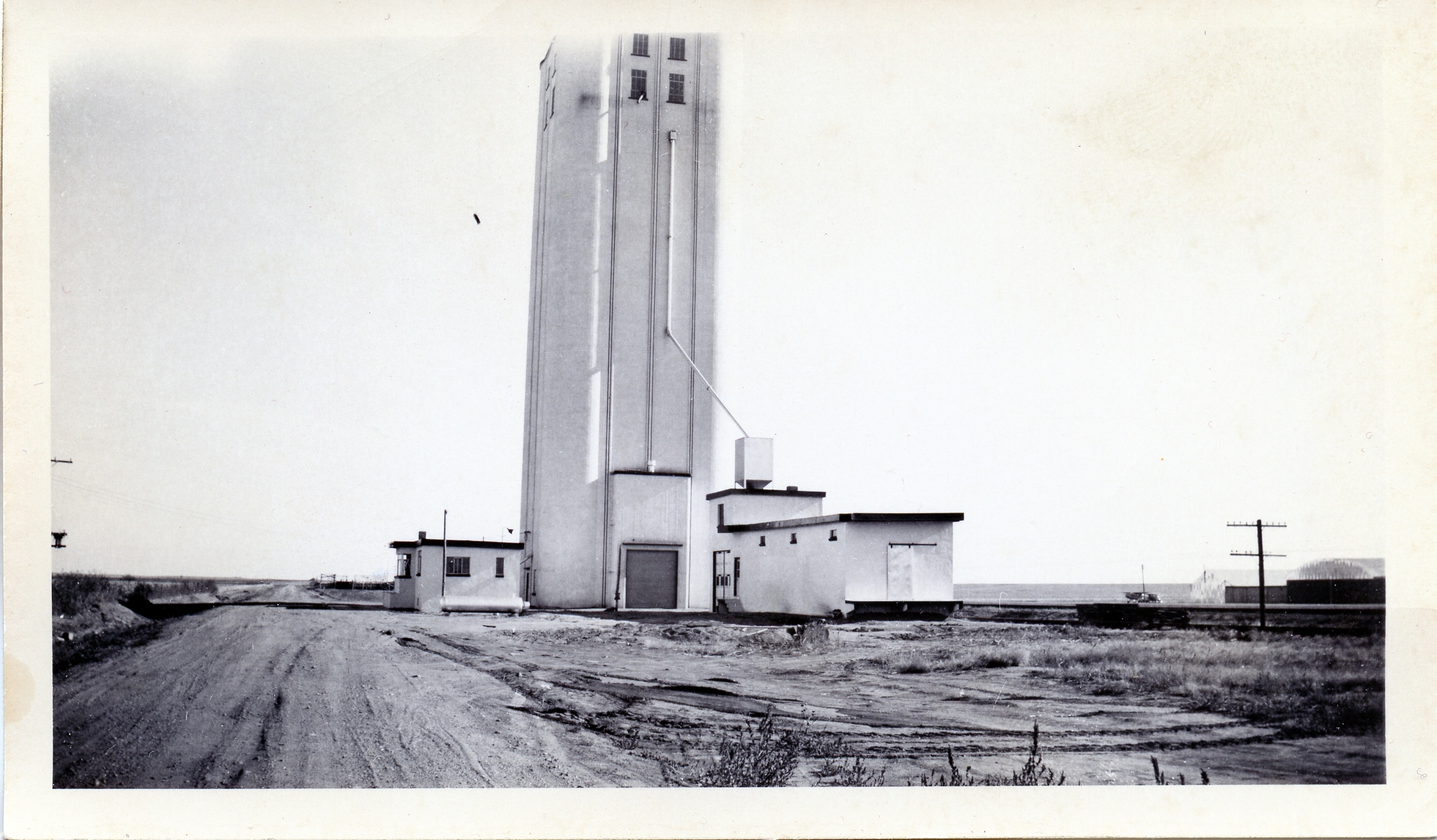
Page City structure exemplifies functional and aesthetic aspects of elevator design

Page City elevator as seen January 26, 2012

Story and photos by Gary Rich

The elevators without a headhouse were called straight-up elevators. J. H. Tillotson, Contractor and Mayer-Osborn Company produced these in the latter 1940s and early 1950s. Their elevators had a smaller diameter pipe that came out about three-quarters up the rail side. Loading a boxcar was time-consuming.

About 1958, there were improvements added for quicker loading of boxcars. These images show the Page City, Kan., elevator. Notice the rail loading chutes are much larger and there are two chutes, so the grain could be loaded equally. These chutes were on all concrete elevators raised during the late 1950s and 1960s. Most boxcars could be loaded within fifteen minutes, whereas on the old wooden elevators it could take up forty-five minutes.

The Page City elevator was built by Johnson-Sampson Construction Company, of Salina, Kan.  It was built about 1958 or 1959. Did Gene Mayer draw up the blueprints for this elevator? We don’t know where he went after the Mayer-Osborn era, which ended after 1955.

Another improvement is the area around the driveway. You can see the three reinforcing columns above the driveway and door. I would think this would add greater strength. The Kanorado, Kan., elevator has a smaller version built out. It is established that Gene Mayer produced the plans for that elevator.

Mysteries surround the origin of Mayer-Osborn Company and its first elevator

By Gary Rich

Let me explain about Wauneta, Neb. I got into a lot of trouble there last week. It was my wife that gave me the trouble. I went into the office trying to gain some information. The lady working inside went into the back room. She had all kinds of blueprints. I wasn’t about to pass up a chance looking at them. It took me over them minutes to look at everything. Needless to say, somebody was over the boiling point when I got back out to the car.

Let me give some other information that we thought about J.H. Tillotson, Contractor. Kristen and I thought Mayer-Osborn took over when Joe passed away. Now, I have proof that this wasn’t the case at all.

I found blue prints that pointed to Denver, but more towards Mayer-Osborn. One set of prints was not for an elevator. It was like footing foundations for a building. One set had the date in the body of blueprint, then there was a box in the lower right hand corner that had the company and another date. The first one had Orrie J. Holmen, Designer, Denver, Colo., but no company name was written there. The body of the blueprint had 1948, but the lower right corner showed 1949.

I found another set that had in the lower right-hand corner the following information; Holmen & Mayer, Designers & Engineers, Denver, Colo. So once Joe Tillotson passed away, I believe Orrie J. Holmen took over the company. We know that Gene Mayer worked for Tillotson–both Tillotson Construction, of Omaha, and J.H. Tillotson, of Denver–as well as Bill Osborn. But I could not find any dates for these blueprints.

Yet another set of blueprints had Holmen & Mayer, 1717 East Colfax, Denver, Colo. This is the exact address that is on the Mayer-Osborn brochure. I found even another set of blueprints, which are not blue. They are on clear paper or yellow paper. It shows the old elevator, which is the one without the headhouse. In the lower right-hand corner, it has the following information; Mayer-Osborn, 5100 York Street, Denver, Colo. But there is no date in the lower right corner box.

Kristen found a small article in the Farmers’ Elevator Guide which was a monthly magazine. It told about Mayer-Osborn moving to the address at 5100 York St. It stated that it gave them more room at this location.

This is my guess and my guess only that this is the way company names happened:

  1. J.H. Tillotson, Contractor
  2. Orrie J. Holmen or Holmen Construction
  3. Holmen & Mayer Construction
  4. Mayer-Osborn Co.

Kristen originally told me that Mayer-Osborn started in 1946. I still think the company name was Tillotson. She mentions that Mayer-Osborn built the McCook, Nebr., elevator, which was their first; however, the plaque inside the elevator shows 1949.

I am planning another trip to Wauneta in a few weeks. I will try to get permission to get into the elevator, so I can see whose name is on the manhole covers. This will tell us for sure, if it Tillotson or Mayer-Osborn who built the original elevator. I am thinking the original elevator was built either 1947 or 1948.

I want to get to the elevators in McCook, too. The one that Mayer-Osborn built there was another elevator standing a ways from the newer elevator. It is one that has no head house, too. I am hoping that they will let me inside this elevator, so I can find out who built this elevator. Some elevator managers are willing to let me inside the elevators, while others say that I can not go inside due to insurance. I am trying to get inside as many elevators as I can before it comes down that no one will be allowed inside.

♦ ♦ ♦

Kristen Cart explains:

Some of the mystery can be explained by the sequence of events leading to the establishment of the Mayer-Osborn Company.  J. H. Tillotson, Contractor was owned by Joe Tillotson. My father told me that Mr. Morris, Joe Tillotson’s construction superintendent, died in a roadside accident while changing a tire early in 1947. Within a month, Joe Tillotson died in a car accident, which we know was in March 1947. The only one left in the company who had contractor experience and construction expertise was William Osborn. It seems apparent to Dad that Gene Mayer had an independent architecture and engineering firm, which worked on projects with J. H. Tillotson, Contractor. For a period of time Gene Mayer was partnered with Orrie Holmen. My Dad says his father started an independent company called Osborn Construction, but it became very immediately apparent that he needed a partner.

This differs from Gary’s interpretation, but since Gary was at the site, talking to the people there, his thinking about it carries some weight. So we need to find more documentation.

In a newspaper story about the building of the McCook elevator in 1949, Bill Osborn was interviewed. He said Mayer-Osborn was incorporated  in September 1948. We do not have any documentation of William Osborn’s interim business other than two elevators that he said he built in 1947, according to the same newspaper account, in Fairbury and Daykin, Nebraska. They probably fulfilled contracts already won by J. H. Tillotson, Contractor.

In the same newspaper article, the author said the Wauneta elevator was built in 1945, which makes us wonder about the purpose of the later dated blueprints that were found there. The yellow blueprint that Gary found at Wauneta could only have been produced after May, 1953, which is when the Farmers’ Elevator Guide announced Mayer-Osborn’s move, from 1717 East Colfax Avenue in Denver, to 5100 York Street in Denver.

The sequence of events Gary describes above accurately tracks Gene Mayer’s business of engineering and architecture that built these elevators.  The business relationship that existed with my grandfather is something we will continue to explore.

William Osborn’s photo of the Kanorado, Kansas, elevator

By Kristen Osborn Cart

This is an image that was in my grandfather’s papers when he died. It was his photo, since he was the only photographer in the family. This was the only elevator image he identified on the back. The caption was “Kanorado, KA, 125,000 bu.” I know Grandpa worked on it because he photographed it. We know it was built before March of 1947, which was the month Joe Tillotson died.

Grandpa was working for Tillotson Construction of Omaha as late as the fall of 1944 through the spring of 1945, when Giddings, Texas, was built. Dad visited Grandpa on the Giddings job, so he was able to date it–they visited in early 1945, the spring, when Dad turned eleven years old. That means the Kanorado elevator was built circa 1945 to 1947.

It may be hard to find information on Joe Tillotson’s business because he was independent for such a short time–even though there were quite a few elevators to his name.

¶ Ronald’s note: While posting this, I gave Kan-o-RAY-do a call and was told that original records pertaining to the elevator’s construction burned in an office fire.


Details of the Kanorado, Kansas, elevator by J.H. Tillotson, Contractor

Story and Photos by Gary Rich

Kanorado, Kansas–J.H. Tillotson, Contractor, of Denver, built this elevator. Here’s a view of the south side. Note the windows near the top. J.H. Tillotson and Mayer-Osborn built the no-headhouse elevators with different window arrangements.


This view shows the elevator, the office building and feed mill. I do not have a date for when it was built.


The office and feed mill were built at the same time.


This is a manhole cover inside the elevator.


The Tillotson Construction Story, by Charles J. Tillotson

Speaking to my Uncle Tim about the airplanes used for business travel in the years after World War Two by my grandfather, Reginald Oscar Tillotson, led me to make a cartoon of one of them, called a Stinson Station Wagon. Then my Uncle Chuck wrote the following narrative in response to some questions I had about the airplanes operated by the business and the nature of the company itself. With his response comes the proviso that his recollections may or may not be entirely accurate!

Looking back, Dad was really an adventurous contractor. Way ahead of his time but I guess he was driven to flight because he was worn out from driving. During the early years of his business, driving 100,000 miles a year was the norm.

Reginald O. Tillotson in his mid-20s

Although Dad took a few flying lessons and probably took the controls while in the air sometimes, he never actually piloted the plane. He had a couple of engineers/salesmen working in the office that got him into flying—both were ex-Air Force pilots. They flew for Dad from time to time but eventually one of them, Marvin Melia, became his full-time pilot. When he wasn’t flying, he was a general overall maintenance/handyman for the business. Dad had double hernias, which I think also prevented him from getting a license. And of course we were glad he couldn’t because of his drinking.

My Grandpa Charles was in the business of constructing wooden grain elevators back in ’20’s thru the late ’30’s. He passed away in 1938 and left the business to his two sons and daughter Mary. The boys, Joe and Mike, (nickname for R.O.) were already working in the business, and shortly before Grandpa Charles died the company started experimenting with constructing grain elevators using reinforced concrete via a method called slip-forming. This method allowed a contractor to build a concrete storage building very fast, which not only provided a more substantial structure but also far more grain storage capacity than the smaller wooden elevators.

After the war, the increase in production of corn, wheat, sorghum, rice, etc., caused the NEED for huge amounts of grain storage, which was virtually non-existent save the old wooden ones. So Dad, Joe, and Mary took off building concrete grain storage, and their business exploded. Many of the grain elevators that you see as you travel the grain belt—from Calgary, Alberta, to Brownsville, Texas, and from Colorado to Illinois, and even some southern states as far east as South Carolina (rice storage)—were built by Tillotson Construction & Development.

Ashland, Neb.

Shortly after the war, my Dad and Joe decided they couldn’t see eye to eye, so they split. Joe moved to Denver to form his own company and Mary remained with Dad in Omaha. As the business grew, the company took on a few employees, including the pilot types, and developed a cadre of field superintendents to handle the construction work. Dad was the initiator of the contracts. His job was to sell, sell, sell. Hence, the 100,000 miles per year of road travel. During the war years, synthetic tires were all you could obtain and of course they weren’t as good as rubber, so Dad went through many tires in those days. He used to come home with a trunk full of casings for retreading and at least one dog, which kept him company during the long hours of driving. He also came home with turtles, tarantulas, cats, shrimp on dry ice, and other sundry items that we got to consume or take care of!

Anyway, between 1940 and 1957, Dad built out hundreds, maybe thousands of elevators. I have no way of knowing how many nor exactly their locations other than to point you to the Midwestern Plains and look for the tall concrete storage tanks. Acquiring a plane was an obvious step. It provided him with faster travel, exacted less wear and tear on his body, and enabled him to spend more time at home.

stinsonstationwagon01When I went back for my 55th high school class reunion, we were invited out to some friends’ home in Gretna, and we drove from Omaha out the old highway, U.S. Route 6, to get there. On the way, I stopped and paid homage to Dad and my aunt in three little towns (spots in the road) where they had built. They didn’t build much in Nebraska, but in Iowa, Kansas, Oklahoma, and Texas they built one in every little farm town where a grain crop was produced. Of course, as the years passed, they had competition, some of which came from men who spun off from Dad—so he wasn’t the only company out there building these units.

By the late ’50s, the need to build more capacity began to diminish and his business started to decline, and it was the end of an era for Tillotson Construction & Development. Dad passed away in 1960 at the early age of 51. He had literally worked and drank and smoked himself to death. I didn’t appreciate all that he did for us kids until much later in life, but to do today what Dad did would be next to impossible with all the government/environmental/safety controls and taxation that now exist.

Tillotson Construction, Omaha, Nebraska, remains legible after 60 years or so. Photo by Charles Tillotson.

About Margaret Tillotson: http://baggyparagraphs.wordpress.com/2009/05/04/things-beyond-control/

“Prairie Cathedrals” article about photographers Bruce and Barbara Selyem, who document grain elevators:  http://www.americanprofile.com/article/31661.html

History of concrete:

http://en.wikipedia.org/wiki/Concrete#History

Recommended book:

http://www.amazon.com/dp/0307351785/?tag=yahhyd-20&hvadid=42537719511&ref=pd_sl_8yzx0tx6xo_e