The J. H. Tillotson-built farm elevator at Traer, Kan., is still standing, but idle

Grafel Farm elevator, built by J.H.Tillotson, Contractor, at Traer, Kan.

Story and photos by Kristen Cart

The road to Traer, Kan., was a bit obscure. The town is south of McCook, Neb., across the border, on unpaved secondary roads. It took some navigating to get close to the elevator, and then to find the right road, once the elevator peeked over the farm fields. We were rewarded with a handsome, squared-up, tall elevator on a lonely rail line in a winding creek valley surrounded by farmland. I hopped out of the van in a grassy parking area and started to take pictures. A truck was parked at the weighing house by the elevator. I knew this was a private farm, and it always had a privately owned elevator, from the time my grandfather built it. So I wanted to make my presence known.

The elevator leg and bins.

When we visited McCook’s elevator earlier in the day, worker Kelly Clapp told me the Traer elevator was still in operation. But his information was about two years out of date. Don Grafel, who greeted me when I entered the elevator office, chuckled when I asked if the elevator was working. “I wish a tornado would take it down,” he said.

Don had started working at the Traer elevator as a kid. His family now leases the farmland from a granddaughter of the Anderson family, who had the elevator built, and as part of the deal, the Grafel family had to buy the elevator. The Grafels operated it for a number of years.

The elevator was retired two seasons ago, Don said. The problem with the elevator was twofold. It had been built in a flood area with a high water table, and the measures taken during construction to account for the water had started to fail. It had leaking problems during wet years. But worse, the elevator was slow. Don said the elevator could take a semi-load at a time in the pit, which was good, but it would take an hour to load the bins. Fifteen years ago, the Grafel farm placed metal bins on high ground above the town. That handled the water risk, but Don said that even those bins were falling behind demand because of slow loading.

“J. H. Tillotson, Contractor, Denver” is stamped on the interior manhole covers.

Shirley Nichols, who also worked at the office, was keenly interested in the history of the elevator. I had a treat to offer her. Russell Anderson, who commissioned the elevator, wrote a letter of recommendation for my grandfather’s new company on May 6, 1949. The Traer elevator was an example of Grandpa’s work before he went out on his own after working for J.H. Tillotson, Contractor. I gave a copy of the letter to her along with a photo my grandfather took during the elevator construction. In return, she gave me another construction photo and some historical pictures of the town.

Finally, my hungry and thirsty children came into the office, and the visit was pretty well over. Don’s brother Greg came in after meeting my husband in the parking lot. He wondered who had dropped by. But it was time to get on the road again, before the complaints got too shrill.

The good people of the Grafel farm made us feel very welcome, and gave us a window into the Traer elevator’s past. I’m glad we were able to see it while it still stands.

Related Articles 

Maywood, Nebraska: another Mayer-Osborn landmark meets its end

Photo by Kristen Cart

By Kristen Cart

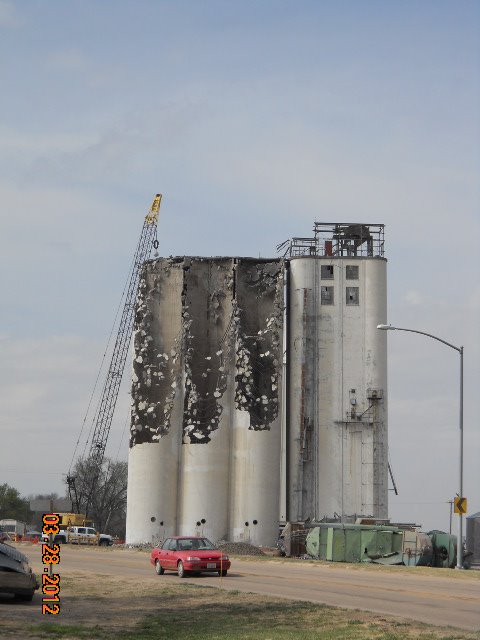
The old Maywood, Nebraska, elevator with its annex built by Mayer-Osborn Contruction Company of Denver, Colorado, was demolished in March of this year. I had planned the trip to see the elevator before its scheduled demolition in 2013. When we arrived in town, I expected to see the familiar straight-up J. H. Tillotson, Contractor-designed elevator with its annex beside it, but it was nowhere to be found. But I saw bulldozers and a football field-sized area framed with rubble piles, with corn impacted into the flat scraped ground. Not good.

Inside the Ag Valley Co-op office, business was in full swing. A truck pulled up, and a corn sample was vacuumed up and tested inside the building as I watched. Newer elevators were handling all of the grain. Turena Ehlers and Charla Werkmeister, employees of the co-op, told me how it went.

Photo by Julie Cox Hazen

The old Mayer-Osborn annex had a pretty good lean and some leaking problems, so it had been slated for destruction first, with the status of the main elevator left in question. But the main elevator was losing chunks of concrete and was deemed a hazard, so it came down soon after the annex. Forest River Colonies, of Fordville, North Dakota, a Hutterite-owned company, tore down the elevator and its annex, with the scrap going to Columbus Metals in Kearney, Nebraska. My hopes were dashed for recovering an intact manhole cover with my grandfather’s Mayer-Osborn company name on it.

Photo by Julie Cox Hazen

The demolition was quite an event for the town. Carol Wood put together a photo montage and hung it at the Maywood town offices. Bill Schnase picked up pieces of the rubble for his daughter to paint, to preserve the image of the elevator on concrete. Everyone had photos of the demolition. Julie Cox Hazen, Bill Schnase’s niece, shared hers with me.

Luckily, Gary Rich visited the elevator last year, taking photos of it in its last year of useful service. It’s type had been surpassed for a long time by newer, faster grain storage facilities of all kinds.

Most of Grandpa’s smaller projects are reaching the end of their service lives. So we are capturing their last moments, mostly, but not always, in the nick of time.

Census data, genealogical work establish Tillotsons from 17th-century onward

In the following passage, Kristen, an experienced genealogist, destroys the myth that my grandmother, Margaret Irene McDunn Tillotson, always perpetuated about the Tillotsons being an Irish family:

I seem to have had a run of very good luck. Your [Tillotson] tree is verified back to 1816 with the census and before that, other researchers have the family back to the 1750s in Connecticut. It was an early family. Lots of families moved west around the time of the Civil War, and some of these very earliest families seem to have gravitated toward Nebraska. It does not surprise me at all to find a New England root for your family.

Charles [father of Reginald] was the son of John W. Tillotson, and his father was John W. Tillotson. They came from Cazenovia, Madison County, New York. The younger John moved to Missouri, then Iowa, then Nebraska. The online researcher has an Ephraim as father of the older John, and an Abraham before that. (I have evidence that Abraham Tillotson served in the Revolutionary War, and got a pension.) The researcher said they came from Hebron, Connecticut. I have not chased down wives. The elder John had a good amount of land—220 acres—in 1860, improved and worth quite a bit of money.

One webpage has data as far back as the 17th century.

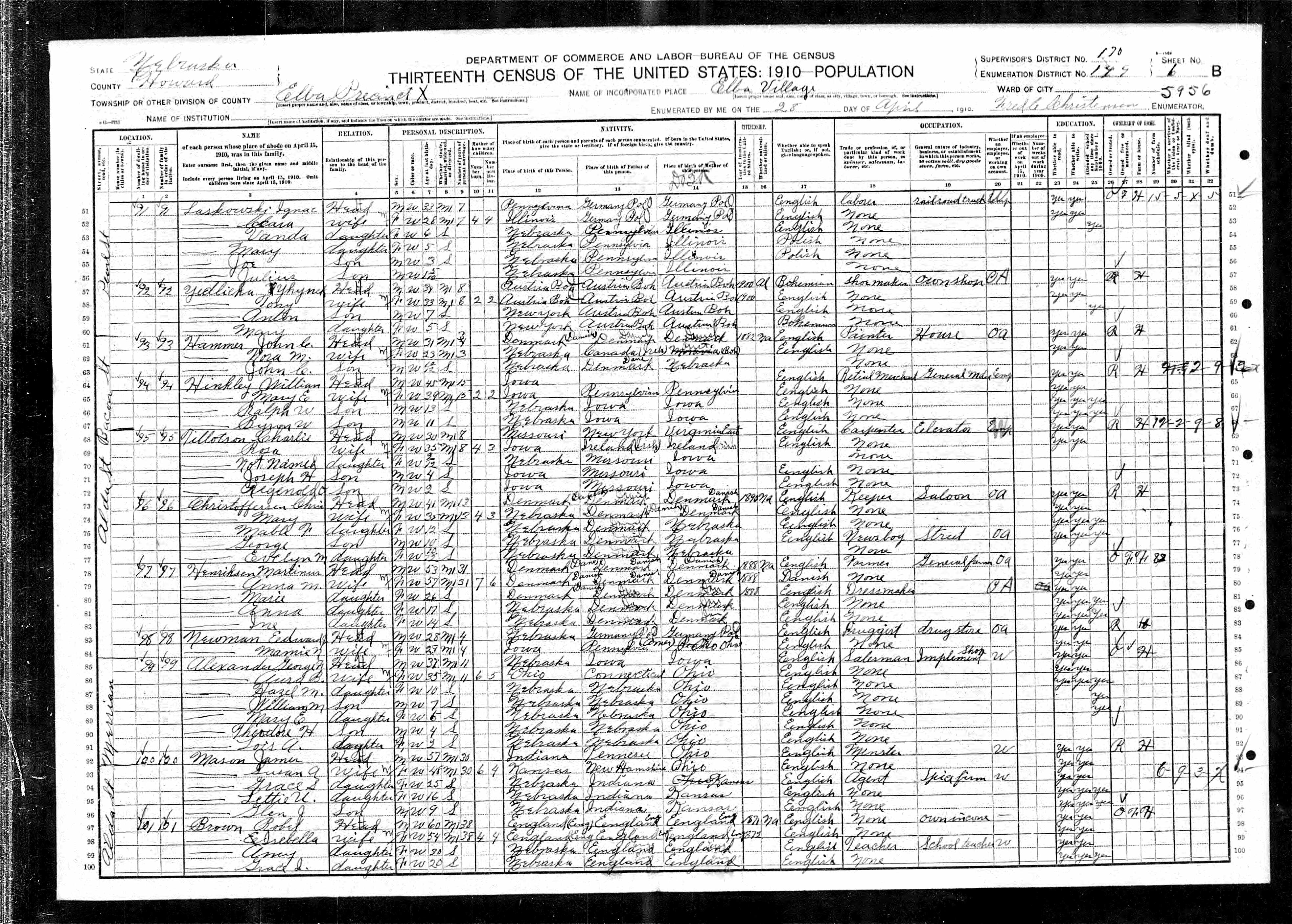
The 1910 census reveals important information. Charlie and Rose Tillotson were 30 and 35 years old, respectively, were able to read and write, and lived on Alda Street in Elba, Howard County, Nebraska. (The seat of this east-central county is St. Paul.) They had already had brought Joseph, age four, and Reginald, age two, and an as yet unnamed baby daughter into the world. Both boys were born in Iowa, but the girl, undoubtedly Mary, had been born in Nebraska, so the Tillotson family had come there within the last two years. Charlie’s occupation is given as carpenter, his place of occupation was an elevator, he evidently had employees, and the family rented a house.

1939 Omaha directory locates Tillotson Construction in Grain Exchange Building

The Omaha city directory for 1939, found by Kristen on Ancestry.com, verifies the status of the Tillotsons. From these pages it emerges that Tillotson Contruction Company kept offices at 720 Grain Exchange Building. Joseph H. Tillotson was president, Reginald O. Tillotson was vice-president, and their mother Rose A. (Brennan) Tillotson was secretary-treasurer in this  year.“Grain elev,” as seen in the listing, would refer to the company’s specialty.

Company president Joe Tillotson appears to have lived at 345 N. 41 St. with his wife Sylvia.

For the other Tillotsons, what could be a residential address of 1804 Dodge St. is given, although the directory’s abbreviations aren’t clear. Included here are Mrs. C.H. (Rose) Tillotson, who was by then the widow of Charles H. Tillotson, and Mary Tillotson, Reginald’s sister.

It seems unlikely that Reginald lived with his mother and sister at 1804 Dodge St. because by 1939 he and his wife Margaret already had at least four children of their own.

All this is in keeping with the announcement the previous autumn of Tillotson Construction Company’s establishment.

Wauneta registers as an important architectural landmark and literary archive

Story by Kristen Osborn Cart

Photo by Gary Rich

The elevator operators at Wauneta, Nebr., have done a remarkable job of retaining the blueprints and correspondence accumulated during the time the elevator complex was designed and built.

In virtually every other case we’ve investigated, blueprints were lost or unavailable, and the histories of the elevators were unknown. At Wauneta, we can track the history of their endeavor very easily.

We know from a newspaper item that the first, straight-up elevator at Wauneta was built by William Osborn, during his years with J. H. Tillotson, Contractor, of Denver, in 1945.

My dad knew that Grandpa built an elevator at Wauneta, so the story has been verified. A few years later, Wauneta obtained designs for an annex to be built by a winning bidder.

Map of Nebraska highlighting Chase County

Among these designs were two blueprints, dated 1948 and 1949, which were done by Holmen and Mayer, and Mayer-Osborn, respectively. Apparently the first set of plans was not built and a second set was ordered, this time from the newly formed Mayer-Osborn Company.

Other builders also submitted plans. Instead of an annex, however, Wauneta eventually built a second elevator, likely as a money-saving move.

A third elevator was also built.

The first two elevators had access to a rail line, and when the third elevator was built by Mel Jarvis Construction of Salina, Kan., it had no rail access, so runs were built connecting it to the other elevators.

After his recent visit, Gary Rich confirms that Mayer-Osborn built the Co-Op office building, formerly a John Deere dealership, and also a boiler room just west of the dealership. The blueprints are still kept at the Co-Op.

According to Gary, who interviewed a member of the Co-Op board, “The Co-Op provided everything for the farmers. They had the elevator, the John Deere dealership, a grocery store, and a lumber yard. Plus, they had a fertilizer plant and gasoline dealership.” 


Note: Follow the embedded link for William Osborn’s explanation of construction techniques used by Mayer-Osborn in nearby McCook, Nebr.

In Chase County, we meet Gary State, an elevator construction veteran

By Gary Rich

Editor’s note: Gary is recently returned from a fact-finding foray in Nebraska.

I stopped at the Chase County courthouse in Imperial, Neb., looking for the dates when the elevators were built in Imperial, Enders, and Wauneta. They did not have much information about the build dates. The only info they have in their records is that the old office building for Frenchman Valley Co-op was done in 1946. The FVC built a new office across the street from the old one.

The ladies on the courthouse staff told me to stop in at the FVC office and talk with Gary State, who might have the dates. Mr. State went to work for Mid States building grain elevators and feed plants. I do not know if it was just Mid States or Mid States Construction. He was living in Imperial when he started working for them.

Map of Nebraska highlighting Chase County

I explained about Tillotson Construction Company, of Omaha, J.H. Tillotson, Contractor, of Denver, and Mayer-Osborn Company. He gave me some leads. He told me that Hugh O’Grady is still alive and lives in Omaha. Mid States was started by a man name Erickson. He had seven sons. Six of the sons ended up working for Mid States. One son died at a construction site. He said Jack Russell was a superintendent. He thought that he was living in Seward, Neb.

Mr. State built the second annex, or elevator number two, at Big Springs, and then elevator number three.

He told me that he built the Woolstock, and Goldfield, Iowa, elevators; the feed plant at Fruita, Colo.; and elevators at Garrison and nearby David City, Neb. At the other end of the Cornhusker State, he built the west elevator in Imperial. After the west elevator was finished, he left Mid States and he went to work for the Co-op. This is the reason that he is working for FVC.

♦ ♦ ♦

Okay, here is another thing. I thought that when a construction company built an elevator that they did everything. This is not true. Mr. State told me about a company based at York, Neb. This company did all the belts inside the elevators, all around Nebraska, no matter who the builder was. So we know the belts were installed by a separate company. Now I am wondering if a separate company was onsite to install the leg as they built the elevator up. Or did the general contractor install the leg?

Big Springs adds 320,000-bushel storage elevator

Photo by Kristen Osborn Cart

BIG SPRINGS–Work on the 320,000-bushel storage elevator is about completed here, giving the Farmers Cooperative Elevator Association of Denver, Colo., a plant with 20 bins, 130-feet high. The elevator with headhouse is 165 feet high. The building is concrete.

Farmers’ Elevator Guide, September 1951

Note:  It isn’t known at the time of this posting which construction company did the project.

Government price supports, loan guarantees led to proliferating grain elevators

By Ronald Ahrens

I see why grain elevators proliferated like mad–like mice, actually–starting in 1949.

This happened before Ezra Taft Benson, the crusader against Socialism, became Secretary of Agriculture in 1953, so the trend can’t be attributed to Mormon food-hoarding instincts in the face of Doomsday.

Here’s the story: Section 417 of the Agricultural Act of 1949 made an extra $8 million in cheap loans available to farmers’ cooperatives through the Commodity Credit Corporation.

150

Ezra Taft Benson, Ag Chief

The United States Department of Agriculture figured the private sector wasn’t keeping pace in grain storage as farmers realized increasingly bountiful crop yields. The USDA stepped in to provide the incentive to build storage capacity. The government price supports had resulted in hundreds of millions of bushels going nowhere.

Washington’s policy of building “warehouse” capacity was of enormous benefit to established outfits like Tillotson Construction Company and J.H. Tillotson, Contractor. For the principals, like my grandfather, Reginald O. Tillotson, it became a matter of  dashing between farflung towns in order to make his sales pitch. And the CCC also breathed life into new organizations like Mayer-Osborn Company.

Given certain conditions, the loans–which were extended through the government’s Banks for Cooperatives–were  intended to cover up to eighty percent of construction costs, with the rest funded by local sources. The eighty percent would cover $100,000 of what looks like an  average cost of $125,000 around then, so we’re talking about eighty new elevators in a year’s time.

And that’s in addition to what supposedly would’ve been ordered in normal periods, although who would turn down a government subsidy and pay retail?

Indeed, I’ve already heard one story of a group forming, with maybe five businessmen kicking in $5000 each, to take up the government’s kind offer, not caring about the disposition of the grain after the three-year guarantee (on new storage) ended.

The CCC pledged it would use seventy-five percentof the additional capacity. And farmers were lining up to sell to the CCC. Indeed, build it and they will come. The more of the subsidized canisters that the government provided, the more that was needed.

United States Department of Agriculture buildi...

United States Department of Agriculture

“The possibility that 1950 will present another storage crisis is evidenced by the latest report of the Department of Agriculture, which shows that as of Nov. 1, farmers had put approximately 353,746,480 bushels of 1949-crop[s] … under CCC price support,” reported the Farmers’ Elevator Guide in December of 1949. “This was nearly 100,000,000 bushels more than with 1948-crop produce.”

Meanwhile, the government had frozen construction of commercial buildings other than hospitals, churches, and schools. So while the traditional construction companies were fighting over those slim pickins, the Tillotsons and Mayer-Osborn, with their specialized knowledge in shaping, reinforcing, and pouring concrete, dashed back and forth like bees, covering the land from Alberta to South Carolina.

They knocked together slip-forms and jacked their way up beyond 100 feet, grinning the whole way.

In Hutchinson, foundries create cast of thousands of manhole covers

Castings Plants Held Not Needed

Hutchinson’s industrial development is apparently not wanting in respect to foundries and the manufacture of metal castings.

Interviews with managers of two local firms bear this out. Frank Hulet of M.W. Hartmann Manufacturing Co., 120 North Adams, and Joe O’Sullivan, Sr., of Hutchinson Foundry and Steel Co., Washington and D, both report the Hutchinson market does not near utilize their capacities for production.

“We have more capacity available than is being utilized by local firms,” said Hulet. His company produces gray iron, alloy iron, brass, bronze and aluminum castings. In 1957 they produced 600 tons of gray iron and alloy castings. They did business in Oklahoma, Colorado, Texas, Nebraska and Missouri.

Hulet pointed out that at the present time they are capable of producing over twice that amount. The company has a second plant at 400 West 2nd in Hutchinson.

M.W. Hartmann Manufacturing Co. makes castings for such industries as hydraulic, agricultural, farm equipment, oil field and municipal. “We furnish our own castings, too,” Hulet said.

O’Sullivan said the work of the Hutchinson Foundry and Steel Co. deals principally with municipal and farm implement castings. They also make iron water well screen.

“The local demand is not over 20 per cent of our production for this area,” said O’Sullivan. He felt that production in their field was more than adequate for Hutchinson needs.

Hutchinson Foundry and Steel Co. is equipped for the heavier type casting work. They meet municipal, highway and agricultural needs and do more outlying area business than local business.

Hutchinson has three main foundry firms, the third being Kraus, Inc., 305 South Monroe.

Hulet summed up the job Hutchinson foundries are doing in meeting local needs when he said, “In comparing Hutchinson’s three foundries with other larger cities having less, I feel there is no need for industrial development here along these lines.”

Hutchinson News, January 22, 1958

Note: Manhole covers used in elevators built by Mayer-Osborn Company and J.H. Tillotson, Contractor were made by Hutchinson Foundry. In 2011, a new foundry was announced as a complement to Hutchinson’s growing wind energy industry.

J.H. Tillotson’s Fairbury elevator, slowed by rain during construction, will miss 1947 harvest


These clippings were among William Osborn’s papers. They come from the Fairbury (Nebr.) Daily News, a long-defunct paper, and appear to have run in the summer of 1947. The article “Rain Hampers Work At New Elevator Site” gives a good summary of the construction methods used on the Farmers Union elevator. The name J.T. Tillotson Contractors, as it appears in the article, should be J.H. Tillotson, according to other records.