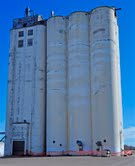
Page City structure exemplifies functional and aesthetic aspects of elevator design

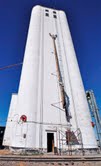
Page City elevator as seen January 26, 2012

Story and photos by Gary Rich

The elevators without a headhouse were called straight-up elevators. J. H. Tillotson, Contractor and Mayer-Osborn Company produced these in the latter 1940s and early 1950s. Their elevators had a smaller diameter pipe that came out about three-quarters up the rail side. Loading a boxcar was time-consuming.

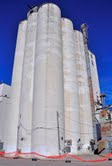
About 1958, there were improvements added for quicker loading of boxcars. These images show the Page City, Kan., elevator. Notice the rail loading chutes are much larger and there are two chutes, so the grain could be loaded equally. These chutes were on all concrete elevators raised during the late 1950s and 1960s. Most boxcars could be loaded within fifteen minutes, whereas on the old wooden elevators it could take up forty-five minutes.

The Page City elevator was built by Johnson-Sampson Construction Company, of Salina, Kan.  It was built about 1958 or 1959. Did Gene Mayer draw up the blueprints for this elevator? We don’t know where he went after the Mayer-Osborn era, which ended after 1955.

Another improvement is the area around the driveway. You can see the three reinforcing columns above the driveway and door. I would think this would add greater strength. The Kanorado, Kan., elevator has a smaller version built out. It is established that Gene Mayer produced the plans for that elevator.

How does a grain elevator work?

By Gary Rich

First of all, let me explain how an elevator actually works. The grain is dumped from a truck through the grates. The area below the grate is called the pit. The leg runs from the pit to the head house. On the leg is a thick rubber belt with buckets or cups. When the leg is started, the belt will move through the pit. The cups will fill up the grain and take it to the head house. As the leg reaches the top, it will arch, the cups will be up side down. When the cups turn to go back down towards the pit, they empty the grain on a conveyor belt. The cups will be facing downward, until the cups reach the pit and the will right themselves, filling up with more grain.

The run is the conveyor belt between the elevator and a storage annex. The run will have walls on the side of conveyor. They could be completely covered, too. Workers will set up the run, to a certain bin. There are openings at each bin. There is generally a door that they can open, so the grain will fall into the bin. They will put another piece of metal on the run, which acts like a chute. Thus, when the grain gets to the proper bin, and the grain hits the chute, the grain will move toward the opening of the run, and the grain will empty into the bin.

Sometimes, there will be a short conveyor belt that can be put under the main conveyor belt from the elevator. It is the same method. The grain will hit the chute, then through the opening, onto the second conveyor belt, which has a rise to it, and it will dump the grain into the bin.

Kristen mentioned that the bins are sloped. Most bins are built this way. You can think of it as self cleaning, as all the grain will come out the bottom of the bin. Now, if they built the bin flat, most of the grain can be removed. However there will still be about three feet of grain that is away from the bottom opening. Then some one has to climb through the manhole into the bin and they must shove the grain through the opening at the bottom. This is the only way that you can empty a flat bin.

The storage annex always has a basement. There is a conveyor belt that runs from a bin, back to the elevator, then up into a hopper. Most elevators have two separate hoppers. One will load a rail car and the other one can load a truck. If you did not have this conveyor belt, you could not unload a bin.

The area where the run is located is enclosed. If you look at a photo of a grain elevator with a storage annex, you will see an enclosed area above the storage annex. Outside this area, the bins are covered with concrete. Inside the run, either part of each bin will be open, or they could have metal slabs that cover the bins.

Details of the Kanorado, Kansas, elevator by J.H. Tillotson, Contractor

Story and Photos by Gary Rich

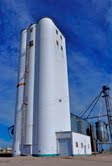
Kanorado, Kansas–J.H. Tillotson, Contractor, of Denver, built this elevator. Here’s a view of the south side. Note the windows near the top. J.H. Tillotson and Mayer-Osborn built the no-headhouse elevators with different window arrangements.


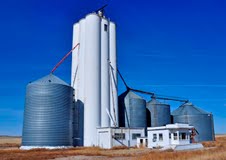
This view shows the elevator, the office building and feed mill. I do not have a date for when it was built.


The office and feed mill were built at the same time.


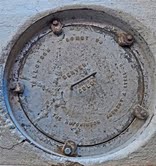
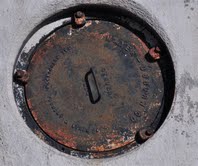
This is a manhole cover inside the elevator.


Comparing Mayer-Osborn elevators in Byers, Colorado, and McAllaster, Kansas

By Gary Rich

It is somewhat strange that you can have a company build an elevator, but there can be differences between two separate models. The Byers, Colorado, elevator was built by Mayer-Osborn. This model has the manhole covers on the outside of the bins, whereas the McAllaster, Kansas, elevator has the manhole covers on the inside. You will notice the manhole covers on the outside of the bins in the Byers view. Plus, there is a walkway door about halfway between the bins. The window arrangements are slightly different between these two elevators. Basically the driveway is the same on the two models.

One thing stands out like a sore thumb: whoever painted the Byers elevator painted the manhole covers. This is the only elevator where I have seen this done. Generally the manhole covers are not painted.

It would be the option of the Co-op what was wanted in the elevator. If the owners chose more options, of course the price of the elevator would increase, too.

There are two sides of an elevator. One is the track side, where the railroad tracks are located. The other side is known as the drive way, where the trucks will dump their loads.

I do not believe that the McAllaster, Kansas, elevator has been used for some years. The steel bins were empty, when I photographed here on November 14, 2011. The weeds were fairly high, and the rail spur has been removed. 

Gary Rich analyzes the leaning Maywood, Nebraska, elevator and storage annex

Ever since Kristen got me interested in the history of elevators, I am always looking for new avenues. One thing that I have noticed that Tillotson Construction Company, J. H. Tillotson, Contractor, and Mayer-Osborn Construction built grain elevators in eastern Colorado and western Kansas. However, I never knew them to build the storage annexes. There are cases in which one of these companies built the grain elevator; then another company called Chalmers & Borton would be in the same town within three to five years building a storage annex.

I was very excited when I walked up to the annex at Maywood, Nebraska. I saw the manhole covers had Mayer-Osborn on them. I knew that I found my first annex that was built by one of the three companies.

There is a major problem with this annex at Maywood. You can see the cracks in the annex and where they have tried patching them. I drove back to Maywood several days later. Part of the annex still has grain in it. I talked with a person at the office. They are planning on tearing down the annex sometime this year or 2013. They have not made up their mind if they will save the elevator or not. When you are standing looking at both the elevator and annex, it is hard to say which is leaning the most. It looks like the elevator is leaning towards the annex. But on the other hand, the annex is leaning towards the elevator. The image that shows the grain dryer, the bin nearest the elevator, has been emptied, as well as the center bin. The north side still has grain in the all the bins, as well as the bin on the southwest corner (the image that has the sunlight on it).

I finally found a grain annex that these companies built, but it will be history soon.

Tillotson Construction’s elevator at Dalton, Nebraska, shows unique features

Gary Rich contributed these photos from Dalton, Nebraska, along with the following analysis:

Tillotson Construction’s elevators were unique, with some features that I have not seen from other elevator builders. One major feature was the curved head house. I have only seen one other company that produced an elevator with the curved headhouse. Another feature was that Tillotson put windows for light into the basement. Of course they had electric lights in the basement. I have not seen another builder put windows in the bottom part of the elevator. This must be a Tillotson trademark. This elevator has the year of construction added to the manhole covers. It shows 1958. Tillotson did a great thing by adding this. All the elevators that I have been inside, I have not seen another company put the year on the manhole covers. The date was on each manhole cover inside the elevator.