Mayer-Osborn Construction completes 450,000-bushel elevator in Burley, Idaho

Burley, July 22–Charles Barnes, manager of Union Seed company here, announced Friday that work is nearly completed on the new grain elevators and storage tanks west of town. He said the tanks, built to store all types of grain, have a capacity of about 450,000 bushels,

Eash of the 23 tanks is 135 feet tall and is made from six inches of reinforced concrete. The head house is 165 feet high, equivalent to a 16-story building. The tanks will be used to handle individual and Union Seed storage needs.

Barnes said that about 20,000 sacks of cement had been used in the construction under contract by Mayer-Osborn Construction company, Denver. He said the latest grain cleaning machinery has been installed, along with scales large enough to weigh the largest trucks, and that there are conveyer belts in both the head gallery and the basement tunnel.

Times-News, Twin Falls, Idaho, July 22, 1955


Tillotson Construction’s elevator at Dalton, Nebraska, shows unique features

Gary Rich contributed these photos from Dalton, Nebraska, along with the following analysis:

Tillotson Construction’s elevators were unique, with some features that I have not seen from other elevator builders. One major feature was the curved head house. I have only seen one other company that produced an elevator with the curved headhouse. Another feature was that Tillotson put windows for light into the basement. Of course they had electric lights in the basement. I have not seen another builder put windows in the bottom part of the elevator. This must be a Tillotson trademark. This elevator has the year of construction added to the manhole covers. It shows 1958. Tillotson did a great thing by adding this. All the elevators that I have been inside, I have not seen another company put the year on the manhole covers. The date was on each manhole cover inside the elevator.

Mary Tillotson’s Plymouth at her Omaha home in 1956

If I properly re-create the scene from my mother’s note on back of the photo, in 1956, as my baby sister Mary Catherine (Katie) was about to be baptized, we stopped by Great Aunt Mary Tillotson’s house on Paxton Boulevard to pick her up for the ceremony. The man on the front step may be my father, Walter, although I’m not sure who would be behind the lens. Aunt Mary had given me the outfit: tan pants and shirt with green trimmings. What interests me is the car, which must have been hers. With the help of Standard Catalog of American Cars, 1946-1975, I declare it to be a 1954 Plymouth Savoy two-door club sedan, factory price $1815, of which some 25,396 were produced. But I could be wrong. – Ronald Ahrens

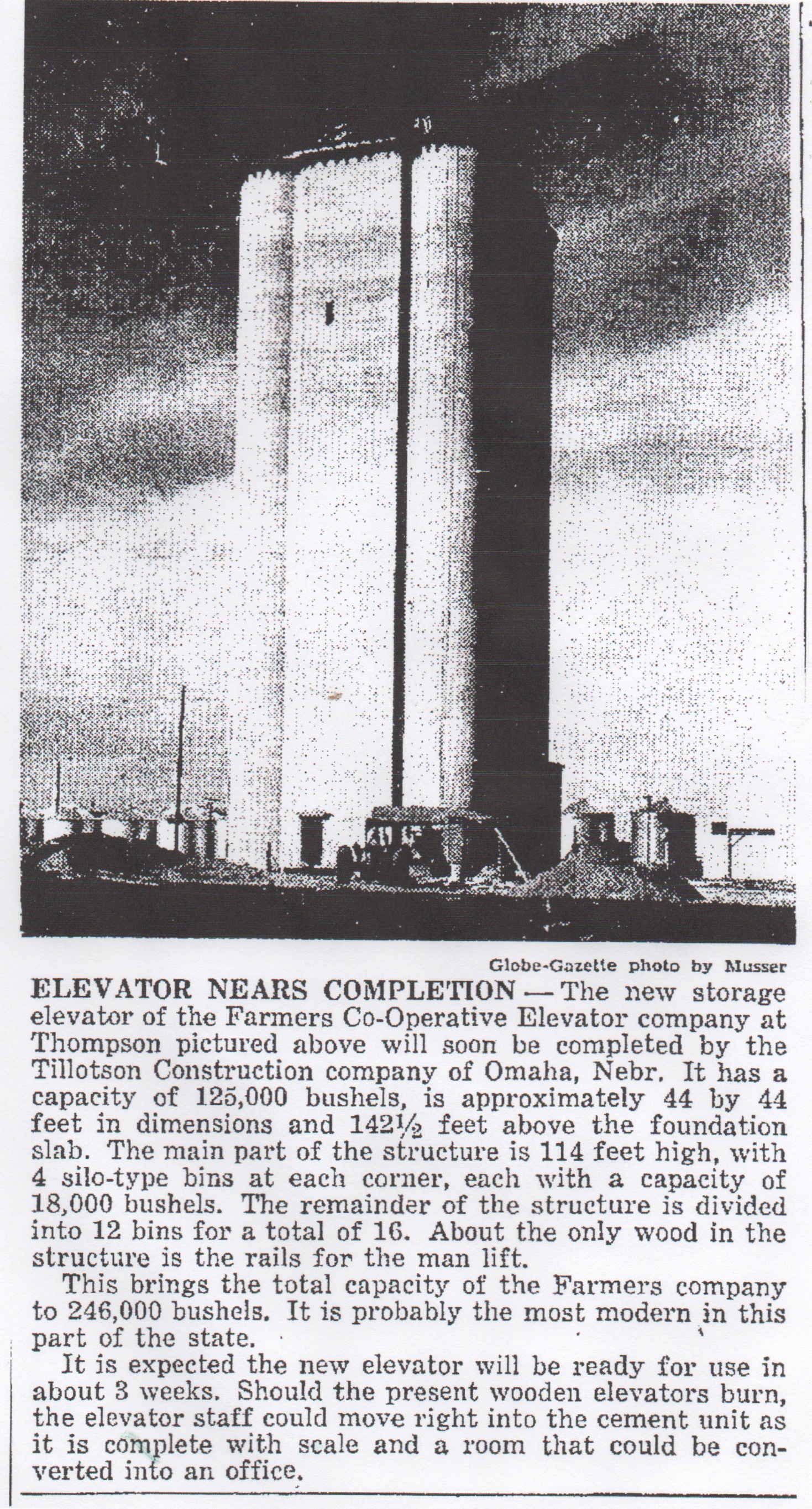
Thompson, Iowa, elevator completed in 1950, torn down in early 1980s

Work Underway on Storage Elevator

Thompson – Work has been started on a 125,000 bushel storage elevator for the local co-operative elevator company by the Tillotson Construction company of Omaha, Nebr.

Mason City (Iowa) Globe-Gazette, June 20, 1950

Mason City Globe-Gazette, September 2, 1950

♦ ♦ ♦

Our call to the Farmers Cooperative elevator in Thompson, Iowa, while preparing this post resulted in a conversation with location manager Lyle Wirtjes, who said he started working at the elevator in 1969. By then, Mr. Wirtjes said, one silo had already “busted out.” After another such incident, a new elevator was constructed across the road and the Tillotson elevator was torn down sometime in the early 1980s.

♦ ♦ ♦

Kristen’s analysis:

This Thompson elevator should not have failed—look at Greenwood, still here after all these years. I would guess there were some corrupt people in the building trades pulling off a scam, and since so many projects were going at once, a few poorly done elevators slipped through. They all looked like carbon copies of one another, so unless soil, water table problems, or fire caused the break, crooked subcontractors could have caused it. Not an uncommon problem when the federal cash spigot is turned on full blast—everyone shows up to the party, whether good or not.  My speculation here.  Nineteen years is not much of a lifetime for an elevator, barring a fire.


Painting a concrete grain elevator in Lincoln, Nebraska

Merle Ahrens, uncle of Ronald Ahrens, has written an account of his summer of 1955, which was spent on a scaffold with another of Ronald’s uncles, Michael Tillotson, youngest son of Reginald and Margaret Tillotson:

After graduating from Omaha North High School in 1955, I went to work for Tillitoson Construction on a grain elevator in Lincoln, Nebraska, with Michael Tillotson. I was paid $1.25 an hour.

Merle at home

Merle Ahrens in 2011, at home in Titusville, Fla.

I remember the first day on the job we had to go to the top of the grain storage tank—at least 100 feet—on a bucket that was used to haul up concrete. The bucket was connected to the swinging boom at the top by a wire cable. The cable went to a stationary, manually operated, rotating spool, which wound up the cable to lift the bucket. The operator let it free-fall down, seeing how close to the ground the bucket and riders could get before hitting the brake. It was a scary ride with four or five other workers standing on the rim of the bucket, especially the free fall down. Thankfully, it didn’t take long to get used to.

At the top, there were no rails around the edges nor any safety provisions like you see today, just one jack rod sticking out of the surface to hold on to as you got on and off of the bucket. The first day, I spent a lot of time holding onto that rod looking over the side.

When Michael and I started work, all the concrete pouring was complete and we were given the task of painting the outside of the whole elevator. We painted it using a lime-base whitewash. We had to crawl over the edge of the top of the tank onto a flying scaffold. The scaffold was held up by a pair of rope block-and-tackles connected to a pair of wood beams that were extended about two feet over the edge of the tank. The wood beams extended about ten feet inboard and were weighed down with sandbags to keep the scaffold from falling. The scaffold was made up of a pair of two-by-twelve boards with a metal frame at each end and two-by-four railings around it. The rope block and tackles were attached to the scaffold on the ground. We had to pull the scaffold up to the top every time for each ten-foot width we painted. There was an old man on the ground who mixed the paint and pulled it up to us in a five gallon bucket. He had a harder job than we had. All we had to do was brush on the paint and pull the rope to release the half hitch that held up the scaffold and let gravity work to lower it. The “flying” part of flying scaffold was when the wind was blowing. You would fly halfway around the tank.

Every night we would take off our Levi’s and stand them in a corner. There was so much paint on them! Yet one pair lasted all summer.

After a couple of months we finished painting the elevator in Lincoln and went to David City to paint another grain elevator. This time we used a new latex paint. It was very slow-drying and the wind kicked up a lot of dust. The elevator ended up white with grey stripes.

We kept hearing of accidents at other sites. One man was said to have fallen from a plank used to walk between the top of two tanks. He was wearing new boots and slipped. Another was killed when roofers removed the sandbags holding the beam for the flying scaffold so they could hot-tar the roof. A couple more were hurt while riding on a bucket and the clamps holding the cable slipped. The clamps were installed wrong. I do know for a fact that one worker at Lincoln was hit in the face when a five-gallon bucket with concrete in it fell while he was using a rope and pulley to lift it overhead.

At the end of the summer, Michael went back to North High, and I went to work for the Union Pacific Railroad.

Merle Ahrens

January 9, 2012

Ports and plaques provide clues about an elevator’s builder

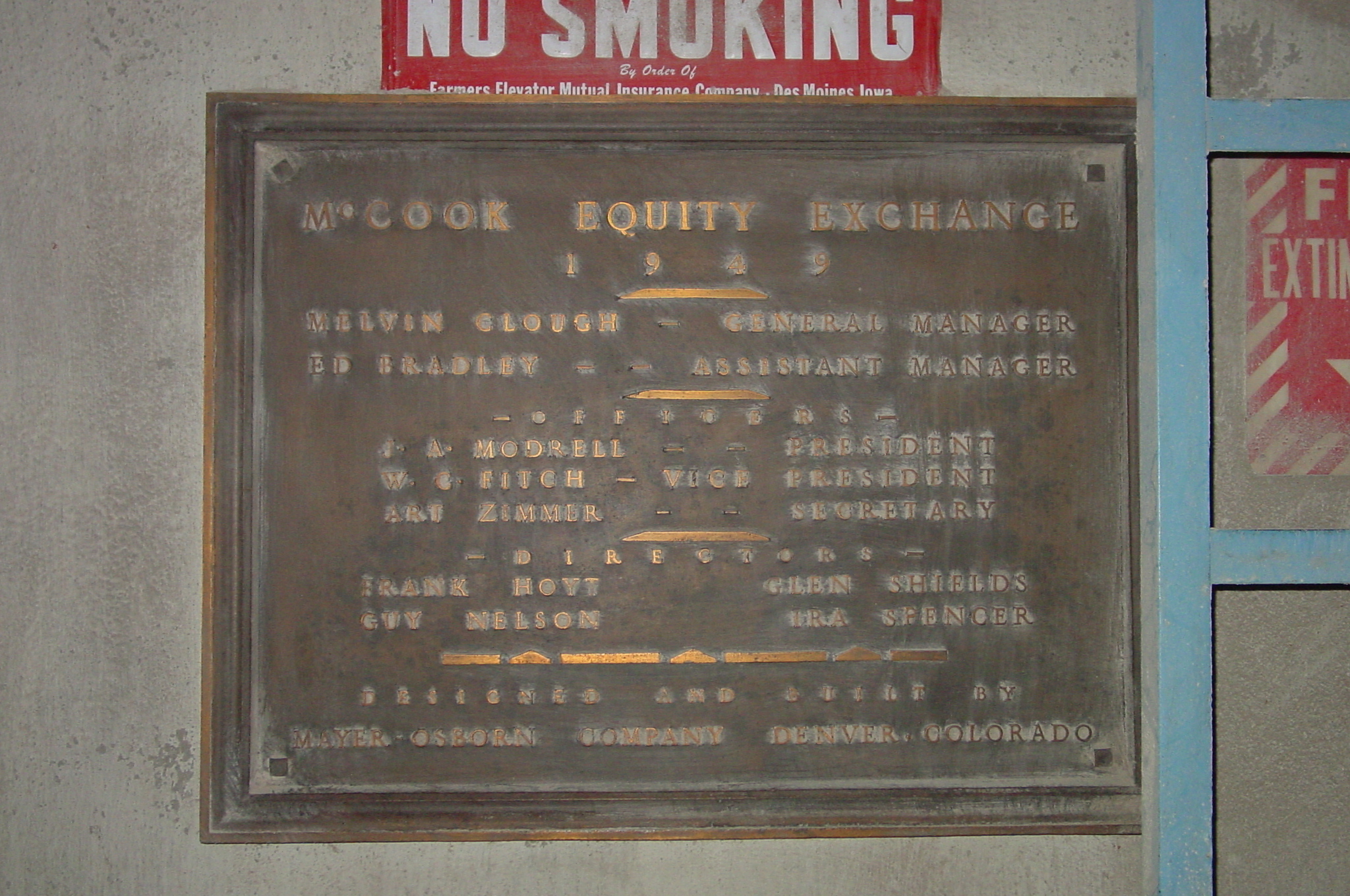
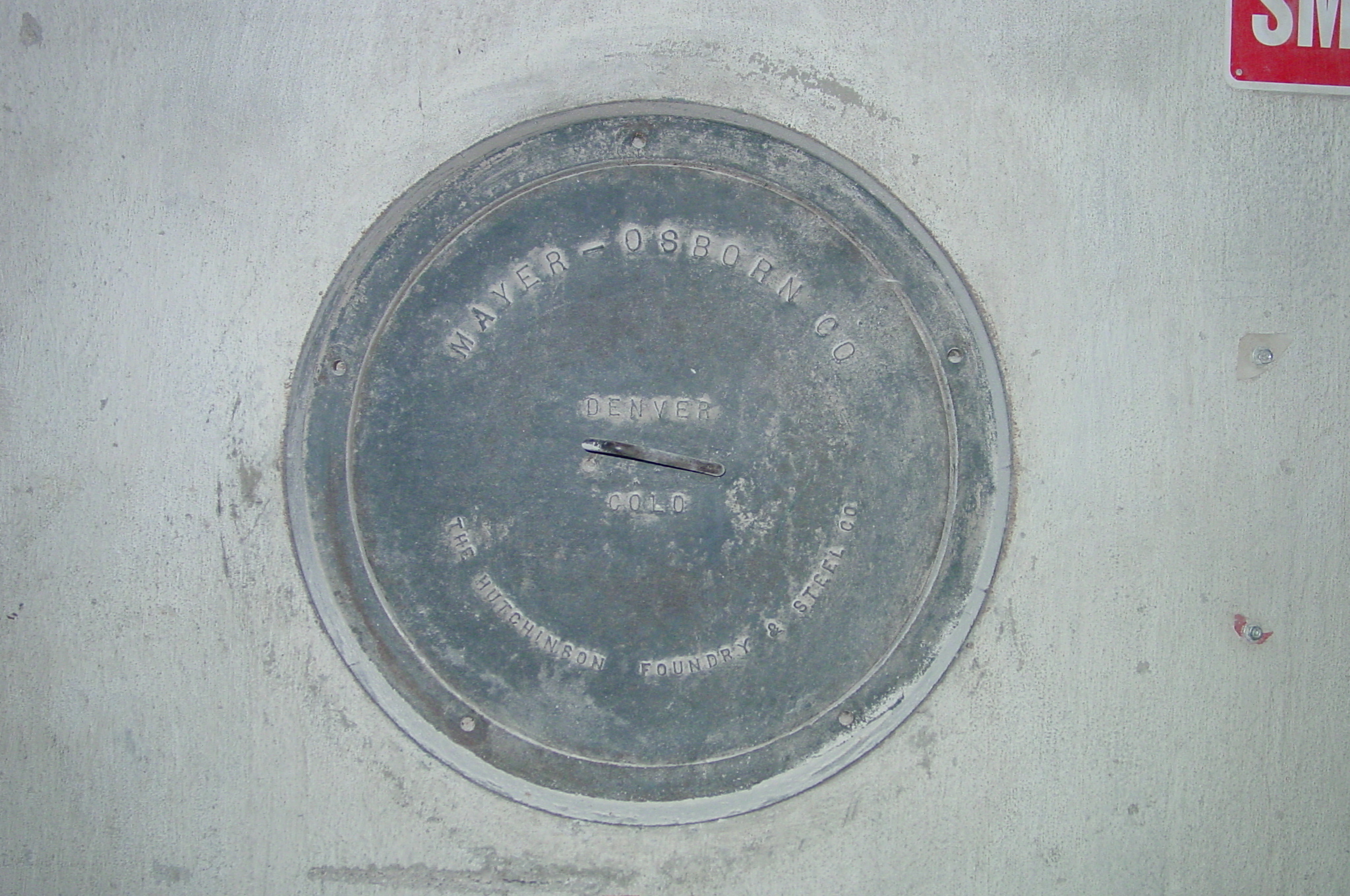
A good quick way to identify the builder of a grain elevator is to check the grain ports. At their first project, in McCook, Nebraska, Mayer-Osborn used these forged steel ports from the Hutchinson foundry. A nice touch was the bronze plaque inside the elevator. It identifies the people responsible for its construction.


Events leading to Mary V. Tillotson’s death recounted by her niece

In 1989, Ronald Ahrens, partner in this blog, asked his mother, Mary Catherine Tillotson Ahrens, to write an account of the death of her aunt, Mary V. Tillotson, who was Reginald’s partner in Tillotson Construction Company. Mary Catherine’s account follows:

Mary V. Tillotson holds five-month-old Ronald Ahrens early in 1956.

She attempted suicide once by swallowing Lysol & lived & about lost her larnix. She was in the hospital a long time & we were all so discusted with her. That was before we [Ronald’s parents] bought her house [3212 Paxton Boulevard, Omaha] on land contract, $500 down. Then she moved to a home. When the black started moving in we put up the sell sign & she was sooo mad at us—she wouldn’t hardly speak to us after that. Julie was due born in June ’63 & I think Mary died in Ap or May. She was found behind bath door dead—I never did hear why (or was never told I should say) I asked Gram—she didn’t know. She left $67,000 to Catholic church. We all got $2000. That’s what we bought the house on Grant with plus $2000—we made off her house. I’ve never forgiven her for the $67,000—HA. She missed Dad a lot when he died. He was all she really had. I think Dad left us 2000 to. She (Mary) had taken life ins policies out for you & Katie. Katie put herself through school with hers. What did you do with yours? The other kids got left out!

After delay, Tillotson completes 101,000-bushel elevator at Wapello, Iowa

Wapello, Ia—The Wapello Elevator and Exchange has let contract for an all-concrete storage addition to its main building to the Tillotson Construction Co., Omaha. Work will begin this week and is to be finished in 60 days.

The Democrat and Leader, Davenport, Iowa, July 31, 1949

The Wapello elevator, by Sam Willson. The flag and ribbon were added during the Persian Gulf War.

New Grain Storage Structure at Wapello—

Here is the new $80,000 grain storage structure of the Farmers elevator at Wapello, which will be completed next week by the Tillotson Construction Co., Omaha, Neb. The structure is 135 feet in height with ground measurement of 24 by 40 feet, and has seven bins with total storage capacity of 101,000 bushels. The four corner bins are of 20,000 bushels capacity each and three inside or overhead bins each have 7,000 bushel capacity. Inlet and outlet pipes extend to the structure from the main elevator building shown in the photo, and the mechanism was operated for the first time Monday in a test run. Construction was started Sept. 1, but delays have extended the time of completion until some time next week. The new structure gives the elevator company a total storage capacity of 135,000 bushels of grain.

The Democrat and Leader, Davenport, Iowa, Dec. 8, 1949

♦ ♦ ♦

Editor’s note: We found an image of the Wapello elevator on a site called Tankwagon Express.

January 7, 2012

Hiya Tankwagon,

A partner and I are doing a blog about the grain elevators that our grandfathers built, and I believe that my own granddad’s Tillotson Construction Company, of Omaha, built the elevator at Wapello. We have a newspaper article that says it was being completed in 1949.

Can you supply any info? Also, could we use the photo that’s on your site?

Many thanks,

Ronald Ahrens

♦ ♦ ♦

January 8, 2012

Ronald,

Feel free to go ahead and use the picture. I can’t verify if that is a Tillotson elevator, but the date of 1949 is probably correct. Is there a place where they may have left a mark or identifier on the structure? Prior to that date, a large wooden square elevator stood in the approximate vicinity. It like most wooden elevators caught fire and burned sometime in the 1940s. Replacing it was a smaller wood structure tied to the feed mill, and the slip form. The wooden mill in the picture burned to the ground in the fall of 1994. While the concrete structure is still standing, it has not been in use since maybe 2001-2002. At that time, I worked there and we had some issues with the headhouse and confined spaces with the insurance company. It still stands unused. The entire facility has capacity for about 3 million bushels of grain more or less.  Since I left the company in 2005 my access to information on the building is not as readily available. But I will see what I can find for you.

Sam Willson