Analysis of photos from Tillotson Construction’s job in Alta, Iowa


scan0020

By Charles J. Tillotson with photos from the Neil A. Lieb archive

The images from the Neil A. Lieb Archive are the best historical, phase-by-phase photos that I’ve seen yet. They give the layman a good concept of what actually takes place, from start to finish, in building a grain elevator.

A few comments I might add:

The excavation for the foundation began with dynamite.

Excavating the foundation began with a bang.

Neil writes about the use of dynamite during the excavation process. Dynamite was used for foundation excavation on many a job because of the deep frost. We even used it for cutting the foundation of the reinforced concrete garage we built on the old place in Omaha. We were young ’ns then, but still got to set (light) the fuses to a few charges.

I remember getting the neighbors excited about what the hell we were doin’ now.

By the way, the garage utilized slip-form construction with steel stays instead of wood for the formwork—another of Dad’s experiments. He was interested in finding materials that could be reused over and over, rather than having to buy lumber formwork for every new job. I guess this method didn’t make a lot of sense, as he never tried it out on an elevator.

scan0008

This photo is an historical testimony as to how the so-called unskilled, common man could be taught layout along with measuring, wood cutting, and other carpentry skills. The labor used to build these forms and construct the entire grain elevator structure was obtained, for the most part, from the inhabitants of the local vicinity where the elevator was to be built. Most of the workmen had no experience whatsoever in the construction industry.

scan0010

People used to marvel at how the cement went into the top of the formwork and came out the bottom of the forms, in a set-up, semi-solid state, all occurring whilst the deck and forms continued to extend upwards, being jacked up on screw jacks. Once the slipping of the forms began, it never stopped, unless by a power outage, a severe storm, or some other interference.

scan0014

Beneath the deck and main formwork, a sub-scaffolding was constructed to provide access to the exterior face of the concrete structure, which required patching and touch-up for a final smooth finish. A rich mixture of cement, sand, and lime was used which was applied to the concrete face by hand, usually covering the entire exterior surface, removing all blemishes. The finish material was hoisted in five-gallon buckets to the finishers. These workmen traversed the scaffold of wood planking—usually two, 2 x 12s laid flat between the wooden hanger frames that attached to the formwork above. Very dangerous work without a safety net!

At the ground level, a workman on a tractor would load a Georgia buggy with cement, to be hoisted to the top and placed in the formwork. Small skip loaders, tractors with scoop-type buckets mounted on the front, were an essential tool used during construction. This included scooping up the sand, gravel, and cement to make concrete and placing them in a mixer.

Neil A. Lieb collection Once the concrete was ready for placement, the tractor scoop was filled with the cementitous mixture and transported to the side of the elevator whereby the tractor would dump its load into a Georgia buggy to be hoisted up to the deck for placement.

Because of the extensive use of the tractor, more than one would be worn out. During the extremely active 1950s, Tillotson Construction Company would purchase Ford Ferguson tractors a dozen at a time, just to keep up with the need for replacement

The logistics of material supply was always challenging for the grain elevator builder. Usually, the projects were located in very rural farmland areas, where the supply of lumber, steel, sand, gravel, cement, gasoline, and oil was miles from the site. Because the construction utilized the slip-form method, the operation never stopped once it began, making it paramount that the supply of materials be established beforehand along with a comfort level that there would be no interruption once the job started.

Neil has noted (in an as yet unpublished commentary) the mixture of the gleaming, white, finished “paint,” which wasn’t really paint at all but instead a cementitious mixture that lasted for a very long time. Some of the elevators existing today still boast the original finish. Tillotson was among the few contractors that finished out their jobs this way.

scan0005

Training the local unskilled labor in the processes of placing and wire-tying the reinforcing steel –and of pouring concrete, turning screw jacks, keeping the slip-form deck level, et cetera– were just a few of the many headaches the job superintendent had to bear during the initial start-up phases.

A view of early preparations at the foundation of Alta Cooperative’s elevator

scan0003

Photo from the Neil A. Lieb Collection

In a July 22 telephone conversation, Neil A. Lieb, who worked for Tillotson Construction Company from 1949 to 1951, described for us the elements of this photo, taken in the spring of 1950 during the earliest stage of work on the Alta Cooperative elevator, in Alta, Iowa.

  • The slab and rebar box in middle is the pit, covered with wood to leave a hole in concrete.
  • The horizontal box in the background is for the elevator’s leg, the critical motor-driven pulley-and-belt mechanism with attached scoops that lift the grain from the pit to the headhouse for distribution to bins and silos.
  • Planking is to provide a smooth course for the wheelbarrow in order to transport and dump freshly mixed concrete.
  • The dirt in the background came from the excavation.
  • In the center, the larger black tank on left contains acetylene and the smaller one holds oxygen, for fueling a torch, presumably to cut rebar.
  • The concrete mixer (upper left) had the capacity of one-half or one cubic yard of concrete.

Editor’s note: Although there is some distortion, the upper-right corner appears to show a worker who is bent at the waist and leaning away from the camera.


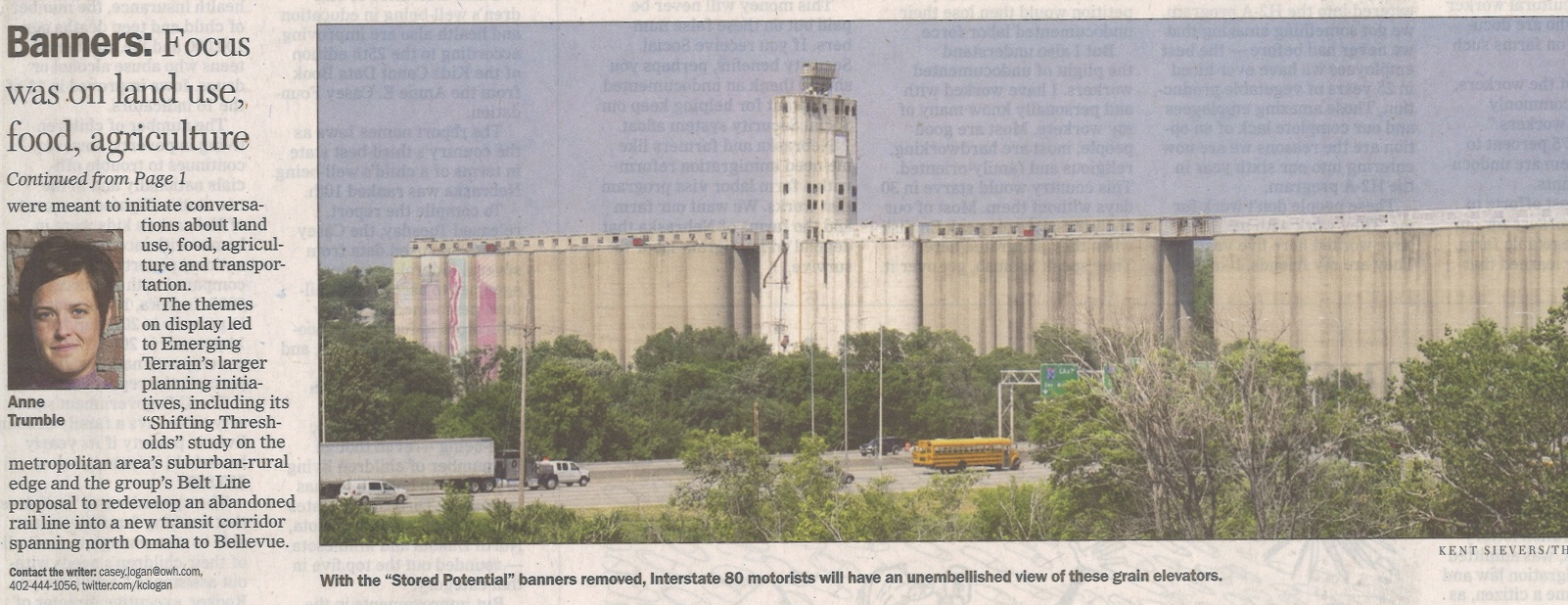
Emerging Terrain’s banners come down from the storage silos at Vinton Street

Banners Page 1

By Ronald Ahrens

As these pages from the July 22 edition of the Omaha World-Herald show, the community art project that adorned storage silos at Tilltoson Construction Company’s landmark Vinton Street elevator have been taken down.

The story by Casey Logan explains that various exigencies combined to signal “time’s up” for the displays.

We were fortunate to have visited in 2012 and seen them for ourselves.

And now we ask what’s next for this massive terminal complex?

Banners Page 2


Excavating with explosives led to trouble on Tillotson’s Alta, Iowa, elevator


scan0001

Story by Neil A. Lieb and photos from the Neil A. Lieb Collection

I do not know exactly when the Alta job started, but I think it was in March or early April of 1950. At that time of the year the ground in Iowa is frozen two to three feet deep. Since the ground was frozen, the bulldozer could not dig the hole needed for the slab. So it was decided they would use dynamite to loosen the soil. I guess Superintendent Bill Russell had this approved by the town fathers and the police and fire chef. 

Neil A. Lieb, left, and Blaine Bell worked on the Alta, Iowa, elevator in 1950.

Neil A. Lieb, left, and Blaine Bell worked on the Alta, Iowa, elevator in 1950.

Now, remember, Alta is a very small town, maybe 900 to 1000 residents then.

It was decided to use one-quarter stick of dynamite at a depth of 18 to 24 inches. The first charge was set off and it loosened about six to seven feet of dirt so they repeated this procedure every six to eight feet.

After setting off several charges, someone decided that if one-quarter stick worked so well, one-half stick would loosen a bigger area. So they used one-half  stick for the next charge. When it was set off, the explosion was so loud that Bill came charging out of his office to find why at about the same time as the woman across the street came out of her house screaming that her china cabinet had fallen over and all her good china had been broken. 

Within a few minutes the mayor, fire and police chiefs, and most of the town council members showed up. I guess Bill was very busy trying explain. Once he’d calmed everyone down, they all left.

That was the end of the dynamiting. The next day everyone was swinging a pick.

scan0007


Newly discovered photos show Tillotson’s big Alta, Iowa, grain elevator in 1950

Neil A. Lieb collection

Photos contributed by Neil A. Lieb

Of the slew of elevators Tillotson Construction Company put up in 1950, the one at Alta, Iowa, could have been considered a typical job, although the photo above shows that a sign company must have gone to work sinking anchors in the headhouse for the raised lettering. Built in the small Buena Vista County town that sits at the highest point on the Chicago-Illinois Railroad in its crossing of the Hawkeye State, the elevator followed Tillotson’s established Palmer Plan, with eight tanks of 18 feet in diameter rising to 115 feet in height. There was a 13-foot-wide driveway passing through the house in an opening 15 feet high under four split bins. An additional note about the Palmer plan says, “Extra dist @ Cupola and on Cleaner Floor,” and we take the abbreviation to mean distribution.

Formwork as the Alta Cooperative's elevator rises in a continuous pour. Note the driveway door.

Formwork as the Alta Cooperative’s elevator rises in a continuous pour. Note the driveway door.

Here is the full list of specifications:

Capacity per Plans (with Pack) 246,070 bushels

Capacity per foot of height 2640 bushels

Reinforced concrete/plans (Total) 2082 cubic yards

Plain concrete (hoppers) 49.6 cubic yards

Reinforcing steel/Plans (includes jack rods) 112.4 tons

Average steel per cubic yard of reinforced concrete 107/96 pounds

Steel & reinforced concrete itemized per plans

Below main slab 9419 lb/91 cu yd

Main slab 32,077 lb/272 cu yd

Drawform walls 142,070 lb/1424 cu yd

Work & driveway floor (including columns) 1485 lb/30 cu yd

Deep bin bottoms 6682 lb/47 cu yd

Overhead bin bottoms 7929 lb/40 cu yd

Bin roof (corner) 10150 lb/51 cu yd

Scale floor (complete) none

Cupola walls 9655 lb/88 cu yd

Distributor floor 1912 lb/10 cu yd

Cupola roof 2753 lb/15 cu yd

Miscellaneous (boot, leg, head, track sink, steps) 2560 lb/13 cu yd (a note here in the plans says “Cleaner floor”)

Elevator construction continued around the clock in a spectacle that must have awed the surrounding community.

Elevator construction continued around the clock in a spectacle that must have awed the community.

Construction details 

Main slab dimensions (Drive length first dimen.) 60 x 73.5 feet

Main slab area (actual outside on ground) 4101 sqare feet

Weight of reinforced (total) concrete (4000#/cu yd + steel) 4276 tons

Weight of plan concrete (hoppers 4000#/cu yd) 99 tons

Weight hopper fill sand (3000#/cu yd) 708 tons

Weight of grain (at 60# per bushel) 7380 tons

Weight of structural steel & machinery 20 tons

Gross weight loaded 12,483 tons

Bearing pressure 3.04 tons per sq ft

Main slab thickness 24 inches

Main slab steel (bent) 1 in diameter at 7 inch o.c.

Tank steel at bottom (round tanks) 5/8 inch diameter at 6 inch o.c.

Lineal feet of drawform walls 762 feet including exterior

Height of drawform walls 115 feet

Pit depth below main slab 15 feet 0 inches

Cupola dimensions (W x L x Ht.) 23 x 61.5 x 39 feet

Pulley centers 161 feet

Number of legs 1

Distributor floor Yes

Track sink Yes

Full basement Yes

Electrical room Yes

Driveway width–clear 13 feet

Dump grate size 3 – 9 x 6 feet

Columns under tanks size 20 inches square

Boot — leg & head Concrete

scan0010

Machinery Details 

Boot pulley 72 x 14 x 2 3/16 inches

Head pulley 72 x 14 x 3 15/16 inches

R.P.M. head pulley 42 rpm

Belt 14 inch 6 ply Calumet

Cups 12 x 6 inch at 8 inch o.c. Howell

Head drive 40 horsepower

Theoretical leg capacity (cup manufacturer rating) 8440 bushels per hour

Actual leg capacity (80 percent of theoretical) 6750 bushels per hour

The finished elevator, before the headhouse windows were installed and whitewashing was done.

The finished elevator, before whitewashing and installation of the headhouse windows.

Horsepower required for leg (based on above actual capacity plus 15 percent for motor) 33 hp

Man lift 1.5 horsepower electric

Load out scale Two 25 bushel Rich.

Load out spout 10.75 inch W.C.

Cupola spouting 10-inch diameter 14 gauge

Truck lift 7.5 horsepower Ehr

Dust collector system Fan → Dust bin

Driveway doors Two overhead rolling

Conveyor 14-inch R.H. 3 hp.

A Tillotson elevator overlooks the 76th Dayton Championship Rodeo grounds

DSC_0591

The Dayton, Iowa, rodeo grounds bustle with activity for the championship event.

Story and photos by Kristen Cart

The Dayton, Iowa, elevator is an especially handsome one, built in a typical Tillotson style. It is one of an overwhelming majority of Tillotson elevators that are still in use. It is quite an achievement to build something so enduring.

DSC_0566

Modern updates are evident in this view.

One of the secrets of the longevity of concrete elevators of this type is the ability to upgrade the machinery and to expand capacity. The elevators were built with the understanding that they would soon be filled and would need additional bins. The Tillotson Construction Company revisited certain sites over and over as they added concrete annexes and other improvements, while occasionally other companies won the contracts.

DSC_0579

The feed mill stands to the right.

You can see that the concrete elevator was retrofitted with an external leg. This modification is a safer design than the old internal one, because accumulated grain dust cannot come into contact with overheated machinery if a bearing or belt fails. Metal bins were added for additional capacity. A feed mill complements the storage facility, completing a one-stop shop for farmers.

The Dayton elevator’s original construction was not without trouble, however. Tillotson Construction Company was compelled to pay for repairs after the elevator cracked under its original grain load. The Farmers Elevator Company sued, according to the Farmers Elevator Guide, in 1954. The repairs were expertly done and the elevator still stands today.

The elevator and its Tillotson annex preside in sleepy Dike, Iowa

The old elevator sits beside its wooden predecessor, as it did in 1946

The old elevator sits beside a wooden elevator, as it did in 1946

Story and photos by Kristen Cart

We took a number of elevator detours on our return home from a Nebraska trip, where we delivered our daughter to her summer veterinary camp. During the four-day program presented by Oxbow Animal Health, she learned the inner workings of a cow, and lovingly operated on and sutured a stuffed bunny. Apparently there is no such experience offered to children in Illinois.

The trip home was a meandering route with a number of switchbacks, with elevators built by Tillotson Construction, of Omaha, spaced every few miles. One elevator stop on our sojourn was Dike, Iowa, in the central part of the state. This fascinating site was the last one we saw before the light failed. We were racing a line of weather, and as the sun sank the clouds built and made for very flat light.

DSC_0721It is enlightening to see an elevator complex in person and compare it with an early photograph. The changes wrought in almost seventy years can be surprising, but even more unexpected can be the features that remain the same.
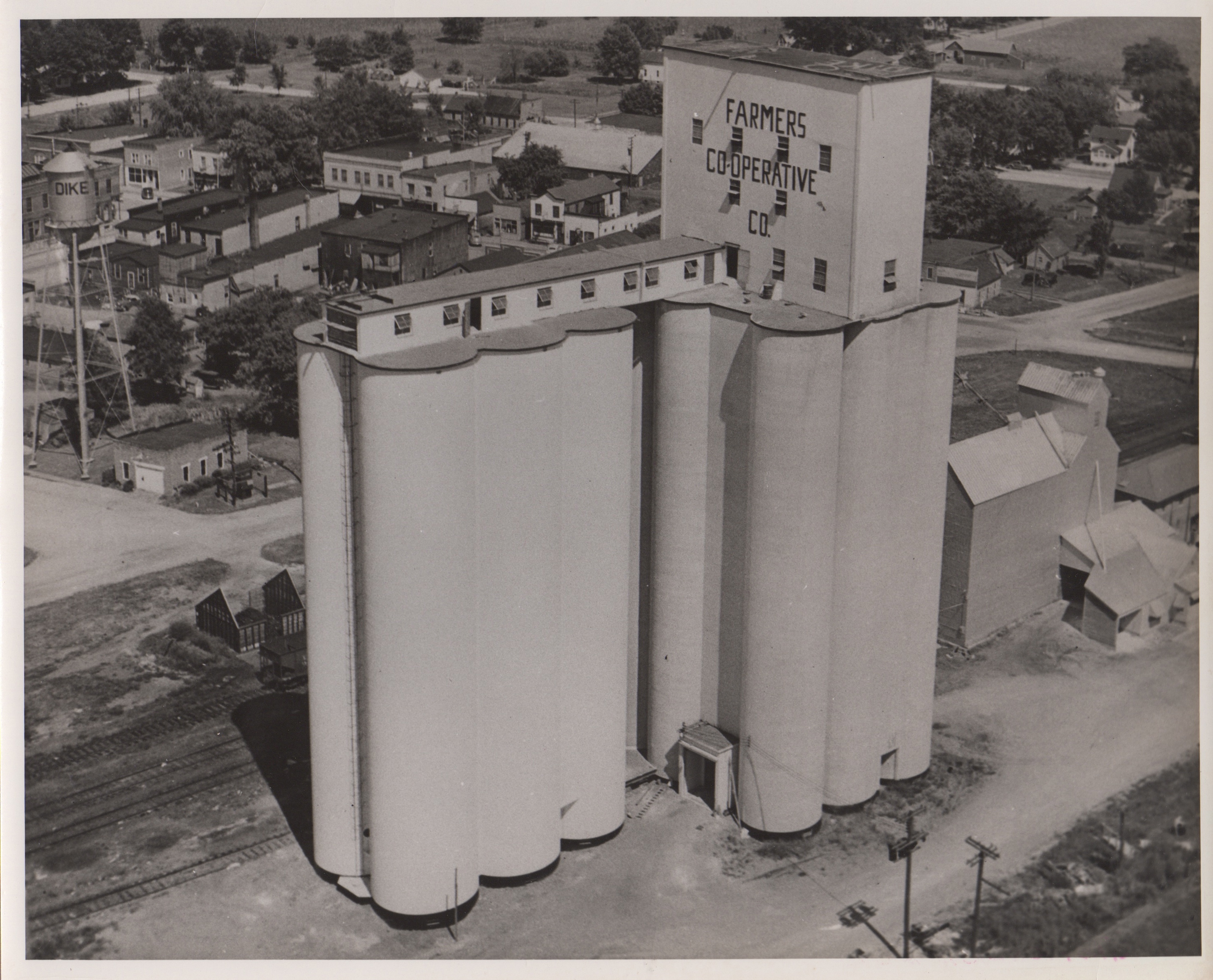
At Dike, you immediately notice a wooden structure behind the main structure. Strangely, it does not appear to be the same elevator that appears in the old photograph. Why would the co-op replace a wooden elevator with another one? The obvious answer would be a fire, but if wood was obsolete, why continue to build with that material?

In my travels, I have rarely come across a wooden elevator that was built before the 1940s and still in use today. Technology rendered the old ones obsolete, and wear and tear made them difficult to operate. Fire also took many of them. Now, wooden elevators built as late as the 1970s are coming down as more valuable uses are found for their wood, and as regulations make them harder to license.

The main house of Tillotson Construction's elevator at Dike, Iowa, built in 1946 (annex, left, 1949), is crowned by a rectilinear headhouse.

The main house of the elevator at Dike, Iowa, built in 1946 (Tillotson Construction’s annex, left, 1949), is crowned by a rectilinear headhouse.

Dike’s concrete elevator was built in 1946, and it came with an unusual (for Tillotson) headhouse. In the one place where we found a similar example, at St. Francis, Kan., the elevator built by J. H. Tillotson, Contractor, sported a rectilinear headhouse. Though it was replaced much later, early pictures show that the St. Francis headhouse was built in that style.

Both the old Omaha company and its later offshoots preferred curved architecture because it was more economical to build.

So the Dike elevator was a non-typical construction, and we know from its early photo that it started out that way. Since we have no record of it in our Tillotson company records, we have to assume it was built by another company. But the Omaha company led by Reginald Tillotson built the annex.

DSC_0702Tillotson Construction arrived on scene in 1949 to add the annex just three years after the main house was built. In the late 1940s, when elevators were filled just as fast as they could be built, annexes sprung up almost before the concrete cured on the original elevators.

The Dike, Iowa, annex specifications

Capacity per plans (with pack): 200,700 bushels

Capacity per foot of height: 1,859

Reinforced concrete per plans (total): 1,255 cubic yards

Plain concrete (hoppers): 3 cubic yards

Reinforcing steel (including jack rods): 73.56 tons

Average steel per cubic yard of concrete: 117.2 pounds

Steel and reinforced concrete per plans:

Below main slab: None

Main slab: 23,665 pounds steel and 218 cubic yards concrete

Drawform walls: 94,152 pounds steel and 880 cubic yards concrete

Work and drying floor: None

Deep bin bottoms: None

Overhead bin bottoms: 18,156 pounds steel and 56 cubic yards concrete

Bin roof: 4,223 pounds steel and 32 cubic yards concrete

Scale floor: None

Distributor floor: 3,570 pounds steel and 30 cubic yards concrete

Cupola roof: Steel included in above amount, and 21 cubic yards concrete

Misc. (Boot, leg, head, track sink, steps, etc.): 500 pounds steel and 4 cubic yards concrete

Attached driveway (for Dike plans, lower tunnel indicated here): 363 pounds steel and 14 cubic yards concrete

Construction details

Main slab dimensions: 46 1/2′ x 68′

Main slab area (actual outside on ground): 2,955 square feet

Weight reinforced (total) Concrete (4000 pounds per cubic yard) plus steel: 2,583 tons

Weight plain concrete (hoppers 4000 pounds per cubic yard): 6 tons

Weight hopper fill sand (3000 pounds per cubic yard): 25 tons

Weight of grain (60 pounds per bushel): 6,021 tons

Weight of structural steel and machinery: 5 tons

Gross weight loaded: 8,640 tons

Bearing pressure: 2.93 tons per square inch

Main slab thickness: 24″

Main slab steel (size and spacing): 1″ diameter,  5 1/2″ o. c.

Tank steel and bottom–round tanks (size and spacing): 5/8″ diameter, 9″ o. c.

Lineal feet of drawform walls: 400′ (no drive)

Height of drawform walls: 120′

Pit depth below main slab: None

Cupola dimensions (outside width x length x height): 13′ x 93′ x 8′

Pulley centers: None

Number of legs: None

Distributor Floor: None

Track sink: None

Full Basement: Yes

Electrical room: In elevator

Driveway width: None

Dump grate size: None

Columns under tanks: 4 columns 16″ square

Boot Leg and Head: None

Machinery details

Top conveyor: 30″ belt at 500 bushels per minute; 7,800 bushels per hour; 10 horsepower drive; Howell tripper.

Bottom Conveyor: 24″ belt at 600 bushels per minute; 5,800 bushels per hour; 7 1/2 horsepower drive

Remarks

Also built: Extended driveway on elevator


An unlikely connection to Tillotson’s elevator in Elkhart, Kansas

photo

By Ronald Ahrens

“Oh, look at the funny building!”

So might a visitor from Southern California say after driving 1300 miles to Elkhart, Kan., in order to celebrate a niece’s graduation.

As it turns out, that visitor keeps bar at my club.

I heard her say she had been to Kansas.photo-1

“Where in Kansas? Atchison? Topeka?”

“Oh, nowhere. Elkhart.”

(They went across the Oklahoma border to have some fun. She won’t send the photo of herself dancing on the pool table.)

“Really? My grandfather built the Elkhart grain elevator, starting in 1945. I hope you took a picture.”

As it turns out, as you see, she took two.

Some day, I’ll explain everything she wants to know about reinforced concrete construction, surface bearing load, elevator motor speed, and storage annexes.

Meantime, we have all this.

Thank you, Shirin.


The vanished Glidden elevator, a concrete giant, has gone the way of the wood

Story by Kristen Cart

It is tremendously disappointing when you realize an elevator should be there, and isn’t. I recently passed through the north-central Iowa town of Glidden, a small place mostly on the south side of Highway 30. I knew from Tillotson construction records that an elevator and an annex were built in Glidden back during the elevator boom. But though I leaned over to that side of the car to peer at the skyline, hoping to see the familiar white Tillotson elevator outline, all I saw were two hulking bins of another more modern sort.

You learn to expect old wooden elevators to disappear. But the 1940s and ’50s vintage concrete elevators usually are not so quick to go.

Glidden, IA 51443 - Google MapsThis situation would require some investigation, but not on a day when I had to get home, with another 400 miles or so to go. I had at least one more stop planned to see an elevator, at Ralston, a town just a few miles further east, and my three kids tolerated the stops, hanging in there at the frazzled edges of their patience.

When I got home, I resorted to the Internet. Satellite images have become so good that you can virtually identify a builder from above. But in the case of Glidden, there was no sign of an old elevator, only a bulldozed area where the forms for two circular bins had been laid out. Apparently I had not overlooked the desired elevator–it was gone.

NEW Cooperative Inc - Google MapsI didn’t count on being able to date the demolition, but the map’s “street view” came to the rescue. An uploaded photo, watermarked 2013, showed a view of the site from an intersection down the street. From that perspective, the old elevator stood as it always had, since it was built. So the old elevator was probably retired after the last of its grain was out, in time for new bins to be built for the next harvest, sometime in 2013 before winter set in.

I missed my grandfather’s (alleged) McAllaster, Kan., elevator by a couple of months when it was torn down over a year ago. But in the satellite image that was available at the time, you could see where the destruction had begun. Several round bins were newly absent, and holes appeared in the top of the headhouse.

I don’t imagine that satellite engineers envisioned this use for their images.


Charles H. Tillotson straddled the divide between wood and concrete

Charles H. Tillotson

By Ronald Ahrens

My Great-grandfather Charles H. Tillotson may have been following his trade by instinct, but he opened the way for descendants to distinguish themselves in the business of elevator construction.

I know the Tillotsons saw themselves primarily as carpenters. My Uncle Charles J. Tillotson went to work as an apprentice carpenter for Tillotson Construction, which was founded after the death of his grandfather Charles. My Uncle Michael Tillotson learned carpentry on through the family business and worked as a carpenter throughout his career. When I helped him finish concrete sidewalks on a couple of side jobs in the 1970s, he preached a gospel that carpenters could do it all, whether it be concrete or painting. And in elevator construction, it was true.

Charles H. Tillotson was born in Brunswick, Mo., in 1880. He married Rose Brennan in Riverside, Iowa.

He and my Great-grandmother Rose had an apparently cozy life in Omaha with their three grown children, Joseph, Reginald, and Mary, all of whom became involved in elevator construction. Kristen Cart’s research has found the Tillotsons listed in the 1930 census. They lived at 624 N. 41st.

A 1936 city directory listed Charles H. as president of Van Ness Construction, a company that built mills and elevators. Joseph served as secretary-treasurer and Reginald was a foreman. Mary worked as a clerk-typist at the Federal Land Bank.

Charles_Tillotson_Obit__The_Nebraska_State_Journal__Lincoln__Nebr___19_June_1938

By then, Reginald was married to my grandmother, Margaret Irene McDunn Tillotson. Their firstborn Charles J., had arrived in 1935, followed the next year by my mother, Mary Catherine.

Uncle Tim Tillotson, the middle of their three sons between Charles J. and Michael (who was born in a home-built house trailer at a Smith Center, Kan., job site), says a story exchanged among the uncles was that Great-grandfather Charles H. would tell Reginald, “Put out that cigarette,” when they were working on jobs. The danger of fire was constant. How ironic, then, that Charles H. held a cigarette for his portrait.

After the death of paterfamilias Charles H., the Tillotson Construction Company was formed by Reginald, Joseph, and Mary. We would love to learn more about how this proceeded.

Meanwhile, the transition to slip-formed concrete construction was under way, with the Tillotsons’ carpentry skills being readily applied to the formwork.