
This wide-angle view shows the entrance to the works of Mayer-Osborn's Big Springs, Nebraska, elevator, with plenty of warnings and accessories added in subsequent years.
This wide-angle view shows the entrance to the works of Mayer-Osborn's Big Springs, Nebraska, elevator, with plenty of warnings and accessories added in subsequent years.

Editor’s note: Gary is recently returned from a fact-finding foray in Nebraska.
I stopped at the Chase County courthouse in Imperial, Neb., looking for the dates when the elevators were built in Imperial, Enders, and Wauneta. They did not have much information about the build dates. The only info they have in their records is that the old office building for Frenchman Valley Co-op was done in 1946. The FVC built a new office across the street from the old one.
The ladies on the courthouse staff told me to stop in at the FVC office and talk with Gary State, who might have the dates. Mr. State went to work for Mid States building grain elevators and feed plants. I do not know if it was just Mid States or Mid States Construction. He was living in Imperial when he started working for them.

I explained about Tillotson Construction Company, of Omaha, J.H. Tillotson, Contractor, of Denver, and Mayer-Osborn Company. He gave me some leads. He told me that Hugh O’Grady is still alive and lives in Omaha. Mid States was started by a man name Erickson. He had seven sons. Six of the sons ended up working for Mid States. One son died at a construction site. He said Jack Russell was a superintendent. He thought that he was living in Seward, Neb.
Mr. State built the second annex, or elevator number two, at Big Springs, and then elevator number three.
He told me that he built the Woolstock, and Goldfield, Iowa, elevators; the feed plant at Fruita, Colo.; and elevators at Garrison and nearby David City, Neb. At the other end of the Cornhusker State, he built the west elevator in Imperial. After the west elevator was finished, he left Mid States and he went to work for the Co-op. This is the reason that he is working for FVC.
♦ ♦ ♦
Okay, here is another thing. I thought that when a construction company built an elevator that they did everything. This is not true. Mr. State told me about a company based at York, Neb. This company did all the belts inside the elevators, all around Nebraska, no matter who the builder was. So we know the belts were installed by a separate company. Now I am wondering if a separate company was onsite to install the leg as they built the elevator up. Or did the general contractor install the leg?

Photos by Gary Rich
Excavation will start Monday morning on a strictly modern 250,000 bushel grain storage plant at Roggen to be constructed for the Farmers Grain & Bean association, a farmers cooperative. The association stores and markets at Roggen the grain grown by hundreds of southeastern Weld county wheat growers.
The new building will tower 160 feet in the air and architects’ drawings show that its beauty will equal its great utility. Mayer Osborn company of Denver has the general contract for the elevator.
 Site is 50 feet east of the present 80,000 bushel elevator of the association. Both elevators are served by the main line of the Burlington railroad.
Construction will be of concrete and steel of multiple slip design. Capacity can be enlarged indefinitely from year to year as need arises.
Marvin Jones, manager of the Farmers Grain & Bean association, said Friday night that the company is also building a similar but smaller structure at Byers on the Denver Kansas City line of the Union Pacific east of Denver. Byers elevator will hold 150,000 bushels.
Jones said that the new elevator will be ready for use by the time the 1950 harvest starts. He said the wheat crop in the Roggen, Kiowa and Prospect districts is looking fine. He said there had been very little damage from wind and that this was confined to the sandier soils of the district.
Present elevator of the association at Roggen will be kept in use giving the association 880,000 bushel storage at Roggen. Allowing 1500 bushels to a carload this is the equivalent of 220 carloads capacity.
The Greeley (Colo.) Daily Tribune, April 6, 1950


Photo by Kristen Osborn Cart
Farmers’ Elevator Guide, September 1951
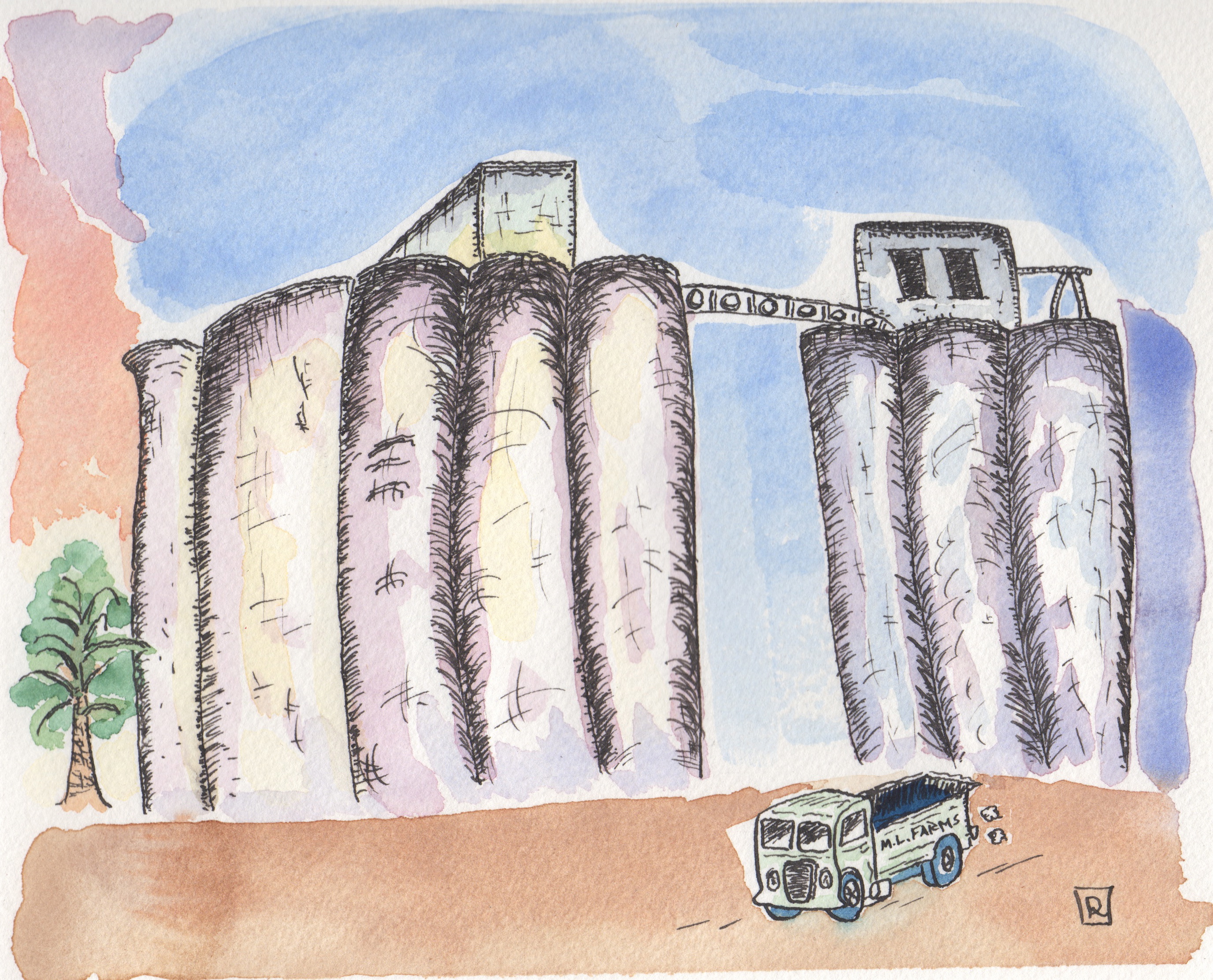
I see why grain elevators proliferated like mad–like mice, actually–starting in 1949.
This happened before Ezra Taft Benson, the crusader against Socialism, became Secretary of Agriculture in 1953, so the trend can’t be attributed to Mormon food-hoarding instincts in the face of Doomsday.
Here’s the story: Section 417 of the Agricultural Act of 1949 made an extra $8 million in cheap loans available to farmers’ cooperatives through the Commodity Credit Corporation.

Ezra Taft Benson, Ag Chief
The United States Department of Agriculture figured the private sector wasn’t keeping pace in grain storage as farmers realized increasingly bountiful crop yields. The USDA stepped in to provide the incentive to build storage capacity. The government price supports had resulted in hundreds of millions of bushels going nowhere.
Washington’s policy of building “warehouse” capacity was of enormous benefit to established outfits like Tillotson Construction Company and J.H. Tillotson, Contractor. For the principals, like my grandfather, Reginald O. Tillotson, it became a matter of dashing between farflung towns in order to make his sales pitch. And the CCC also breathed life into new organizations like Mayer-Osborn Company.
Given certain conditions, the loans–which were extended through the government’s Banks for Cooperatives–were intended to cover up to eighty percent of construction costs, with the rest funded by local sources. The eighty percent would cover $100,000 of what looks like an average cost of $125,000 around then, so we’re talking about eighty new elevators in a year’s time.
And that’s in addition to what supposedly would’ve been ordered in normal periods, although who would turn down a government subsidy and pay retail?
Indeed, I’ve already heard one story of a group forming, with maybe five businessmen kicking in $5000 each, to take up the government’s kind offer, not caring about the disposition of the grain after the three-year guarantee (on new storage) ended.
The CCC pledged it would use seventy-five percentof the additional capacity. And farmers were lining up to sell to the CCC. Indeed, build it and they will come. The more of the subsidized canisters that the government provided, the more that was needed.

United States Department of Agriculture
“The possibility that 1950 will present another storage crisis is evidenced by the latest report of the Department of Agriculture, which shows that as of Nov. 1, farmers had put approximately 353,746,480 bushels of 1949-crop[s] … under CCC price support,” reported the Farmers’ Elevator Guide in December of 1949. “This was nearly 100,000,000 bushels more than with 1948-crop produce.”
Meanwhile, the government had frozen construction of commercial buildings other than hospitals, churches, and schools. So while the traditional construction companies were fighting over those slim pickins, the Tillotsons and Mayer-Osborn, with their specialized knowledge in shaping, reinforcing, and pouring concrete, dashed back and forth like bees, covering the land from Alberta to South Carolina.
They knocked together slip-forms and jacked their way up beyond 100 feet, grinning the whole way.

Castings Plants Held Not Needed
Hutchinson’s industrial development is apparently not wanting in respect to foundries and the manufacture of metal castings.
Interviews with managers of two local firms bear this out. Frank Hulet of M.W. Hartmann Manufacturing Co., 120 North Adams, and Joe O’Sullivan, Sr., of Hutchinson Foundry and Steel Co., Washington and D, both report the Hutchinson market does not near utilize their capacities for production.
“We have more capacity available than is being utilized by local firms,” said Hulet. His company produces gray iron, alloy iron, brass, bronze and aluminum castings. In 1957 they produced 600 tons of gray iron and alloy castings. They did business in Oklahoma, Colorado, Texas, Nebraska and Missouri.
Hulet pointed out that at the present time they are capable of producing over twice that amount. The company has a second plant at 400 West 2nd in Hutchinson.
M.W. Hartmann Manufacturing Co. makes castings for such industries as hydraulic, agricultural, farm equipment, oil field and municipal. “We furnish our own castings, too,” Hulet said.
O’Sullivan said the work of the Hutchinson Foundry and Steel Co. deals principally with municipal and farm implement castings. They also make iron water well screen.
“The local demand is not over 20 per cent of our production for this area,” said O’Sullivan. He felt that production in their field was more than adequate for Hutchinson needs.
Hutchinson Foundry and Steel Co. is equipped for the heavier type casting work. They meet municipal, highway and agricultural needs and do more outlying area business than local business.
 Hutchinson has three main foundry firms, the third being Kraus, Inc., 305 South Monroe.
Hulet summed up the job Hutchinson foundries are doing in meeting local needs when he said, “In comparing Hutchinson’s three foundries with other larger cities having less, I feel there is no need for industrial development here along these lines.”
Hutchinson News, January 22, 1958
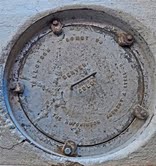
Note: Manhole covers used in elevators built by Mayer-Osborn Company and J.H. Tillotson, Contractor were made by Hutchinson Foundry. In 2011, a new foundry was announced as a complement to Hutchinson’s growing wind energy industry.

When I was out to Nebraska with the kids to see my Mom and Dad in 2011, we took the long way home to Illinois and stopped at Blencoe, Iowa, to see the grain elevator.
Dad helped to build it with Grandpa and Mayer-Osborn Company in the summer of 1954, just as he was starting his last year of college.
Blencoe is a tiny Monona County town of about 200 people. It’s just off Interstate 29, halfway between Council Bluffs and Sioux City.
In March of 1954 Mayer-Osborn won the contract from Blencoe Co-operative Company, worth $153,000, to build the 259,000-bushel facility. It featured a stepped, rounded headhouse.

Dad and his brother Dick laid the rebar during the concrete pour as the elevator went up. Dad had to go back to school before construction was finished because football practice was getting under way.
On my visit, I stopped at the office, where they had a notebook with the fifty-year history of the cooperative. They were proud of their elevators at Blencoe, and the folks there showed me around.
This elevator is very similar to the elevator Grandpa built in McCook, Nebraska.

 By Kristen Osborn Cart
Long before my grandpa William A. Osborn started working in the elevator business, his father Arthur K. Osborn lost his Nebraska farm when the loan he co-signed for a son-in-law went bad. This occurred around the start of the Great Depression. Being the eldest son, Grandpa had to find another way besides farming to make a living. He was in the National Guard for a time when he was very young, and afterward he worked as an auto mechanic and in construction.
His first car was a Model A Ford. Around 1939, he bought a used 1936 Chevy. By 1945, after he had worked for Tillotson Construction Company, of Omaha, and had moved from a farm where they rented into town, he bought a 1941 Chevy. That was the last used car he owned.

Alice and Bill Osborn, in back, with their brood, from left: Dick, Audrey, Jerry--and the '36 Chevy.
In 1948 Grandpa bought a 1948 Chevrolet sedan. Two years later, he bought a 1950 Buick Special, brand new, and also purchased two new 1950 Chevy sedans. My Dad’s brother Dick likely paid for one of them, which he drove. Grandpa and Grandma went to Oklahoma to pick up the other one for Grandma and drive it back.
These purchases came after Mayer-Osborn Company was established and their first project, the elevator in McCook, Nebraska, was finished.
In 1951 Grandpa bought a new 1951 Buick Roadmaster. Two years later he bought a 1953 Packard, but soon the engine block cracked, so the next year he bought a new 1954 Cadillac and another new Chevrolet for my grandmother. After Grandpa moved to Denver, Dad lived alone with Grandma for a number of years, and he had the use of her car when he worked his first teaching job at Luther College in Wahoo, Nebraska, in the fall of 1955. After 1956, Dad purchased her ’54 Chevy for $1000 and had it when he moved with Mom to Denver. He paid it off by 1961.

Kristen's dad, Jerry, with the 1950 Buick Special.
Grandpa retired from Mayer-Osborn in 1955. He drove his Cadillac until the early ’60s when he bought a new Oldsmobile that he drove for a number of years, finally trading for his last car, a 1968 Olds, which is presently in Dad’s barn. I remember that car and sitting on its burning hot seat in the middle of summer, the inside smelling like softened plastic. I remember when it was new, with seats as wide as a park bench and a big round steering wheel.

Dick Osborn with 1950 Chevy Deluxe
Grandpa did pretty well in his business. There was still a good nest egg after he died in 1977. He had to have a good reliable vehicle because he certainly put on the miles.

Page City elevator as seen January 26, 2012
The elevators without a headhouse were called straight-up elevators. J. H. Tillotson, Contractor and Mayer-Osborn Company produced these in the latter 1940s and early 1950s. Their elevators had a smaller diameter pipe that came out about three-quarters up the rail side. Loading a boxcar was time-consuming.
About 1958, there were improvements added for quicker loading of boxcars. These images show the Page City, Kan., elevator. Notice the rail loading chutes are much larger and there are two chutes, so the grain could be loaded equally. These chutes were on all concrete elevators raised during the late 1950s and 1960s. Most boxcars could be loaded within fifteen minutes, whereas on the old wooden elevators it could take up forty-five minutes.
The Page City elevator was built by Johnson-Sampson Construction Company, of Salina, Kan. It was built about 1958 or 1959. Did Gene Mayer draw up the blueprints for this elevator? We don’t know where he went after the Mayer-Osborn era, which ended after 1955.
Another improvement is the area around the driveway. You can see the three reinforcing columns above the driveway and door. I would think this would add greater strength. The Kanorado, Kan., elevator has a smaller version built out. It is established that Gene Mayer produced the plans for that elevator.


