Kristen’s visit to her grandfather’s elevator in Blencoe, Iowa

Story and photos by Kristen Osborn Cart

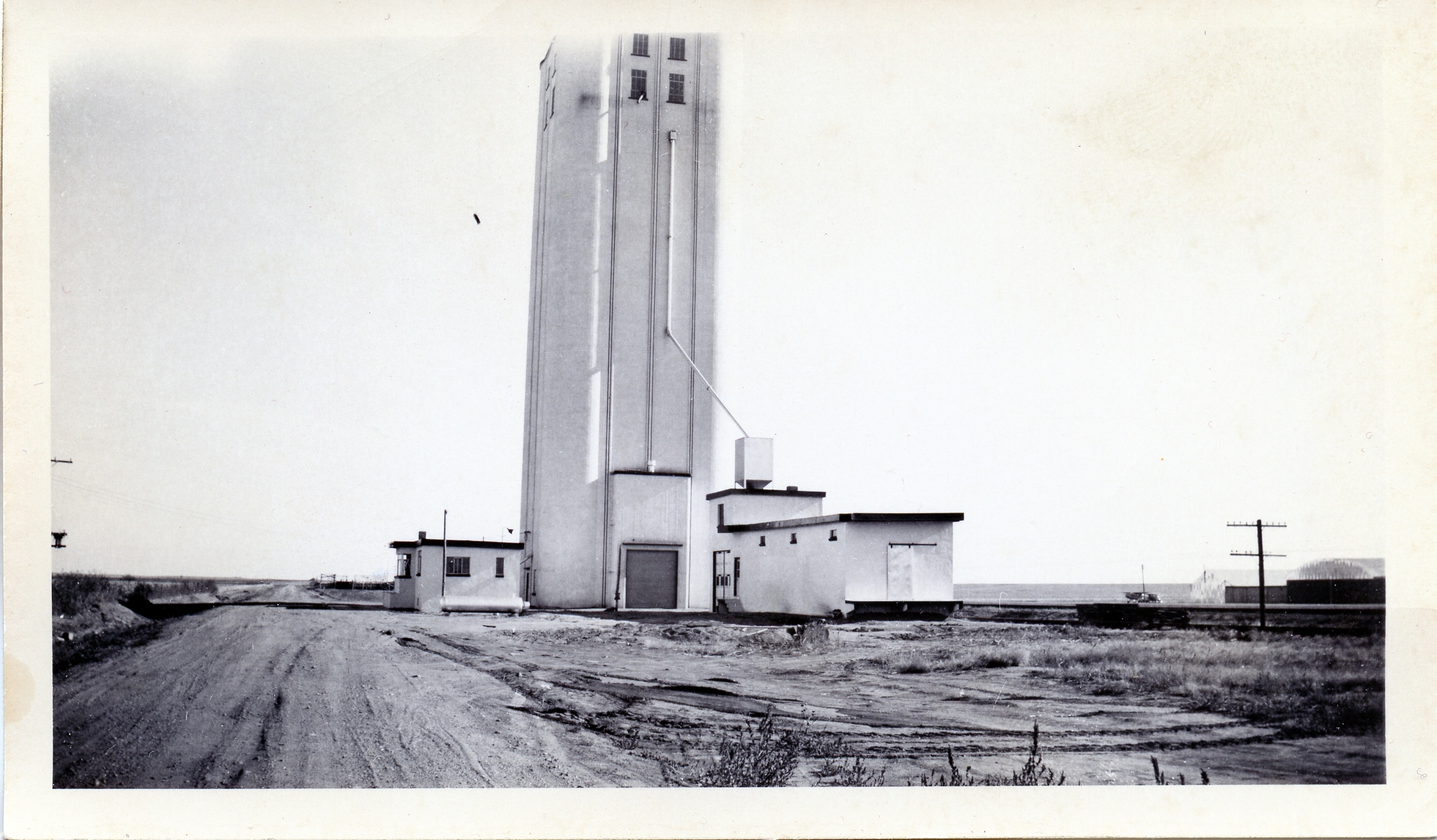
When I was out to Nebraska with the kids to see my Mom and Dad in 2011, we took the long way home to Illinois and stopped at Blencoe, Iowa, to see the grain elevator.

Dad helped to build it with Grandpa and Mayer-Osborn Company in the summer of 1954, just as he was starting his last year of college.

Blencoe is a tiny Monona County town of  about 200 people. It’s just off Interstate 29, halfway between Council Bluffs and Sioux City.

In March of 1954 Mayer-Osborn won the contract from Blencoe Co-operative Company, worth $153,000, to build the 259,000-bushel facility. It featured a stepped, rounded headhouse.

Dad and his brother Dick laid the rebar during the concrete pour as the elevator went up. Dad had to go back to school before construction was finished because football practice was getting under way.

On my visit, I stopped at the office, where they had a notebook with the fifty-year history of the cooperative. They were proud of their elevators at Blencoe, and the folks there showed me around.  

This elevator is very similar to the elevator Grandpa built in McCook, Nebraska.

Memories of William Osborn’s automotive fleet from A to Olds

By Kristen Osborn Cart

Long before my grandpa William A. Osborn started working in the elevator business, his father Arthur K. Osborn lost his Nebraska farm when the loan he co-signed for a son-in-law went bad. This occurred around the start of the Great Depression. Being the eldest son, Grandpa had to find another way besides farming to make a living. He was in the National Guard for a time when he was very young, and afterward he worked as an auto mechanic and in construction.

His first car was a Model A Ford. Around 1939, he bought a used 1936 Chevy. By 1945, after he had worked for Tillotson Construction Company, of Omaha, and had moved from a farm where they rented into town, he bought a 1941 Chevy. That was the last used car he owned.

Alice and Bill Osborn, in back, with their brood, from left: Dick, Audrey, Jerry--and the '36 Chevy.

In 1948 Grandpa bought a 1948 Chevrolet sedan. Two years later, he bought a 1950 Buick Special, brand new, and also purchased two new 1950 Chevy sedans. My Dad’s brother Dick likely paid for one of them, which he drove. Grandpa and Grandma went to Oklahoma to pick up the other one for Grandma and drive it back.

These purchases came after Mayer-Osborn Company was established and their first project, the elevator in McCook, Nebraska, was finished.

In 1951 Grandpa bought a new 1951 Buick Roadmaster. Two years later he bought a 1953 Packard, but soon the engine block cracked, so the next year he bought a new 1954 Cadillac and another new Chevrolet for my grandmother. After Grandpa moved to Denver, Dad lived alone with Grandma for a number of years, and he had the use of her car when he worked his first teaching job at Luther College in Wahoo, Nebraska, in the fall of 1955. After 1956, Dad purchased her ’54 Chevy for $1000 and had it when he moved with Mom to Denver. He paid it off by 1961.

Kristen's dad, Jerry, with the 1950 Buick Special.

Grandpa retired from Mayer-Osborn in 1955. He drove his Cadillac until the early ’60s when he bought a new Oldsmobile that he drove for a number of years, finally trading for his last car, a 1968 Olds, which is presently in Dad’s barn. I remember that car and sitting on its burning hot seat in the middle of summer, the inside smelling like softened plastic. I remember when it was new, with seats as wide as a park bench and a big round steering wheel.

Dick Osborn with 1950 Chevy Deluxe

Grandpa did pretty well in his business. There was still a good nest egg after he died in 1977. He had to have a good reliable vehicle because he certainly put on the miles.

Page City structure exemplifies functional and aesthetic aspects of elevator design

Page City elevator as seen January 26, 2012

Story and photos by Gary Rich

The elevators without a headhouse were called straight-up elevators. J. H. Tillotson, Contractor and Mayer-Osborn Company produced these in the latter 1940s and early 1950s. Their elevators had a smaller diameter pipe that came out about three-quarters up the rail side. Loading a boxcar was time-consuming.

About 1958, there were improvements added for quicker loading of boxcars. These images show the Page City, Kan., elevator. Notice the rail loading chutes are much larger and there are two chutes, so the grain could be loaded equally. These chutes were on all concrete elevators raised during the late 1950s and 1960s. Most boxcars could be loaded within fifteen minutes, whereas on the old wooden elevators it could take up forty-five minutes.

The Page City elevator was built by Johnson-Sampson Construction Company, of Salina, Kan.  It was built about 1958 or 1959. Did Gene Mayer draw up the blueprints for this elevator? We don’t know where he went after the Mayer-Osborn era, which ended after 1955.

Another improvement is the area around the driveway. You can see the three reinforcing columns above the driveway and door. I would think this would add greater strength. The Kanorado, Kan., elevator has a smaller version built out. It is established that Gene Mayer produced the plans for that elevator.

Mysteries surround the origin of Mayer-Osborn Company and its first elevator

By Gary Rich

Let me explain about Wauneta, Neb. I got into a lot of trouble there last week. It was my wife that gave me the trouble. I went into the office trying to gain some information. The lady working inside went into the back room. She had all kinds of blueprints. I wasn’t about to pass up a chance looking at them. It took me over them minutes to look at everything. Needless to say, somebody was over the boiling point when I got back out to the car.

Let me give some other information that we thought about J.H. Tillotson, Contractor. Kristen and I thought Mayer-Osborn took over when Joe passed away. Now, I have proof that this wasn’t the case at all.

I found blue prints that pointed to Denver, but more towards Mayer-Osborn. One set of prints was not for an elevator. It was like footing foundations for a building. One set had the date in the body of blueprint, then there was a box in the lower right hand corner that had the company and another date. The first one had Orrie J. Holmen, Designer, Denver, Colo., but no company name was written there. The body of the blueprint had 1948, but the lower right corner showed 1949.

I found another set that had in the lower right-hand corner the following information; Holmen & Mayer, Designers & Engineers, Denver, Colo. So once Joe Tillotson passed away, I believe Orrie J. Holmen took over the company. We know that Gene Mayer worked for Tillotson–both Tillotson Construction, of Omaha, and J.H. Tillotson, of Denver–as well as Bill Osborn. But I could not find any dates for these blueprints.

Yet another set of blueprints had Holmen & Mayer, 1717 East Colfax, Denver, Colo. This is the exact address that is on the Mayer-Osborn brochure. I found even another set of blueprints, which are not blue. They are on clear paper or yellow paper. It shows the old elevator, which is the one without the headhouse. In the lower right-hand corner, it has the following information; Mayer-Osborn, 5100 York Street, Denver, Colo. But there is no date in the lower right corner box.

Kristen found a small article in the Farmers’ Elevator Guide which was a monthly magazine. It told about Mayer-Osborn moving to the address at 5100 York St. It stated that it gave them more room at this location.

This is my guess and my guess only that this is the way company names happened:

  1. J.H. Tillotson, Contractor
  2. Orrie J. Holmen or Holmen Construction
  3. Holmen & Mayer Construction
  4. Mayer-Osborn Co.

Kristen originally told me that Mayer-Osborn started in 1946. I still think the company name was Tillotson. She mentions that Mayer-Osborn built the McCook, Nebr., elevator, which was their first; however, the plaque inside the elevator shows 1949.

I am planning another trip to Wauneta in a few weeks. I will try to get permission to get into the elevator, so I can see whose name is on the manhole covers. This will tell us for sure, if it Tillotson or Mayer-Osborn who built the original elevator. I am thinking the original elevator was built either 1947 or 1948.

I want to get to the elevators in McCook, too. The one that Mayer-Osborn built there was another elevator standing a ways from the newer elevator. It is one that has no head house, too. I am hoping that they will let me inside this elevator, so I can find out who built this elevator. Some elevator managers are willing to let me inside the elevators, while others say that I can not go inside due to insurance. I am trying to get inside as many elevators as I can before it comes down that no one will be allowed inside.

♦ ♦ ♦

Kristen Cart explains:

Some of the mystery can be explained by the sequence of events leading to the establishment of the Mayer-Osborn Company.  J. H. Tillotson, Contractor was owned by Joe Tillotson. My father told me that Mr. Morris, Joe Tillotson’s construction superintendent, died in a roadside accident while changing a tire early in 1947. Within a month, Joe Tillotson died in a car accident, which we know was in March 1947. The only one left in the company who had contractor experience and construction expertise was William Osborn. It seems apparent to Dad that Gene Mayer had an independent architecture and engineering firm, which worked on projects with J. H. Tillotson, Contractor. For a period of time Gene Mayer was partnered with Orrie Holmen. My Dad says his father started an independent company called Osborn Construction, but it became very immediately apparent that he needed a partner.

This differs from Gary’s interpretation, but since Gary was at the site, talking to the people there, his thinking about it carries some weight. So we need to find more documentation.

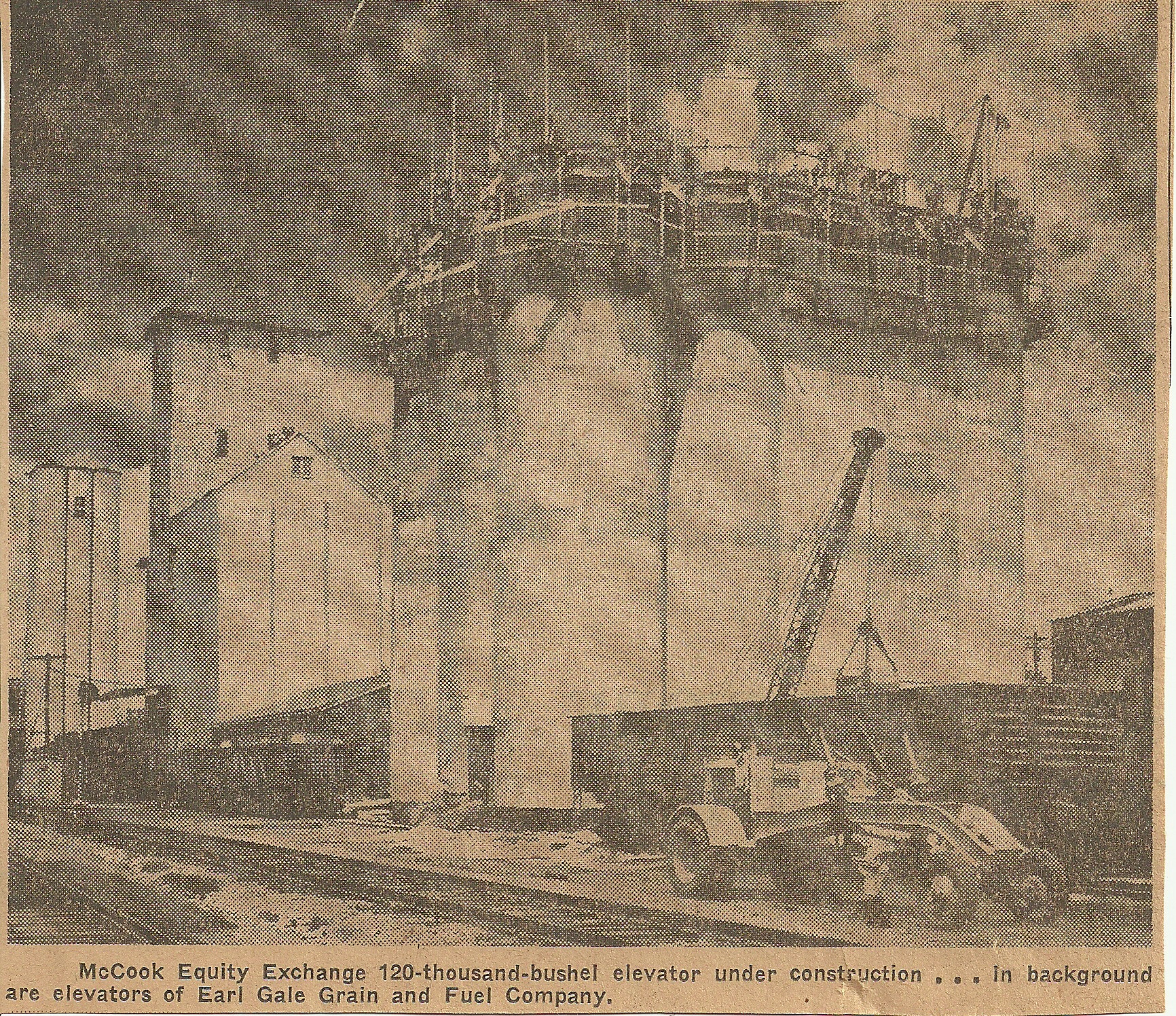
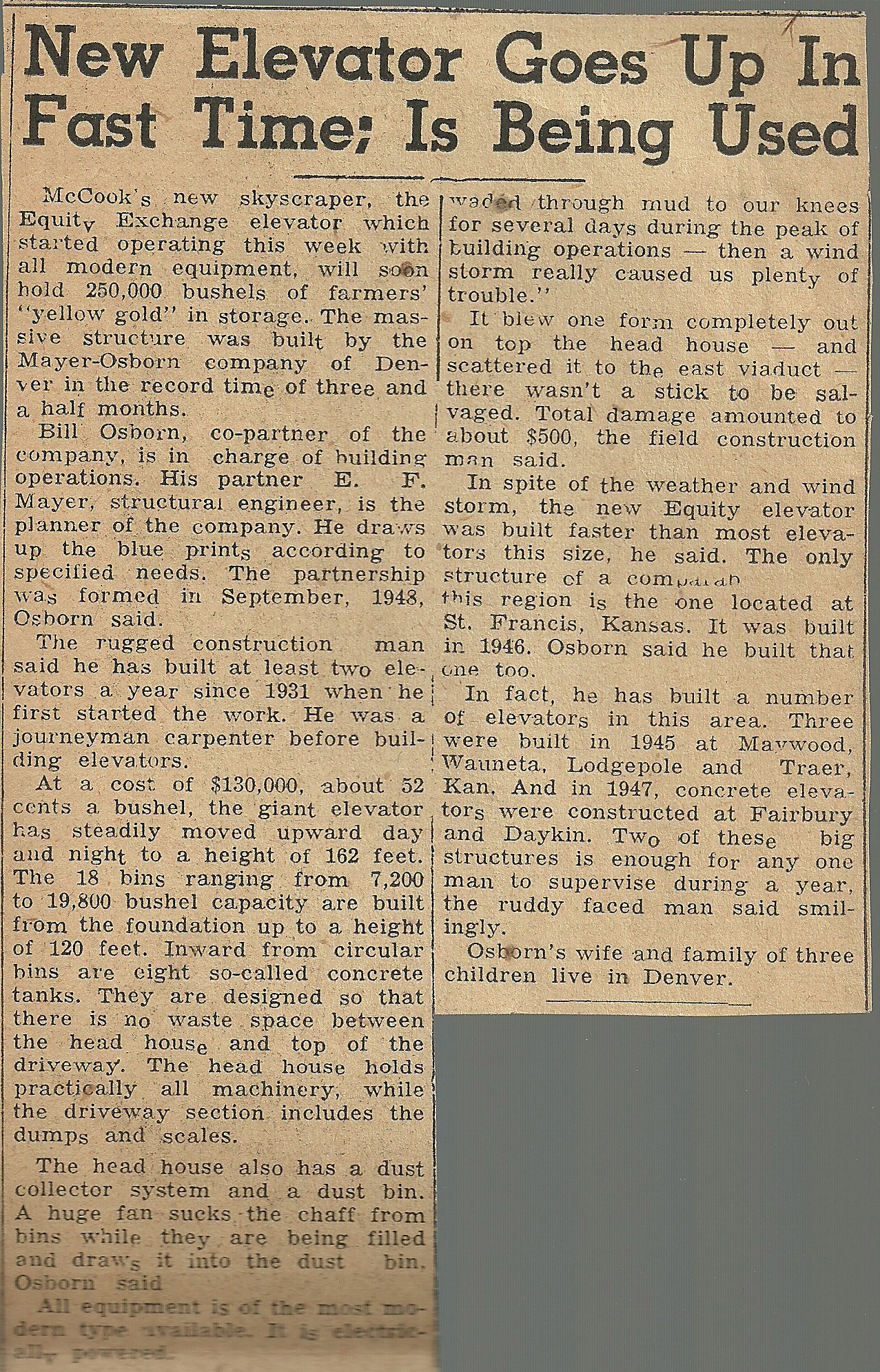
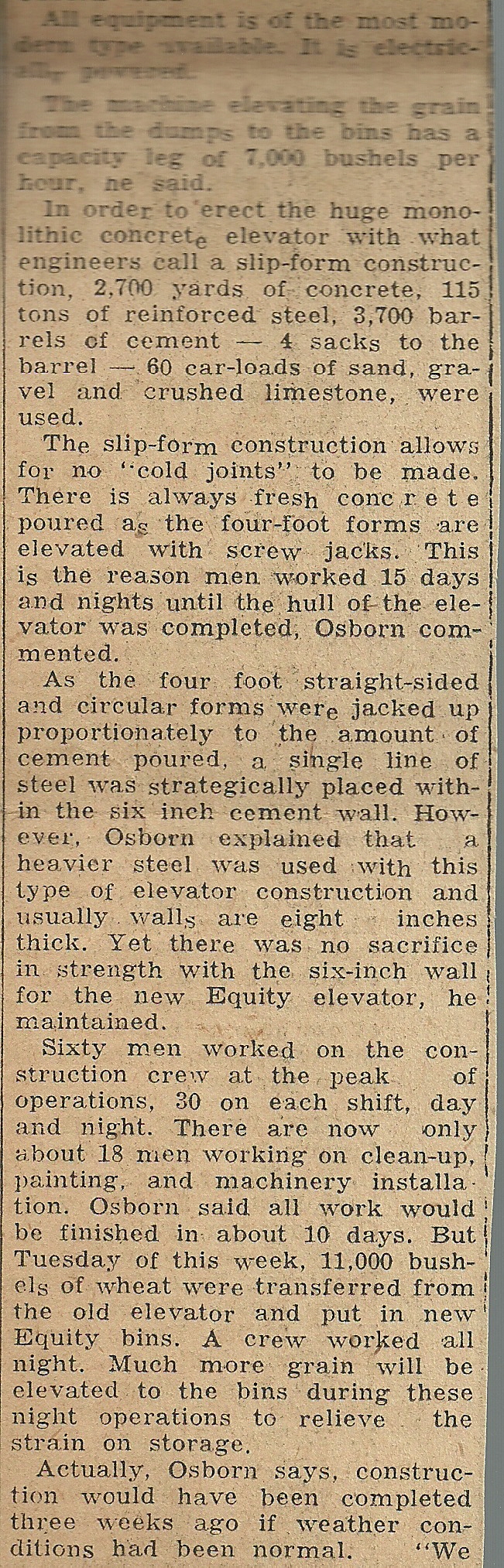
In a newspaper story about the building of the McCook elevator in 1949, Bill Osborn was interviewed. He said Mayer-Osborn was incorporated  in September 1948. We do not have any documentation of William Osborn’s interim business other than two elevators that he said he built in 1947, according to the same newspaper account, in Fairbury and Daykin, Nebraska. They probably fulfilled contracts already won by J. H. Tillotson, Contractor.

In the same newspaper article, the author said the Wauneta elevator was built in 1945, which makes us wonder about the purpose of the later dated blueprints that were found there. The yellow blueprint that Gary found at Wauneta could only have been produced after May, 1953, which is when the Farmers’ Elevator Guide announced Mayer-Osborn’s move, from 1717 East Colfax Avenue in Denver, to 5100 York Street in Denver.

The sequence of events Gary describes above accurately tracks Gene Mayer’s business of engineering and architecture that built these elevators.  The business relationship that existed with my grandfather is something we will continue to explore.

William Osborn’s photo of the Kanorado, Kansas, elevator

By Kristen Osborn Cart

This is an image that was in my grandfather’s papers when he died. It was his photo, since he was the only photographer in the family. This was the only elevator image he identified on the back. The caption was “Kanorado, KA, 125,000 bu.” I know Grandpa worked on it because he photographed it. We know it was built before March of 1947, which was the month Joe Tillotson died.

Grandpa was working for Tillotson Construction of Omaha as late as the fall of 1944 through the spring of 1945, when Giddings, Texas, was built. Dad visited Grandpa on the Giddings job, so he was able to date it–they visited in early 1945, the spring, when Dad turned eleven years old. That means the Kanorado elevator was built circa 1945 to 1947.

It may be hard to find information on Joe Tillotson’s business because he was independent for such a short time–even though there were quite a few elevators to his name.

¶ Ronald’s note: While posting this, I gave Kan-o-RAY-do a call and was told that original records pertaining to the elevator’s construction burned in an office fire.


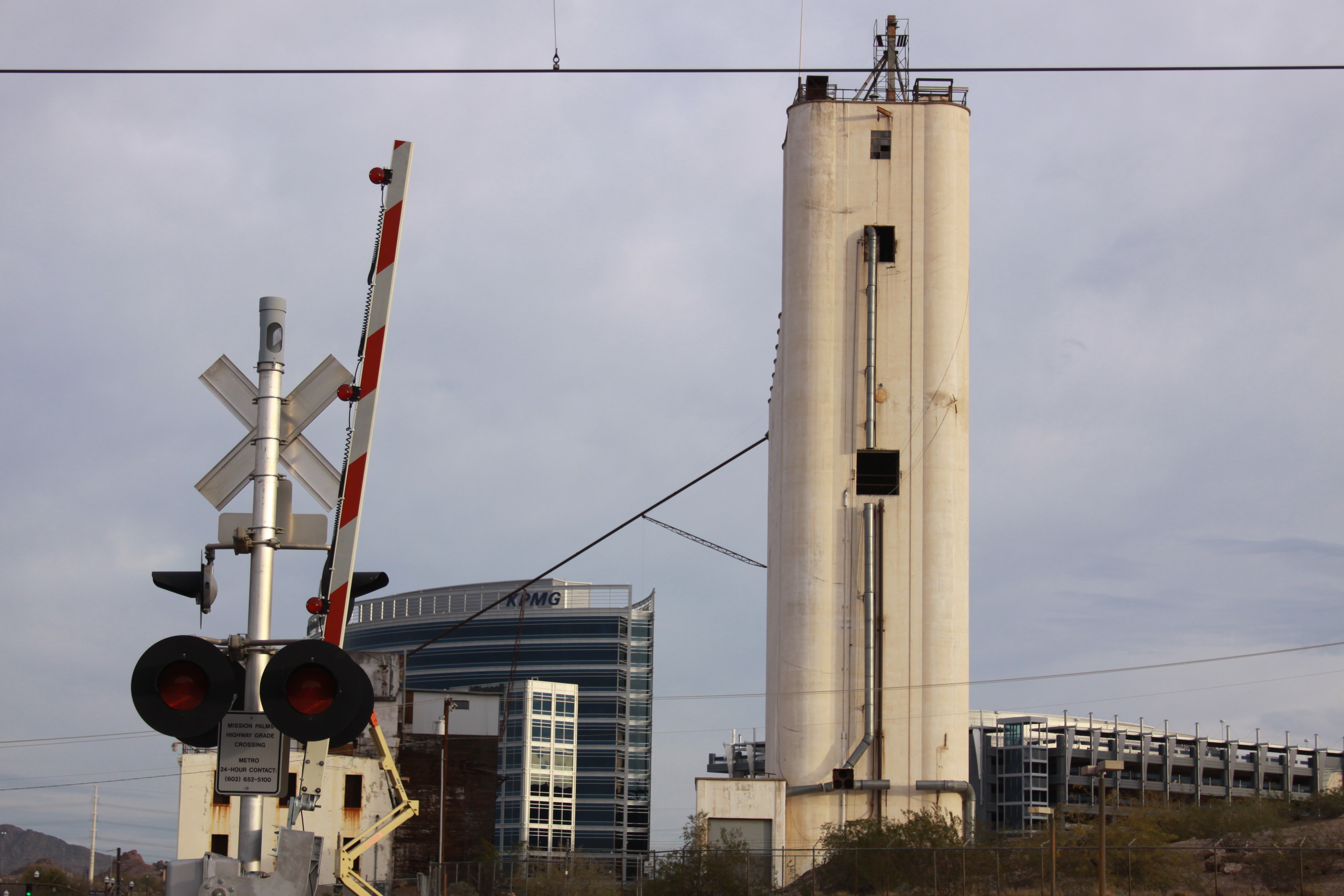
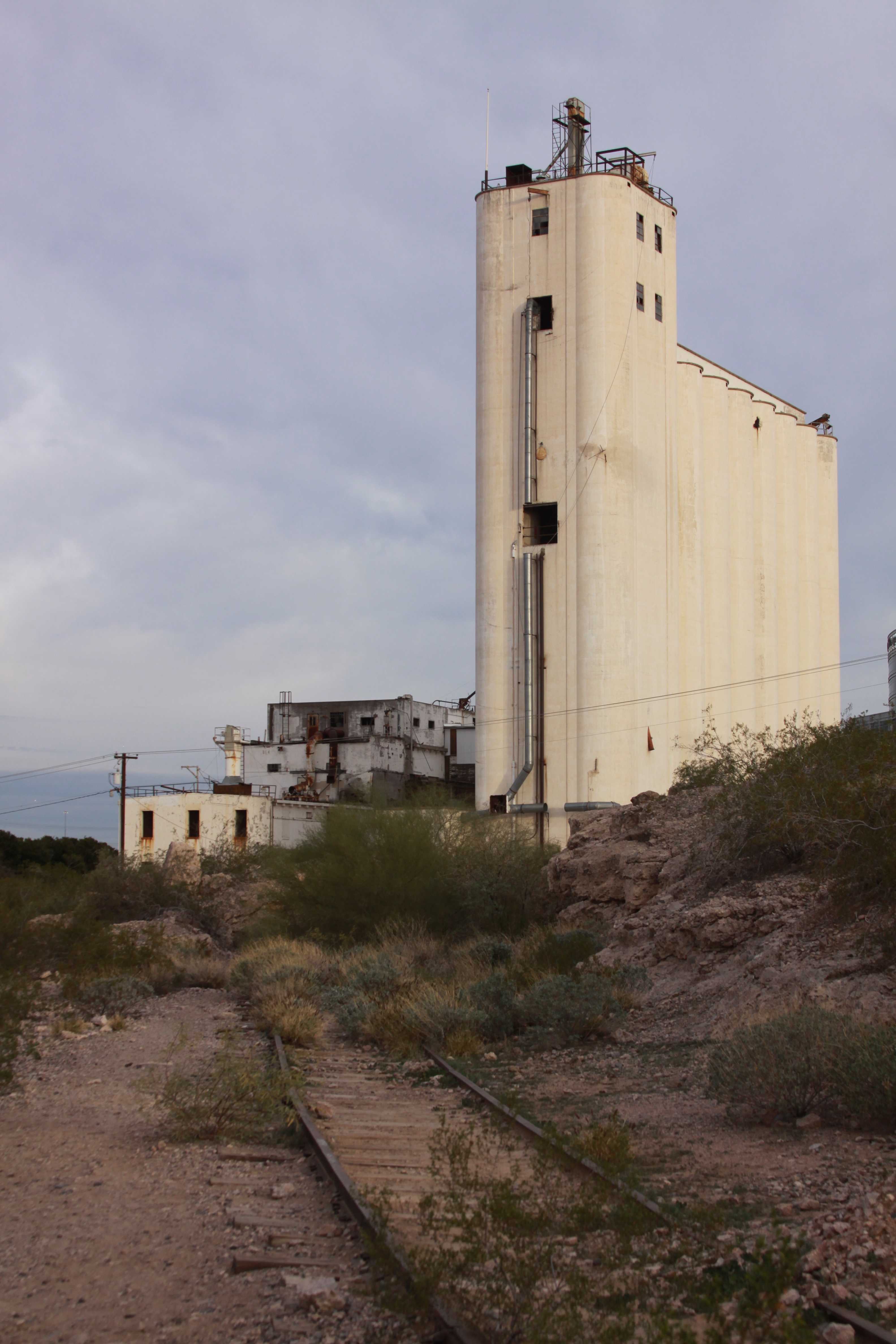
In Tempe, a Mayer-Osborn elevator complements the historic Hayden Mill

Story and Photos by Ronald Ahrens

Tempe, Ariz.–Ensconced amid sleek office buildings on South Mill Avenue here, the Hayden Flour Mill represents the very origin of this city now best known as the home of Arizona State University.

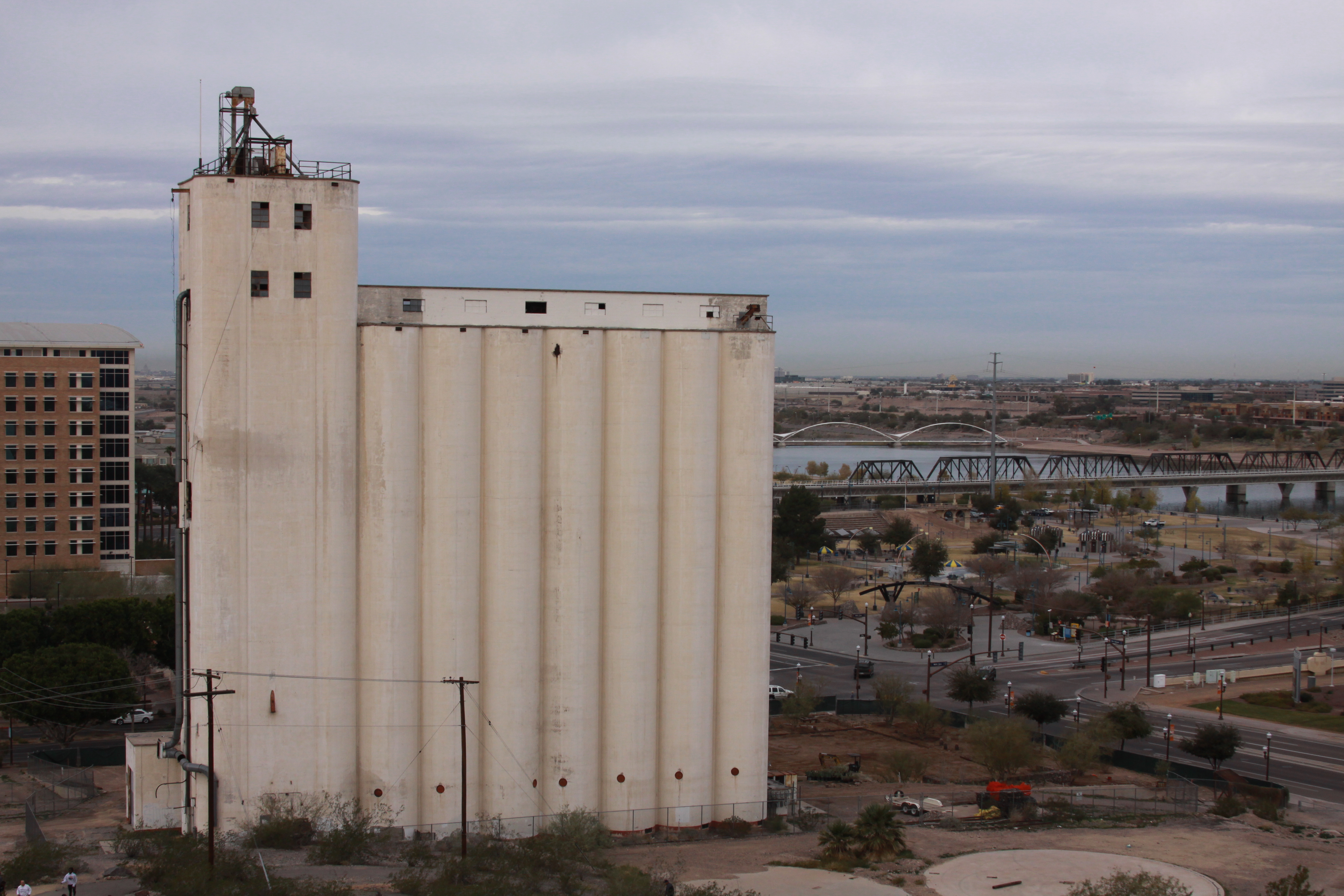
Charles Trumbull Hayden’s mill was built of adobe in 1874, burned in 1917, and rebuilt in concrete in the following year. In 1951, Mayer-Osborn constructed the elevator beside it, looking up to Hayden Butte, which is famous as the freeloader’s vantage point for watching football games in Sun Devil Stadium to the east.

The mill and elevator fell into disuse in the 1980s.

plan announced in 2011 (with implementation already overdue) calls for the mill building to get a coat of paint and a lawn as the first step in a redevelopment effort.

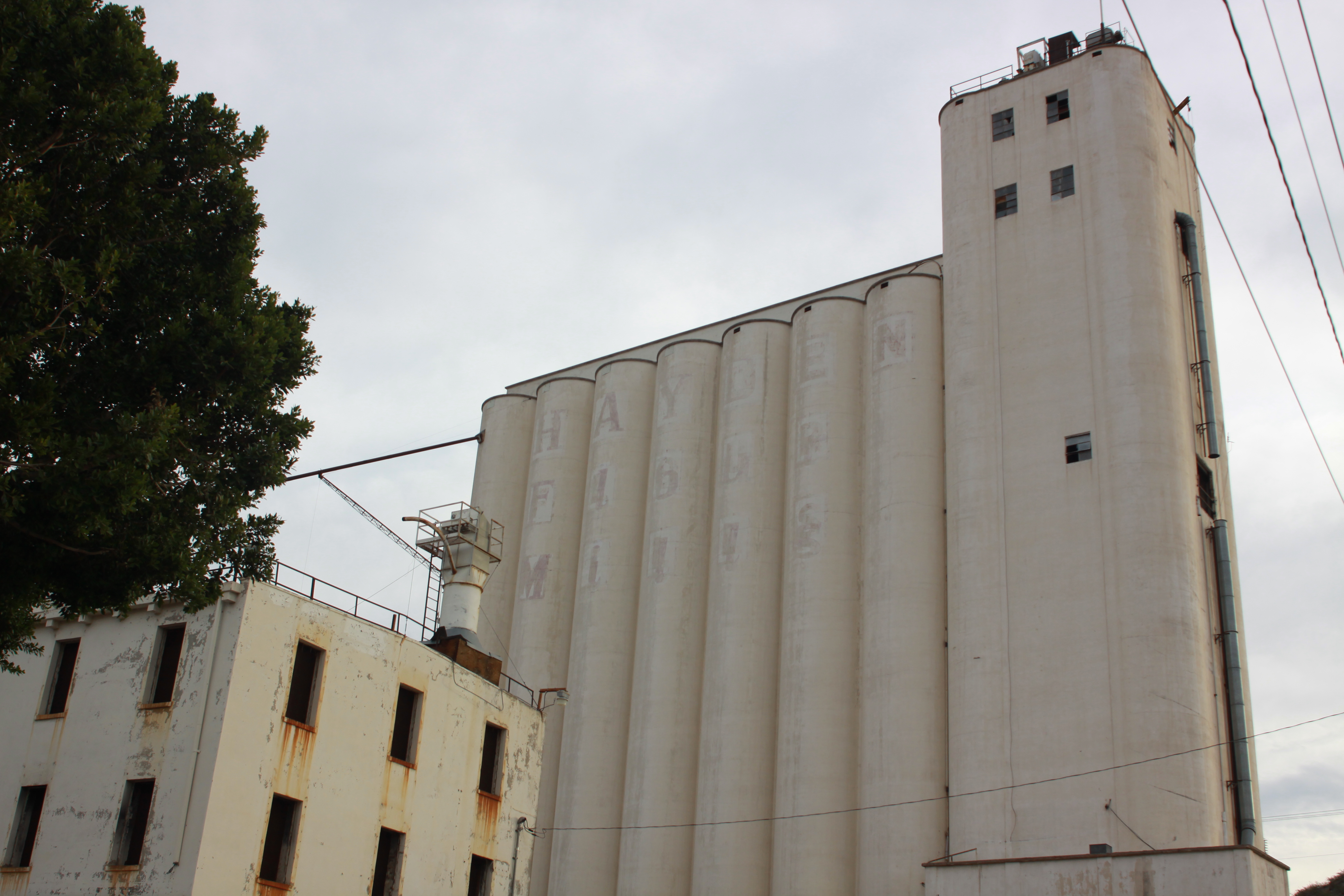
The elevator could use some new glass while they’re at it. And wouldn’t it be interesting if the lettering on the west side of the seven silos were restored?

I was in Scottsdale last weekend for the Barrett-Jackson auction and made a run down to Tempe on Saturday morning. It was impossible to make out the second name in faded paint on that west side. Is it Hayden Elbup Mills?

At any rate, this is a handsome elevator.

With a little thought–designers, awaken!–it could be an interesting complement to the surroundings.

Leland Ulrich explains some facts about Mayer-Osborn’s elevator in Burley, Idaho

Story and photos by Kristen Cart

Burley, Idaho, January 18—I spoke to Leland Ulrich, manager here for the past seventeen years, and learned some particulars about this town’s Mayer-Osborn elevator. Mr. Ulrich replaced the old manager, Ivan, long since passed, who apparently had the building’s plans and pictures and history. That investigation is for another visit, since their whereabouts is unknown.

Mr. Ulrich took me for a short tour. I had to put on a hardhat to go inside. The vertical, rectilinear part of the building houses the headhouse way on top, with a “run” protected by a tin roof that went out from it to all of the round bins. The tin roof was a bit of an oddity, he said, but it was original. Most are concrete. The elevator was designed for seed, both barley and wheat, for farm planting.

Formerly a wood and metal elevator was beside it, but it burned in the late-1950s. Some of the big metal parts in the new building might have been that old, salvaged, but there was no way to be sure.

But the elevator built by Mayer-Osborn was all original. The number one bin, closest to the part that houses the head house and the man lift, was empty and I could look inside, but it was too dark to see anything. The bins have sloped floors at a pretty good angle so the last of the seed could be emptied down below, in the “pit.” Whether it was carried out of there by conveyor or some other means is something I missed. The “leg,” he said, in the bin adjacent to the number one bin, went all the way to within eight inches of the top, to facilitate proper distribution between the bins.

(Maybe Gary Rich can add a comment explaining what on earth that means.)

I did ask Mr. Ulrich what the ports are used for, and it is for access—so someone could get into the bins. So “manhole covers” it is. The port cover that was removed on the number one bin, which I’d peeked into, was only identified as Hutchinson foundry steel.

But there were Mayer-Osborn ports inside and out, painted and unpainted.  It’s a big elevator—much bigger than anything I’ve seen of theirs before, perhaps even as big or bigger than Tempe, Arizona.

Mr. Ulrich remembered another visitor who took pictures about ten years ago and sent him some prints. He thought Gary’s name sounded familiar, especially when I mentioned he worked for the railroad.

There is an old citizen in town named Lou Dilley, whose father, known as Pop, built the older flour-mill elevator. Mr. Dilley is said to be in his eighties and loves to tell about the history of the town. He apparently worked on his dad’s construction jobs. So if I can get back, he would be the one to see.

Comparing Mayer-Osborn elevators in Byers, Colorado, and McAllaster, Kansas

By Gary Rich

It is somewhat strange that you can have a company build an elevator, but there can be differences between two separate models. The Byers, Colorado, elevator was built by Mayer-Osborn. This model has the manhole covers on the outside of the bins, whereas the McAllaster, Kansas, elevator has the manhole covers on the inside. You will notice the manhole covers on the outside of the bins in the Byers view. Plus, there is a walkway door about halfway between the bins. The window arrangements are slightly different between these two elevators. Basically the driveway is the same on the two models.

One thing stands out like a sore thumb: whoever painted the Byers elevator painted the manhole covers. This is the only elevator where I have seen this done. Generally the manhole covers are not painted.

It would be the option of the Co-op what was wanted in the elevator. If the owners chose more options, of course the price of the elevator would increase, too.

There are two sides of an elevator. One is the track side, where the railroad tracks are located. The other side is known as the drive way, where the trucks will dump their loads.

I do not believe that the McAllaster, Kansas, elevator has been used for some years. The steel bins were empty, when I photographed here on November 14, 2011. The weeds were fairly high, and the rail spur has been removed. 

Gary Rich analyzes the leaning Maywood, Nebraska, elevator and storage annex

Ever since Kristen got me interested in the history of elevators, I am always looking for new avenues. One thing that I have noticed that Tillotson Construction Company, J. H. Tillotson, Contractor, and Mayer-Osborn Construction built grain elevators in eastern Colorado and western Kansas. However, I never knew them to build the storage annexes. There are cases in which one of these companies built the grain elevator; then another company called Chalmers & Borton would be in the same town within three to five years building a storage annex.

I was very excited when I walked up to the annex at Maywood, Nebraska. I saw the manhole covers had Mayer-Osborn on them. I knew that I found my first annex that was built by one of the three companies.

There is a major problem with this annex at Maywood. You can see the cracks in the annex and where they have tried patching them. I drove back to Maywood several days later. Part of the annex still has grain in it. I talked with a person at the office. They are planning on tearing down the annex sometime this year or 2013. They have not made up their mind if they will save the elevator or not. When you are standing looking at both the elevator and annex, it is hard to say which is leaning the most. It looks like the elevator is leaning towards the annex. But on the other hand, the annex is leaning towards the elevator. The image that shows the grain dryer, the bin nearest the elevator, has been emptied, as well as the center bin. The north side still has grain in the all the bins, as well as the bin on the southwest corner (the image that has the sunlight on it).

I finally found a grain annex that these companies built, but it will be history soon.