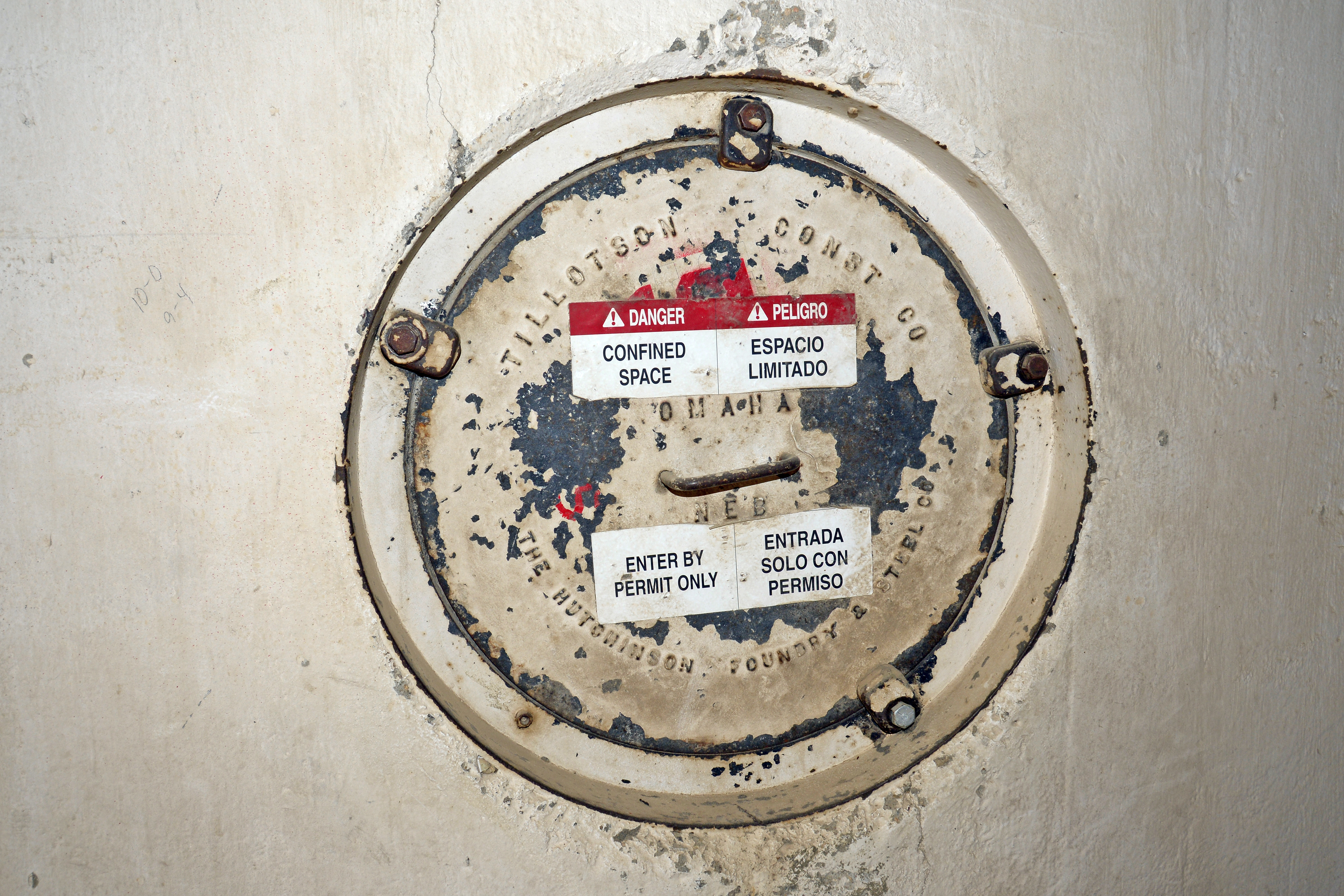
Hutchinson Foundry, where manhole covers were cast, closed in 1972

mail

Hutchinson Foundry, photo courtesy of Linda Laird

The “foundry” in Hutchinson Foundry & Steel Inc., D and Washington, will be a misnomer after Oct. 1.

Blaming federal safety requirements, the firm has announced it will shut down its gray iron foundry on that date.

Ken Green, general manager, said last week that the measure is being taken because of requirements for environmental air dust handling handed down by the Occupational Safety and Health Administration (OSHA).

Green said that the step is not being taken because of new state air quality requirements.

OSHA has not inspected the Hutchinson foundry. But Green says it would take construction of a new facility to meet the standards which are designed to prevent employees from breathing pollutants.

Hutchinson Foundry, photo courtesy of Linda Laird

Hutchinson Foundry, photo courtesy of Linda Laird

As for the state regulations, Green remains confident that the foundry could meet those regulations. In fact, the state had given preliminary approval for the preliminary design of a scrubber.

The company, which will get a new name, will continue manufacturing structural steel, fabrication and building specialties.

Closing the foundry will mean the loss of 13 employees. But Green expects some of this loss—all of it in the long run—will be offset by the manufacture of a small hydraulic iron worker.

The iron worker was designed and engineered by Harry Oswalt, Garden City, president of the Hutchinson firm. Oswalt hand-built the prototype model which is now in operation at the plant.

Manufacture of the iron worker is expected to begin within six months.

Hutchinson Foundry, photo courtesy of Linda Laird

Hutchinson Foundry, photo courtesy of Linda Laird

The foundry has been working on an arrangement with Wyatt Manufacturing Co., Inc., Salina, whereby the firms patterns and customers will be transferred to Wyatt’s foundry operation.

Hutchinson (Kan.) News, August 13, 1972 

How we know Tillotson Construction built the Burlington, Colorado, grain elevator

_DSC0033_9425

Story by Charles J. Tillotson and photos by Gary Rich

Editor’s note: Chuck Tillotson had just finished high school in Omaha when he and his two younger brothers, Tim, 16, and Mike, 13, were dispatched by their father, Reginald, to work on the family construction company’s grain elevator project in Flagler, Colo. Chuck had drawn up the plans himself in the preceding months during breaks from school. They drove out together in a 1953 Ford, towing the twenty-eight-foot travel trailer in which they would live for the duration. To the best of Uncle Chuck’s recollection, they subsisted on beans and wieners when they weren’t dining in the Flagler cafe. “That was when Tim and I weren’t screaming over to Elitches Park outdoor pavilion, in Denver, some 120 miles to the west, to squeeze in a night of dancing and return at daybreak to assume our work shift—no sleep of course.” Uncle Mike fended for himself, alone, in Flagler. 

When we were building the Flagler job in 1953, Tillotson also commenced the construction of a new elevator in Burlington, Colo. The thing I remember about that job is a story regarding a cement mixer.

We had contracted with a local hauler with a pickup truck to relocate one of our mixers to the Burlington job, which was about forty-five miles to the east on US-24.

He came one day, hitched it up to the back end of his pickup, and started off down the road. Just about where the Flagler town sign is, the road made a ninety-degree turn, and then it crossed the tracks to the south.

The hauler made the turn and started southward. Just as he crossed the tracks, his truck ran out of gas.

He ended up stalled—with the mixer straddling the tracks.

Every afternoon about 3:00 p.m., the eastbound passenger train came roaring along toward Kansas.

Well, the hauler jumped out of his truck and started running, ’cause he heard the train a-comin’, comin’ down the track, clickety-clack, like Johnny Cash sings.

The train barely slowed down as it passed through town, and it ended up smashing the mixer to smithereens.

The engine, and, as I recall at least, one of the first cars behind, were derailed.

It was a mess, but no one was injured.

That’s how I know we built Burlington.

It looks like a Tillotson elevator in Bird City, Kansas, but it’s a surprise instead

Wheeler, KS 044 copy

Story and photos by Gary Rich

I wanted some information about the Bird City Equity Co-op elevator that is now operated by Frontier Ag, Inc. Bird City is located on U.S.-36 in Cheyenne County, Kan., which is in the very northwestern corner of the state.

The Bird City elevator features a rounded headhouse.

The Bird City elevator features a rounded headhouse.

I was positive this elevator was built by Tillotson Construction Company, of Omaha, Neb. I called the elevator manager prior to my trip and drove to Bird City on Dec. 7. Upon arriving I went into the office. It was noon, so the whole crew was having lunch. I introduced myself to the manager. One employee told me there was a plaque on the outside of the elevator. I have never seen a plaque on a Tillotson elevator. I guess I should have had some qualms at this point that it wasn’t a Tillotson elevator.

We walked out to the elevator. The plaque, dated 1950, showed the elevator was built by Vickroy-Mong Construction Company, of Salina, Kan. Another interesting thing: the manhole covers in most elevators were produced by the Hutchinson Foundry, of Hutchinson, Kan, but these were made in Salina by Wyatt Manufacturing.

There have been other stories in our blog about elevators that Mayer-Osborn built and another construction company that was building identical elevators. This company was Johnson-Sampson Construction Company, of Salina, Kansas. Now, we have Vickroy-Mong building a Tillotson-lookalike elevator.

It has been demonstrated that the curved headhouse was a Tillotson signature. Did someone leave the Tillotson operation and branch out on his own, or were the plans sold to Vickroy-Mong?

In the future, I plan on photographing the Bird City elevator in more detail and will compare it closely to a Tillotson elevator.

Stay tuned for more information.

Editor’s note on Dec. 14: The reference desk at the Salina Public Library has come through with information that Carl Vickroy and Raymond Mong were partners in a company located on South 9th Street, according to the Salina city directory of 1950. Additionally, it’s possible that the Hutchinson Foundry produced the manhole covers for Wyatt Manufacturing. 

Wheeler, KS 049 copy

Concrete’s prevalence in elevator construction was ‘just a matter of time’

Photo from The American Grain Elevator: Function & Form, by Linda Laird, courtesy of Grain Elevator Press.

Photo from The American Grain Elevator: Function & Form, by Linda Laird, courtesy of Grain Elevator Press.

The American Grain Elevator: Form & Function

By Linda Laird
(Grain Elevator Press, 120 pages, $23)

Because men with shovels weren’t quite up to the task of unloading farmer’s wagons and filling rail cars with wheat or corn, grain elevators became prevalent after railroads pushed through the American grain belt in the 1870s. A line elevator, each with a mechanical leg that lifted the grain for distribution, was put up on nearly every rail spur on the prairies and plains.

imagesIn those days, elevators were made of wood in studded or crib-style construction. Although many of those buildings were clad with galvanized steel, they remained vulnerable to the prodigious quantities of sparks thrown off by visiting locomotives.

Seeking reliably fireproof structures, some buildings tried brick but found it “not a satisfactory solution,” reports Linda Laird in The American Grain Elevator: Form & Function. (Order here.) The book published earlier this year supplies useful perspective on trends as well as carefully detailing how a grain elevators works.

Ceramic tiles strengthened by steel bands have been used in building elevators, and iron and steel structures stand here and there in defiance of rust. In the latter case, several good examples from Kansas are shown by Ms. Laird, who has a background in historic preservation and devoted herself to photographing 1200 elevators in the Sunflower State.

But as she notes in her deftly written book, from the time of Peavy’s Folly, an 1899 experimental elevator near Minneapolis, the solution was at hand and “it was just a matter of time before the use of concrete would revolutionize the grain storage business in America.” Concrete was costly, but lower insurance rates helped in the recovery of costs. Much to the dismay of insects and rodents, which were always a problem at wooden elevators, the editors of influential periodicals like Grain Dealers Journal encouraged the new material’s use. Low-cost government financing later became available.

Specialized crews skilled in the slip-form technique began to create towering silos topped by fantastic cupolas, or headhouses, of varying heights. Farmers’ co-op elevators were modest jobs. Others were epic affairs like the half-mile-long, 18.3-million-bushel terminal in Hutchinson, Kan., where Ms. Laird lives.

Frank photos and helpful drawings make the results vivid, but historic images documenting the rise of Chalmers & Borton’s massive annex at Topeka, Kan.–an exercise that took just seven days in 1955–are the coup de grace.

Thanks to Ms. Laird’s splendid work, it’s easier now to understand what our own grandfathers accomplished, and how they did it. From heaps of lumber and steel on flat ground by the tracks, they ascended skyward, leaving behind functional, impermeable buildings that are also enduring monuments to enterprise and bounty.

— Ronald Ahrens

By making tricky distinctions, it’s possible to discern the builder of an elevator

Story and photos by Kristen Cart

The question whether each elevator construction company had a signature style has become a topic of intense discussion and research here, and we don’t have all of the answers yet.

Johnson-Sampson Construction Company, of Salina, Kan., built elevators that were very similar to those of J. H. Tillotson, Contractor, of Denver and Mayer-Osborn Construction, also of Denver, prompting a great deal of debate about how that came to be.

Our pages for McCook, Neb., and Blencoe, Iowa, show elevators each with a stepped, rounded headhouse and about a quarter-million-bushel capacity. It was a standard elevator style for Mayer-Osborn, even appearing in their ads, until they closed their doors in 1954.

After that date, Johnson-Sampson was building a nearly identical elevator. We don’t know whether the architect moved on to work for Johnson-Sampson or the design was sold. The elevator at Limon, Colo., is in the same style, but there is no indication who built it—no paperwork, and no name on the manhole covers or the interior of the elevator.

Mayer-Osborn’s elevator at Kanorado, Kan., shows the company’s typical grooved vertical style.

So the question becomes: was the style proprietary to one company or to one designer who sold his design to all comers?

The Kanorado, Kan., elevator was built by Mayer-Osborn, in a design adopted from J. H. Tillotson, Contractor, after Joe Tillotson died in 1948. The same company essentially carried on under the new partnership of William Osborn and Eugene Mayer, and some of the earlier designs remained unchanged. The grooved vertical lines are only found on elevators made by those two companies.

Identical detailing can be found on elevators in Lodgepole and Wauneta, Neb., and Monument, Traer, and Goodland, Kan., among others—all of which were built by J. H Tillotson.

Another example, at Page City, Kan., comes from Johnson-Sampson, as proven by the manhole covers. The operator says it was built in the late 1950s. It looks very similar to the elevators in Wauneta, Neb., and Traer, Kan., built by J. H. Tillotson before his death in 1948. A few details and dimensions differ, and in this case the changes appear to be distinctive for Johnson-Sampson elevators. I feel fairly confident that the Page City elevator is an example of an identifiable Johnson-Sampson design.

Johnson-Sampson’s elevators in Brandon, Colo., and Page City, Kan., are clones to each other. They look very much like the Mayer-Osborn design but have slightly different dimensions and lack the vertical grooves.

Arriba, Colo., is another of the same type.
Johnson-Sampson’s Page City elevator lacks the vertical grooves.

My best guess is the larger, successful companies had a few standard designs for their customers. If a customer wanted to request a proposal, they would give specifications, and the company would customize to meet the described needs, presenting the plans in their contract bid. Upon acceptance, the elevator would rise, with enough differences from the basic design to make it unique.

A few telltale details suggest the builder’s identity, but you can’t be absolutely sure until you see a document or a manhole cover to confirm your suspicion.

Unsolved mysteries abound at Tillotson Construction’s Elkhart, Kansas, elevator

Story and photos by Gary Rich

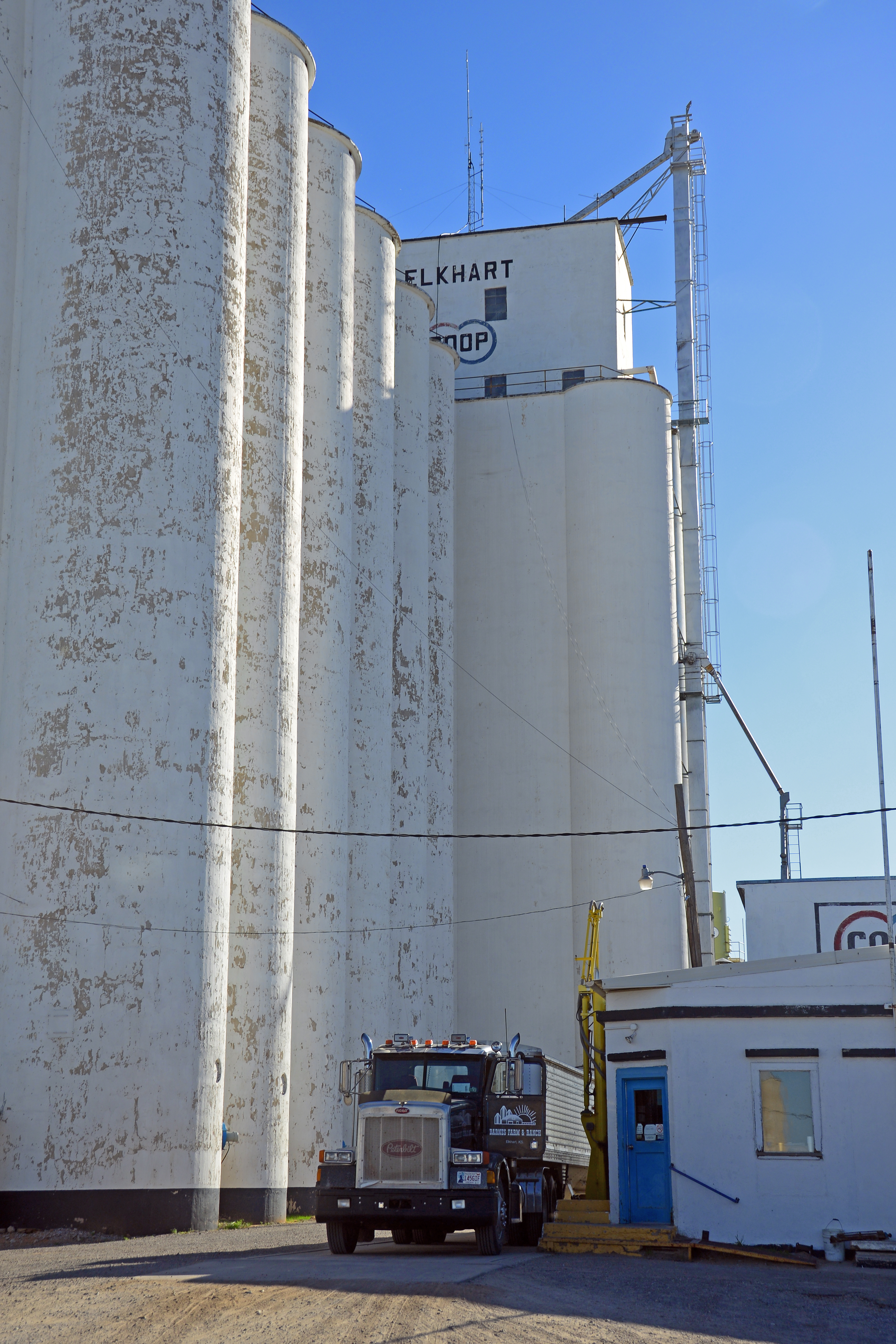
Elkhart is located in extreme southwestern Kansas. This is Morton County. The 2000 census showed Morton County had 3,196 people, of which 2,036 live in Elkhart. The town sits just north of the Oklahoma border and is about 8 miles east of the Colorado border. The area has been known for wheat production. However, this has changed in the past few decades. Corn and milo are now grown as spring crops.

Tillotson Construction Company received the contract from the Elkhart Equity Co-op for the first concrete elevator built in Elkhart. Construction started in late 1945 and finished in late spring 1946. The elevator had a 225,000-bushel capacity.

I was totally shocked when I first viewed this elevator. The Elkart Co-op had three different elevators built over the years. Plus they added five different annexes. Tillotson built what is now known as Elevator Number One.

Elevators Number Two and Three were built by Chalmers & Borton, as well as all annexes.

Was the Elkhart elevator Tillotson’s first? Elkhart was started 1945.

Once I realized which elevator in Elkhart was the Number One, I noticed that it had a rectilinear headhouse. This is quite different from Tillotson’s other elevators. It has been thought that one Tillotson signature was the curved headhouse. Is the Elkhart elevator a one-of-a-kind?

Tillotson did one other thing different on their headhouses from other construction companies.

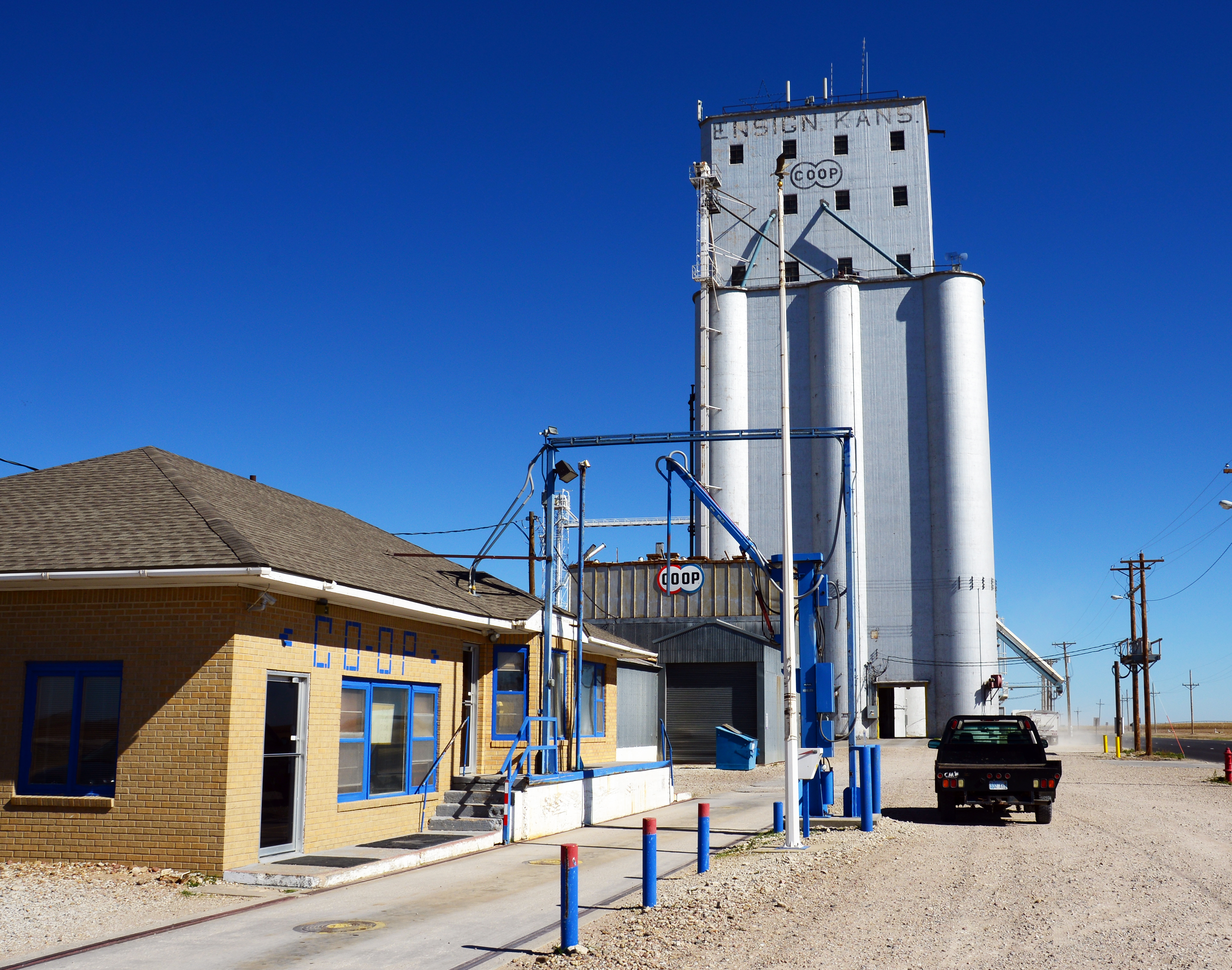
The long side of the headhouse had two different rows of windows. (You can view the window arrangements of other elevators on this blog, such as those in Rolla and Satanta, Kansas, as well as Ensign, Kansas.)

Could the Elkhart elevator actually have been the first line-elevator that they built. Why did they change to the curved headhouse in their future construction? Was it more cost effective, more efficient, or was it designed to distinguish their elevators from those of their competitors?

I wish to thank Morgan Walls, operations manager-Elkart Equity Co-op for much of their history.

Tillotson Construction’s grain elevators often varied in capacity

The allotment of grain to bins is shown in this chart inside the Satanta, Kansas, elevator.

Story and photos by Gary Rich

Tillotson Construction Company erected grain elevators of different capacities that could meet the unique demands of Midwestern and Plains farmers’ co-ops. Such was the case in southwestern Kansas.

Satanta, Kansas

Satanta and Rolla are towns located along U.S. Route 56. Satanta, named for the Kiowa chief, is in Haskell County and Rolla is in Morton County. The two towns are 42 miles apart.

As noticed in towns in Colorado, Iowa, and Nebraska, the Satanta elevator is of larger capacity. This elevator is now part of United Prairie Ag.

The elevator in Rolla, however, has a much smaller capacity. This was probably due to the Co-op not having the funds to build one larger. Rolla was constructed around 1954, maybe a little earlier, and is now owned by the Elkhart Co-op Equity Exchange.

While it’s a smaller elevator, there was no stinting on style. Tillotson’s signature curved headhouse graces the top of the structure.

Once again, Tillotson met the demands of the local community and the Co-ops.

The annex to Tillotson’s Rolla elevator was built by Hamilton. We don’t know much about this company.

The other elevator at the site was done by Borton Construction around 1964.

The beautifully curved headhouse distinguishes Tillotson’s smaller elevator in Rolla, Kansas. The annex, center, was built by Hamilton, and the newer elevator, right, by Borton Construction in 1964.

How Tillotson Construction made a good first impression with the Ensign Co-op

Story and photos by Gary Rich

During the late 1940s and early 1950s many Kansas co-ops were planning new elevators. Grain production was increasing; thus, the old wooden elevators were not large enough. Ensign Co-op, located in Gray County thirteen miles southwest of Dodge City on US-56, needed a new one.

Looking for a concrete elevator with a lot of capacity, the Co-op contacted Tillotson Construction Co., of Omaha, Nebr. I am guessing the elevator was built around 1950 or 1951. Ensign Co-op has since changed hands several times. There are no records or blueprints available.

The first annex, seen right, was of single bins and allowed a path for trucks.

The elevator Tillotson Construction built was of a very unique design. First of all, it did not have a curved headhouse like so many other elevators they were building.

Secondly, this elevator had a double driveway. Many elevators built at that time had a single driveway. The use of semis hauling grain to the elevator was many years away. The only vehicles bringing grain to the elevator were farm trucks and pickups.

When the Ensign Co-op needed further expansion, they contacted Tillotson, which built the first annex east of the elevator. This probably occurred in 1952 or 1953.

The double driveway created some engineering problems. The annex had to be built at an angle from the elevator. This would allow trucks using both driveways a path around the new annex. The first annex was set a distance from the elevator.  Tilloston solved the problem, making the annex with eleven bins. The first bin was a single bin, while the others were double bins.

About 1957, Ensign Co-op was looking at additional expansion. Tillotson was contacted again. They built the second annex, connected to the first, in 1958. Nine double bins increased the total capacity to twenty-nine bins.

Typical of the company’s later projects, the second annex’s manhole covers included the year of construction. All manhole covers inside the elevator and first annex have “Tillotson Construction, Omaha, Nebr.”–but no dates.

Tillotson built the elevator as well as the first and second annexes. The company produced a quality product as the Ensign Co-op kept contacting the company for additional capacity. The Ensign Co-op had to be very impressed with their work. 

This is a rare case where Tillotson built an elevator and then returned to the same town and built several annexes. Generally other construction companies built the expansions.

Tillotson Construction’s Giddings, Texas, elevator rose by 10 feet per day but then disappeared entirely

By Ronald Ahrens

The Fairmont Foods Co. elevator that Tillotson Construction Co. built in Giddings, Tex., around 1945 became the hub of a busy and diverse agricultural service, one that had started a decade earlier.

As part of its Giddings operation, Fairmont, of Omaha, Neb.–just like Tillotson Construction–ran the largest turkey dressing plant in the Southwest. Every year, over 200 carloads shipped from here for the Thanksgiving and Christmas markets. During other parts of the year, the dressing plant stayed busy with chickens destined for such grocery chains as Weingarten’s, which in 1951 had twenty-five stores in Texas, Arkansas, and Louisiana.

Besides the poultry dressing, Fairmont processed eggs here and had a locker plant described as “huge” in the June 13, 1974 centennial edition of the Giddings Times & News. A hatchery and feed-mixing plant completed the operation.

On July 14, 1955, the Times & News carried the following item:

Fairmont Foods Co. has announced the sale of its feed mixing plant in Giddings to the Nutrena Mills, Inc., of Wichita Falls and Minneapolis, Minn.

Change of ownership will take place officially about July 15. Nutrena is one of the nation’s oldest and largest feed manufacturers. Nutrena feeds are distributed in a 24-state area from the Rocky Mountains to the Southeastern coast and from Canada to Mexico.

Fairmont Foods recently observed the 20th anniversary of their opening in Giddings. Fairmont officials emphasize that they will continue to serve their customers with the poultry processing plant.

The former site of the Fairmont Building has been paved over. Photo by Ray Kirchmeyer.

In 1966, Nutrena remodeled the offices. But few traces of the operation remain today. Tillotson’s Fairmont Building was demolished, and a bare parking lot is found at the site.

Special thanks to Ray Kirchmeyer for providing the photo and historical documents. 

Related articles

In 1945, William Osborn worked on Tillotson Construction’s elevator in Giddings, Texas

A Galveston seaside respite for the Osborns and Salroths in 1945

Gary Rich’s analysis reveals subtle aspects of Mitchellville, Iowa, elevator operation

Story by Gary Rich
Photos by Kristen Cart

There are several possibilities as to why Heartland Co-op’s Mitchellville, Iowa, elevator would only use rail service for shipping out its grain. The most obvious one is that this might be a shuttle operation. Whether corn or soybeans, the company that receives the grain might have a contract with the elevator specifying shipment of a certain number of carloads per week. It is probably a larger-name company, and they could be paying for the shipping charges. This would keep their operation from having to shut down for lack of grain.

The photos appear to show nine or ten covered hopper cars at the elevator’s far right. In the view at top, we see yellow markings on the rail on the elevator track. This is known as the “clearance point.” You can’t have cars sitting beyond these markings without “fouling” the main line. The following links to lexicons of railroad terminology will explain both terms:

http://www.icrr.net/terms.htm
http://cfr.vlex.com/vid/214-7-definitions-19944901

Here’s an illustration why it’s cheaper to move grain by rail. The amount of grain in one covered hopper car leaving the elevator equals three semi-trailer loads. If you load ten hopper cars, you’re probably looking at an equivalent of around thirty-three or thirty-four semi-trailers. If the plant that receives the grain is over 200 miles from Mitchellville, it would take more than a week to move all that grain over the highway.

Indeed, if the plant is 200 miles away, you also have to consider the amount of time a trucker can work. He wouldn’t be able to cover two round-trips per day. And besides, the trucker’s charge of something over $4.00 per mile might erode all profit for the grain operation.