Details, details! Here’s more about the finished grain elevator at Alta, Iowa

The finished elevator. Photo from the Neil A. Lieb Archive.

The finished elevator. Photo from the Neil A. Lieb Archive.

Commentary by Neil A. Lieb, with photo from his archive

That’s the west side of the elevator. If you were bringing grain in, you would go in that door and out the other door. See that railroad track? All elevators I’ve ever been near, seems you go in the back side and out the front side. You see the second row of windows? You see where the last “A” is? That’s where the motor sets. The belt would be on the right-hand side of the driveway. The driveways are always offset to one side, and the belt to the other side. The drive motor sits about where that “A” is, maybe about the top. It sits on top of two I-beams. They go into the wall of the headhouse and the wall of the shaft that drives the belt. The lettering was done after we left. Tillotson didn’t have anything to do with it. Some sign company came in and did it. They used lead anchors. It had a steel in the middle and lead sleeve on the outside. You can go to a hardware store and still buy them. They had a drill—they called a star drill—and you hit it with a hammer. You hit it, you turned it. You hit it, you turned it. You use a five or seven pound shop hammer to hit it with. Now they have drill bits that cut through concrete. There’s probably an anchor, on the T, at each corner, the middle at the top, and the bottom. The big letters have three or four. The small letters have two. I have no idea, I didn’t do it. See the dark part at the bottom of the pipe, that’s flex pipe so you could put it in the grain car.


Visitors from 113 countries checked in on grain elevators in 2014

The WordPress.com stats helper monkeys prepared a 2014 annual report for this blog.

Here’s an excerpt:

The concert hall at the Sydney Opera House holds 2,700 people. This blog was viewed about 16,000 times in 2014. If it were a concert at Sydney Opera House, it would take about 6 sold-out performances for that many people to see it.

Click here to see the complete report.

How a grain elevator works: A motor will power the ‘leg,’ lifting the grain from ground level

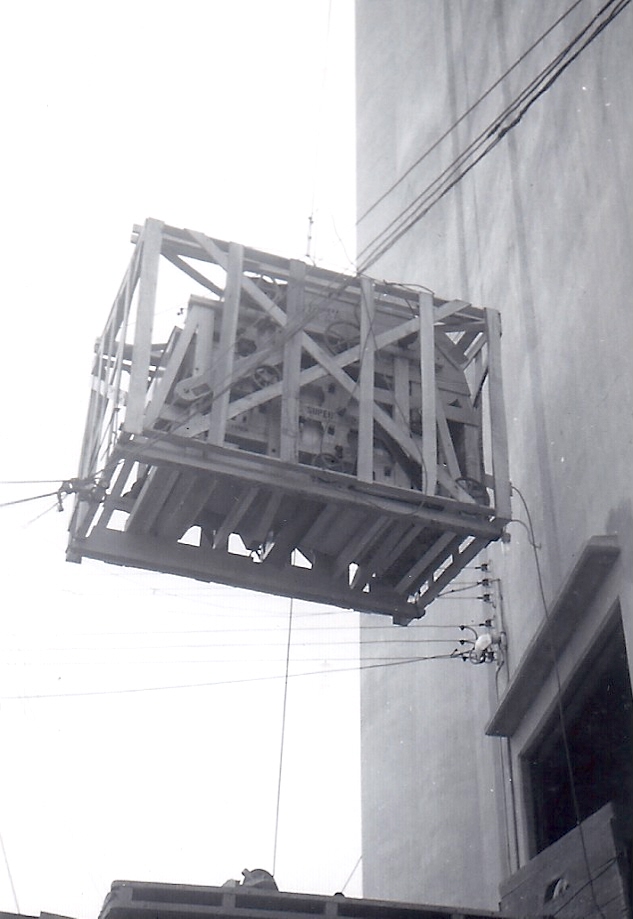
In this 1950 photo from Neil Lieb's archive, he explains what we see inside a crate that's being hoisted to the top of the Alta, Iowa, grain elevator. "That’s the motor for the belt and probably the gearbox," he says. "We didn’t take it out of the crate till we got it on top because the crate was designed so we could lift it. That little crane could hold a lot of weight.

In this 1950 photo from our contributor Neil Lieb’s archive, he explains what we see inside a crate that’s being hoisted to the top of the Alta, Iowa, grain elevator. “That’s the motor for the belt and probably the gearbox,” he says. “We didn’t take it out of the crate till we got it on top because the crate was designed so we could lift it. That little crane could hold a lot of weight.”


During the Alta, Iowa, elevator’s construction, temporary bins held the grain


scan0020

In this 1950 photo from Neil Lieb’s archive, our contributor explains what we see in this view from atop the newly completed elevator in Alta, Iowa. “Those were storage bins for the excess before the elevator was built,” he says.


How a grain elevator works: Moving grain from the silo to a rail car

scan0019

That pipe is used to run the grain down to the railroad cars when they’re shipping it. Inside of that tank, there’s a hole that connects to that pipe. The system works [this way], you open a tank at the bottom, and run the grain into the pit. You use a belt to take it to the top and into this pipe. Commentary by Neil Lieb, photo from his archive. 

Collin Quiring delivers a load of corn to Tillotson’s Aurora South elevator

IMG_5453

Collin Quiring, a 26-year-old reader of this blog who farms with his brother in Henderson, Nebr., made contact and offered to send some photos when he took a load of grain to the Aurora South elevator, which was built by Tillotson Construction Company in 1959.

Collin had first commented on one of Kristen’s posts.

A view of Tillotson Construction Company's Aurora South elevator, as seen Nov. 2, 2014, by Collin Quiring.

A portrait of Tillotson Construction Company’s Aurora South elevator, as seen Nov. 2, 2014, by Collin Quiring.

“It’s funny that you drove through Hampton,” he wrote. 

“I’ve been following this blog for a while now and started looking at all the manhole covers on elevators that I haul to, and sure enough there were a lot of Chalmers-Borton, Tillotson, and Mayer-Osborn elevators around.

Hampton has the manhole covers on the outside of the silos and they’re 10 feet or so off the ground, so I’ve been wondering who made it for a while now!

It looks like you just saw the one downtown elevator in Aurora though?

The other elevator is called Aurora South and is on the southwest edge of town. It used to be a Cargill elevator, but Aurora Coop purchased it.

I’m pretty sure that’s a Tillotson elevator, too.”

So Collin did some more reconnoitering and took pictures on his next run.

IMG_5454

Collin’s view from the scale house.

“We’ve been alternating where we were taking corn, and I was planning to get back there for a few more pics.

But harvest will be over in an hour.

So I won’t be getting back there anytime soon.

Here’s what I did get while trying not to hold up the line.

End of this week or beginning of next I will be hauling to Hampton and will send you some from over there.”

Two days later, he made the run to Hampton but found it was not a Tillotson elevator; instead, it was built in 1959 by Grain Storage Construction Company, of Council Bluffs, Iowa.

‘A Tillotson unique feature: the end of the headhouse is round’

Neil Lieb Collection

Commentary by Neil A. Lieb, photo from his archive

The concrete work is finished. You see those windows up there? The end of the headhouse is round because it’s hard to lay steel on a square corner. When you’re laying rebar, you have long straight sticks. Corners are hard to do. The is a Tillotson unique feature, as far as I know. It looks good because it matches the contours of the rest of the building. It was functional because the steel of the tank comes in about four pieces, and you lay them and they overlap. It was pretty exacting. You worked on your knees all night, up and down. You got the steel off the rack and you had to get down under neath and run it under all that stuff. And you did that over and over. The day that we were going to put the glass in the windows, those were steel-frame windows. There’s a little metal clip that holds the glass. You put the putty on the outside and you’re all done. The day we were doing that, the wind was blowing so hard, it was breaking the glass as we were put it in. We had to quit because of the danger of flying glass. They bought some different glass that was stronger, double-strength glass. It was just one of those things. All of a sudden, boom, this flying glass comes across the room at you.

Filled with concrete, a nail keg counterbalanced the rooftop crane

scan0017

Commentary by Neil A. Lieb, with photo from his archive

See the little cornice atop the tank? Those are forms for the cornice, the overhang. They call them eaves on a house.

The roof was poured before the headhouse went up.

That crane is a concrete-hoisting crane.

The headhouse is quite an operation because you had to hoist the concrete up to the top of the tank. And then they had a deck crane, and you had to hoist it [the concrete] to the top.

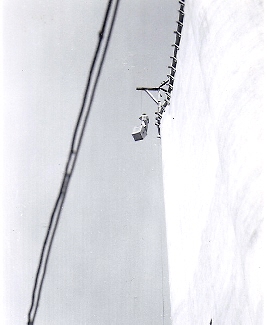
Every job I worked on, they used a nail keg that had been filled with concrete as a counterbalance weight. When you went up and down on the cable to go to work, that’s what you stood on—two guys, one foot each. That’s all there was room for.

It didn’t take that long, about fifteen or twenty seconds.

The motor and cable were down on the ground.

The operator had a shed to keep him out of the rain and sun.


Summer 1950: All finished with the main house in Alta, Iowa

scan0016

Commentary by Neil A. Lieb and photo from his archive

From a telephone interview on July 22, 2014

It’s all done. It looks like they’re putting scaffolding up for painting. The main hoist is on the left. That’s a Georgia buggy hanging on the hoist. The guy that’s standing there is going to push it as soon as it hits the deck. They might be just starting on the headhouse. I can’t figure that scaffolding out. It’s a rigid scaffolding.