Timeline for Tillotson Const., J.H. Tillotson, and Mayer-Osborn companies and jobs

Ronald Ahrens and Kristen Cart cofounded this blog. Gary Rich is a primary contributor. We have visited elevators around the United States and Canada.

Ronald’s maternal grandfather was Reginald Oscar “Mike” Tillotson.

Kristen’s paternal grandfather was William Arthur Osborn.

Reginald O. Tillotson

R. O. Tillotson

Reginald’s company was Tillotson Construction Co., of Omaha. The company had been building and repairing wooden elevators since the 1920s, when it was led by Reginald’s father Charles H. Tillotson. Before his death, experiments were made with slip-form concrete construction techniques.

1938: Charles dies, and the company passes to his sons Reginald and Joseph H. Tillotson and daughter Mary V. Tillotson. They begin to perfect slip-forming and refine their design strategy, which includes a rounded headhouse.

1945: Tillotson Construction builds a concrete elevator in Giddings, Tex. William Osborn works on this project. He is probably employed by the company by late in ’44. Tillotson Construction wins the contract to build in Elkhart, Kan., and starts construction.

1946: The 225,000-bushel elevator in Elkhart is completed. “Shortly after the war, my Dad and Joe decided they couldn’t see eye to eye, so they split,” writes Charles J. Tillotson in “The Tillotson Construction Story” on this blog. Joe forms J.H. Tillotson, Contractor in Denver. William Osborn works for Joe Tillotson.

William A. Osborn in 1965

William A. Osborn in 1965

1947: Tillotson Construction builds  the Vinton Street elevator in Omaha. Joe Tillotson dies in a car accident in March. J.H. Tillotson, Contractor builds at Daykin and Fairbury, Neb., and Hanover and Linn, Kan., with William Osborn supervising the projects. Maxine Carter leaves Tillotson Construction on Oct. 7 to wed Russell L. Bentley.

1948: Formed in September from the residue of J.H. Tillotson, Contractor, the Mayer-Osborn Company builds its first elevator at McCook, Neb. Joe Tillotson’s wife Sylvia was a Mayer, and her brother Eugene Mayer is one of the partners. William Osborn is the other. Meanwhile, Reginald begins to use a light airplane for business travel in the postwar years. Reginald’s nephew John Hassman joins Tillotson Construction in September; among many other duties, he pilots the company plane to jobs in Nebraska, Kansas, and Oklahoma. Tillotson’s projects that year are in Paullina, Iowa, and Montevideo, Minn.

1949: John Hassman’s father Ralph, Reginald’s cousin, joins Tillotson Construction in sales and stays through 1952.

1950: Construction begins in November on the Tillotson house, which is built of concrete. It still stands north of Omaha. Tillotson employee Jess Weiser weds Lavonne Wiemers on Dec. 22.

1951: Drafted into the Air Force, John Hassman leaves Tillotson Construction in January.

Related articles

An inside look at the J. H. Tillotson elevator at Hanover, Kansas

The J. H. Tillotson straight-up elevator in Hanover, Kan. just after a rain

The J. H. Tillotson straight-up elevator in Hanover, Kan. just after a rain. 

Story and photos by Kristen Cart

One of the loveliest elevators J. H. Tillotson, Contractor ever built is still in use at Hanover, Kansas. Last October, during a visit to this small Washington County town just seven miles south of the Nebraska border, I photographed the elevator under moody skies and marveled at its clean, graceful lines. Then it was time to get to the business of finding out about it.

DSC_0681

Ryan Riekenberg takes a moment to show me around the elevator.

Fortunately, Ryan Rieckenberg, a twenty-year employee of the Farmers Cooperative Association, was on hand to show me inside. He had previously worked for the grain department and currently worked as a crop sprayer. He said before the Hanover location joined the Worchester-based Farmers Cooperative, it operated its own association called the Farmers Union of Hanover. He said the elevator was currently used for milo.

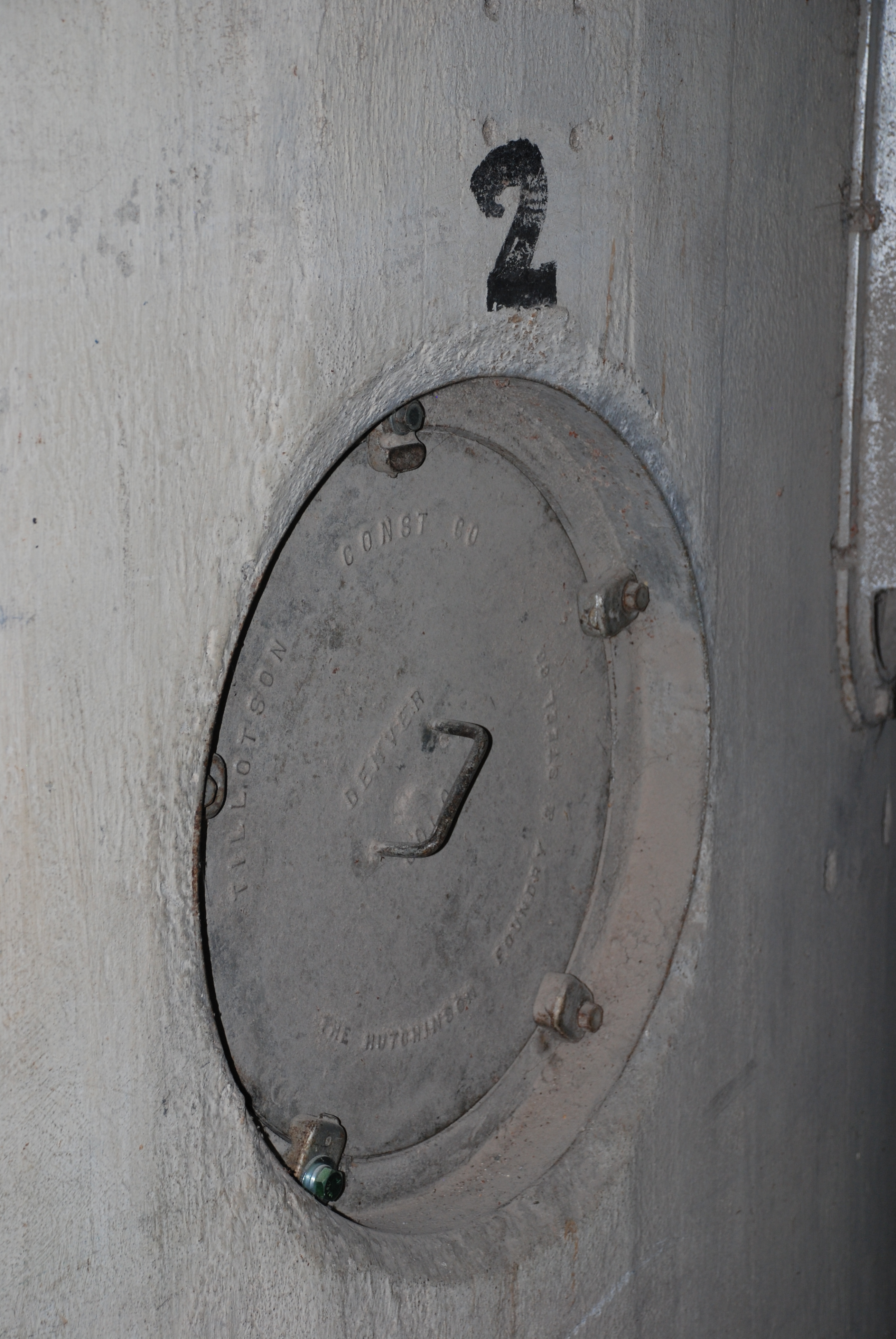
The manhole cover identified the builder

Manhole cover

He pulled up in his truck, fished out his keys, and took me into the elevator to look at its interior, including the manhole covers that positively identified the elevator as a J. H. Tillotson project.

As he unlocked the door, Ryan supplied some historical details. The elevator had been built beside an old wooden elevator, which was used as a feed mill until it was demolished about eight years ago. We entered the doorway a couple of steps up from the gravel drive where the old wooden edifice used to stand.

DSC_0673

The elevator leg

Once inside, we could see the leg in the center of the elevator. A grate covered the pit, and Ryan opened the grate to display the sloped bottom where the grain would funnel toward the base of the leg, to be scooped up and carried to the top of the elevator for distribution to the bins. The leg extended all the way to the bottom of the pit. A ladder went into the pit from another opening, providing access for cleaning and maintenance.

Nearby, a cage-enclosed man-lift gave access to the integral head-house at the top of the elevator. The cage was almost certainly a later modification, since the old man lifts didn’t have them.

DSC_0670

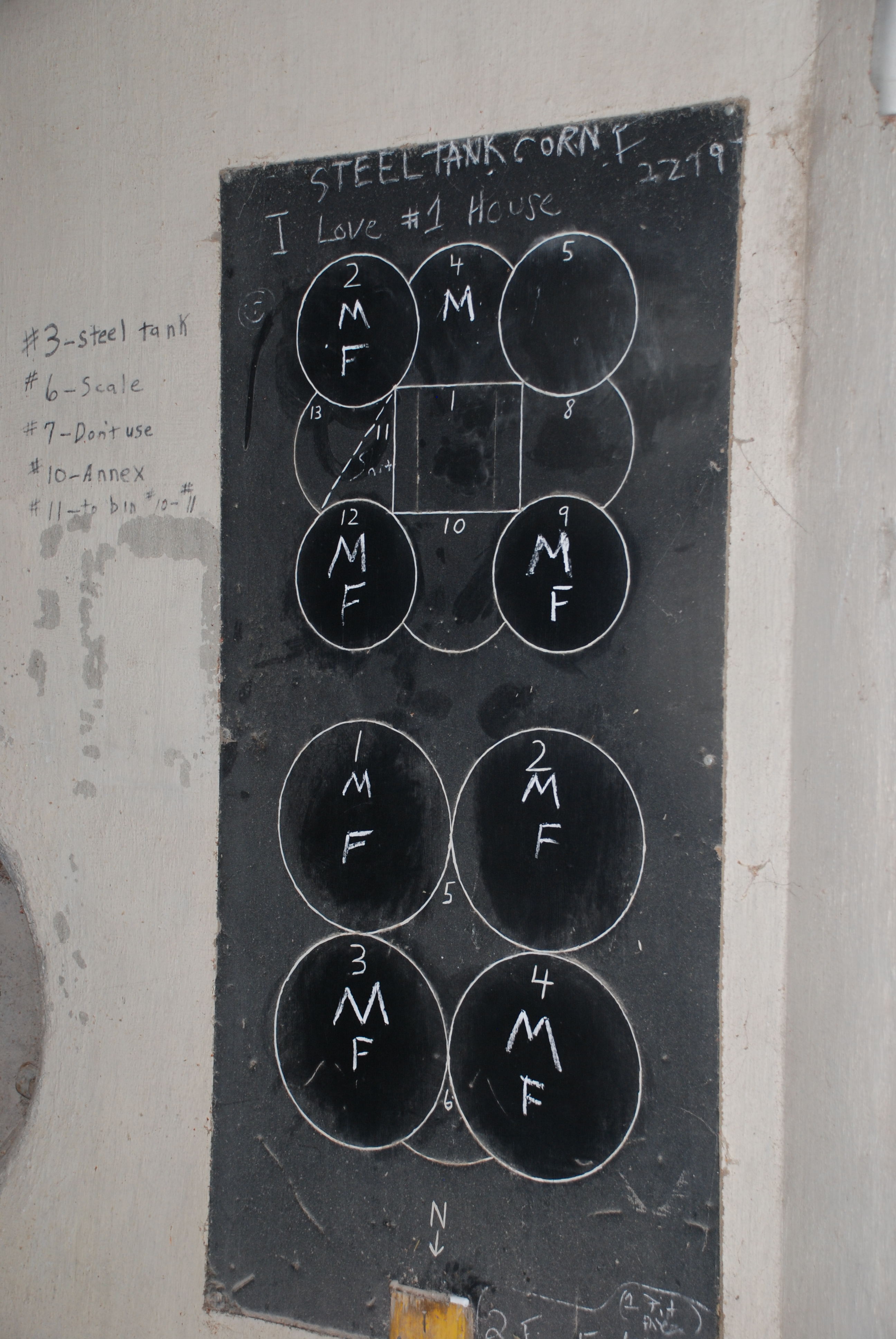
The distribution diagram

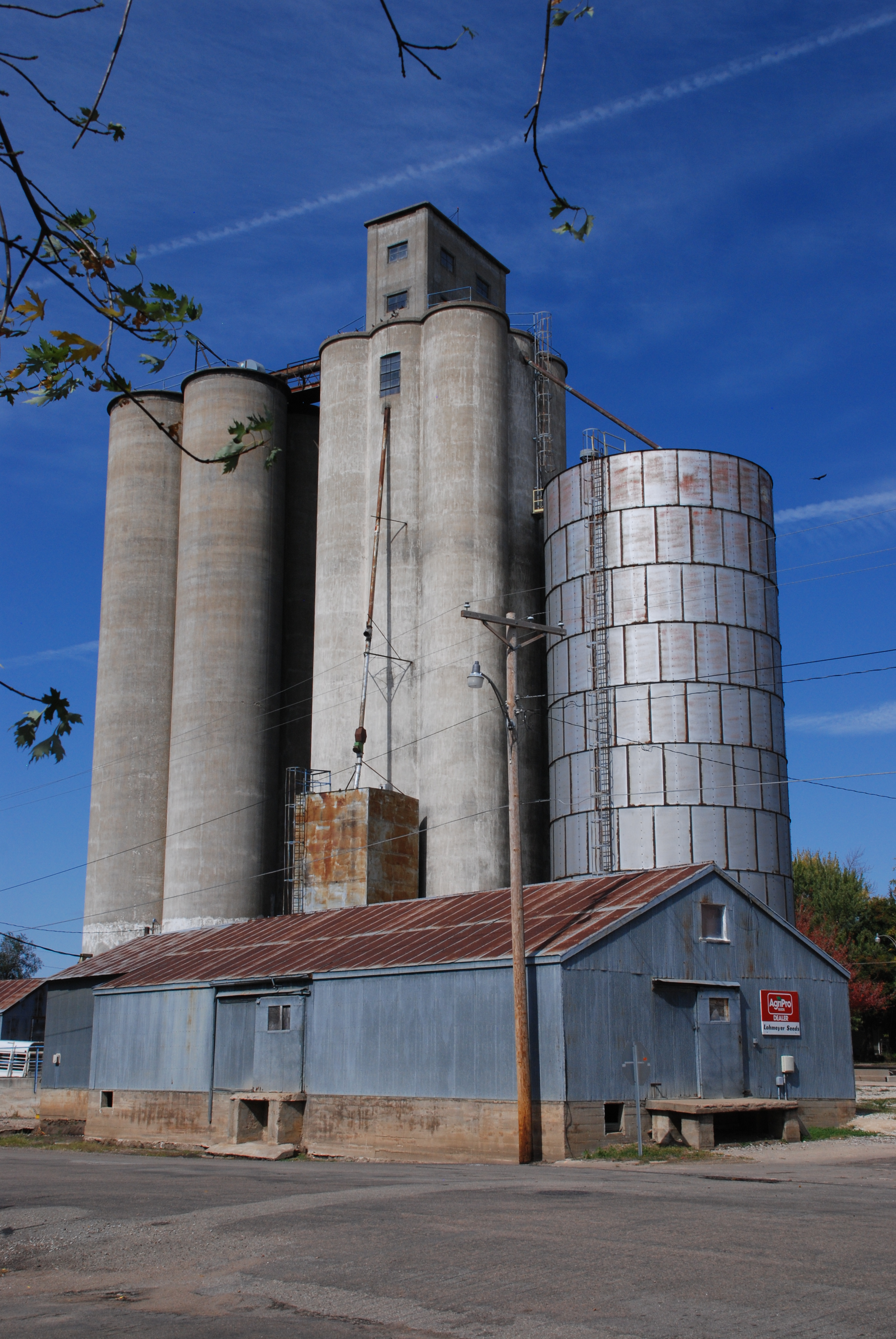
Prominently displayed on one of the bins was a diagram of the elevator and its annex. Here the storage assignments for each of the bins were noted, including the neighboring steel bin, which was served by the same integral head-house with a chute from the top of the elevator. Presumably, “M” stood for milo, and a note indicated that the steel bin held corn. Perhaps “F’ indicated feed, but that is just a guess.

I’m not sure why someone wrote “I love #1 house,” but if they meant this lovely elevator that my grandfather, William Osborn, built for Joe Tillotson’s company in 1947, I must share the sentiment. It was a dandy, and it appeared to have a long, useful life ahead of it.

DSC_0689

A view from the west side where the feed mill used to stand. 

The J. H. Tillotson elevator at Linn, Kansas, stands unused, idled by regulatory changes

The elevator built by J. H. Tillotson is flanked by later additions.

This handsome elevator built by J. H. Tillotson is flanked by later additions.

Story and photos by Kristen Cart

While the concrete elevator at Fairbury, Neb., was being built, rising by nine feet every twenty-hour workday, the elevators no more than thirty miles away at Hanover and Linn, Kan., were also nearing completion, according to a newspaper clipping found in my grandfather’s papers. J.H. Tillotson, Contractor, based in Denver, had all three projects going for the 1947 harvest.

Though we knew my grandfather, William Osborn, worked as superintendent at Fairbury, my dad didn’t remember his father working on the two Kansas elevators, so in October  2012, I took a swing through Kansas to investigate them.

The Chalmers and Borton elevator at Linn is still in use.

The Chalmers & Borton elevator at Linn is still in use.

The first elevator that came into view in Linn was a 1950s-vintage Chalmers & Borton structure of about 250,000-bushel capacity, judging from its appearance. Across the town square, a couple blocks away along an extinct railroad bed, was another elevator that did not fit my notion of any J. H. Tillotson design, since it sported a rectangular head house. I peered at it from all angles, straining to see any lettering on the manhole cover about halfway up, without much success. I thought perhaps the old J. H. Tillotson elevator hadn’t survived and that I was too late, as had happened at Maywood, Neb.

Finally, I drove over to the co-op office to learn more. Jeff Wiese, the location manager for the York-based United Farmers Cooperative, kindly agreed to answer questions about the old elevator. Jeff said he had worked for the local elevator cooperative since 1994, first in petroleum, then as an implement dealer, and finally as manager in 2000. In 2005, UFC took over from the Farmers Cooperative Equity Association, which, in turn, was formed when the Linn Cooperative Exchange joined with Greenleaf.

Jeff said that when the old elevator was first built, farmers thought they would never fill it, but new capacity was needed almost immediately. To my surprise, he said the manhole covers on the interior of the elevator were embossed with “J. H. Tillotson, Denver, Colo.,” though I was not able to go inside and see them. The old elevator was still there, graceful and sturdy, but locked up and no longer used.

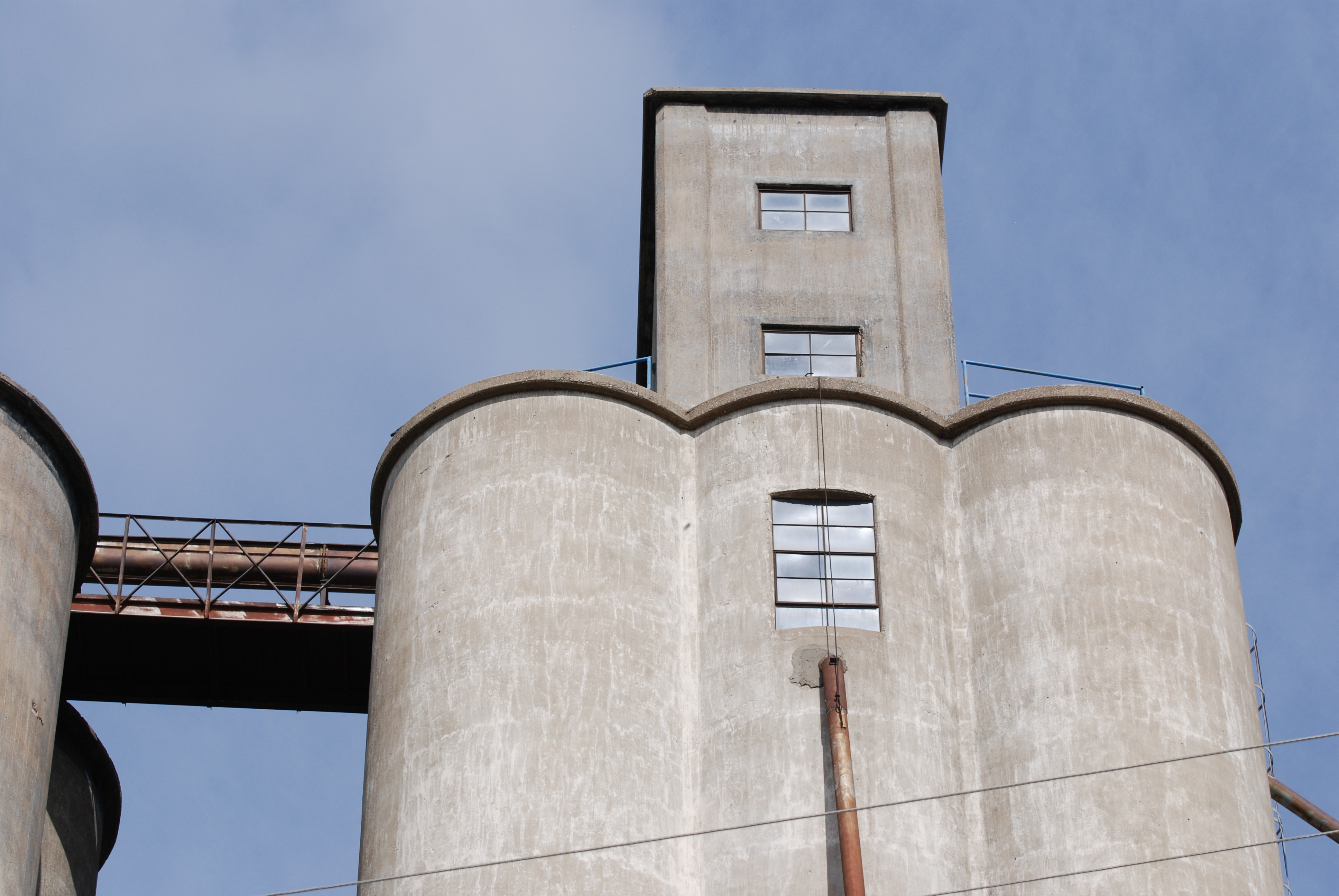
The unusual square head house incorporates stylish details.

The unusual square headhouse incorporates stylish details.

The Tillotson elevator fell victim to economic realities after the Occupational Safety and Health Administration (OSHA) ordered safety upgrades under new federal rules. The agency had taken a keen interest in elevator operations since the 1998 DeBruce elevator explosion in Wichita, Kan., and many safety regulations stemmed from the analysis of that accident. Dust management and cleanliness became paramount. The Linn elevator’s older, lower-capacity design meant it could no longer earn its keep after the cost of improvements, so it retired after the 2011 growing season, now finally empty of its last harvest of wheat.

This type of elevator also commonly required a safety upgrade for its man lift. Everywhere the old elevators are still operating, new OSHA-mandated safety cages enclose the man lifts, ostensibly to prevent certain types of injuries or death.

It is fair to say that the old Linn elevator is endangered, and will be torn down as soon as it is convenient.

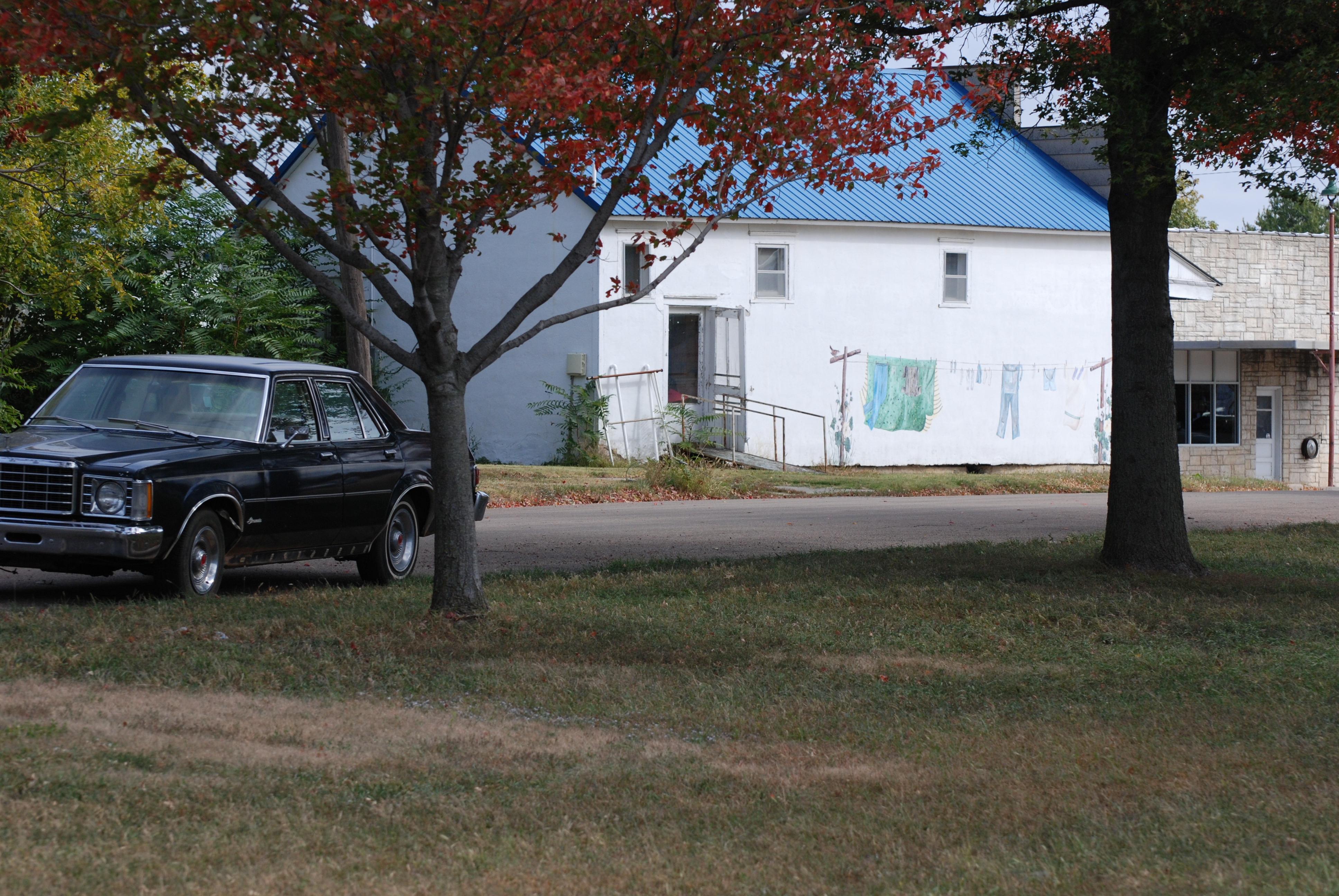
A nearby house with painted mural.

It seems a shame that another Kansas landmark, nestled and quite at home amid tidy houses and bustling businesses, should soon disappear. Beside it is a home painted with a mural depicting gaily flapping laundry on a clothesline, and across the street stands a grocery. A neatly mowed park occupies the old railroad right-of-way.

The elevator has been there as long as most people can remember. Luckily, I was able to pay my respects, and tip my hat to my grandfather’s stately work of long ago, before it passes into memory.

DSC_0884

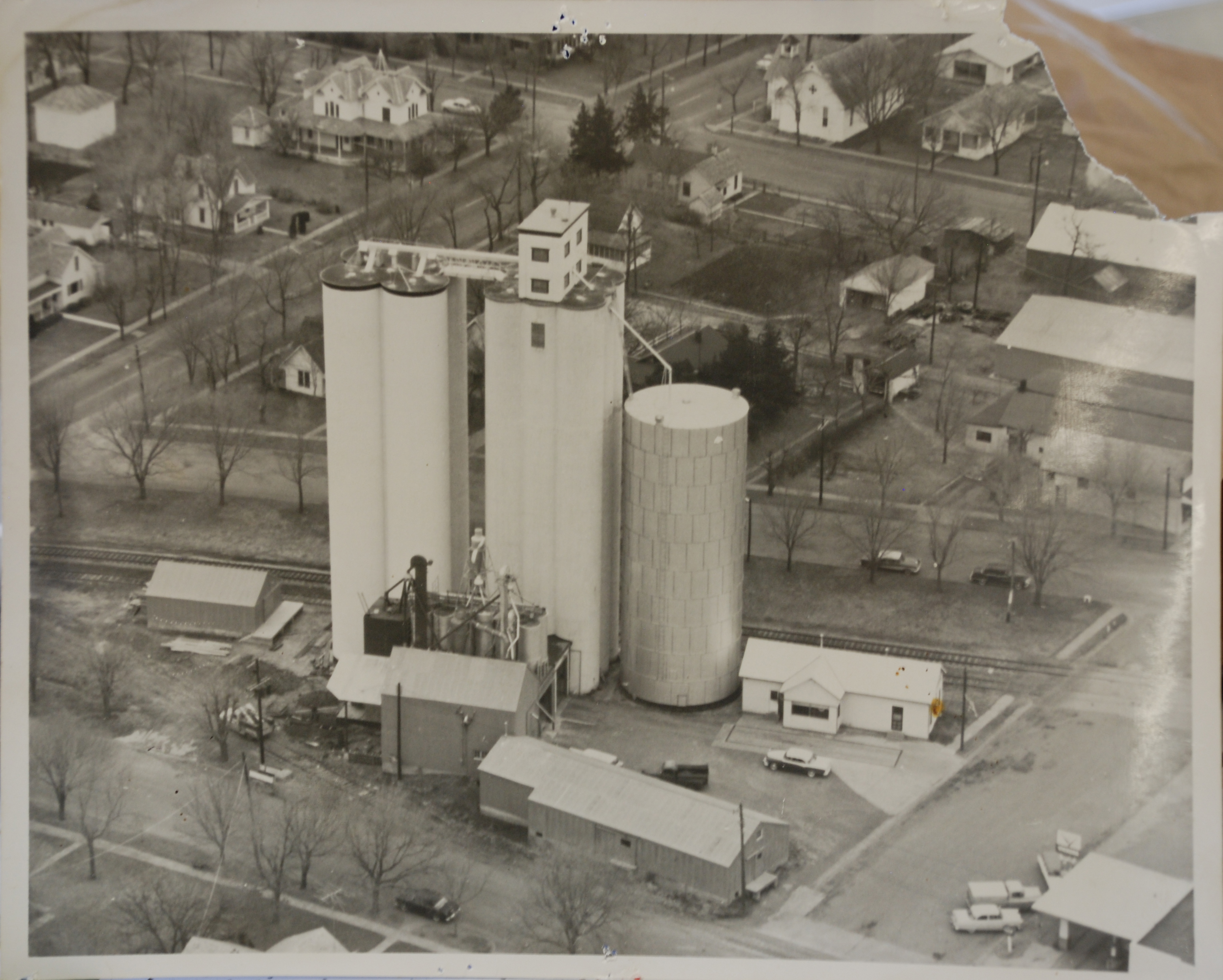
An old aerial view of the Linn, Kan., elevator after the annexes were added. Note the old vehicles in the photo.

By making tricky distinctions, it’s possible to discern the builder of an elevator

Story and photos by Kristen Cart

The question whether each elevator construction company had a signature style has become a topic of intense discussion and research here, and we don’t have all of the answers yet.

Johnson-Sampson Construction Company, of Salina, Kan., built elevators that were very similar to those of J. H. Tillotson, Contractor, of Denver and Mayer-Osborn Construction, also of Denver, prompting a great deal of debate about how that came to be.

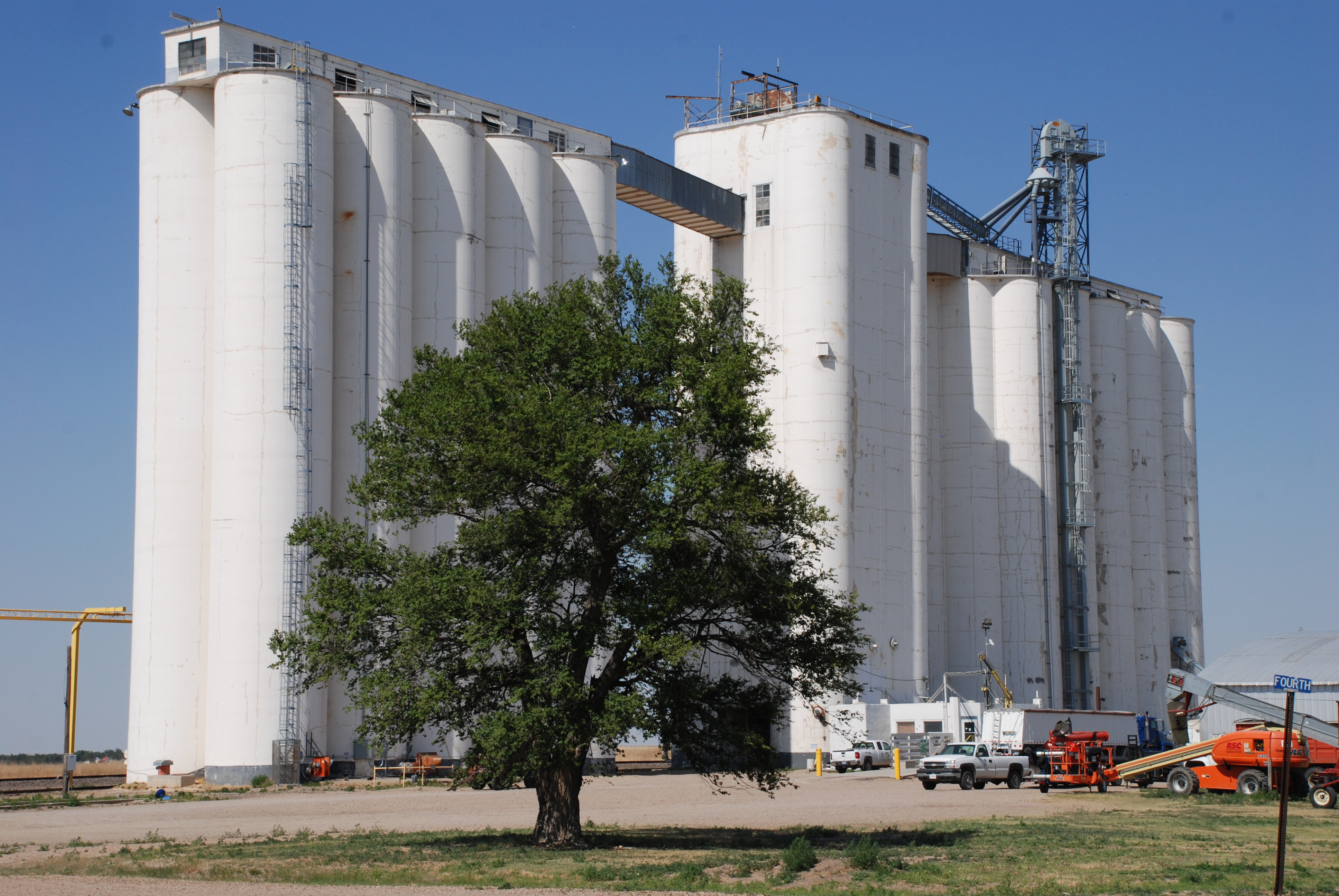
Our pages for McCook, Neb., and Blencoe, Iowa, show elevators each with a stepped, rounded headhouse and about a quarter-million-bushel capacity. It was a standard elevator style for Mayer-Osborn, even appearing in their ads, until they closed their doors in 1954.

After that date, Johnson-Sampson was building a nearly identical elevator. We don’t know whether the architect moved on to work for Johnson-Sampson or the design was sold. The elevator at Limon, Colo., is in the same style, but there is no indication who built it—no paperwork, and no name on the manhole covers or the interior of the elevator.

Mayer-Osborn’s elevator at Kanorado, Kan., shows the company’s typical grooved vertical style.

So the question becomes: was the style proprietary to one company or to one designer who sold his design to all comers?

The Kanorado, Kan., elevator was built by Mayer-Osborn, in a design adopted from J. H. Tillotson, Contractor, after Joe Tillotson died in 1948. The same company essentially carried on under the new partnership of William Osborn and Eugene Mayer, and some of the earlier designs remained unchanged. The grooved vertical lines are only found on elevators made by those two companies.

Identical detailing can be found on elevators in Lodgepole and Wauneta, Neb., and Monument, Traer, and Goodland, Kan., among others—all of which were built by J. H Tillotson.

Another example, at Page City, Kan., comes from Johnson-Sampson, as proven by the manhole covers. The operator says it was built in the late 1950s. It looks very similar to the elevators in Wauneta, Neb., and Traer, Kan., built by J. H. Tillotson before his death in 1948. A few details and dimensions differ, and in this case the changes appear to be distinctive for Johnson-Sampson elevators. I feel fairly confident that the Page City elevator is an example of an identifiable Johnson-Sampson design.

Johnson-Sampson’s elevators in Brandon, Colo., and Page City, Kan., are clones to each other. They look very much like the Mayer-Osborn design but have slightly different dimensions and lack the vertical grooves.

Arriba, Colo., is another of the same type.

Johnson-Sampson’s Page City elevator lacks the vertical grooves.

My best guess is the larger, successful companies had a few standard designs for their customers. If a customer wanted to request a proposal, they would give specifications, and the company would customize to meet the described needs, presenting the plans in their contract bid. Upon acceptance, the elevator would rise, with enough differences from the basic design to make it unique.

A few telltale details suggest the builder’s identity, but you can’t be absolutely sure until you see a document or a manhole cover to confirm your suspicion.

Photo tour reveals the Goodland, Kan., elevator’s symmetries and history

Story and photos by Kristen Cart

My dad, Jerry Osborn, always knew Grandpa built this elevator, and I remember pictures of it from long ago. It still rises gracefully above the Kansas plain, tucked in among its neighboring elevators, listing slightly in its old age. It has always held a place of pride since its construction in the town of Goodland, Kan.

Contributor Gary Rich discovered, when he visited the site, that this elevator, built by J. H. Tillotson, Contractor, is now used for sunflower seed. When I saw it, it was all buttoned up, presumably awaiting its summer crop. The slight tilt is obvious from some angles, but the elevator appears sound.

William Osborn photo of the Goodland, Kan. elevator, found among his papers.

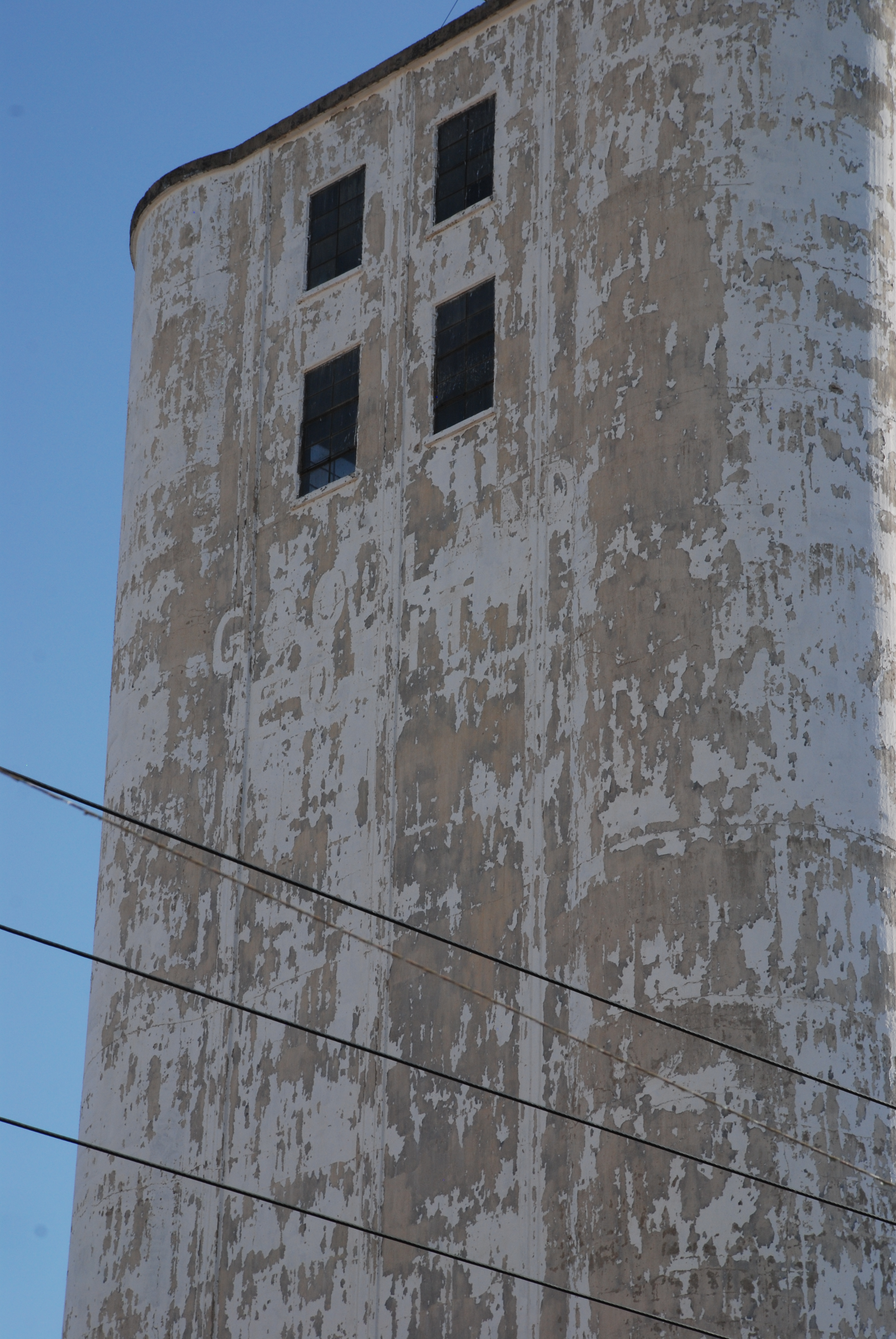
The words “Goodland Equity” can be faintly discerned under the white paint.

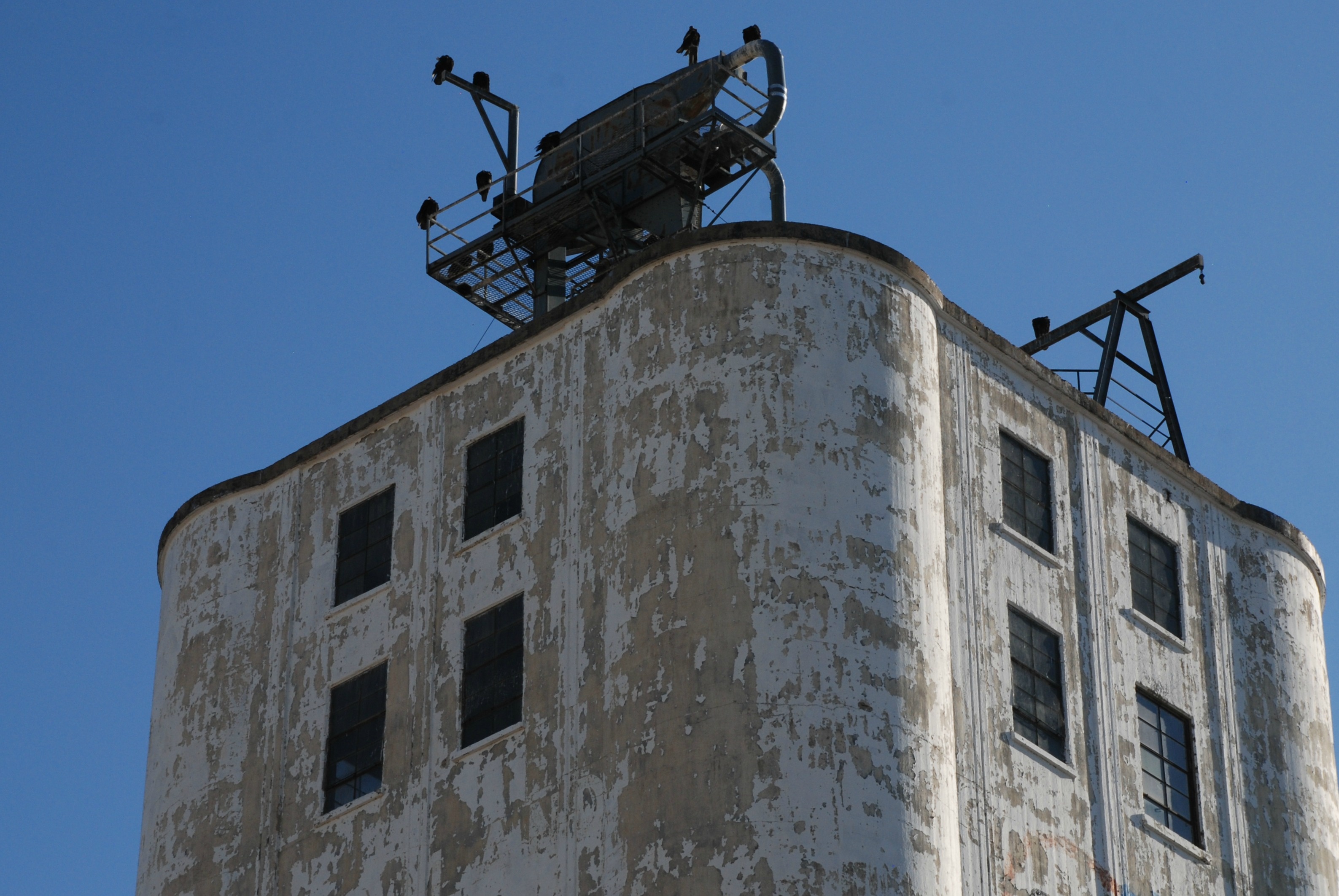
You can still see, faintly outlined in white letters, the name Goodland Equity, long since painted over. At one time  the elevator sported a neon sign proclaiming “Goodland Equity” to the night sky. That sign has disappeared and now vultures adorn the top of the leg in a lofty roost.

This beautiful elevator will continue to attract photographers as long as it stands. Aside from building useful, well-engineered, long-lasting structures, my grandpa, Bill Osborn, built beauty into the flat Kansas landscape.

For that, I am grateful.

A convenient roost for vultures.

Wauneta, Nebraska’s elevator tells a compelling business story

Wauneta’s original elevator–built by J. H. Tillotson, Contractors, of Denver–is the centerpiece of the complex.

Story and photos by Kristen Cart

In a sense, writing about the elevator at Wauneta, Neb., is saving the best for last. I visited Wauneta in June and held off writing about it, hoping for documentary confirmation that my grandfather, William Osborn, built it. But my dad, Gerald Osborn, said that he did, and when I visited, the clean lines and design details of the straight up elevator confirmed it.  It was without question one of J. H. Tillotson, Contractor’s efforts. My grandfather led the company’s construction effort in the late forties.

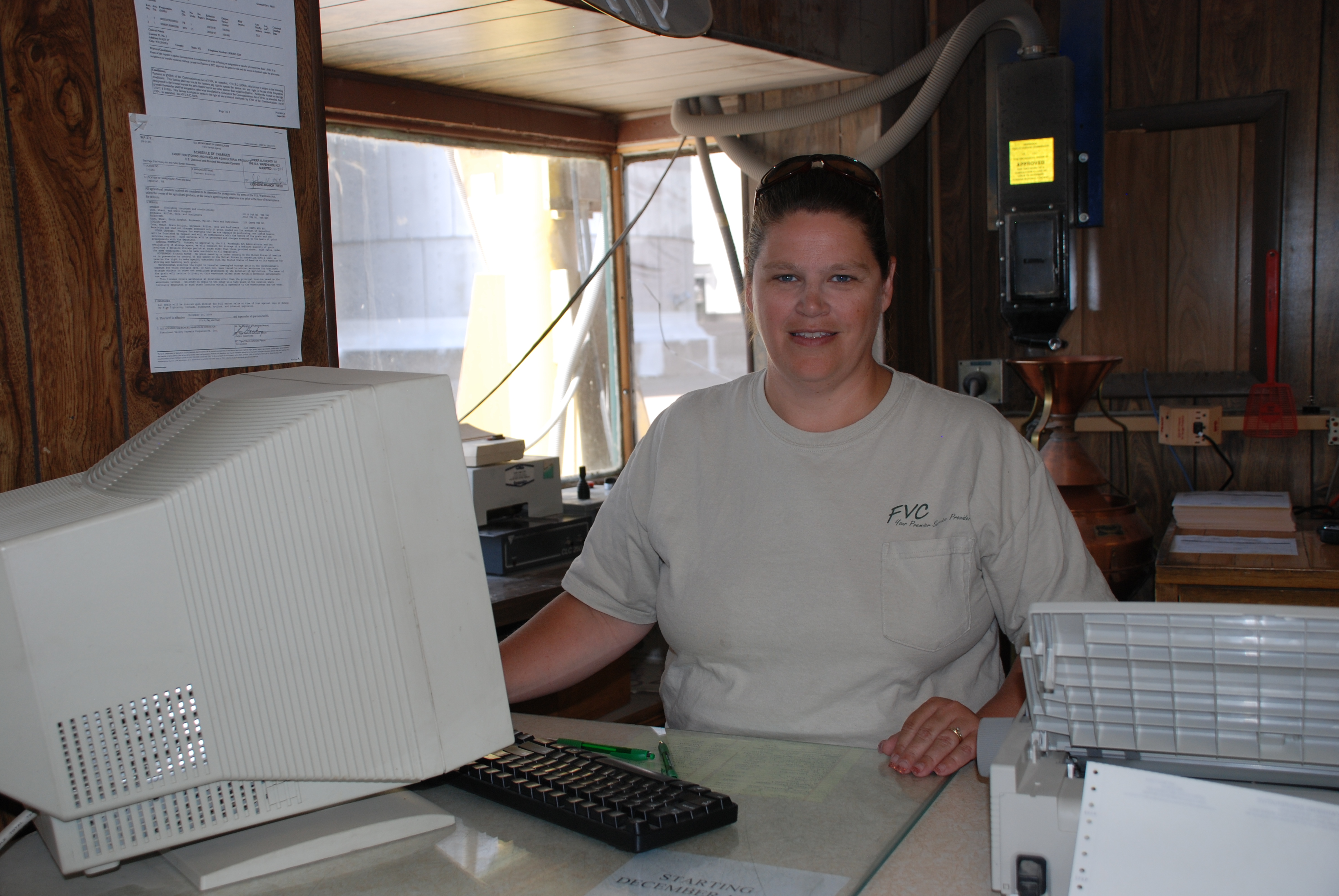
Cindy Fischer of the Frenchman Valley Cooperative

What I found there surpassed expectations. Cindy Fischer warmly welcomed me into the Frenchman Valley Co-op office, and kindly opened up the co-op records room, giving access to the history of the Wauneta elevator. We carefully unrolled blueprint after blueprint on the counter. The records showed that very soon after the original elevator was built, the cooperative found itself short of storage space as the grain boom (helped by federal subsidies) grew. So the co-op went shopping for an annex.

The Treow-Jensen built annex

The familiar name Mayer-Osborn Construction popped out immediately, on an old, yellowed set of blueprints, but the plans did not match what was eventually built. It left me scratching my head until I saw the plans submitted by Treow-Jensen. Ah, hah!  We were looking at competing proposals for the annex, and Mayer-Osborn had submitted two alternatives but was beat out by a lower-cost bidder. Treow-Jensen built Wauneta’s first annex in 1955. Jarvis Construction came in later to complete another annex in 1977.

Gary Rich, who contributes to Our Grandfathers’ Grain Elevators, had visited Wauneta before, and he and I had a protracted debate about what all the blueprints meant, since we found “Holmen and Mayer” on the plans for a building. What we could never settle was the identity of the builder of original elevator, whose plans were nowhere to be found. Eventually, we agreed to leave our diverging interpretations up in the air, all in good humor.

Cindy gave me access to the inside of the straight up elevator. She said that it had been completely redone, so the familiar Hutchinson Foundry manhole covers were absent. The replacement covers gave no indication of the elevator’s builder. Happily, the elevator appears to be ready to take on another sixty or more years of active service.

I wish to thank Cindy Fischer for her kindness and all of her time. We spent a whole morning going through plans, and I borrowed a number of them to be reprinted for my own records. She showed me, for the first time, the sales and engineering aspects of the Mayer-Osborn business. Many of these kinds of records have disappeared over the years, so she afforded a unique opportunity to peer into the past and see Grandpa’s business in a new light.

For that, I am grateful.

Elevator operations

The elevator at Daykin, Nebraska shows a characteristic J. H. Tillotson design

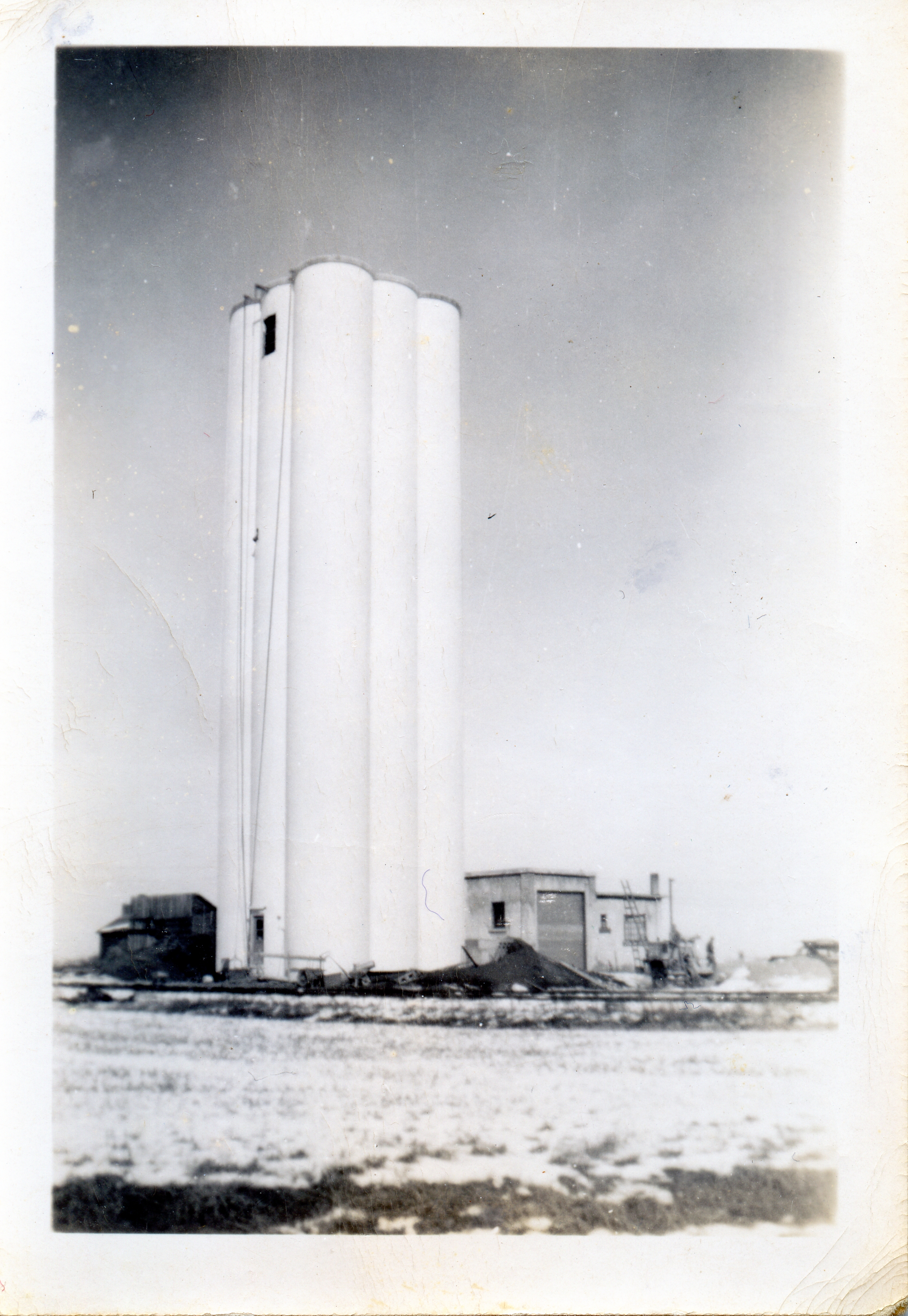
The Daykin, Neb. elevator seems to match an unknown William Osborn photo

Story and photos by Kristen Cart

William Osborn photo ca. 1947

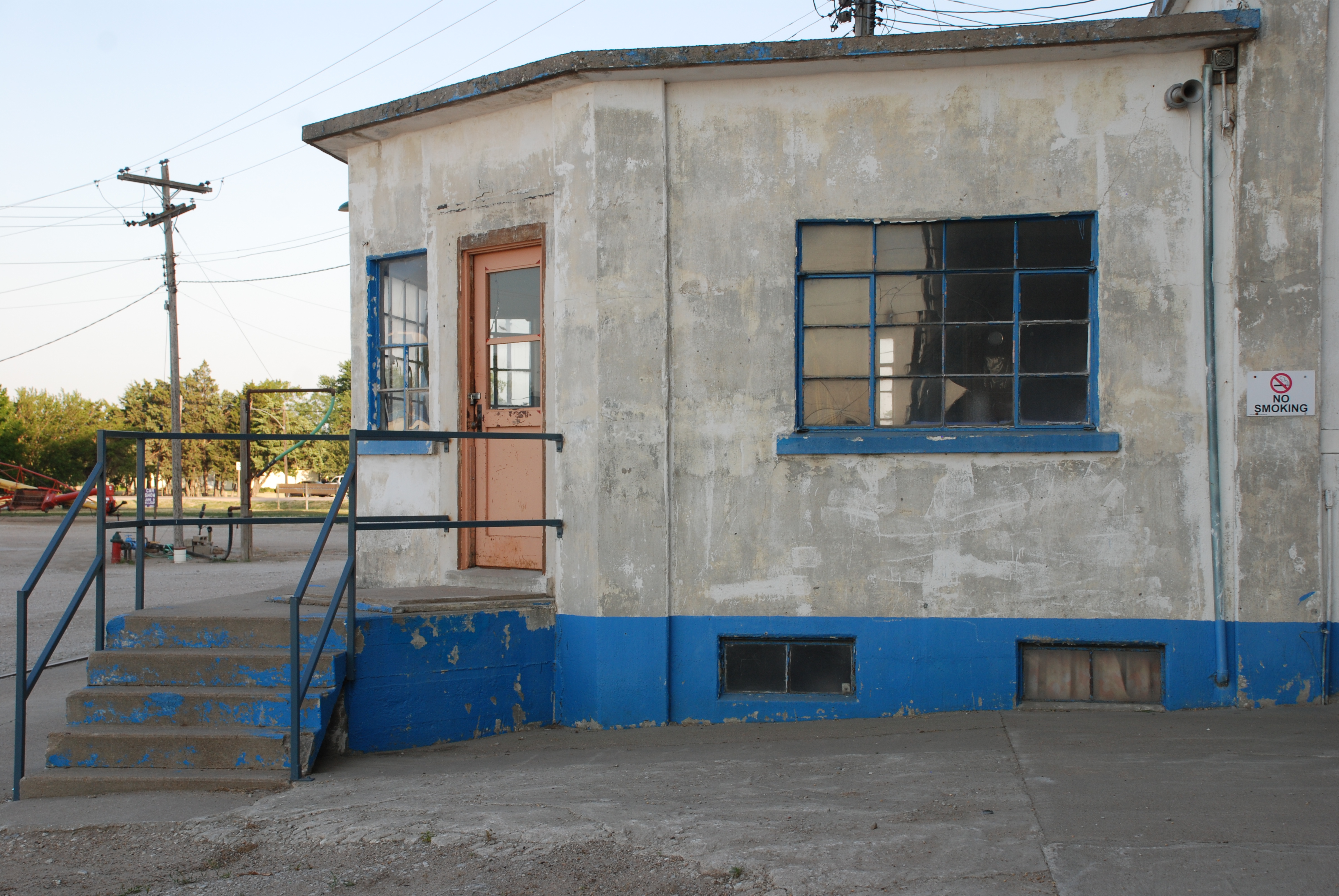
My husband and I took a day trip to look at some elevators in June, letting the kids off the hook and sparing ourselves their groans and complaints as we toured the countryside. Daykin was one of our stops. This J. H. Tillotson, Contractor elevator was built in 1947, according to my grandfather, William Osborn. He listed it among his previous projects when he was interviewed during construction of the McCook, Neb. elevator. As I went over the photographs for this post, I noticed, with excitement, that the photo matches one of grandpa’s unidentified photographs in every detail: The concrete driveway has the same inset from the corners, and the windows of the scale house match perfectly.  A mystery has been solved.

No one was about when we stopped to see the elevator, just before sunset. There was something beautiful about the scale house with its big, multi-paned windows, its blue trim, and its corner detail, with the elevator rising precipitously behind it.  I have admired all of Grandpa’s projects for their spare good looks.  I wonder how he saw these buildings.  It must have given him great satisfaction as he looked upon a completed project–or was it mainly relief? I know he loved tropical fish. He must have appreciated beauty for its own sake–at least a little bit. Was he too close to the elevators to see what I see? In certain light and at certain times, a beautifully done elevator takes your breath away.

The elevator at McAllaster, Kansas, proved to be a missed opportunity

McAllaster, Kan., photo by Gary Rich

Story by Kristen Cart

Sometimes our elevator quest ends in a dead end, without definitive answers. In the case of McAllaster, Kan., we had only an old photo belonging to my grandfather, William Osborn, to go on, and Gary Rich and I never got any independent confirmation of the builder. When I went to visit the elevator two months ago, nothing was left and there was no sign it had ever existed.

William Osborn photo

Gary Rich tried hard to get information about the builder, after he had gone to McAllaster to photograph the elevator. Both of us made calls to the cooperative. But all we were able to confirm was that it was slated for destruction sometime this year. It was shut up tight, of course, when Gary went to see it, and, no man-hole covers were visible from the outside. The only clue we could find was an old photo of one of grandpa’s projects, which was probably built for J. H. Tillotson, Contractor, of Denver, Colo., judging by the style. The caveat was that quite a few others similar to this one were also built, and some of them have long since disappeared.

Gary Rich photo

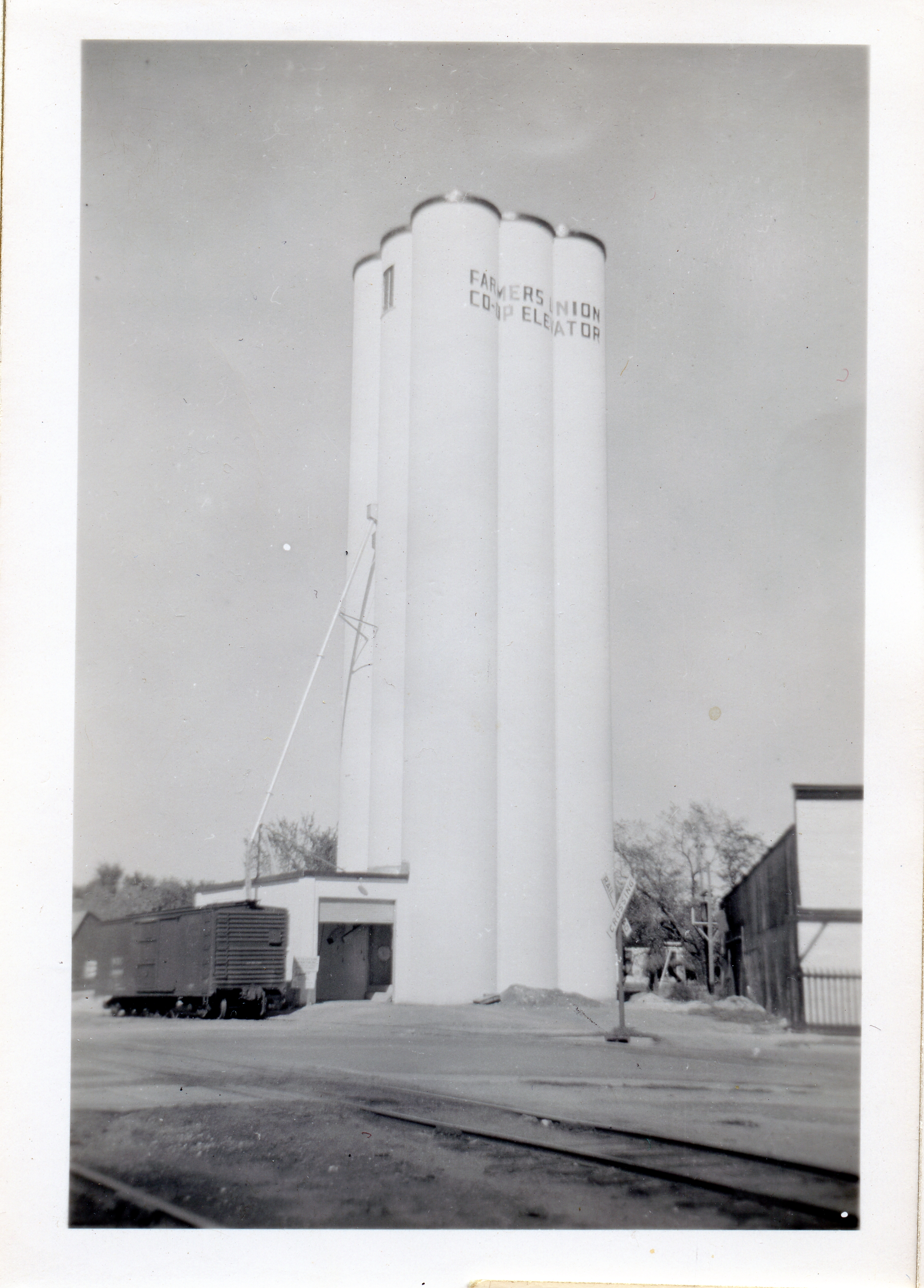
Elevators like those at Daykin, Fairbury, and Bradshaw, all in Nebraska, were built in a similar style, so the only clues to their builder are external to the main house: elements such as windows, driveways, office buildings, and loading chutes can be compared to details in my grandfather’s old photos. Of course, if we have independent verification, such as contemporary newspaper accounts or my dad’s memories, it makes our lives easier, since only one of grandpa’s photos has any caption. Daykin and Fairbury have both been verified in this way.

When the photo above is compared with the photos taken by Gary Rich of the McAllaster elevator, it shows just enough difference to dash our hopes for an identification. The building behind the driveway appears to be attached, and the windows don’t match our photos of McAllaster. So we are at a frustrating impasse. We still don’t know the identity of the elevator in grandpa’s photo, and we still don’t know the builder of the McAllaster elevator, though we suspect it was a J. H. Tillotson project. With no way to verify it, we are at the disappointing end of our quest.

In Monument, Kansas, the elevator is closed to visitors and its story sealed

Story and photos by Kristen Cart

I approach this post with a little bit of trepidation, since the Monument, Kan., elevator does not invite tourists–even those with family connections. It is operated by a large corporation which primarily supplies corn for ethanol. It seems that an overly inviting manager might be risking his job, so I contented myself with photos taken from off of the property. But I was able to cobble together some information about it, from a variety of sources. Suffice it to say, it would not be prudent to reveal all of them.

A view of the Monument, Kan., elevator, taken from off-property. Visitors weren’t permitted at the facility.

I was able to determine the builder for the stand-up elevator with its integral head house. The manhole covers are stamped with the company name of J. H. Tillotson, Denver, Colo. The annex on the left has unmarked ports, but the annex on the right has man-hole covers stamped with the company name Mayer-Osborn. I did not see any of the ports for myself, so I am relying on secondhand information. But my grandfather apparently made a return trip after building the original house.

The original elevator was built for a Mr. Bertrand, whose son is still living. The elevator once had a brass plaque installed, which has since been removed and may still be with the Bertrand family. There were also early photographs of the elevator, and it is believed that they went with the plaque.

I spoke with a gentleman named Fred Wassemiller, who said, “These elevators were the best thing going–they should have kept building them.” He also said it was too bad that the “old-timers around here are gone.”

Apparently, they could have told me a lot.

Then and Now: The J. H. Tillotson elevator at Fairbury, Nebraska

Story and photos by Kristen Cart

Photo by William A. Osborn, about 1948

A current view

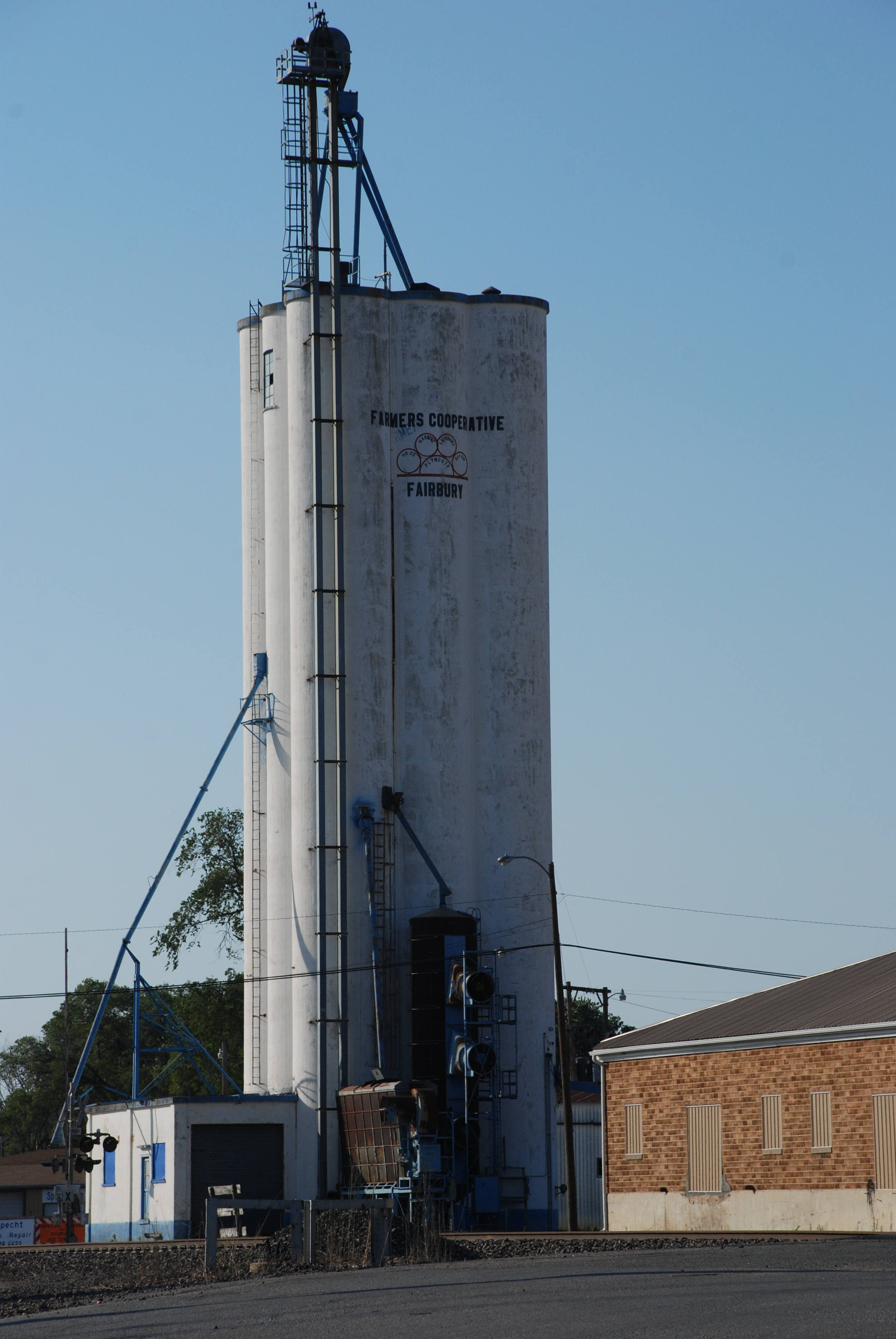
Some of the elevators Grandpa built were a little hard to identify, for certain, from his old photos.  Many of his projects were similar in design during the time he worked for J. H. Tillotson, Contractor, of Denver, Colorado.  So seeing an elevator in person,  only tentatively identified with an old black and white photo, and recognizing it, was quite an exhilarating experience.  Fortunately Gary Rich’s sharp eye made the connection between Grandpa’s photo and the elevator at Fairbury, Nebraska.

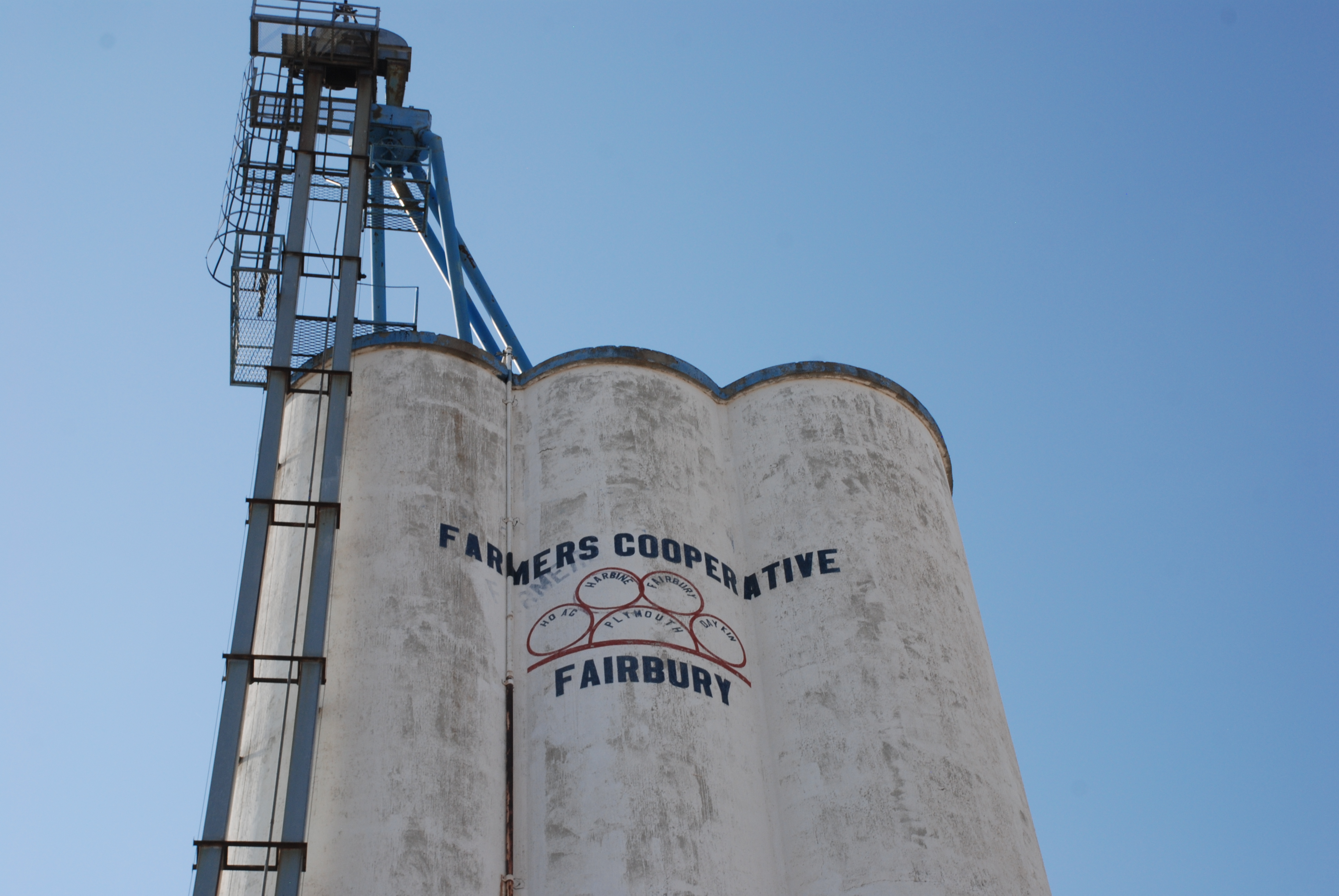
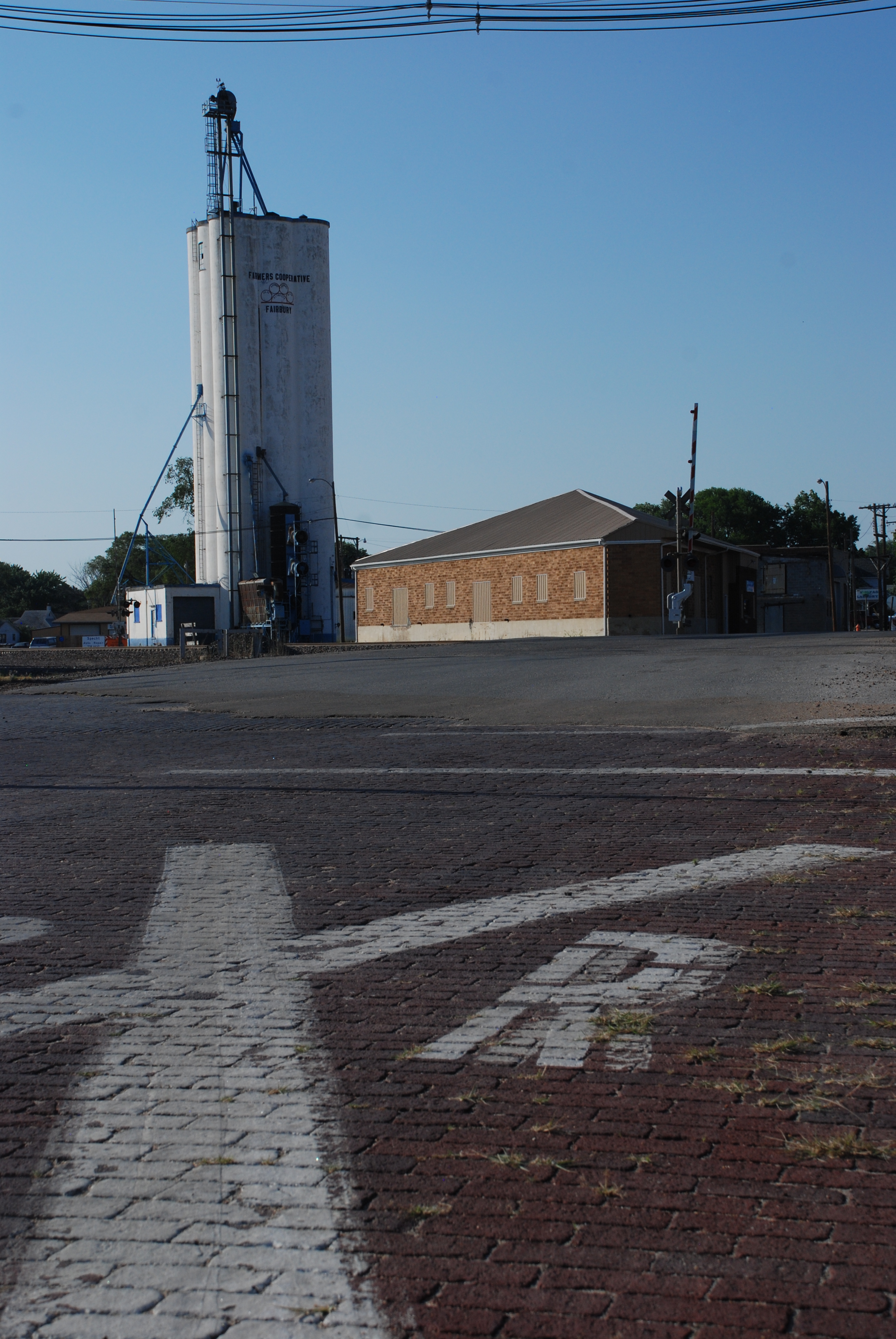
When I saw it, the Farmers Cooperative elevator did not give a clue to its builder from the outside.  It warned intruders away emphatically with “No Trespassing” signs, and it sported a freshly painted logo, which seemed to indicate that it was still in use. But because it was deserted I had no one to ask.  We knew from a newspaper article, marking the construction progress of the McCook, Neb. elevator in 1949, that my grandfather had previously built the Fairbury elevator.  So when my husband and I went to see for ourselves, I took documentary photos. Later, Gary Rich compared them with Grandpa’s old photos and quickly made the identification, noting the relative position of the railroad tracks, and the loading chute extending beyond the drive way.

The elevator stood beside one of the busiest rail lines I have seen in Nebraska. Freight and coal trains roared by every few minutes.  While spending the better part of an hour photographing every angle, I found a railroad spike, well rusted and tossed aside, and I brought it back to the car for the kids.  I don’t know why I thought it would impress them–when they saw it, they barely glanced up from their video games.  I guess old railroad stuff was more a part of my childhood than theirs.

With a little luck, these kids will remember the long drives through corn and wheat country chasing elevators.  At least they will have a unique perspective on them. Perhaps in their travels, when a towering white structure first peeks over the horizon, they will ask, “I wonder who built it?  And when?”