Virginia Slusher remembers her years as Tillotson Contruction’s office girl

Virginia Slusher 05

Story by Virginia Slusher, photos from her collection

Editor’s note: Virginia Slusher, who lives near Kansas City, contacted us to share these recollections and photos. We have previously written about The Office, part of the old Anheuser-Bush brewery on Jones Street, which served as Tillotson Construction’s headquarters in the 1950s. 

Beginning in the fall of 1951, I worked for Mike (Reginald) and Mary Tillotson for seven years. I was the “office girl”–some bookkeeping, receptionist, et cetera.

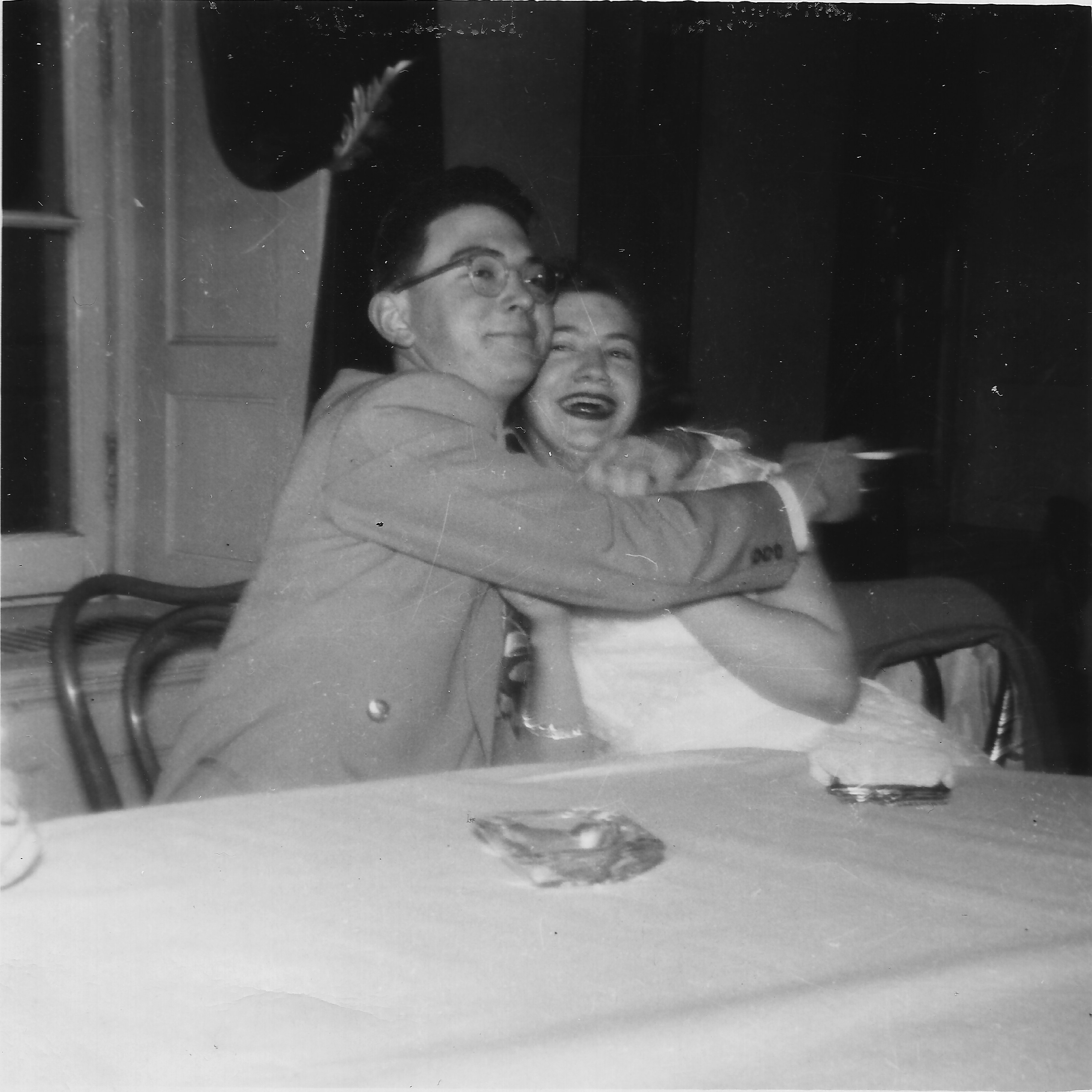
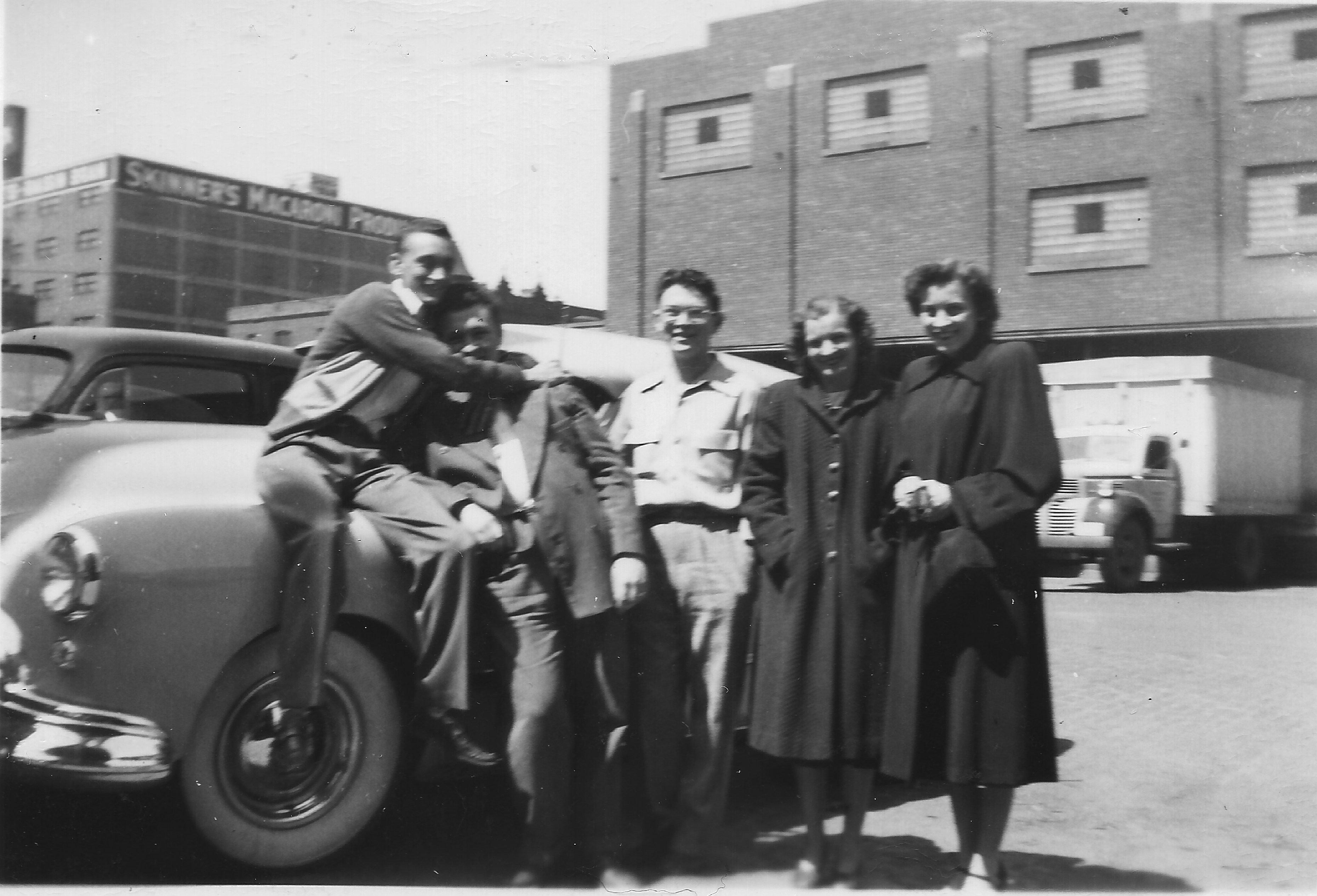
I went to Commercial Extension School of Commerce, and Johnny Hassman was my date for our graduation party. He was in the office quite often. I think Johnny helped with sales. IMG_1390

One morning I arrived first, and the safe was hanging open. Because of the burglary, I immediately ran down to the gas station on the corner. The thief took the petty cash they kept in the safe. I don’t think he bothered anything else. The police came to investigate.

I loved working there; they were so good to me.

The three guys and I would sit up on the balcony and play cards sometimes when Mary was gone. It was a raised area where Wayne and Ted, the two engineers, sat. Bob the bookkeeper sat just below.

I loved the guys. They took me out for my first legal drink when I turned 21 years old. They teased me unmercifully but were so good to me.

I remember typing about 2000 W-4s at the end of the year. Men would work for one or two days and quit. I also sent all the “give us your business” cards to the small towns in multiple states. Virginia Slusher 01

The other woman–I can’t remember her name–was working there when I started.

They had a huge NCR bookkeeping machine that she taught me how to operate. Shortly after I started there, the company sold it to, I think, China.

Mary was different to say the least. She had an ugly Boxer that came to work with her sometimes. He would slobber on me; therefore, I did not like him!

She used to tape a St. Christopher medal on her desk. We joked that we wondered if the desk would take her somewhere.

Johnny Hassman and Virginia Slusher celebrate her business school graduation. Photo from the Virginia Slusher archive.

Johnny Hassman and Virginia Slusher celebrate her business school graduation.

She was very good to me, gave me nice bonuses at the end of the year, not quite as big as the three guys. But very good for the ’50s. I received $1000 to $15oo. The men usually around $10,000. Very large amount for the times.

Mike (Reginald) was funny, not in the office much. I had to write the checks to pay the family bills.

I was still Virginia Engel but married William Slusher while working there, 60 years now, and they were very nice to us.

When the company closed, Mary found a new job for me at Power District credit union.

Bill Russell delivered the first load of grain in Alta’s new concrete elevator

First load of grain being dumped in the elevator. Man on left is probably an elevator employee, Bill Russell, right.

An Alta Cooperative employee, left, and Tillotson’s superintendent Bill Russell dump the first load of grain in 1950. Photo from the Neil A. Lieb archive.

By Ronald Ahrens

We’ve laid out the story of Tillotson Construction Company’s concrete elevator at Alta, Iowa.

Now for the completion.

The photo shows the ceremonial first load of grain being dumped after the elevator was wrapped up in 1950. The job had started in early spring.

Bill Russell superintended from start to finish. As his son Dennis has told us, Bill was born in 1900 and built ammunition depots during World War Two before coming to work for Tillotson.

He was father of eight sons. One of them, Jim, a promising law school student, died in a fall on Tillotson’s elevator at Murphy, Neb.

After a long run with Tillotson, Bill started Mid-States Construction, which became known as Mid-States Equipment, with Gordon Erickson.

During the key postwar period of elevator expansion, few men contributed more than Bill Russell, and we are proud to remember and honor him.

Tillotson’s employee ‘Tiny’ could sucker the locals in any barroom


Photo from the Neil A. Lieb Archive.

Story by Ronald Ahrens, photo from the Neil A. Lieb Archive

He was called Tiny, and he could always put one over on the locals.

Neil Lieb couldn’t recall Tiny’s full name during our telephone conversation on April 29, when we sought to identify people shown in photos from Tillotson Construction Company’s job at Alta, Iowa.

As a young man just out of high school, Neil was part of the crew, and even sixty-five years later he still marvels at the older, wiser Tiny.

Members of the crew would go into the beer parlor after hours. scan0017

“Tiny would bet you he could drink a bottle of beer in 10 seconds,” Neil said. “It takes eight seconds for the bottle to run dry by itself. He would bet five or ten dollars, and he would find some sucker.”

Tiny was 6 feet 2 inches tall, Neil recalled.

Neil couldn’t identify the man at the rear of the photo, nor could he express details of the job they were undertaking because he had moved on after the Alta Cooperative’s new concrete elevator was finished.

Photos document the construction of a chimney that rose from a small building next to the old wooden elevator. We don’t know this stack’s purpose, but Neil (and my Uncle Tim Tillotson) don’t suspect it had to do with grain drying.


From their ever-rising perch, elevator men saw the workaday world of Alta, Iowa

scan0013

Story by Ronald Ahrens, photo from the Neil A. Lieb archive

Reader Frank Nine recently expressed fond memories of his job with Tillotson Construction Company, writing, “I can’t believe it has been 61 years ago that I started working for Tillotson. It seems like yesterday and was some of the best times of my life.”

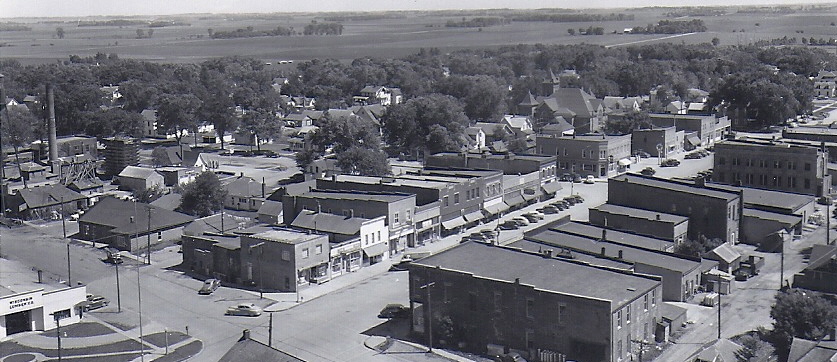
This view of downtown Alta, Iowa, from Tillotson’s new grain elevator for the Alta Cooperative makes his statement easy to understand. Aside from the challenge of the work itself, part of the appeal of building a reinforced-concrete elevator was the high-profile nature of the job, in every aspect.

In a town like Alta, with 1350 inhabitants in 1950, the construction crew had to feel the eyes of everybody in town. Wherever they went, whether the cafe or saloon, they were known and perhaps treated differently.

And from their lofty perspective, the workers could be forgiven for harboring a sense of superiority over the townsmen, some of whom may not have been inside a building taller than three stories. Building an elevator made you part of an elite team, rather like a visiting circus troupe.

In the photo we look to the south-southeast and see a lumber company, the downtown businesses, and an important church. Assistance would be welcome in identifying buildings around the smokestack, as well as other establishments.

From the neighborhood, the Alta grain elevator loomed ever larger

scan0010

Story by Ronald Ahrens, photo from the Neil A. Lieb archive

As the Alta Cooperative’s new elevator rose in the early summer of 1950, life went on at its not too vigorous pace in the namesake town.

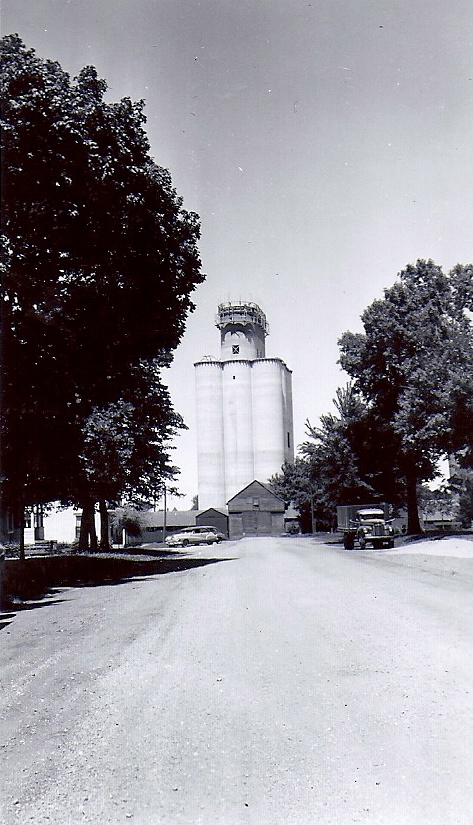
Here, we see the elevator as the headhouse nears completion. The view, as far as I can determine from satellite imagery on Google Maps, is looking north on Cherokee Street–which, as we see, was unpaved.

Pressed for a guess, I’d say the truck is an International and the light-colored car is a Pontiac.

Note the cross-bracing in the headhouse window.

On the extreme right, through the opening under the tree, you see the outline of the old wooden elevator building.

The crew had only a few more feet, or maybe it was inches, to go before topping out the new reinforced-concrete elevator. After dismantling the formwork, they would install the equipment inside the main house and headhouse.

Then the painters would sway on a flying scaffold and apply whitewash, making the elevator gleam.

Welcome to Alta. Please slow-down and see our new grain elevator!

scan0009

Story by Ronald Ahrens, photo from the Neil A. Lieb archive

Why would we not be blamed for thinking the sign in the photo was actually about the new elevator that Tillotson Construction Company had just completed in Alta, Iowa? Or do we read too much into it?

Just think what was required to build the elevator in 1950. Men started in the mud and gloom of early spring. All they had were piles of sand and lumber and steel bars, relatively few, simple tools, and an ingenious way of keeping the formwork level. They were about to perform an amazing feat.

By midsummer, the job was done, the lettering affixed to the headhouse, and farmers could more efficiently store and ship their corn.

The men who built the elevator moved on to another job, maybe in Iowa, maybe in Texas.

What they left behind towered over the countryside of Buena Vista County. Some folks had probably never seen a monument this grand.

Shucks, by scrooching up your eyes, you might even have been able to see it all the way from Storm Lake, three miles down Route 7.

Near Chelsea, Mich., an elevator introduces us to ‘blisters’

IMG_5902

IMG_5894Story and photos by Ronald Ahrens

In Michigan for some meetings and library research, I drove along the back road in Lima Township between the towns of Chelsea and Dexter and came upon an elevator.

IMG_5896Seeing me taking pictures, an employee asked if he could help me with anything. Identifying myself as a grain elevator buff, I received an invitation to come into the office. So I climbed up a steel ladder, entered a dock area, and passed through two doors leading into a warm office.

Photos on the wall showed the elevator when it must have been new in the mid-1950s. I’d noticed a “B” on the manhole cover, but the name of the builder was unknown. However, I was told that laborers from the state prison in Jackson worked on the construction.

Chelsea Grain LLC has operated the elevator a relatively short time. (It made news in 2013 after the local fire department responded to an incident involving a grain dryer.)

IMG_5899My other question concerned the apparent oval shape of the silos.

The answer: “Blisters.”

“Blisters?”

I dashed back to the car to fetch a business card. By the time I returned, a drawing had been prepared by way of answering.

Yet, this term begs for elaboration, which perhaps our readers can provide.

Meantime, thanks to Chelsea Grain for the hospitality.


Elevator construction men found time for romance on the side

Commentary by Neil Lieb with photo from his archive

A little quirk happened in West Bend, Iowa. Construction men were known as love ’em and leave ’em. Blaine Bell, Ed Hart (roommate from Gilmore, Iowa) and myself all married girls from West Bend. Pop Bell was a sawman for Bill Russell—all he did was cut lumber, all the pieces, all the forms. He had a big table saw, probably an 18-inch rotary blade driven by a two- or three-horsepower electric motor.

Neil A. Lieb, left, and Blaine Bell .

Neil A. Lieb, left, and Blaine Bell .

Blaine Bell and I, in West Bend, they built a feed manufacturing building next to the elevator next to Main Street, downtown. My wife Jolene’s father, Joseph Higgins, had a barber shop. They had an apartment right behind the barber shop and she used to come out and hang up clothes and the normal stuff. My wife was a redheaded Irishman. Blaine kept saying, “I have to see if I can get a date,” and it irritated me.

One day I made a point to be on the ground when I knew she was coming out of the house. I got a date with her. She wasn’t supposed to date construction people. We were married over 59 years. That was in October of 1950.

Editor’s note: This anecdote is from an interview on July 18, 2014.

Getting off-level and taking a fall at Tillotson’s Bushland, Tex., elevator

Entering Bushland, Texas. Photo by Stefan Joppich, used with permission.

Entering Bushland, Texas. Photo by Stefan Joppich, used with permission.

Commentary by Neil Lieb with photo from his archive

Somewhere between checking the water level when we started and checking it in the middle, the forms became about 3.5 inches off level. That’s because one guy who was running the jacks on one side wasn’t making his rounds as he was supposed to. The guy was fired on the spot.

Now you had to get the decks level again. When you’re going off level, you’re going at an angle. So what happened, you got a little swerve in the tanks. It’s only an inch. You can’t see it. The only time is if you go up and down on a hoist. So the bottom and top are not exactly over each other.

It had no effect. Not enough to be significant. We were about 65 or 70 feet in the air when it happened.

Every job had a peculiarity. The guy in Bushland jumped off the top. He started to fall, so he jumped. He jumped out far enough to land on the sand pile. We were probably 40 to 50 feet. He landed on the side of the sand pile and slid to the bottom.

We said, “How you doing?”

He said, “Oh, I’m fine. I’ll be a little stiff and sore.”

There were seven guys that I worked with. Baker was one and Bill Russell, all of ’em fell or got killed somewhere along the line.

When you’re working in the air, you become careless because it’s like walking on the ground, but you’re not walking on the ground.

Steelworkers, they all say you get too familiar with working off the ground. When they do that, they become careless.