The Tillotson homestead north of Omaha was sold in 2025, and as a consequence Our Grandfathers’ Grain Elevators has received a few leaves from a photo album with snapshots of 1930s jobs. Together, these pictures comprise the earliest documentation we’ve ever seen of Van Ness Construction and Tillotson activities.
After the sudden passing of Charles H. Tillotson in 1938, his sons Reginald and Joseph built Tillotson Construction Company’s first concrete elevator, located in Goltry, Oklahoma. Prior to that, they worked for Ralston Van Ness out of Omaha. The photos we received appear to show jobs done for that company earlier in the 1930s.
Most of the photos are inscribed on the back with a name, location, and date.
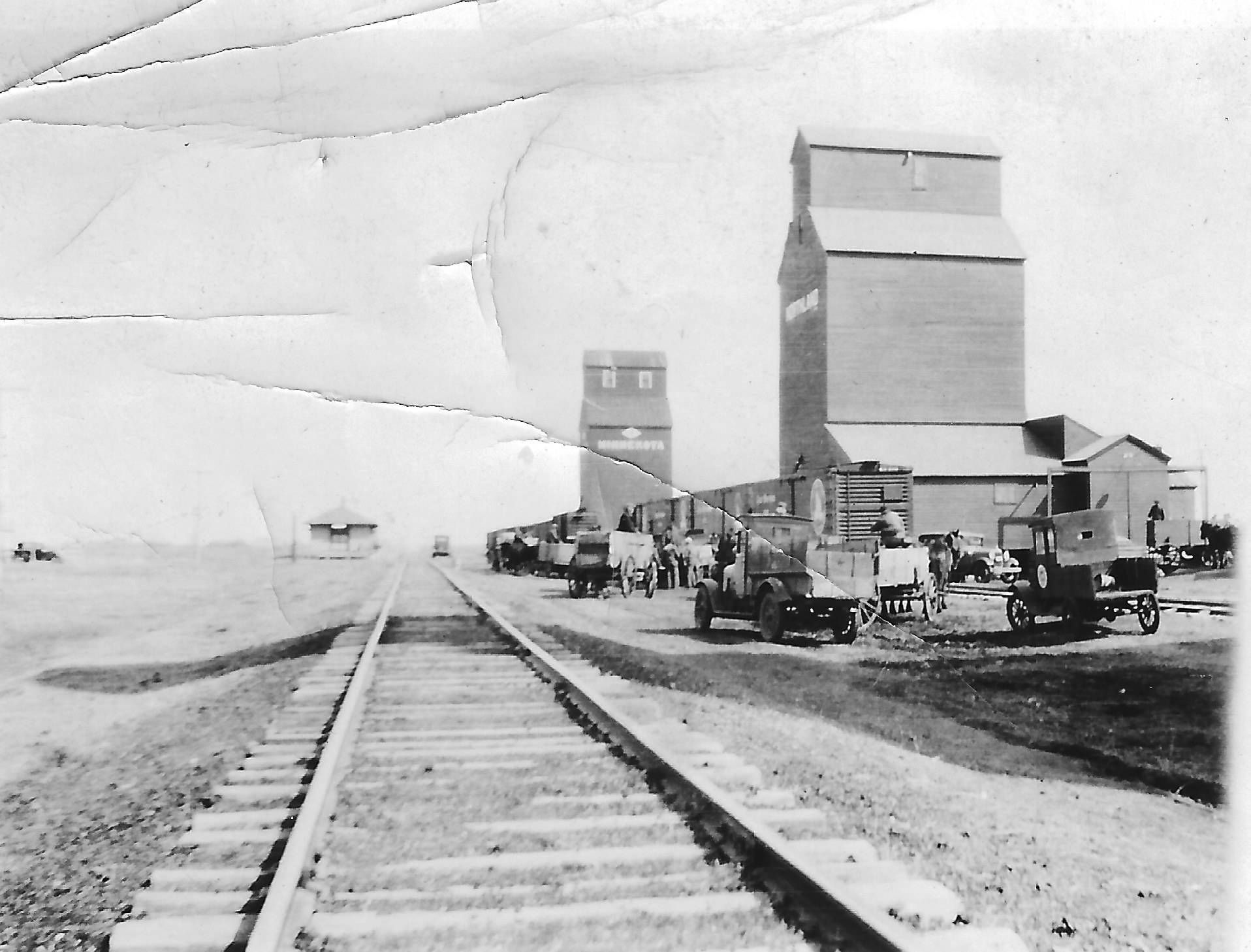
The above photo depicts a 1933 scene at a twin-elevator complex in Norma, North Dakota. Norma is a dot on the map in Renville County northwest of Minot and twenty or so miles south of the Canadian province of Saskatchewan. A note on the album page says “Rebuilt Fire Loss 1933.”
Searching through a newspaper archive turns up no more details, so we can only look at the image and suppose the relief felt by local farmers who had limited options for grain disposition. Especially at a country location like this, a damaged elevator was an unhappy circumstance that would have required hauling grain over an extended distance.
On a sunny day at Norma, a few motor vehicles converge at the complex with at least four horse-drawn farm wagons. It’s illuminating to see wagons still in use at that time. Their limitations surely gave farmers a sense of urgency about acquiring a motor truck.
An old pickup with wooden artillery-style wheels in the right foreground was likely a Ford. It has an emblem on the driver’s door, but we can’t determine anything more about it.
Under close examination of the photo, the elevator tower in the distance appears to be labeled “Minnekota.” The sign on the near tower can’t be read at all.
A number of men are going about their business, whether they’re still seated on wagon perches, standing inside a wagon, or on the ground. In the mix of trucks and cars, note the silhouette of an automobile way down the sidetrack.
Several boxcars await service. Norma is on a secondary road leading south from North Dakota Route 5, and it seems likely the rail line was a spur. This could have been part of Soo Line operations.
We lack additional information about the event that led to the reconstruction. Newspaper pages often had stories of grain elevator fires in 1932 and 1933, with casualties in Chicago at a 200,000-bushel elevator on the river there, and with lesser tolls at smaller elevators in prairie locations.
The Bismark Tribume reported on Aug. 24, 1933 that a 20,000-bushel Minnekota Grain Co. elevator had burned at Butte, North Dakota, to the southeast of Minot. It also claimed a 14,000-bushel carload of wheat. Butte was left with three elevators after the disaster.
We invite our readers to stay with us as we post the rest of the thirty photos in the newly obtained archive.
 Our Grandfathers' Grain Elevators